It’s possible that I shall make an ass of myself. But in that case one can always get out of it with a little dialectic. I have, of course, so worded my proposition as to be right either way (K.Marx, Letter to F.Engels on the Indian Mutiny)
Friday, May 22, 2026
Mines, Blockades, And Coercion: Iran’s Strategy In The Strait Of Hormuz – Analysis
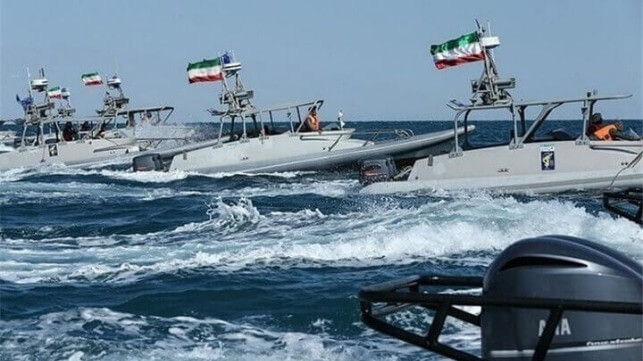
The Islamic Revolutionary Guard Corps (IRGC) prepares to seize the Epaminondas ship in the Strait of Hormuz. Photo Credit: Tasnim News Agency
The Strait of Hormuz currently sits at the heart of the ongoing conflict in the Middle East, which began with the launch of air campaigns by the US and Israel against Iran. Tehran’s strategic decision to partially close the Strait in response aims to pressure the US and its partners involved in the conflict to stand down, and has brought to the fore several dimensions of maritime security that continue to shape the war’s trajectory. As part of this effort to partially close the Strait, Iran has effectively blocked most vessel movement through the maritime corridor, with the exception of ships from a handful of countries that Tehran deems friendly.
Tehran’s reported use of naval mines is central to operationalising this selective blockade. The deployment of mines by Iran underscores their enduring value as a strategic tool to deny access to the Strait. While the United States has launched operations to locate and remove the mines, these efforts have faced multiple challenges to date. The episode has reaffirmed the importance of mines as a critical instrument of modern warfare. The unfolding events at sea amid the Middle East conflict have also raised urgent questions about access to and control of maritime corridors and chokepoints. These developments have not only disrupted supply chains of goods, commodities, and resources, but have also rendered the letter and spirit of a rules-based order at sea, which guarantees freedom of navigation, vulnerable to unilateral coercive tactics.
The Strait of Hormuz is a strategically significant maritime passage for oil and energy, and its selective closure has triggered a major upheaval in the global energy market, described as the world’s largest oil supply disruption. In response to Iran’s actions, the US threatened to take sweeping measures to reopen the Strait to all countries and restore stability in global energy supplies. First, President Trump announced that the US would close the Strait to ships transiting to and from Iranian ports, ostensibly to build tactical and economic pressure on Tehran. Washington then briefly launched a naval mission to escort traffic through the mined waterway, before pausing the operation to allow diplomacy with Tehran another chance. Officials from both sides have met in Pakistan on multiple occasions to negotiate an end to the conflict, but have yet to reach an agreement. Amid these developments, Iran’s restrictions on passage through the Strait of Hormuz remain in place — a unilateral closure that raises several pressing questions about maritime security.
How did Iran enforce coercive control over the Strait of Hormuz? Tehran’s strategy to close the Strait combines several tactics. Alongside naval deployments and patrols, there have been reported incidents of gunboat fire to keep vessel movement through the Strait minimal and restricted to only those ships Iran selectively approves. Central to sustaining this closure is Iran’s use of naval mines, which can be tactically placed across the narrow maritime corridor to deter and deny the movement of ships.
Naval mines have a long history of use across conflicts worldwide, playing a critical role in shaping the course of warfare during the First and Second World Wars. However, given that much of the discourse on maritime security has long bent normatively towards freedom of navigation and a rules-based order at sea, the use of naval mines — which are typically deployed to curtail free movement across the oceans — has emerged as a flashpoint in the conversation around maritime security and a potent naval strategy in the context of the Middle East conflict. Iran’s reported use of naval mines should therefore be understood as more than a straightforward attempt to deny passage through the Strait; it reflects Tehran’s broader strategy to cultivate an atmosphere of uncertainty and instability as a means of achieving deterrence.
The threat of Iranian naval mines in the Strait of Hormuz has been a long-established concern in US national security thinking. During the Tanker Wars of the 1980s, both Iran and Iraq mined the Persian Gulf to deter each other, prompting the US to conduct escort missions. During the First Gulf War, Iraq again mined the Persian Gulf to deter US naval operations, necessitating a protracted clearance mission involving eight nations. In the context of the current conflict, not only is the precise number of mines deployed by Iran unknown, but the situation is further complicated by Tehran’s claim that it cannot locate all the mines it has deployed and lacks the capability to clear them. Such ambiguity deepens the risk premium facing international shipping transiting the waterway and places the onus squarely on the US to restore freedom of navigation.
Figure 1. Naval Mines: Types and Trigger Mechanisms
Source: Authors’ illustration, generated with AI assistance.
Historically, mines have been the US Navy’s greatest vulnerability, damaging more ships than any other armament since World War II. The US therefore faces one of its most serious operational challenges in recent history, as any mine-clearing mission in the Strait of Hormuz carries significant risk. Iran has deployed various multi-domain assets along the waterway to enforce its selective blockade and deter any concerted attempt to clear the mines. Mine-clearing operations generally take weeks to complete even in the absence of active threats; given that Iran is likely to counter any such mission before a diplomatic solution is reached, a low-risk clearance operation in the current environment is virtually impossible. Tehran is believed to possess a mix of seabed, moored, limpet, and floating mines, including variants equipped with magnetic and acoustic sensors that trigger detonation when a vessel comes within range. Figure 1 illustrates how some of these mines are deployed. Adding to the challenge, certain mines in Iran’s arsenal — such as the Maham 7 — are specifically designed to evade sonar detection.
The US has traditionally relied on dedicated minesweeping assets but has largely retired that fleet in recent years, and its current minesweeping protocols are undergoing transition. The US Navy’s principal assets for this mission are its Independence-class Littoral Combat Ships (LCS), which employ the AN/AQS-20 mine-hunting system. US Central Command has also reported deploying two destroyers to the region to support mine-clearing operations. However, given the operational risks involved, these efforts have yielded limited results. Should the diplomatic impasse continue, the US is likely to deploy uncrewed systems to carry out this precarious mission in such a saturated battlespace. Alternatively, Washington may look to NATO allies with specialised minesweeping capabilities to assist in clearing the Strait.
More than two months have passed since Operation Epic Fury was launched with the stated aim of regime change in Tehran. The situation today is best described as a stalemate: a selective Iranian blockade in the Strait of Hormuz, a US counter-blockade in the Gulf of Oman to restrict Iranian oil exports, and a rudderless diplomatic back-and-forth mediated by Islamabad. All the while, Iran has successfully weaponised the chokepoint to advance its strategic goals — deploying naval mines to heighten navigational risk and, in turn, driving up global energy prices. For Iran, the physical denial of passage matters less than maintaining a minefield credible enough to make commercial transit seem prohibitively risky. For the rules-based maritime order, the deeper danger is that freedom of navigation may remain intact on paper while, in practice, being held hostage by deliberate ambiguity beneath the seas. About the authors:
Sayantan Haldar is an Associate Fellow with the Strategic Studies Programme at the Observer Research Foundation.
Tuneer Mukherjee is a Non-Resident Associate Fellow with the Strategic Studies Programme at the Observer Research Foundation.
The strategic and spiritual resonance of the Strait of Hormuz is deeply woven into Iran’s identity. It represents a profound geographic constant in Iranian history. This narrow waterway has served as a central artery for Persian political and economic power, historical consciousness and culture across millennia.
Whether safeguarding Zoroastrian trade routes under the Sassanids, expelling European powers in the Safavid era, or commanding energy routes today, Iran’s geopolitical identity is fused with this narrow stretch of water. It is a physical manifestation of sovereignty, insuring that the “Passage of the Palm Groves” and its divine namesake “Ahura Mazda” remains a focal point of global history.
Linguists and historians trace the etymology of “Hormuz” to “Ohrmazd,” the Middle Persian derivation of “Ahura Mazda” (the supreme deity of Zoroastrianism). To ancient Persian monarchs, this body of water was more than a trade route; it was an extension of the imperial cosmic divine order.
In the ancient dialect of southern Iran, the name is believed to have evolved from “Hur-Mogh.” In the local tongue of Hormozgan, Hur means waterway and Mogh refers to palm trees. For people who lived there for millennia, the strait was not a military chokepoint, it was simply, “The Passage of the Palm Groves.”
The Strait of Hormuz presents a profound historical paradox. Its name honors the Zoroastrian source of cosmic harmony, Ahura Mazda. Yet today, this narrow chokepoint whose foundational ethos, “humata, hukhta, and huvarshta” (good thoughts, good words, and good deeds), is now the epicenter of severe international geopolitical friction and trade instability.
Long before it became the jugular vein of the modern global economy, the Strait of Hormuz was the sacred and strategic maritime gateway to the Persian empire.
The Achaemenid Empire, founded by Cyrus the Great in 550 BC, was the first imperial power to recognize the strait as a strategic artery to be owned. Its name is tied to the Sassanian dynasty (224-651 CE), the last great pre-Islamic Persian empire and initiator of Zoroastrianism as a state religion.
During the Sassanian era, its Zoroastrian rulers expanded outward from the Iranian plateau to dominate both the northern and southern shores of the strait.
By commanding the entrance to the Persian Gulf by constructing forts and coastal infrastructure, these ancient kings secured their control over the lucrative maritime trade routes, linking Mesopotamia, the Indian subcontinent and the broader world.
Control over the Strait of Hormuz – the only sea passage from the Persian Gulf to the open ocean – has long been a linchpin of imperial power in West Asia. Its control has shifted across empires, passing from Sassanian Persian rulers and the Abbasid Caliphate to the formidable Kingdom of Hormuz, and eventually into the hands of expanding European colonial powers.
When the Safavid Empire (1501-1736) recaptured the region from the Portuguese in the 17th century, the strait was reestablished as an Iranian geopolitical asset. In the modern era, the reality of the waterway has been magnified on a global scale due to the discovery of petroleum in Iran in 1908.
The impact of the Strait of Hormuz extends far beyond the physical movement of petroleum, liquified natural gas and global commerce. Historically, this narrow sea passage became a natural crossroads connecting civilizations, diffusing and blending Persian, Arab and Indian art, philosophy and belief systems. Also, the prosperity generated by taxing trade through the chokepoint allowed for port cities like old Hormuz to build grand mosques and complex architecture.
In the modern era, particularly following the 1979 Iranian Revolution, Iran’s political geography has become inextricably tied to the strait’s unique topographical realities. Its main navigational corridors are incredibly constrained, forcing commercial and military vessels to travel through the territorial waters of Iran and Oman.
The once-open international thoroughfare, is now at the center of conflict because of the 28 February 2026 U.S.-Israeli war on the Islamic Republic of Iran. For Tehran, control of the natural chokepoint serves as an asymmetric strategy to counterbalance foreign military power. Iran has successfully relied on its geographical proximity, utilizing coastal missiles, fast-attack boats and strategic islands to assert control over the strait.
Today, the Strait of Hormuz, through which nearly a fifth of the world’s daily energy sources flow, remains the ultimate trump card in Iranian political geography. The passage grants Iran undeniable economic and strategic leverage.
From the divine association of Zoroastrian antiquity to the modern age of energy diplomacy, the Strait of Hormuz remains a defining feature of Iranian political geography. It continues to be the narrow gate through the geopolitical ambitions, economic lifeline and historic legacy of Iran intersecting with the wider world.
Iran continues to make unsubstantiated claims that under its control, transits are increasing in the Strait of Hormuz. It cites the “coordination and security provided by the IRGC Navy.”
“The Revolutionary Guard Navy has established a safe route for the continuity of international trade,” the public relations office of the IRGC said in a statement posted by media channels linked to the command. It is part of its ongoing effort to claim that it is providing stability as Iran also seeks to formalize its control of the waterway and establish its tolling system.
According to the IRGC Navy statement released on Friday, a total of 35 oil tankers, container vessels, and commercial ships had made the transit in the past 24 hours. This would be an increase from the 31 ships it reported on Thursday and 26 on Wednesday.
It says all of these ships had “permission to pass” and received security safety on a coordinated route. However, no details or substantiation were provided for the claims. There have been incidental reports of a few Chinese vessels making the transit, and the one South Korean tanker, but India, for example, continues to call for the release of vessels.
Maritime intelligence group Kpler posted a new tracking video showing only a handful of ships making the transit. It says on May 20, it confirmed 10 vessels, up from four the prior day. Most of the traffic observed was west to east, and it did not identify any new Iranian export loadings.
Iran’s Mehr News Agency, however, released a report claiming that Iran was exporting 1.4 million barrels of oil per day despite the U.S. blockade. In the same report, it cited data from the International Energy Agency reporting production was down a further 620,000 barrels per day in April to 20.18 million barrels per day from OPEC. It said this was after a 9.57 million barrel per day decrease in March. It highlighted that OPEC’s production was down by a third (32 percent) while writing that “other OPEC members outside the Persian Gulf region have not been able to effectively compensate for the drop in oil production from the region.”
U.S. Central Command, however, asserts that it remains vigilant in its enforcement of the blockade. As of Friday, CENTCOM is saying 97 commercial vessels have been redirected, and four were disabled.
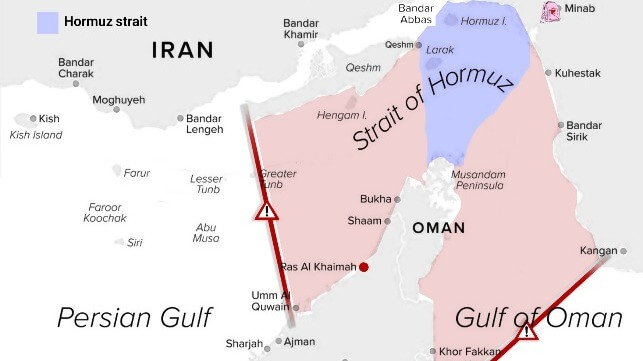
Iran released its new boundaries for control of the area around the Hormuz Strait as it launched the Persian Gulf Strait Authority. At the same time, Bloomberg reported on Wednesday that Iran was having talks with Oman about control of the strait. It was reported to be proposing its scheme for charging fees, possibly sharing revenue with Oman.
France’s Foreign Ministry on Friday confirmed it has drafted a U.N. Security Council resolution as part of an international mission to reopen the Strait of Hormuz, reports Reuters. It says that France is prepared to launch a joint effort with Britain when conditions permit.
A separate U.S. resolution drafted with Bahrain, Reuters reports, remains bogged down after more than two weeks. China and Russia vetoed a U.S. effort in April and are believed to be opposed to the US-Bahrain draft. Reuters reports the United States has secured almost 140 countries as co-sponsors in hopes of avoiding a second veto.
U.S. Secretary of State Marco Rubio on Friday reiterated the U.S. position that the Strait needs to be open. He said it is not acceptable for Iran to be charging a fee, but said the talks were showing “slight progress.” Donald Trump has said he has no timeline and that the deal must be the right deal to end the conflict.
Erratic Traffic Poses Real Risks for Strait of Hormuz Transits
Iran's view of its area of military control, bounded by twin red lines (IRGC)
A new industry-written guide to transiting the Strait of Hormuz paints a picture of exceptional risk, and not just from the missile and drone attacks launched by Iran. While the shipping industry's leading associations think that transits are a responsible choice under the right circumstances, the navigational hazards on the route are real, and the consequences of a collision or grounding are elevated.
The new official guidance was released this week by ICS, BIMCO, Intertanko, IMCA, Intercargo and OCIMF, and it reflects the full spectrum of industry concerns. The kinetic threat is the headline risk factor in any discussion of the strait, and the guide's advice is to stay clear of the waterway for at least 12 hours after a confirmed attack and avoid mined areas.
But the other risk is the traffic situation that may develop during an opening of the waterway. The guidance advises operators to prepare for a rush, and to expect little regard for COLREGS. Conditions may include simultaneous, uncoordinated transits; erratic, nonstandard vessel maneuvers; close-quarters situations in confined waters, with limited sea room; a wide mix of vessel sizes and maneuvering characteristics; and elevated crew stress.
"During extreme traffic congestion periods, collision and grounding risks may materially increase. Both dimensions must be appropriately addressed in the pre-transit planning," the associations recommended.
In the event of a casualty, masters are advised that any oil spill control efforts should be secondary to ensuring crew life and safety. Given the hazards, a spill response vessel or a salvage tug might not be coming quickly; the industry consensus suggests that masters and vessels should be prepared to be self-reliant for the transit, and should not expect assistance from military forces.
The details of the preparations required are revealing. Before instructing the crew to make the run, owners should ensure that insurance is in order, contingency plans are in place, the crew is well-rested, and the ship is in top technical condition and well-provisioned. It may be best to disembark supernumeraries (like cadets or riding gangs) in advance, minimizing the number of personnel exposed to risk on board. Watertight doors and hatches should be kept closed to aid in damage control.
On the bridge, operators are advised to make sure that their officers are truly ready to navigate in a GPS-denied environment, ideally using radar range and bearing plotted on physical paper charts (a practice which has fallen out of use). "The planning assumption must be total unavailability – or unreliability – of the GNSS signal for the entirety of the transit," the guide advises. For the same reason, radar and visual monitoring should be used as primary tools for collision avoidiance, not just AIS. An enhanced bridge team should be standing watch, with the master or chief officer, one additional officer, a lookout and a helmsman present.
Transmitting AIS position data is up to the operator, but the guidance recommends taking measures to shut down crew cell phone transmissions. Mobile devices capture GPS positioning for a variety of reasons and this data can be hacked and exploited by a capable actor to track the ship. Phones should be in airplane mode, and nonessential positioning & networking services on the device should be turned off.
While waiting for a chance to transit, the associations recommend that operators pick lower-risk anchorage areas. For vessels that have an elevated risk of attracting an Iranian attack, like ships owned by American or Israeli interests, periodic repositioning from one spot to another is recommended in order to make targeting more difficult.
Iran War Prompts GCC Countries to Reduce Regional Trade Barriers
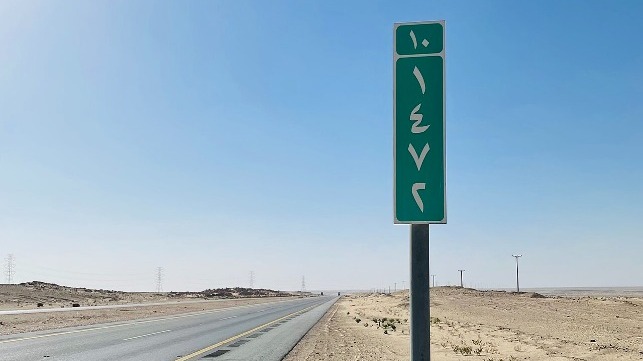
Saudi Route 10, the world's longest continuously straight road (Slayym / CC BY SA 4.0)
Faced with the urgent demands of their customers, logistics operators are not waiting for a political settlement to the war in the Gulf to solve their problems and the interruption of supply through the Strait of Hormuz.
Customs procedures within the GCC have always been an impediment to truck movements, but the lack of external, direct shipments into the Gulf has forced traffic onto the roads linking markets with the ports where there is still free access. These customs delays remain a significant problem on most of the important routes loaded with additional traffic:
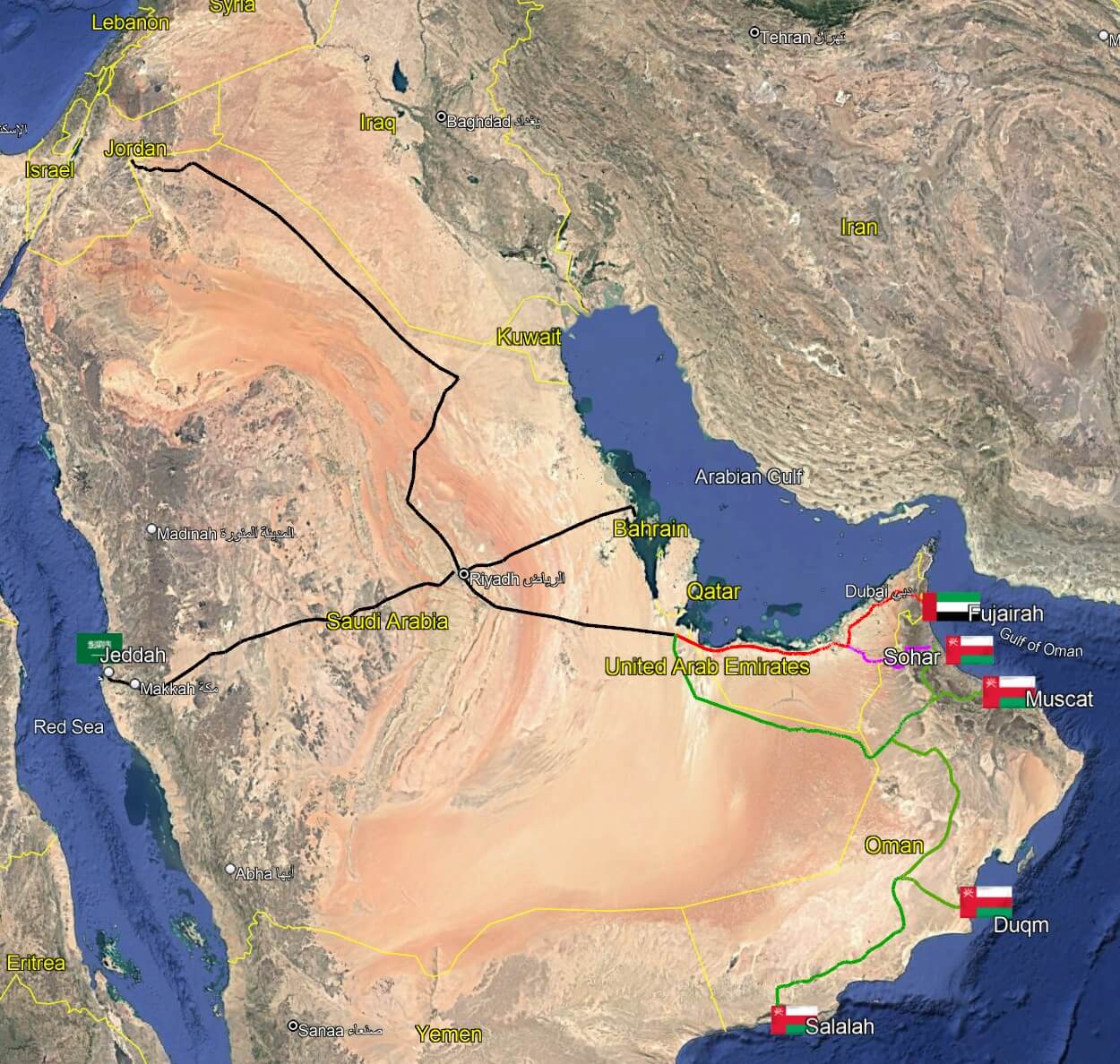
- The Northern International Highway 85 which stretches from Bahrain and Dammam, through Riyadh, and then follows the course of the old Trans-Arabian Pipeline to Al Hadithah on the Jordanian border and thence to Syria and the Mediterranean.
- Highway 40, 850 miles long, stretches from what is now Saudi Arabia’s busiest port in Jeddah on the Red Sea, continuing through Riyadh to Bahrain and Dammam, the petro-chemical heart of Saudi Arabia.
- Highway 10, branching off from Riyadh direct to the UAE.
- Routes from Abu Dhabi and Dubai both to Fujairah and Khor Fakkan on the Gulf of Oman, taking the bulk of the container traffic which used to be moved through Kizad and Jebel Ali, but also being used for traffic to ports in Oman, principally Sohar.
- Finally, Highway 95, from the Saudi-Qatari border crossing at Salwa, passing through the Shaybah oilfield and the Empty Quarter and into Oman at the Ramlet Khelah border crossing point which was opened in January 2023, then linking up through Ibri with the Gulf of Oman ports of Sohar and Muscat, or the Arabian Sea ports of Duqm and Salalah. The value of goods crossing through Ramlet Khelah nearly trebled to $830m in March, from $300m in February. The opening of Highway 95 has been popular: not only is it shorter, but it also cuts out often 24-hour delays at UAE-Saudi border crossings which no longer need to be traversed.
Road routes within KSA (black), from KSA to Omani ports (green), Etihad Rail to Fujairah (red) and Hafeet Rail nearing completion (purple) (Google Earth/CJRC)
With the need to keep traffic moving and reduce delays, the war has been a catalyst for the removal of customs barriers. The Emirates of Dubai and Sharjah have agreed new customs procedures with Oman to speed movement through the Hatta, Khatmat Malaha and Al Madam checkpoints by loads originating in Omani ports. Through Dubai’s Hatta checkpoint alone, the value of customs declarations rose from $270 million in March to $2.16 billion in April.
The Hafeet Rail route from Sohar into the Emirati network, now 40% complete and due to come into service in 2028, will feature a one-stop customs system for containers with no delays at the border.
But perhaps of most significance, after some last minute cliff-hanger delays, the GCC signed a comprehensive Free Trade Agreement with the United Kingdom on May 20, removing a further raft of customs duties and tariffs. The UK resisted the temptation to do bilateral deals with individual GCC countries, as the UAE had urged, in the hope that an all-GCC deal would boost the GCC as an integrated trading entity, as much as to benefit trade between the GCC and the UK. The deal will help British luxury car exports and financial services in particular, but it should also lead to an easing of tariff barriers within the GCC.
The UK-GCC agreement is the first that the GCC has signed collectively with a G7 country. The UK was part of the EU team when negotiations began with the GCC in 1990, and whilst the EU negotiations have stalled, the UK has used its independent sovereign status to quickly complete its own deal, Kemi Badenoch having opened negotiations in 2022. But undoubtedly, the desire on the part of the GCC to strengthen alliances with those who have supported it in times of trouble has contributed to a renewed impetus to complete the deal.
.jpg)

No comments:
Post a Comment