Putin says the war in Ukraine is “coming to an end”

Russian President Vladimir Putin said he believed the war in Ukraine was “coming to an end”, signalling what appeared to be one of the Kremlin’s clearest indications yet that Moscow may be seeking a negotiated settlement after more than four years of fighting.
“I think the (war in Ukraine) is coming to an end,” Putin told journalists at a Kremlin press conference following Victory Day commemorations in Moscow on May 9. “I believe that things are moving toward a conclusion, though it remains a serious matter.”
The remarks came as the Kremlin renewed calls for direct talks with Ukrainian President Volodymyr Zelenskiy. Putin said he would be willing to meet Zelenskiy in a third country, departing from his longstanding position that negotiations should take place in Moscow.
“Whoever wishes to meet is welcome to come,” Putin said, according to Meduza on May 9. “A meeting could also take place in a third country, but this would require reaching definitive agreements beforehand.”
The Gulf states and Turkey have offered themselves as possible venues. With the Trump administration withdrawing from the negotiating efforts, distracted by its war in the Gulf, Zelenskiy has reached out to Turkish President Recep Tayyip Erdogan in the last weeks as a possible replacement in the mediation efforts.
Kremlin foreign policy adviser Yuri Ushakov earlier repeated Russia’s standing invitation for Zelenskiy to visit Moscow. Zelenskiy has previously said he is prepared to meet Putin in any city not directly involved in the conflict.
Putin also said a planned exchange of 1,000 prisoners from each side remained possible under a three-day ceasefire announced by Moscow, although he claimed Kyiv had yet to submit formal proposals.
The Russian president argued that western governments had expected Russia’s rapid defeat after launching large-scale military support for Ukraine following Moscow’s 2022 invasion.
“First of all, they were expecting a crushing defeat for Russia — as we know full well — and the collapse of its statehood within a matter of months,” Putin said. “But then they got stuck in this rut, and now they simply cannot find a way out of it.”
He added that the US appeared increasingly interested in ending the conflict. “They clearly have no need for this conflict; they have many other priority tasks,” Putin said.
Simon Saradzhyan, a longtime Russia observer and Time correspondent, said Putin’s comments represented “the strongest signal he has sent so far that he wants to end the war soon”.
Putin is under increasing pressure due to a flagging economy and rising popular dissent to new restrictions on internet freedoms to bring the war to an end.
Separately, a political window to do a deal with the Trump administration is closing. Putin and Trump get on well personally, and as IntelliNews has reported, Trump is motivated as he wants to do business with Russia. Reportedly there is a so called “Dmitriev package” of business deals worth $12 trillion on the table – six times more than the entire value of the Russian economy – that would the US access to everything from oil and gas, through critical minerals and on to Russia very large consumer market that Trump is interested in to counter China’s monopoly over many of the world’s strategically important commodities. However, with the Republicans likely to lose control of both the House and the Senate in the November mid-terms, Putin is motivated to close a deal with Trump soon, while he has complete control of the US political process.
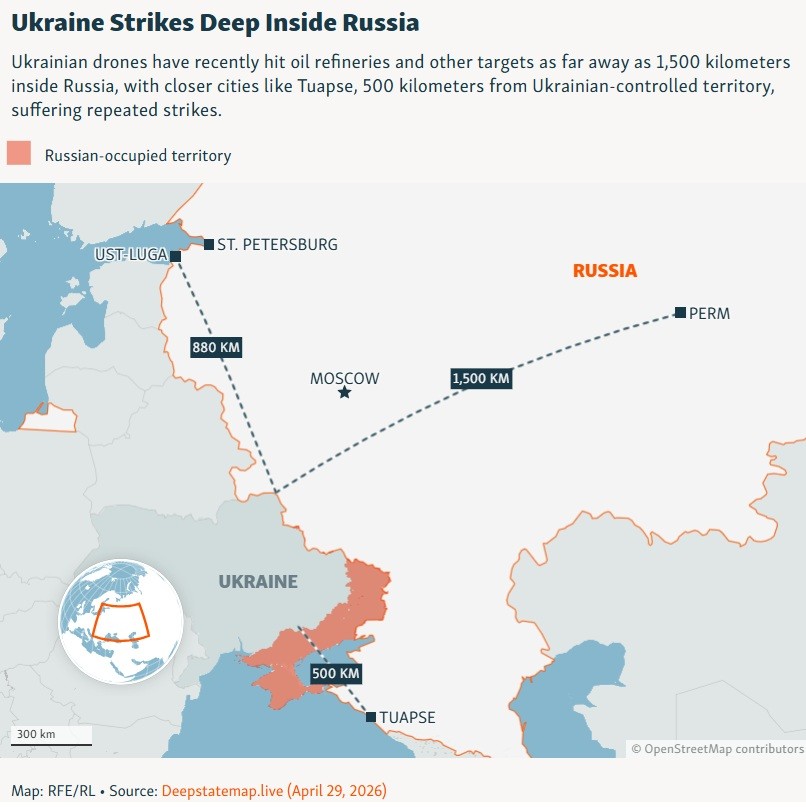
Ukraine’s Drone War Is Reaching Deep Into Russia’s Oil Heartland
- Ukrainian drone and missile strikes are increasingly targeting Russian oil facilities far from the front lines.
- Analysts say the attacks are forcing Russia to disperse air defenses and absorb growing economic costs.
- The campaign highlights Ukraine’s expanding drone production and evolving long-range warfare strategy.
Russia’s Leningrad Oblast lies some 600 kilometers from the closest corner of Ukraine.
But on April 15, its governor declared it a “frontline” region. Part of his explanation: From January through March, a total of 243 Ukrainian drones were shot down over the province, he said.
Some drones were not shot down, though. From export terminals on the Gulf of Finland to refineries inland, oil facilities in the region that surrounds St. Petersburg, President Vladimir Putin’s hometown, have been among the hardest hit in an upsurge of Ukrainian strikes on Russian hydrocarbon production, storage, and export infrastructure.
The attacks, which often hit hundreds of kilometers or more from the front lines, have changed the tenor of Russia’s war on Ukraine, now in its fifth year since Putin ordered the full-scale invasion of the neighboring country in February 2022.
To what degree they may change the war's trajectory is not yet clear. But the strikes -- mainly with drones but also with missiles, and also targeting military installations such as air defense systems, airfields, and weapons plants -- come as Russia struggles on the battlefield, advancing at a glacial pace and at a massive cost in soldiers killed and wounded.
They have hampered Russia’s ability to profit from sharp increases in the price of oil -- a key source of funding fueling its war on Ukraine that have resulted from the US-Israeli war with Iran and Tehran’s throttling of the Strait of Hormuz.
They have made images of black smoke billowing over Russian oil facilities seem suddenly almost commonplace and brought Moscow’s war on Ukraine home to Russians in the Black Sea port of Tuapse, for example, where residents reported oily droplets raining down amid a series of strikes in recent weeks.
And they have led Putin to scale down plans for the May 9 military parade in Red Square commemorating Nazi Germany’s World War II defeat: The Victory Day event is set to take place without a show of heavy weapons such as tanks and intercontinental ballistic missiles for the first time in almost 20 years. Smaller parades in several cities have been cancelled.
According to French open-source researcher Clement Molin, Ukraine launched about 1,000 drones into Russia in August 2024, 3,000 in July 2025, and 7,000 in March -- for the first time, more than Russia launched into Ukraine.
The number, based in part on Russian Defense Ministry figures, decreased moderately in April. But in any case, measuring the effects is a matter of quality in addition to quantity, in part because Moscow's claims about the number of drones its military has downed are unreliable.
"I would be careful about drawing too strong conclusions from the raw figures alone.... That said, the broader trend is real," John Helin, co-founder of the research organization Black Bird Group, told RFE/RL. "Ukraine has clearly expanded its long-range drone strike capacity, and Russia is now challenged to defend a much larger rear area against regular Ukrainian attacks."
The numbers "suggest a change in scale, but the success of Ukraine's long-range campaign should be judged more by effects," Helin said, such as "what was hit, how often, how deep inside of Russia, whether the strikes forced Russia to disperse air defence, disrupted logistics, reduced refinery output, or imposed real economic and military costs."
"On those counts it’s clear that the Ukrainian long-range campaign is becoming increasingly effective," he said.
Ukraine struck Russian oil infrastructure at least 21 times in April, including nine strikes on processing facilities, which helped cut the country’s crude oil processing volume to its lowest level since 2009, according to Bloomberg News.
On the battlefield and in air attacks carried out by both countries, drones have become a massive factor in the deadliest war in Europe since 1945, and both sides are seeking to build, acquire, and improve them as fast as they can.
“Today, our Ukrainian drones have fundamentally changed approaches to warfare,” President Volodymyr Zelenskyy said at a demonstration in April marking Ukraine’s Gunsmith Day, where he showed off more than 30 types of drones.
Ukraine’s new defense minister, Mykhaylo Fedorov, said in late April that Kyiv purchased more drones in his first three months in office than it did in all of last year.
“We are now seeing the moment when the capabilities of Russia's air defense are much smaller than the growth in production of Ukrainian drones,” Oleksandr Karpyuk, a soldier with the 59th Assault Brigade of Ukraine’s Unmanned Systems Forces who goes by the call sign Serge Marco, told RFE/RL.
Targeting Russian air defense systems is a crucial element in Ukraine’s strategy, soldiers, officials, and military analysts suggest -- whether it means damaging or destroying them with direct strikes or neutralizing them by sending multiple drones their way, keeping them busy and unable to protect targets against missiles and other attacks.
If Russian systems shoot down dozens or hundreds of drones, those systems will be depleted, opening the skies for further strikes, Karpyuk said: "First the drones arrive, then the missiles arrive. They take out the air defense systems -- and that means some Flamingos, with a 1,000-kilogram warhead, can strike [the targets] with ease.”
Ukraine has been touting the homegrown Flamingo cruise missiles. It fired several of them on May 5, Zelenskyy said, including in an attack on a plant in Cheboksary, some 1,200 kilometers from Ukraine, that makes navigation components for Russia's military. The regional governor said at least two people were killed and more than 30 injured.
Ukraine’s Unmanned Systems Forces destroyed 41 Russian air defense units in March, according to the service’s commander, Robert Brovdi, stepping up the pace after destroying 54 units over the previous three months.
Analysts caution that such claims are hard to verify. Oryx, an outfit that monitors wartime military equipment losses, counted 18 destroyed or damaged Russian surface-to-air air defense systems and seven radars in March.
Whatever the numbers, the destruction or incapacitation of air defense systems can help Ukrainian forces at the front repel Russian advances and make their own gains.
It also “opens a window for deep strikes, middle strikes, and effective strikes. We see them in the Leningrad region and along the Black Sea coast," Oleksiy Bezuhliy, spokesman for the 413th Separate Regiment of the Unmanned Systems Forces, told RFE/RL, referring to the recent wave of Ukrainian attacks on Russian oil facilities.
Russia’s vastness increases its vulnerability to Ukrainian “air defense suppression strikes,” according to University of Oslo researcher Fabian Hoffmann, because the loss of a single system can mean an entire area is no longer under the umbrella.
A focus on protecting Putin, the government, and Moscow may leave far-flung energy and military facilities or forces near the front more exposed -- a factor that has come to the fore ahead of the May 9 parade in Moscow, a high-profile annual event that Putin presides over from a grandstand near Lenin's Tomb.
"Russia's apparent reluctance to redeploy assets from the tight ring of air defense and missile defense around Moscow -- likely due to fears of bringing the realities of war closer to the regime's door -- exacerbates the problem," Hoffman wrote.
In an April 12 blog post, he wrote that the “strike campaign alone does not win Ukraine the war, nor does it eliminate Russia’s economic potential.”
However, he added, the cumulative effects of the restraints it imposes “are real, bearing meaningfully on Russia’s budget and planning even if they fall short of collapsing its capacity to wage war.”
By RFE/RL
Putin vows victory in Ukraine and targets NATO at Moscow's scaled-back parade
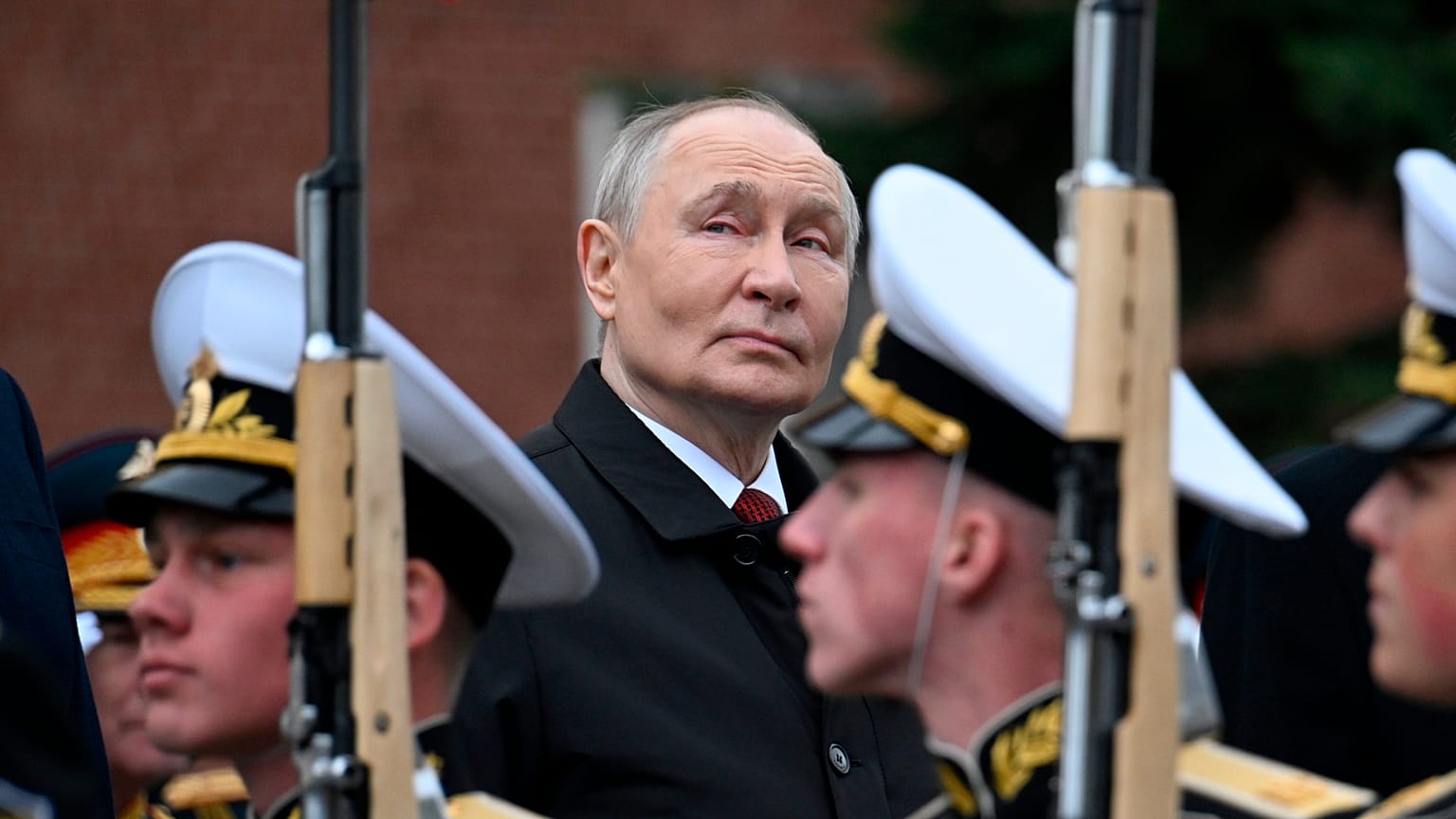
Enhanced security measures have been taken in Moscow ahead of President Vladimir Putin's speech at the Red Square parade marking the victory over Nazi Germany in World War II.
Meanwhile, a three-day ceasefire brokered by the United States the previous day eased fears of possible Ukrainian strikes on the Russian capital during the celebrations.
Speaking in front of hundreds of military personnel and flanked by a few world leaders, the Russian president said he was fighting a "just" war as he identified Ukraine an "aggressive force" that is being "armed and supported by the whole bloc of NATO".
Putin, in power for more than a quarter of a century, uses Victory Day, Russia's most important secular holiday, to showcase the country's military might and rally support for a military invasion of Ukraine starting in 2022. However, this year, for the first time in nearly two decades, the parade is being held without tanks, missiles and other heavy weaponry, except for the traditional flyover of combat aircraft.
Russian officials attributed the sudden change in format to the "current operational situation" and cited the threat of Ukrainian attacks. Kremlin spokesman Dmitry Peskov said "additional security measures" had been taken.
Previous ceasefire agreements have not held up
Russia declared a unilateral ceasefire for Friday and Saturday, while Ukrainian President Volodymyr Zelensky imposed a truce from 6 May, but neither agreement was honoured as sides exchanged mutual accusations of continued attacks.
On Friday, US President Donald Trump announced that Russia and Ukraine had accepted his request for a ceasefire from Saturday to Monday and agreed to exchange prisoners, saying a pause in fighting could be the "beginning of the end" of the war.
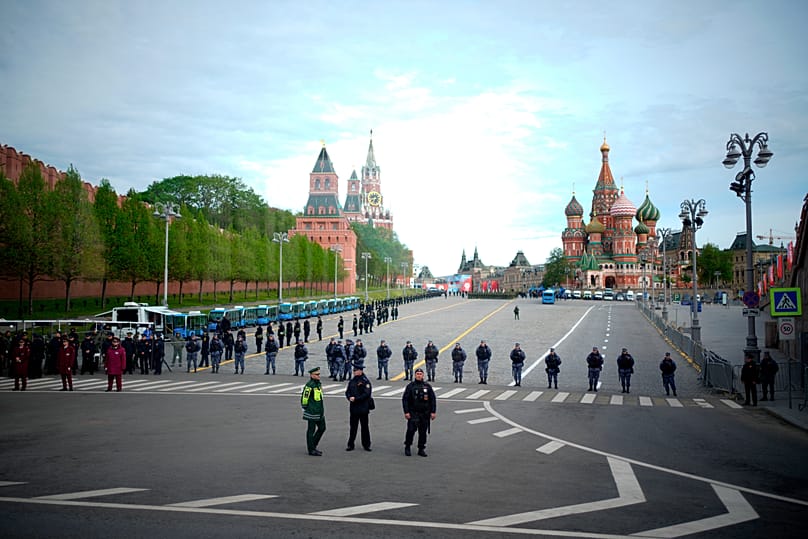
Zelensky, who said earlier this week that Russian authorities "fear drones could fly over Red Square" on 9 May, followed up on Trump's statement by issuing an executive order "allowing" Russia to hold Victory Day celebrations on Saturday, declaring Red Square temporarily closed to Ukrainian strikes.
Peskov, the Kremlin spokesman, called Zelensky's decree a "silly joke" as he told reporters, "We don't need anyone's permission to be proud of Victory Day."
Russian authorities have warned that if Ukraine tries to disrupt Saturday's celebrations, Russia will launch a "massive missile strike on the centre of Kyiv".
Russia's defence ministry urged civilians and staff of foreign diplomatic missions to "immediately leave the city". The EU said its diplomats would not leave the Ukrainian capital despite Russian threats.
Putin is using Victory Day celebrations to bolster national pride and emphasise Russia's position as a world power. The Soviet Union lost 27 million people between 1941 and 1945 in the Second World War.
Addressing the parade participants, the Russian president recalled the huge contribution of the Soviet people to the victory over fascism and said his soldiers are now fighting in Ukraine against an "aggressive force" backed by NATO.
Putin expressed confidence in victory in Ukraine
"Victory has always been and will always be ours," Putin said as columns of troops lined Red Square. "The key to success is our moral strength, courage and valour, our unity and ability to withstand anything and overcome any challenge."
Those present in Red Square were then shown a propaganda video sequence designed to emphasise the power of the Russian army and its "achievements" in the war against Ukraine.
Russian military units paraded through Moscow’s Red Square, accompanied by an official broadcast detailing the armed forces' various accomplishments.
Among those marching were North Korean soldiers who had been sent to help the Russian army in the war against Ukraine. They had, as the announcer's speech claimed, made a great contribution "to the defeat of neo-Nazi invaders in the Kursk region."
The parade was over in 45 minutes
On Saturday, as troops prepared to march through Red Square, authorities imposed restrictions on access to mobile internet and text messaging services in the Russian capital, citing public safety.
The government has been methodically tightening internet censorship and imposing ever-tighter controls on online activity, prompting discontent and rare public displays of discontent.
Malaysia's King Sultan Ibrahim Iskandar, Lao President Thongloun Sisoulith, Kazakh President Kassym-Jomart Tokayev, Uzbek President Shavkat Mirziyoyev. Belarusian President Alexander Lukashenko and Slovak Prime Minister Robert Fitzo travelled to the Russian capital for the celebrations.
'No comment' after Schröder named by Putin
for Ukraine talks
Russian President Vladimir Putin suggested that the former German chancellor serve as a mediator in Russia-Ukraine peace talks.

Gerhard Schröder's office on Sunday refused to comment after Russian President Vladimir Putin said he would like the former German chancellor as a possible European mediator in peace talks to end the Ukraine war.
Putin told reporters on Saturday: "Of all European politicians, I would prefer talks with Schröder."
The ex-chancellor has maintained close relations with Moscow and is a personal friend of Putin.
Speaking at the end of Victory Day celebrations, the Russian leader also said he thought the four-year conflict with Ukraine was heading toward an end.
In response to a question from DPA news agency, Schröder's office said it would not comment on the matter.
On Sunday, news agencies cited anonymous German government officials as saying Putin's suggestion was "not credible" as Moscow had not altered its conditions for ending the war.
The sources added that a first test of credibility would be for Russia to extend this weekend's 3-day ceasefire.
Schröder defended Russia over Ukraine war
The 82-year-old Schröder has courted controversy over his close ties to Russia, personal friendship with Putin and his role in Russian energy companies after leaving politics.
Writing in the Berliner Zeitung newspaper in January, Schröder described the Russian invasion as contrary to international law.
"But I'm also against demonizing Russia as the eternal enemy," he added, before urging Germany to restart imports of Russian energy, which were cut over the conflict.
Putin's remarks come as Kyiv and Moscow observe a three-day ceasefire in the conflict this weekend.
The truce was announced on Friday by US President Donald Trump after negotiations brokered by Washington.
The Financial Times reported this week that European Union leaders are quietly preparing for possible direct negotiations with both sides, citing growing frustration with US efforts.
European Council President Antonio Costa on Thursday said the EU was prepared to hold separate talks with the warring parties “when the right moment comes."
SPD politicians are divided on Schröder's suitability
Some senior officials in Schröder's Social Democratic Party (SPD), a junior partner in Germany's coalition government, believe his links to the Kremlin make him unsuitable for any mediator role.
"[A mediator] cannot be Putin's buddy," Michael Roth, a former SPD lawmaker and chair of the foreign affairs committee, told Tagesspiegel newspaper, adding that any mediator must be accepted by Ukraine.
Others within the party have been more open to Putin's suggestion, including lawmaker Ralf Stegner, who said the EU needed to play a more important role in peace negotiations.
"If someone like Schröder were to succeed in doing so, it would be negligent to reject it," he told Spiegel magazine.
Edited by: Louis Oelofse
Berlin sceptical as Putin proposes
Germany's ex-chancellor Schroeder as
Ukraine mediator
Russian President Vladimir Putin on Saturday said he would "personally" prefer longtime ally and friend, former German chancellor Gerhard Schroeder, as mediator in the Ukraine war – an idea that has been met with scepticism in Berlin. Schroeder, 82, has remained close to the Kremlin leader long after leaving office, standing apart from most Western leaders since Russia invaded Ukraine in 2022.
Issued on: 10/05/2026 -
By: FRANCE 24

Russian President Vladimir Putin has proposed longtime ally and friend, former German chancellor Gerhard Schroeder, as mediator in the Ukraine war – an idea that has been met with scepticism in Berlin.
Asked on Saturday who he would like to help restart talks with Europe, Putin said he would "personally" prefer Schroeder, who led Germany from 1998 to 2005.
Schroeder, 82, has remained close to the Kremlin leader long after leaving office, standing apart from most Western leaders since Russia invaded Ukraine in 2022.
German officials reacted cautiously, saying they had "taken note" of Putin's comments but viewed them as part of "a series of bogus offers" from Russia, government sources told AFP Sunday.

01:59
One source said a real test of Moscow's intentions would be to extend the current three-day truce.
Schroeder's stance has made him a controversial figure at home. He has never publicly condemned the invasion of Ukraine, costing him several privileges normally granted to former chancellors.
He previously held key roles in Russian energy projects, including work on the Nord Stream gas pipelines and a seat on the board of Russian oil firm Rosneft, which he gave up in 2022.
Some German politicians from Schroeder's own SPD party – a junior partner in Germany's coalition government – say this makes him unsuitable for any mediator role.
Michael Roth, former SPD lawmaker and chair of the foreign affairs committee, said a mediator "cannot be Putin's buddy", in an interview with Tagesspiegel.
He stressed that any mediator must above all be accepted by Ukraine. "Neither Moscow nor we can decide that on Kyiv's behalf."
Others within the party, however, have been more open to Putin's suggestion.
Quoted by Der Spiegel, the SPD's foreign affairs spokesman in parliament, Adis Ahmetovic, said the proposal needs to be "carefully considered" with European partners.
SPD lawmaker Ralf Stegner argued, in the same magazine, that "if we don't want Putin and (US President Donald) Trump to decide Ukraine's future" alone, Europe should seize every possible chance – however small.
"We should turn to the former chancellor. What do we have to lose?" said Fabio De Masi, leader of the pro-Russia left-wing BSW party, speaking to AFP on Sunday.
Others remain unconvinced, with Marie-Agnes Strack-Zimmermann of the liberal FDP warning there were "serious doubts" that the ex-chancellor was the right choice as a go-between.
(FRANCE 24 with AFP)
Germany's SPD open to Putin proposal of Schröder mediating on Ukraine
10.05.2026, DPA

Photo: Holger Hollemann/dpa
Foreign policy experts from the former party of Gerhard Schröder are calling for a serious assessment of Russian President Vladimir Putin’s proposal for the former German chancellor to be used as a mediator in the war in Ukraine.
“Every offer must be seriously assessed to determine how reliable it is,” said Adis Ahmetovic, foreign policy spokesman for the centre-left Social Democratic Party (SPD), speaking to Der Spiegel news magazine on Sunday.
“We cannot accept that the US and Russia alone decide the future of Ukraine and European security. Our aim must be to have a seat at the negotiating table,” said Ahmetovic.
“If a condition for this is the involvement of the former German chancellor, it should be considered in close consultation with our European partners and not immediately ruled out." A first test of credibility would be an extended ceasefire on both sides, he said.
SPD foreign policy expert Ralf Stegner expressed a similar view. So far, he said, Europe has not been involved in the negotiations and is unable to make proposals. “If this could be achieved through someone like Schröder, it would be negligent to rule it out.”
Putin had said at a press conference that although the US had attempted to mediate, he could envisage the former SPD leader acting as a mediator on the European side. “Of all European politicians, I would prefer talks with Schröder.”
The German government has expressed scepticism regarding Putin’s proposal. Government sources in Berlin stated that they had taken note of the remarks.
“However, Germany and Europe will not allow themselves to be divided by this,” they added. “A first test of credibility would be for Russia to extend the ceasefire.”
No comments:
Post a Comment