It’s possible that I shall make an ass of myself. But in that case one can always get out of it with a little dialectic. I have, of course, so worded my proposition as to be right either way (K.Marx, Letter to F.Engels on the Indian Mutiny)
Thursday, May 28, 2026
In Sudan’s war economy, gold keeps flowing as miners risk mercury and collapse
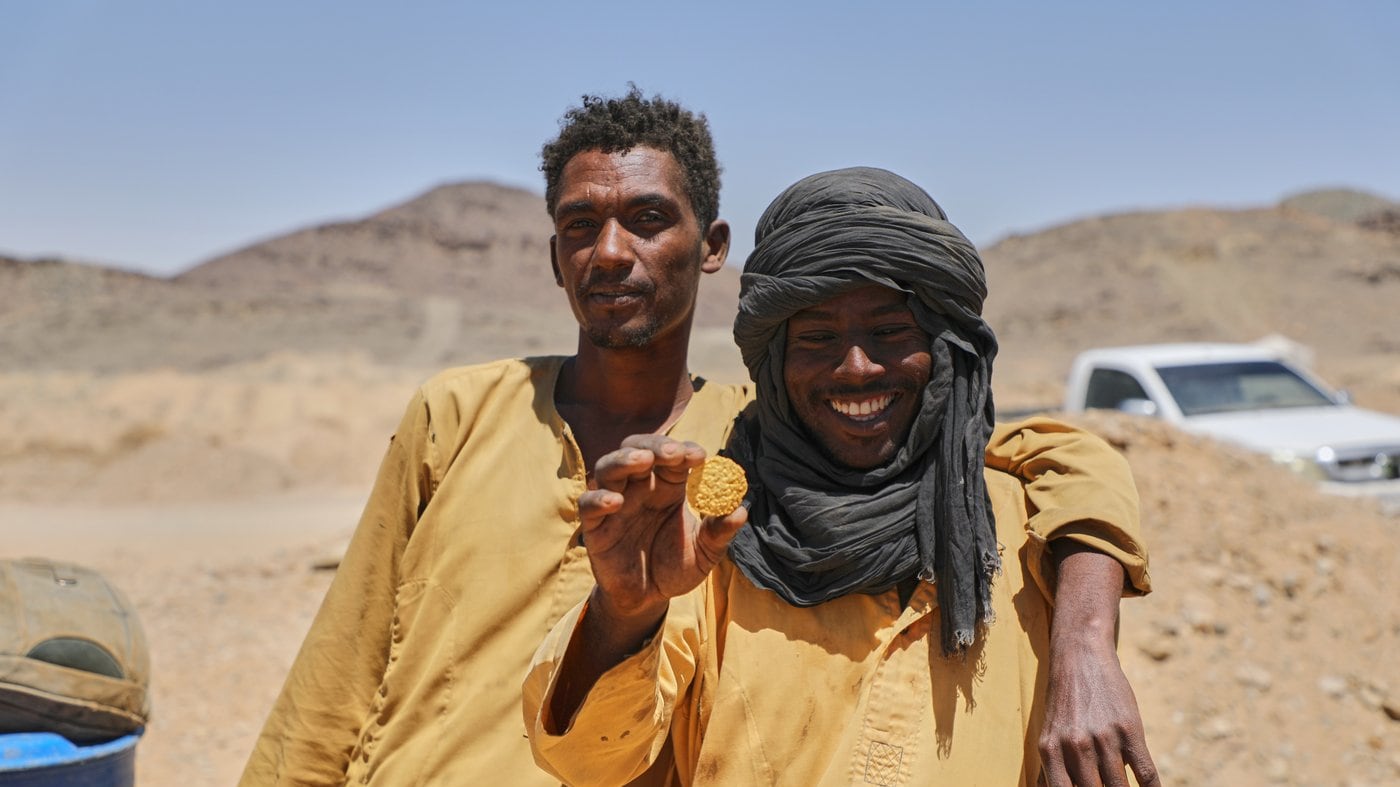
Miner Atta al-Khazin, right, shows a gold nugget produced by artisanal miners after processing ore at a mining site in Dalago Mahas, Sudan's Northern State, Friday, May 8, 2026.(AP Photo/Mohnd Blal)
DAGALO MAHAS, Sudan — The men carried metal detectors as they scanned a mountainous area in northern Sudan in search of gold. One man knelt to examine the ground with a digging tool for the precious metal in an environment that lacks even the most basic safety measures.
They are unregulated miners working in a small-scale private gold mine in the northern town of Dalgo Mahas. The mine is one of thousands of small-scale and artisanal mines scattered across Sudan, part of a sector that is at the center of the devastating war that has at times pushed parts of the country into famine.
Gold has become a major source of funding for Sudan’s treasury after the country lost over two-thirds of its oil revenues with the secession of South Sudan in 2011. The precious metal accounted for 70 per cent of national revenues in the years that followed South Sudan’s departure, providing the Sudanese government with much-needed foreign currency.
Most recently, gold has been at the center of the ongoing war between the military and the paramilitary Rapid Support Forces. Large quantities of gold have been smuggled out of the country to finance paramilitaries, who control gold-producing areas in Darfur and Kordofan regions, according to United Nations-commissioned experts.
The conflict has killed at least 59,000 people, according to the Armed Conflict Location & Event Data Project, a U.S.-based war tracking group that says its toll is almost certainly an underestimate, given the difficulties in reporting.
The war also created the world’s largest humanitarian disaster, forcing over 10 million people to flee their homes. Many displaced people joined the mining industry in order to make ends meet for their families.
“Gold mining is the only thing I can rely on,” said Atta al-Khazin, a 28-year-old miner who abandoned his previous profession as a farmer. “Due to the high oil prices, agriculture no longer covered expenses.”
Zahir Adam, a 35-year-old father from the Darfur city of el-Fasher who worked in gold mining for more than a decade, said the sector has drawn many people since the war broke out over three years ago.
They had “no other option,” he said. “Many young people, and many families, depend on mining.”
Sudan produced 70 tons of gold last year, up from 64 tons in 2024, according to official figures, making it one of Africa’s top producers. Gold generated about US$1.8 billion in revenues in 2025, figures from the state-run Sudanese Mineral Resources Company showed.
Artisanal and small-scale gold mining accounts for the majority of gold extracted in the sprawling country, where safety standards are largely ignored.
Artisanal miners like the men in Dalgo Nahas usually extract the gold, then crush the ore before applying toxic mercury to create the amalgam. The amalgam is then heated, usually on a stove, to evaporate the mercury and recover the gold.
The process, which includes using hazardous chemicals, is also risky for people living near the mines.
Many of these mines are not controlled by the government. The U.N. panel of experts said in their 2024 report that more than 50 per cent of the gold mined in Sudan was not traded through formal channels but was smuggled out of the country.
Deadly mine collapses are not uncommon in Sudan, where safety standards are not widely applied. Last month, at least seven miners were killed in a mine collapse in the Red Sea province. Thirteen others were killed in another collapse in South Kordofan province in January.
A civilian transitional government that ruled the country for over a year after the military overthrow of longtime dictator Omar al-Bashir in April 2019 attempted to regulate the crucial industry.
However, its efforts were aborted by a military coup in October 2021, and the war that began in 2023.
Mohnd Blal, The Associated Press
Libya ‘Central Node’ In RSF’s War Machine
Colombian mercenaries Photo Credit: La Silla Vacía, via ADF
New reporting on Colombian mercenaries in Sudan’s civil war shows how outside forces have prolonged the conflict and eroded regional stability.
With the help of a Libyan militia called the Subul al-Salam Battalion, Sudan’s Rapid Support Forces (RSF) paramilitary group used southern Libya as a transit corridor, support base and rear operations center in its war against the Sudanese Armed Forces (SAF).
The Subul al-Salam Battalion, which is associated with the Libyan National Army, facilitated the transfer of recruits, including Colombian mercenaries, weapons and fuel across the border to support the RSF, according to an April 19 report by a United Nations Panel of Experts on Libya.
“The Panel found that Subul al-Salam was involved across multiple stages of the supply chain to the Rapid Support Forces,” the report stated. “Subul al-Salam exercised functional control over key logistical, security and facilitation components required to sustain the transportation of fighters, fuel, arms and related materiel, including militarized vehicles.”
The experts said the RSF in 2025 used a rear base in Libya controlled by Subul al-Salam to coordinate logistical operations from Libyan territory, access the Maateen al-Sarrah Air Base and use the al-Kufra Air Base, which “served both as transit points for Colombian fighters and as sites for the modification of vehicles imported through Libya.”
Colombian mercenaries supplied by the United Arab Emirates (UAE) gave the RSF crucial military support for and participated in the gruesome siege of El-Fasher, North Darfur, in October 2025, according to an April 2026 report by security analysis organization Conflict Insights Group.
“This is the first research where we can prove UAE involvement with certainty,” managing director Justin Lynch told the BBC for an April 22 article. The group’s report “shows mercenaries involved with drones travelling from a UAE base to Sudan before the RSF takeover of el-Fasher.”
As many as 380 Colombian mercenaries have deployed to Sudan since 2024, according to La Silla Vacía, a news website based in Bogotá, Colombia. The mercenaries, known as the Desert Wolves, were associated with a UAE-based company with documented ties to senior Emirati government officials, the report found. The UAE has repeatedly denied accusations by international groups that it provides support to the RSF.
The Desert Wolves brigade, which is composed of four companies of retired Colombian military personnel, reportedly served the RSF as drone pilots, artillerymen and instructors, including “training child soldiers.” In a February 2026 report, the U.N. said that RSF forces committed “widespread atrocities that amount to war crimes and possible crimes against humanity.”
Lynch said his group’s report assessed that the UAE-backed Colombian mercenary network “bears shared responsibility for these outcomes. The scale of atrocities and siege in el-Fasher wouldn’t have happened without the drone operations the mercenaries provided.”
In Libya, Subul al-Salam “directly supported” RSF armed operations by deploying units, providing foreign recruits and escorting RSF-affiliated factions across Libyan territory. The RSF remained present in Libya during the U.N. experts’ reporting period from October 2024 to February 2026, resulting in armed clashes with the SAF in Libya in June 2025.
Seeking to disrupt the RSF’s supply route, the SAF in November 2025 launched airstrikes that targeted shipments of vehicles and foreign fighters in transit from Libya to Sudan.
Ismail Jibril Tisso, a prominent Sudanese researcher and author, said southeastern Libya has become an open corridor for war.
“Libya has shifted from being merely a neighboring state to becoming a central node in a transnational supply network, fueling the Sudan conflict with foreign fighters and military equipment amid a growing war economy,” he wrote in an April 5 analysis for Sudanow Magazine.
“As the conflict expands, the fundamental challenge remains whether states and the international community can contain these networks and restore regional security — before the entire region devolves into an open theater of endless conflict.”


No comments:
Post a Comment