It’s possible that I shall make an ass of myself. But in that case one can always get out of it with a little dialectic. I have, of course, so worded my proposition as to be right either way (K.Marx, Letter to F.Engels on the Indian Mutiny)
Monday, May 04, 2026
Astronomers explore the surface composition of a nearby super-Earth
Webb observations constrain the properties of a rocky exoplanet’s hot crust
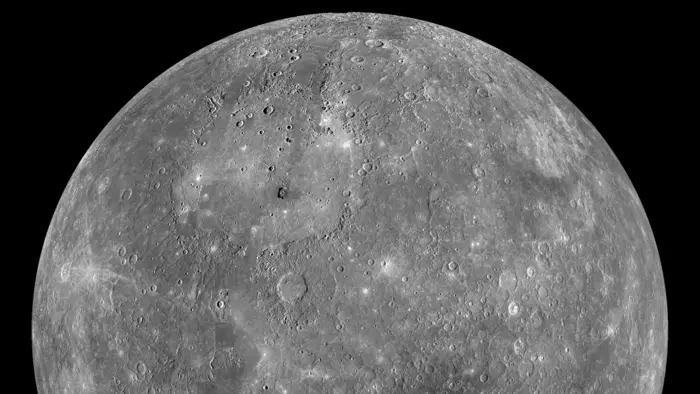
This high-resolution photo of the planet Mercury probably resembles the rocky exoplanet LHS 3844 b. Results from JWST observations favour an airless rocky planet with a dark, basalt-like surface, likely space-weathered by irradiation and meteorite impacts.
Credit: NASA/Johns Hopkins University Applied Physics Laboratory/Carnegie Institution of Washington (cropped) https://science.nasa.gov/photojournal/mercury-globe-0n-180e/
Using MIRI (Mid Infrared Instrument) on board the James Webb Space Telescope (JWST), a team of researchers led by former MPIA (Max Planck Institute for Astronomy, Heidelberg, Germany) PhD student Sebastian Zieba (Center for Astrophysics | Harvard & Smithsonian, Cambridge, USA) and Laura Kreidberg, MPIA Director and study PI (principal investigator), analysed the surface composition of the rocky exoplanet LHS 3844 b. Beyond characterizing exoplanetary atmospheres, this kind of deciphering the geological properties of planets orbiting distant stars is the next step in unveiling their nature. The results of this investigation are now published in the journal Nature Astronomy.
A dark and airless rocky super-Earth
LHS 3844 b is a rocky planet 30% bigger than Earth and orbits a cool red dwarf star once within roughly 11 hours. Whirling just three stellar diameters above the host star’s surface, the planet is tidally locked to its orbit. This means one rotation takes just as long as one revolution. As a result, the same hemisphere of LHS 3844 b always faces its star, producing a constant dayside with an average temperature of about 1000 Kelvin (approximately 725 Degrees Celsius or 1340 Degrees Fahrenheit). The LHS 3844 system is only 48.5 light-years (14.9 parsecs) away from Earth.
“Thanks to the amazing sensitivity of JWST, we can detect light coming directly from the surface of this distant rocky planet. We see a dark, hot, barren rock, devoid of any atmosphere.” – Laura Kreidberg, MPIA.
With its dark surface, LHS 3844 b may resemble a larger version of the Moon or the planet Mercury. This conclusion is based on analysing the infrared radiation received from the planet’s hot dayside. However, when measuring this radiation, we cannot see the planet directly; instead, we register the repeating change in brightness we receive from the star and the orbiting planet combined.
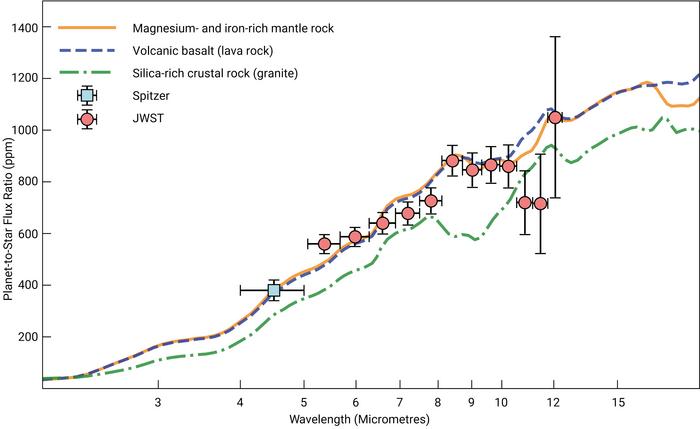
MIRI divided a portion of the planet’s infrared emission, ranging from 5 to 12 micrometres, into smaller wavelength sections and measured the brightness per wavelength bin. This is what astronomers call a spectrum, a rainbow-like distribution of the light’s components. Another data point, obtained from observations with the Spitzer Space Telescope and published a few years ago, augmented the analysis.
Constraining geological activity
Similar to how exoplanetary atmosphere research has benefited from climate science, this emerging field of exoplanetary geology draws on Earth-based geologic knowledge. Zieba, Kreidberg, and their collaborators ran models and accessed template libraries of rocks and minerals known from Earth, the Moon, and Mars to see what infrared signatures they would produce under the conditions on LHS 3844 b. Comparing observation-based data with these computations confidently ruled out a composition comparable to Earth’s crust, typically silicate-rich minerals such as granite.
Although this result is not very surprising – even in the Solar System, Earth is the only planet with such a crust – it may reveal details on LHS 3844 b’s geological history. Earth-like silicate-rich crusts are thought to form through a prolonged refinement process that requires tectonic activity and typically relies on water as a lubricant. The rocky material repeatedly melts and solidifies as it is mixed with mantle material, leaving the lighter minerals on the surface.
“Since LHS 3844 b lacks such a silicate crust, one may conclude that Earth-like plate tectonics does not apply to this planet, or it is ineffective,” says Sebastian Zieba. “This planet likely only contains little water.”
What can we deduce about the exoplanet’s rocky surface?
Instead, the dark surface points to a composition reminiscent of terrestrial or lunar basalt, or of Earth’s mantle material. However, the astronomers attempted an even more detailed characterization.
A statistical analysis of how well this spectrum fits various mineral mixtures and configurations revealed that extended solid areas of basalt or magmatic rock best match the observations. They are rich in magnesium and iron and can include olivine. Crushed material, such as rocks or gravel, also fits fairly well, whereas grains or powders are inconsistent with the observations due to their brighter appearance, at least at first glance.
Without a protective atmosphere, planets are subjected to space weathering, predominantly driven by hard, energetic radiation from the host star and impacts from meteorites of various sizes.
“It turns out, these processes not only slowly dissolve hard rocks into regolith, a layer of fine grains or powder as found on the Moon,” explains Zieba. “They also darken the layer by adding iron and carbon, making the regolith’s properties more consistent with the observations.”
Geologically fresh or weathered? Two possible scenarios
This assessment left the astronomers with two scenarios for the planet’s surface that match the data equally well. One involves a surface dominated by dark, solid rock composed of basaltic or magmatic minerals. Compared to geological timescales, space weathering alters its properties quickly. Therefore, the astronomers conclude that, in this scenario, the surface should be relatively fresh, produced by recent geological activity, such as widespread volcanism.
The second scenario also proposes a dark surface, comparable to the Moon or Mercury. Still, it accounts for prolonged space weathering, which leads to extended regions covered by a darkened regolith layer, a fine powder also present on the Moon, as evidenced by the iconic photos of the astronauts’ footprints. This alternative relies on longer periods of geological inactivity, thereby requiring conditions opposite to the first scenario.
Attempts to resolve the ambiguity
These two alternatives differ in the degree of recent geological activity required. On Earth and other active objects in the Solar System, a typical phenomenon during such activity is outgassing. Sulphur dioxide (SO2) is a gas commonly connected to volcanism. If present on LHS 3844 b in reasonable amounts, MIRI should have detected it. Still, it found nothing. Therefore, a recent period of activity seems unlikely, which leads the astronomers to favour the second scenario. If correct, LHS 3844 b may truly look much like Mercury indeed.
In order to test their idea, Zieba, Kreidberg, and their colleagues are already pursuing a more direct approach. They have obtained additional JWST observations, which should enable them to discern surface conditions by exploiting small differences in how solid slabs and powders emit or reflect light. The distribution of emission angles depends on surface roughness, which affects the amount of radiation received at a given viewing angle. This concept is successfully applied to characterizing asteroids in the Solar System. “We are confident the same technique will allow us to clarify the nature of LHS 3844 b’s crust and, in the future, other rocky exoplanets,” concludes Kreidberg.
Additional information
Laura Kreidberg is the only MPIA astronomer involved in this study.
Other researchers were: Sebastian Zieba (Center for Astrophysics | Harvard & Smithsonian, Cambridge, USA), Brandon P. Coy (Department of the Geophysical Sciences, University of Chicago, USA), Aaron Bello-Arufe (Jet Propulsion Laboratory, California Institute of Technology, Pasadena, USA [JPL]), Kimberly Paragas (Division of Geological and Planetary Sciences, California Institute of Technology, Pasadena, USA), Xintong Lyu (Peking University, Beijing, China), Renyu Hu (The Pennsylvania State University, University Park, USA and JPL), Aishwarya Iyer (NASA Goddard Space Flight Center, Greenbelt, USA), Kay Wohlfarth (Technische Universität Dortmund, Germany)
The JWST observations used in this study were conducted as part of GO program #1846 (PI: Laura Kreidberg, co-PI: Renyu Hu) titled “A Search for Signatures of Volcanism and Geodynamics on the Hot Rocky Exoplanet LHS 3844 b.”
The MIRI consortium comprises the ESA (European Space Agency) member states: Belgium, Denmark, France, Germany, Ireland, the Netherlands, Spain, Sweden, Switzerland, and the United Kingdom. National science organisations fund the consortium’s work – in Germany, the Max Planck Society (MPG) and the German Aerospace Center (DLR). Participating German institutions include the Max Planck Institute for Astronomy in Heidelberg, the University of Cologne, and Hensoldt AG in Oberkochen, formerly Carl Zeiss Optronics.
The James Webb Space Telescope is the world’s leading observatory for space research. It is an international programme led by NASA and its partners ESA and CSA (Canadian Space Agency).
The Spitzer Space Telescope was operated by the Jet Propulsion Laboratory, California Institute of Technology, under a contract with NASA.
Caption
Infrared spectrum of LHS 3844 b’s hot dayside derived from the brightness contrast to its host star in ppm (parts per million = 0.0001%) at different wavelengths. The observational data obtained from the James Webb and Spitzer Space Telescopes (circles and squares) are consistent with mantle (solid orange line) or lava rock (dashed blue line), whereas they rule out an Earth-like crust (dash-dotted green line).
Inmarsat's high-end broadband service is fast, but its recent tie-up with U.S. satcom giant Viasat promises to make it even faster. Inmarsat's multi-orbit hybrid network is designed to integrate bandwidth from ViaSat's next-generation satellite constellation, ViaSat-3. First launched in May 2023 for service over the Americas, the VS3 satellite series should bring high speed broadband over Europe and Asia as well - and it is now one big step closer to full deployment. On April 29, the third and final ViaSat-3 satellite took flight on a SpaceX rocket, and it successfully reached orbit.
ViaSat-3 has been years in the making. The first satellite had challenges with antenna deployment, and has not been able to attain its full data throughput rate. It serves the Americas, and is currently capable of about one-tenth of its rated one-terabit capacity. ViaSat has filed a claim with its insurers for $420 million in connection with the satellite's underperformance, a historically high request.
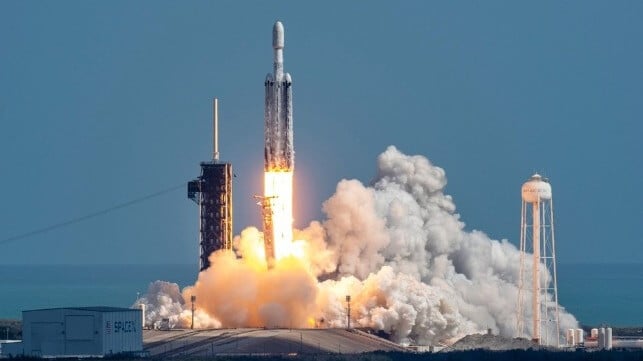
The second satellite went up without issue aboard an Atlas V rocket in November 2025, and is slated to serve the EMEA region once it comes fully online. The third and most-anticipated satellite, Viasat-3 F3, launched on a SpaceX Falcon Heavy rocket on Wednesday. Following a dramatic flight up and out of the atmosphere, the six-tonne telecom relay was delivered successfully to a geosynchronous orbit.
Using Viasat-3, combined with a purpose-built terminal that works with the new constellation, Inmarsat expects to add much more capacity to its bonded network. The terminal is capable of 250 mbps download speeds - enough bandwidth to provide full redundant backup for a high speed LEO service. The F3 satellite will put that coverage over the busy shipping lanes of the Pacific.
"As ViaSat-3 capacity becomes available, we’re taking another big step forward for our customers and partners by bringing more bandwidth, better flexibility, and a forward-thinking upgrade path to ensure connected confidence for the future," said Ben Palmer, president of Viasat Commercial, in announcing the addition of Viasat-3 to the lineup last year.
Russia launches new Soyuz-5 rocket from Kazakhstan cosmodrome in first test flight
On Thursday, April 30, at 23:00 local time (Astana), the Baikonur Cosmodrome witnessed the first test launch of the Soyuz-5/Sunkar vehicle. The rocket lifted off from Site 45 as part of flight development tests, according to Kazakhstan’s Ministry of AI and Digital Development.
A new Russian medium-class launch vehicle Soyuz-5, was launched overnight on Friday from the Baikonur Cosmodrome in Kazakhstan as part of its first flight tests, Russia’s state space corporation Roscosmos said.
According to Roscosmos, the Soyuz-5 is equipped with what it described as the world’s most powerful liquid-fuelled rocket engine.
The launch marked the first test flight of the new-generation rocket.
Roscosmos said the first and second stages operated normally and that a payload mock-up was placed on a planned suborbital trajectory before falling into the Pacific Ocean.
The space agency said the new rocket is designed to reduce the cost of launching payloads, double payload capacity to up to 17 tonnes and use environmentally cleaner fuel components.
Baikonur marks new era in spaceflight as first Soyuz-5 rocket is launched in test mission Copyright: Kazakhstan’s Ministry of AI and Digital Development.
In 1961, it became the launch site of the world's first human spaceflight, with Russian cosmonaut Yuri Gagarin lifting off from there in the Vostok 1.
After the collapse of the Soviet Union, Russia continued to operate Baikonur under a lease agreement with Kazakhstan.
In 2004, Kazakhstan and Russia launched the joint Baiterek project, aimed at modernising launch facilities at Baikonur and facilitating a transition to more environmentally friendly rocket systems.
Related
Kazakhstan and Russia continue close cooperation in the space sector. In 2021, the Kazakh parliament extended Russia’s lease of Baikonur until 2050.
The launch of Soyuz-5/Sunkar marks a turning point for Kazakhstan’s space ambitions, positioning the country closer to becoming a new space power.
With the development of the Baiterek launch complex and growing control over modern launch infrastructure at Baikonur, Kazakhstan is moving beyond its historical role as a spaceport operator.


No comments:
Post a Comment