Shipping giant MSC opens new trade route to bypass Hormuz disruption

As tensions choke the Strait of Hormuz, Mediterranean Shipping Company races to keep global trade moving with new route.
Global container shipping giant, Mediterranean Shipping Company (MSC), has announced a new Europe-Red Sea-Middle East express service, linking key European ports with Saudi Arabia and other regional hubs.
The announcement comes as companies across global supply chains respond to surging demand and mounting disruption across Middle Eastern trade routes as a result of the US-Iran conflict.
MSC said its new service will offer faster, more efficient, multimodal alternatives in an increasingly volatile maritime landscape.
Ships sailing from the Baltic sea and across Europe will be directly connected to Jordan’s Aqaba, Saudi Arabia's King Abdullah Port and Jeddah via the Suez Canal.
“All European origins, from NWC-Scan Baltic to West Med Adriatic and East Med Black Sea will be served through MSC’s capillary network of service,” the company said in a statement.
From King Abdullah Port, onward links to other hubs in the Gulf, particularly the United Arab Emirates, will be available through land transport.
The first vessel on this service is scheduled to depart from Antwerp on 10 May.
MSC’s decision to introduce this new route bypasses the need to sail through the Strait of Hormuz, which has been effectively restricted due to Iranian measures and heightened military tensions involving the United States.
Situated between the Persian Gulf and the Gulf of Oman, this critical maritime corridor has become a major sticking point in negotiations between Tehran and Washington as they seek a resolution to the conflict.
Trump Announces Plan to "Guide" Ships Out of Strait of Hormuz
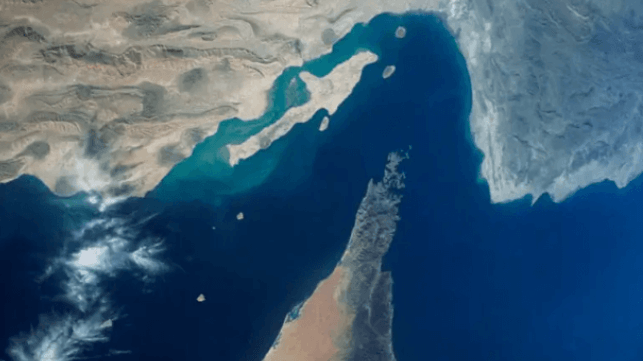
On Sunday, President Donald Trump announced a new effort to help guide foreign-flag ships out of the Arabian Gulf, where hundreds of vessels are trapped by the ongoing Iranian blockade. The new American effort, "Project Freedom," will provide a degree of assistance to other nations' merchant ships; it does not reportedly include convoy escorts, but it will provide masters with information on safe routes and the locations of naval mines.
"We have told these countries that we will guide their ships safely out of these restricted waterways," Trump wrote in a statement. "We will use best efforts to get their ships and crews safely out of the strait. . . . If, in any way, this humanitarian process is interfered with, that interference will, unfortunately, have to be dealt with forcefully."
The operation is set to begin Monday morning. In an update to shipping, Central Command's Joint Maritime Information Center said that the U.S. has set up an "enhanced security area" for vessel transits to the south of the Traffic Separation Scheme, within the Omani sector of the strait.
Iran swiftly rejected the plan. In a statement, Ebrahim Azizi, head of Iran’s parliament national security committee, confirmed that the strait remains closed. "Any American interference in the new maritime regime of the Strait of Hormuz will be considered a violation of the ceasefire," said Azizi. "The Strait of Hormuz and the Persian Gulf would not be managed by Trump's delusional posts!"
The Wall Street Journal reports that the newly-announced "Project Freedom" will not send U.S. Navy sailors into harm's way: It is an operational framework for guiding and insuring shipping, without (as of yet) any plans to provide warship escorts in the near term.
Control of the Strait of Hormuz is the biggest leverage that Tehran has over the U.S. in ongoing negotiations, and the Islamic Revolutionary Guard Corps (IRGC) claims to be getting revenue from a newly-created "tollbooth" permission system for safe passage. If successful, and if continued at scale, a tolling system would provide Iran with a much-needed new source of income - one it has emphasized that it is keen to keep. Iran is not expected to cede control of the waterway without significant incentives, either in the form of a negotiated agreement or an expanded military operation.
For shipowners, it is not clear what immediate protection might be available under "Project Freedom" in the event of an Iranian attack. U.S. Central Command said in a statement that the effort would be resourced with "guided-missile destroyers, over 100 land and sea-based aircraft, multi-domain unmanned platforms, and 15,000 service members."
Iranian opposition may already be taking shape in the form of renewed attacks. At about 1940 hours UTC, after the announcement of Project Freedom, a tanker reported that it had been hit by unknown projectiles at a position on the south side of the waterway - the general area of the declared security zone. Earlier Sunday, a bulker on the Iranian side of the waterway reversed course after coming under attack by small craft, a hallmark of IRGC operations.
Bulker Attacked by Small Craft in the Strait of Hormuz
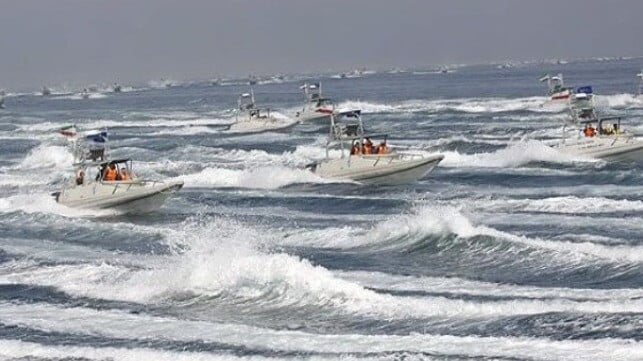
Both Iran and the U.S. Navy are taking steps to enforce their respective blockades in the Strait of Hormuz. On Sunday, a foreign-flagged bulker reported that it was attacked while headed northbound into the strait, just off the coast of Sirik, Iran. Consultancy Vanguard Tech reports that multiple small craft approached the ship at about 1130 hours UTC; all crew were reported safe, and no environmental impact was reported.
The vessel has been identified as the Minoan Falcon, a Greek-owned bulker of about 90,000 dwt. AIS data shows that at the time of the interdiction, the ship entered just inside of Iran's 12-mile territorial sea boundary, indicating either a diversion or an intent to use the tightly-controlled route on Iran's side of the waterway. AIS data shows that the ship reversed course; however, she appears to have disabled its transponder as of 1600 hours local time. Her last reported destination was Bandar Imam Khomeini, Iran, a port opposite Umm Qasr at the far northern end of the Arabian Gulf.
Relatedly, ships at anchor at Ras al Khaimah (off the northeastern shores of the UAE) have reported a new Channel 16 navigational advisory from the Islamic Revolutionary Guard Corps. Radio call harassment from the IRGC is commonplace in the waterway, but this specific item is new: the IRGC has reportedly ordered all of the vessels at anchor at Ras al Khaimah and Mina Saqr to relocate to Dubai immediately, or face consequences that would be "their responsibility" if they do not comply.
The U.S. continues its own enforcement effort to corral Iranian tanker traffic inside the Gulf. As of Sunday, U.S. Central Command reports that it has turned around 49 vessels bound to or from Iran, and says that it remains committed to "total enforcement."
The majority of the intercepted vessels have not been outbound, laden tankers. TankerTrackers.com has identified 25 tankers that departed Iran in laden condition during the month of April, including the two-week period before the blockade began. Seven were redirected back to Iran, two were seized in the Indian Ocean, and most of the rest have arrived at their commercial destinations.
No comments:
Post a Comment