It’s possible that I shall make an ass of myself. But in that case one can always get out of it with a little dialectic. I have, of course, so worded my proposition as to be right either way (K.Marx, Letter to F.Engels on the Indian Mutiny)
Canada announces new nuclear strategy and microreactor initiative
Minister of Energy and Natural Resources Tim Hodgson has announced the government's intention to release a "transformative" Nuclear Energy Strategy for Canada before the end of the year - and will also invest millions of dollars to assess the potential of a Canadian-controlled microreactor that could provide heat and electricity to remote and northern defence-related facilities and operations.
(Image: Canadian Nuclear Association)
Hodgson made the announcement at the Canadian Nuclear Association Conference, which taking place in Ottawa from 28-30 April.
Citing the endorsement by 38 countries of the goal of at least tripling global nuclear capacity by 2050, Hodgson said this was a time of opportunity for Canada to grow its nuclear industry to achieve energy affordability and security at home while seizing the global opportunity of an industry that is expected to grow by up to CAD200 billion (USD146 billion) per year by 2030.
The strategy, which is being developed by Natural Resources Canada (NRCan), will build on four pillars: Enabling New Builds Across Canada; Being a Global Supplier and Exporter of Choice; Expanding Uranium Production and Nuclear Fuel Opportunities; and Developing New Canadian Nuclear Innovations (including fission and fusion).
The first pillar - enabling new nuclear builds - focuses on "building big at home in both small- and large-scale nuclear", Hodgson said. "To do this, we must derisk nuclear investments, facilitate private and public financing, advance Indigenous partnership and prioritise projects that make economic and strategic sense."
Under the second pillar - positioning Canada as a global supplier and exporter - the minister said Canada was "assertively pursuing a nuclear energy trade strategy that will target priority markets and support Canadian players at all levels of the supply chain as they look abroad", leveraging "all arms of government, including the Trade Commissioner Service and Export Development Canada, to tailor our export goals to key markets with the highest chance for success".
The third pillar will see Canada "make the most" of its uranium resources domestically, "in order to reliably meet the needs of allies’ nuclear fleet expansion with Canadian uranium".
The fourth pillar will focus on next-generation innovation, "whether for power - such as SMRs, microreactors - or other areas, like fusion", Hodgson said.
"We are focused on nuclear energy security and innovation from coast to coast to coast. But perhaps there is nowhere it is needed more than in our North, where bills are highest, energy security is most fragile and sovereignty is increasingly important," Hodgson said. In recognition of this, Canada's Defence Industrial Strategy prioritises the North, including for new, dual-use infrastructure, he said.
"Of course, that infrastructure needs power. Ideally, power that is clean, reliable and Canadian. That is why, today, I am announcing a new joint feasibility programme with the Department of National Defence and Atomic Energy of Canada Limited that will assess the potential of Canadian-controlled microreactor technology in the North.
"The Department of National Defence is investing over CAD40 million this fiscal year to examine whether next-generation microreactors can safely and reliably provide heat and electricity for remote and northern DND and Canadian Armed Forces facilities. Importantly, while this work supports defence and sovereignty in remote regions, it also has broader civilian potential and could support remote communities and other industrial sites looking for clean, dependable power."
Recognising the underpinning role of science, research, technology and innovation for these plans, the minister noted the federal government's commitment of CAD2.2 billion over 10 years in capital investments at the Chalk River Laboratories, Canada's national nuclear labs, including the new Advanced Materials Research Centre and other critical infrastructure across the campus.
"Nuclear energy is central to our future, whether you are talking about our economy, our security, our climate or our role in the world," he said. "The scale of the global opportunity is massive, but it is not one by which we should be intimidated."
Today, 17 CANDU reactors in Ontario and New Brunswick generate about 13% of Canada's electricity and the nuclear energy sector adds CAD22 billion annually to the Canadian economy, according to NRCan. The nation produced about 24% of total global uranium output in 2024. About 90% of its uranium production is exported to fuel nuclear power plants.
Darlington SMR project's foundation module milestone
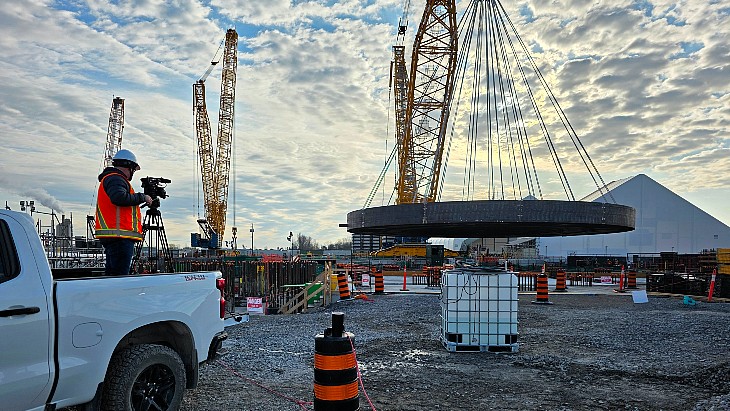
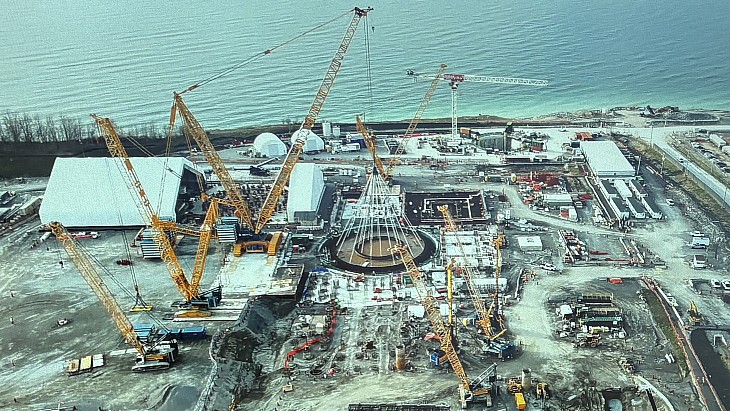
The giant Basemat module, which will serve as the foundation of the reactor building for the first small modular reactor to be built in a G7 country, has been set into place 35 metres below ground in the excavated reactor building shaft.
(Image: OPG)
Weighing in at close to 953 tonnes (2.1 million pounds) - more than the weight of three Airbus A380 aircraft - and with a diameter of 37 metres, the Basemat is the foundation for the integrated reactor building and containment structure. It was fabricated, welded, and put together in one piece before being lifted into place by one of the world's largest crawler cranes. This is the first time in Canada that a foundation for a reactor building has been assembled modularly, "putting the 'M' in SMR", according to Ontario Power Generation (OPG).
For conventional large-scale nuclear power plants, the pouring of the first concrete for the reactor's basemat is usually taken as marking the point at which a project becomes a nuclear power unit under construction.
The Basemat module features components made of Diaphragm Plate Steel Composite, an innovative and ground-breaking modular steel-concrete material, which were produced by OPG and its partners, with the help of skilled trades from across Ontario.
The Province of Ontario approved OPG to begin construction of the first of four GE Hitachi BWRX-300 small modular reactors (SMRs) planned at the Darlington New Nuclear Project site in May 2025, weeks after the Canadian Nuclear Safety Commission (CNSC) issued a construction licence. Early site preparation works began in the autumn of 2022 and were completed in early 2024, clearing the way for main preparation works to begin. The company recently submitted its application to the CNSC for a licence to operate the plant: it plans to connect the first unit to the grid by the end of 2030.
The basemat was lifted into place in a precision operation (Image: OPG)
Building the chain
Alongside the basemat lift, the Ontario government announced that more than 100 Canadian companies have now signed on to the supply chain to support SMR builds, with the recent addition of 16 new Ontario-based companies and six companies from Quebec and Alberta. Recently awarded contracts include Walters Group, which has been awarded a CAD44.5 million (USD32.8 million) contract for structural steel; Marmon Industrial Water, with a CAD17.8 million contract for a condensate purification package; Tractel, with a CAD9.9 million contract for the reactor building weather enclosure; and Hooper Welding, awarded a CAD8.8 million contract for sampling and collection tanks.
"Ontario just executed with great precision the first foundation of a new nuclear reactor in Ontario in over 30 years," Ontario Minister of Energy and Mines Stephen Lecce said. "This is a major achievement as the world turns to Ontario to refurbish and build large scale nuclear on-time and on-budget."
The SMR supply chain is "infusing" more than CAD500 million into Ontario's economy, Lecce added: "Our government is deeply committed to building more in Canada, which is why we are proud to invest at least 80 per cent of every dollar in the Canadian supply chain."
"With the foundation of the first small modular reactor at the Darlington New Nuclear Project in place, we are now able to begin building up, with the project team now advancing construction on the reactor building's structure, internal systems and components," said Nicolle Butcher, OPG President and CEO. "This was a milestone months in the making, requiring significant attention to detail and safety, as well as the hard work of dedicated trades and project partners from across Ontario."
Belgian government in talks to take over nuclear power plants
The Belgian government has begun talks to take direct ownership of the country's seven nuclear power reactors - with all decommissioning and dismantling works suspended "to ensure that all options remain available to the Belgian State".
The Doel plant (Image: Tractebel-Engie)
Engie, the French parent of Belgian power company Electrabel, and the Belgian government said their Letter of Intent covers a proposed transaction which "encompasses the full scope of the nuclear activities currently owned and operated by Engie and Electrabel and their affiliates, including the complete nuclear fleet of seven reactors, the associated personnel, all nuclear subsidiaries, as well as all associated assets and liabilities, including decommissioning and dismantling obligations".
The joint statement said: "This initiative reflects the Belgian Government's strategic decision to assume direct ownership of the country's nuclear assets, in line with its ambition to extend the operation of existing nuclear reactors and to develop new nuclear capacity in Belgium. By doing so, the Belgian Government is taking responsibility for Belgium's long-term energy future, with the objective of building a financially and economically viable activity that supports security of supply, climate objectives, industrial resilience and socio-economic prosperity."
The two sides "will negotiate in good faith with the objective of concluding heads of terms by 1 October 2026". The Letter of Intent does not constitute a binding commitment - the completion "remains subject to, among other things, the negotiation and execution of definitive agreements and the required third-party and regulatory approvals".
Background
Belgium's federal law of 31 January 2003 required the phase-out of all seven nuclear power reactors in the country. Under that policy, Doel 1 and 2 were originally set to be taken out of service on their 40th anniversaries, in 2015. However, the law was amended in 2013 and 2015 to provide for Doel 1 and 2 to remain operational for an additional 10 years. Doel 1 was retired in February 2025. Doel 3 was closed in September 2022 and Tihange 2 at the end of January 2023. Tihange 1 was disconnected from the grid on 30 September 2025. The fifth closed unit, Doel 2 in the Flanders region, was taken offline for the final time after 50 years of operation and disconnected from the grid in December.
Belgium's last two operating reactors - Doel 4 and Tihange 3 - had also been scheduled to close at the end of 2025. However, following the start of the Russia-Ukraine conflict in February 2022 the government and Electrabel began negotiating the feasibility and terms for the operation of the reactors for a further ten years, to 2035. A final agreement was reached with a balanced risk allocation - equal ownership of Doel 3 and Tihange 4 between the Belgian state and Engie, and the transfer of nuclear waste liabilities from Engie to the Belgian state for EUR15 billion (USD16 billion) payable in two instalments.
For the continued operation of Doel 4 and Tihange 3, Electrabel had to submit an extensive LTO (Long Term Operation) file with safety studies and an action plan to further increase the safety of the youngest reactors. This file was submitted in December 2024 for both units. Tihange 3 was taken offline on 5 April 2025 for a so-called 'LTO overhaul' - an extensive inspection and maintenance period with a view to safe long-term operation of the reactor. After a thorough analysis, regulator FANC and its technical subsidiary Bel V determined that the reactor meets the conditions for a safe restart and the 1020 MWe PWR resumed operation on 10 July. Doel 4 was taken offline on 30 June for its LTO overhaul and was restarted on 8 October.
In February 2025, Belgium's new coalition government announced plans to operate the two units for a further 10 years beyond 2035. In May 2025, Belgium's federal parliament voted by a large majority to repeal the 2003 law which set out a phase-out of nuclear power and ban on the construction of new nuclear generating capacity.
Tangerine peel's radiation health benefits researched
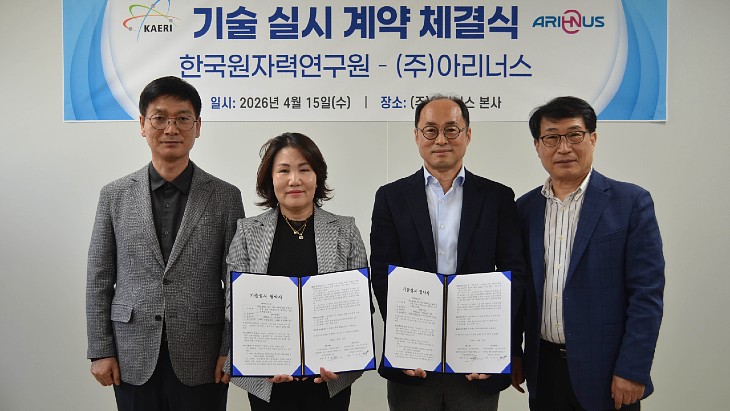
The Korea Atomic Energy Research Institute has signed a technology transfer agreement with Arinus Co for a technology that protects cells from radiation using an antioxidant ingredient contained in citrus fruit peel.
(Image: Andrii/Adobe Stock)
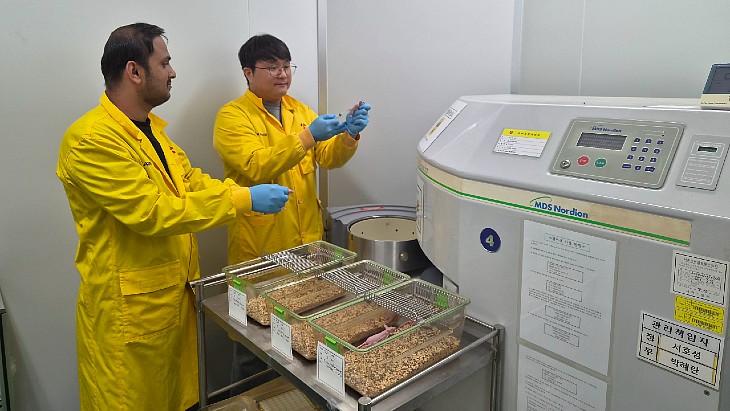
Sang-Hyun Park's team at the institute's Advanced Radiation Research Institute identified the efficacy of the antioxidant - hesperidin - in restoring liver, heart and kidney tissues damaged by radiation.
Korea Atomic Energy Research Institute (KAERI) said that the research team had found that "when hesperidin was administered for seven days to mice with reduced liver enzyme function due to radiation exposure, enzyme function recovered by more than 90%. In addition, they demonstrated both preventive and therapeutic effects by proving that normal function was restored even when hesperidin was prescribed in advance of radiation irradiation".
(Image: KAERI)
The technology transfer also includes the means of "extracting high-purity hesperidin from tangerine peels using radiation fusion technology ... previously, high-purity extraction was difficult due to pesticide residues remaining on the tangerine peels, but the research team developed a new extraction technique that uses radiation to destroy pesticide residues while maximising hesperidin content".
(Image: KAERI)
Jeong Byeong-yeop, Director of the Advanced Radiation Research Institute, stated: "The institute's world-class technological capabilities will serve as a win-win model leading to the product competitiveness of small and medium-sized enterprises."
The technology transfer was carried out with the support of the Ministry of Science. Arinus Co is a specialised manufacturer of health-focused products and plans to use the technology in health supplements and products for patients undergoing radiation therapy.
Fuel loading begins at Changjiang 3
The initial loading of fuel assemblies into the core of unit 3 at the Changjiang nuclear power plant is under way. It is the first of two Hualong One (HPR1000) reactors under construction as the second phase of the site in China's Hainan province.
(Image: CNNC)
The first of 177 nuclear fuel assemblies was loaded into the reactor on 30 April, China National Nuclear Corporation (CNNC) announced.
"This marks the official entry of unit 3 of the Hainan Changjiang Nuclear Power Plant into the nuclear commissioning phase, laying a solid foundation for the subsequent grid connection and power generation target, and taking a crucial step forward," the company said. "After fuel loading is completed, the project construction team will continue to uphold the core concept of 'pursuing excellence' and strictly follow technical specifications and quality standards to advance the subsequent commissioning work, ensuring that the unit is put into operation with high quality as planned."
(Image: CNNC)
First concrete was poured for the base slab of unit 3's nuclear island in March 2021, with that of unit 4 being poured in the December of that year.
Cold hydrostatic testing - carried out to confirm whether components and systems important to safety are properly installed and ready to operate in a cold condition - were completed in April last year. These were followed by hot functional tests, which involved increasing the temperature of the reactor coolant system and carrying out comprehensive tests to ensure that coolant circuits and safety systems are operating as they should.
Changjiang Phase II - units 3 and 4 - represents a total estimated investment of CNY40 billion (USD6.4 billion), according to China Huaneng, which holds a 51% share in the project, with CNNC holding the remaining 49%. The construction period is expected to be 60 months. Both Hualong One units are scheduled to be fully operational in early 2027.
The Changjiang nuclear site is already home to two operating CNP-600 pressurised water reactors (PWRs) - Changjiang 1 and 2 - which entered commercial operation in 2015 and 2016, respectively. In 2021, CNNC also began construction of a demonstration ACP100 small modular reactor at the site. The multi-purpose 125 MWe PWR - also referred to as the Linglong One - is designed for electricity production, heating, steam production or seawater desalination.
Second Indian fuel cycle complex gets operating licence
The Atomic Energy Regulatory Board has issued an operating licence for the NFC-Kota fuel plant at Rawatbhata in Rajasthan.
NFC-Kota (Image: DAE)
The Nuclear Fuel Complex (NFC) is an industrial unit of India's Department of Atomic Energy (DAE) which manufactures fuel for India's pressurised heavy water reactors in its safeguarded facilities at Hyderabad. According to World Nuclear Association information, the Hyderabad facilities produce 1500 tonnes of pressurised heavy water reactor (PHWR) fuel per year, as well as about 25 tonnes of fuel per year for India's two small boiling water reactors at Tarapur.
NFC-Kota is a second PHWR fuel plant which is being set up to meet the needs of India's planned fleet of indigenously designed 700 MWe PHWRs, three of which - Rajasthan Atomic Power Project unit 7 and Kakrapar units 3 and 4 - are already in operation.
The Kota facility handles only natural uranium and is categorised as a low-hazard facility, according to the Atomic Energy Regulatory Board (AERB).
NFC-Kota submitted its application for an operating licence for the facility to the AERB on 17 March after the completion of hot commissioning activities, proposing the production of 500 tonnes per year of finished UO2 (uranium dioxide) fuel bundles for use in 700 MWe PHWRs.
"AERB conducted safety review and assessment of NFC-Kota's application for Licence for operation following its established consenting process to check completeness of the data/information required and compliance to the corresponding operating license requirements specified in applicable regulatory safety documents … the proposed activity of Operation can be carried out in compliance [with] this licence without undue risk to workers, the public and the environment," the regulator said.
The Department of Atomic Energy said operational clearance for NFC-Kota was a milestone which "marks a decisive step in strengthening the nation’s nuclear fuel cycle", meaning NFC is now "fully geared" to supply nuclear fuel for Nuclear Power Corporation of India Ltd's 700 MWe indigenous PHWRs. "NFC has been consistently delivering nuclear fuel and core structural components for all operating PHWRs since inception. Aligned with India’s Nuclear Energy Mission, NFC-Kota stands as a testament to indigenous capability, resilience, and the nation’s commitment to reliable, clean, and self-reliant energy for a ViksitBharat," it said.
Viksit Bharat is the strategy launched by the government in 2023 to make India a developed nation by 2047.
The operating licence is valid until 30 April 2031.
TerraPower starts building first utility-scale advanced nuclear power plant in the US
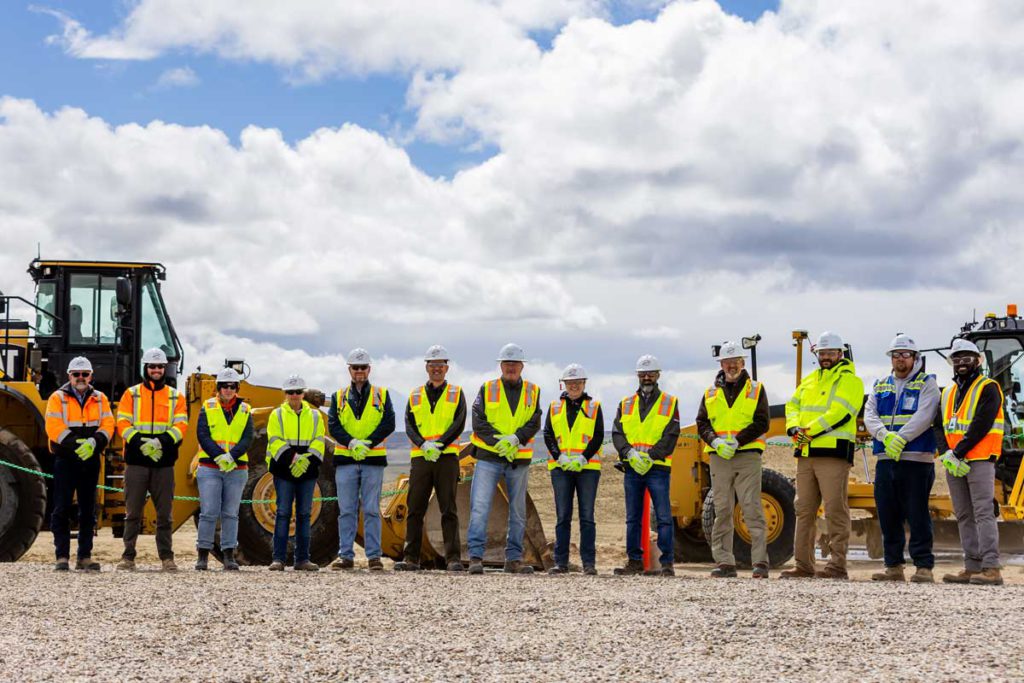
Bill Gates-backed TerraPower has started construction on its flagship Natrium plant in Kemmerer, Wyoming, which it says is on track to be the first utility-scale advanced nuclear power plant in the United States.
The news follows the issuance of a construction permit by the US Nuclear Regulatory Commission (NRC), and is the culmination of years of innovation, engineering and disciplined site preparation, the company said.
The plant features a 345-megawatt (MW) sodium-cooled fast reactor with an integrated molten salt-based energy storage system. According to TerraPower, the storage technology — known as Natrium — can boost energy output to 500 MW of power when needed, equivalent to the amount of energy needed to power around 400,000 homes.
The energy storage capability is designed to keep base output steady, ensuring constant reliability, and can quickly ramp up when demand peaks, TerraPower said, noting that Natrium is the only advanced reactor design with this unique feature.
“This is the moment our industry has been working toward for a generation. We’re not just breaking new ground on a first-of-a-kind nuclear plant in Wyoming; we’re building the next generation of America’s energy infrastructure,” TerraPower CEO Chris Levesque said in an April 23 news release.
“The Natrium plant will deliver reliable and dispatchable power to the grid, and Kemmerer Unit 1 serves as a commercial blueprint to mobilize a fleet of Natrium plants across the country and around the world.”
TerraPower is mobilizing a workforce of roughly 1,600 workers to begin plant construction, bringing the first Natrium reactor and energy storage system one step closer to fruition.
“The start of construction on TerraPower’s Natrium plant in Kemmerer marks a major milestone not just for Wyoming, but for the future of American energy,” said Wyoming Governor Mark Gordon.
“Wyoming has long powered this country, and today we are leading again, this time in next-generation nuclear technology. This project reflects our commitment to reliable energy, good-paying jobs, and a future built on innovation and Wyoming values.”
The first Natrium plant is being developed through the US Department of Energy’s Advanced Reactor Demonstration Program (ARDP), a public-private partnership. When complete, the project will be the first utility-scale advanced nuclear power plant in the country and Wyoming’s first-ever commercial nuclear generating station.
The project has been under active development since TerraPower broke ground on the greenfield site in June 2024 and began construction on non-nuclear support facilities.
The Bellevue, Washington-based TerraPower is rapidly commercializing the Natrium technology, which includes an agreement with Meta for up to eight Natrium plants by 2035.
_67350.jpg)
_34792_80490.jpg)

_23464.jpg)
_2a5b871f.jpg)
_98025.jpg)

No comments:
Post a Comment