The Boring Trump-Xi Summit: Boring Is Good
Critics of the May 2026 summit between President Trump and Xi Jinping, president of the People’s Republic of China (PRC), widely condemned the outcome as being long on pomp and ceremony but short on meaningful substantive results. They noted that most of the agreements reached, especially on trade and other economic issues, were either preliminary or relatively minor. There was a virtual consensus among the opinion-shaping elites that Trump had secured no major concessions on either his commercial or his security objectives.
In other words, the outcome of the summit was rather bland and boring. That criticism may be true, but in international affairs boring is usually good. It is definitely preferable to the “excitement” of confrontation and crisis.
The one issue that did receive considerable attention from the U.S. news media and foreign policy community was Xi’s admonition to Trump not to let Washington’s support for Taiwan reach the point of causing serious disruption in the bilateral relationship between the United States and the PRC. That warning, both establishment and more hawkish voices contended, was ominous and confirmed the PRC’s ambition to be Washington’s principal geostrategic rival.
The Wall Street Journal’s editorial board and some of the Journal’s favorite China-bashing columnists did their best to hype the image of Xi attempting to intimidate Trump regarding Taiwan. Those analysts and other hawks especially criticized the U.S. president for his subsequent comment warning Taiwanese leaders not to pursue formal independence for the island.
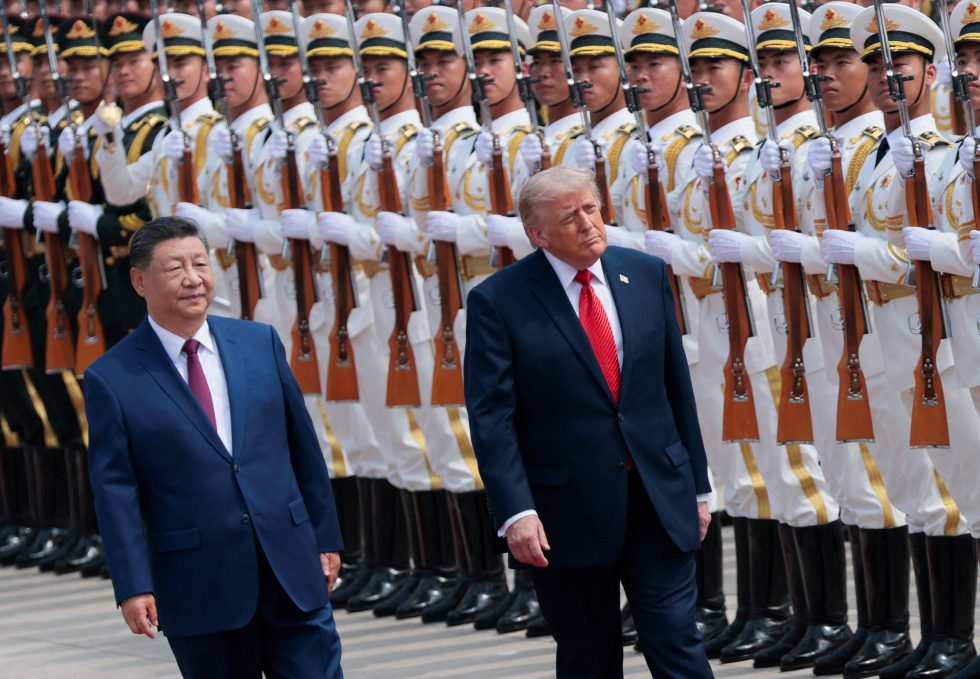
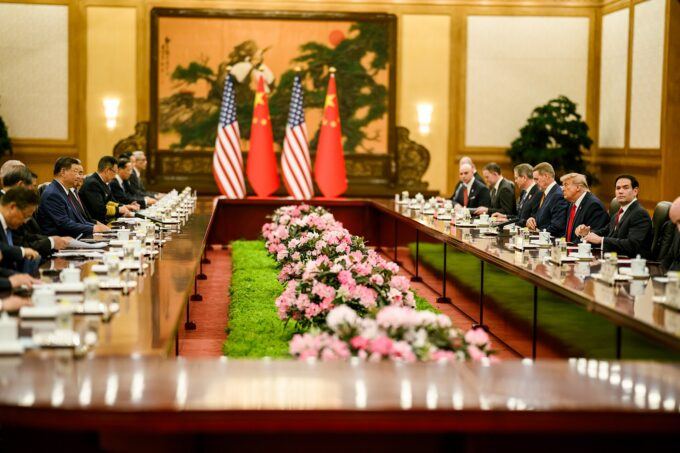
U.S. President Donald Trump inspects an honor guard during a welcome ceremony with Chinese President Xi Jinping at the Great Hall of the People in Beijing, China, May 14, 2026. REUTERS/Evan Vucci
However, in terms of substance the brouhaha about Xi’s warning and Trump’s expression of caution was much ado about nothing. For decades, PRC officials have warned their Taiwanese counterparts against pushing the envelope on independence. Whenever Taipei has become too assertive on that issue in Beijing’s opinion, the PRC has made emphatic countermoves. That trend has become especially apparent over the past ten years when two consecutive Taiwanese presidents (Tsai Ing-wen and Lai ching-te) have been members of the officially pro-independence Democratic Progressive Party (DPP).
Beijing has displayed its displeasure in two ways. PRC officials cajole and bribe the handful of small, weak nations in the international community that still recognize the Republic of China (Taiwan’s official name) as China’s legitimate government to switch their recognition to the PRC. Beijing has been increasingly successful in doing so. During Tsai’s administration, 10 countries severed relations with Taipei.
That outcome is primarily a blow to Taiwan’s pride and the status of its diplomatic corps. Because of the island’s economic importance (especially in the field of advanced semiconductors) most of the world’s nations are eager to have extensive commercial relations with Taipei, despite the official diplomatic blackout.
Beijing’s other countermeasure, deploying a growing presence of air and naval forces near Taiwan, is far more substantive and worrisome to the island’s leaders than the PRC’s actions in the arena of diplomacy. The military component has been intensifying over the past decade.
The DPP has long been on record as advocating Taiwan’s formal independence, but the reality is that independence remains a dreamy aspiration, not a real strategy. Despite his sometimes-militant rhetoric on independence, even the outspoken Lai is cautious about pushing Beijing too far.
Xi’s statement to Trump regarding Taiwan likewise does not appear to signal a substantial, worrisome change in the PRC’s approach. Indeed, during the first summit meeting between the two leaders in December 2025, Xi apparently assured his counterpart that Beijing would make no change in policy on Taiwan that would upset the status quo during Trump’s term in the White House.
The outcome of the latest summit indicates that neither side wishes to create a confrontation over Taiwan. To the extent that there are troubling tensions between the United States and the PRC, they have far more to do with the war in Iran than with the Taiwan issue. Beijing is intent on undermining Washington’s continuing pretensions about being the global hegemon. In addition, because the PRC is a major oil and natural gas consumer, Chinese authorities are not happy about witnessing a sharp increase in global energy prices and the problems associated with constrained energy supplies. If there was a disappointing outcome from the Xi-Trump summit, especially from the U.S. standpoint, it was the failure to make meaningful progress to narrow the policy differences on that set of issues.
However, for both economic and geostrategic reasons, China has an incentive to continue undermining Washington’s goal of isolating and weakening Iran. The longer the United States remains bogged down in the ongoing war, the narrower the U.S. economic and military edge over the PRC becomes. Several observers have noted that from a symbolic standpoint, the summit was a solid success for Xi. China established itself as a fully equal great power to the United States.
Such an observation is quite accurate. However, the summit merely confirmed a long-developing trend. In terms of economic, diplomatic, and strategic influence, the United States and the PRC have occupied a higher level than any other great power for years already. The foolish obsession of the U.S. foreign policy and media establishments with Russia and the alleged threat that it poses has unfortunately obscured the extent of China’s achievement for far too many observers.
China, not Russia, is America’s true peer competitor. Consequently, a boring summit between the leaders of those two leading peer competitors is something that should be welcomed, not scorned. Despite the crude attempt among opinion shapers in the United States to hype the Taiwan issue as a source of confrontation between Beijing and Washington, Xi and Trump have apparently succeeded in holding a relatively mundane summit. We should all be pleased with such an outcome.
Beyond Scorecards: A Ping‑Pong Lesson for China‑US relations
While American media commentators are busy evaluating the latest China-US summit— calculating which side “won” — a video that went viral on Chinese social media showcased something far simpler: A US media host playing ping-pong with a middle-aged Beijing local on an outdoor table in Chaoyang Park, a laid‑back public space beloved by locals for morning exercise and leisure.
Dressed in a full suit, the host tried to smash powerful forehands. The Beijinger, wearing a white T-shirt, remained unfazed and calmly returned every shot. What stood out most was how he deliberately “fed” the ball to the spots where the host could return it comfortably. Chinese netizens quipped: “This isn’t athletic skill — it’s understated Chinese interpersonal wisdom.”
This scene exemplifies classic Chinese-style goodwill – no grand speeches, just a quiet effort to make the other person feel good. It’s not about crushing one’s opponent; it’s about ensuring everyone walks away comfortable and smiling.
Traditional Chinese philosophy prioritizes harmony over outright victory; outcompeting and defeating others is never the ultimate goal. Instead, genuine connection means ensuring that every participant leaves an interaction relaxed, respected and satisfied. To me, this brief park rally encapsulates what healthy China‑US relations could genuinely resemble: respectful engagement built on mutual accommodation rather than relentless competition. For decades, ping‑pong famously bridged early China‑US exchanges, and this casual modern match revives that gentle spirit of people‑to‑people diplomacy.
The choice of venue at the Hall of Prayer for Good Harvests in Temple of Heaven carried a similar quiet message. The hall stands without a single nail. Twenty-eight massive pillars are held together purely by intricate mortise-and-tenon joints. The wooden pieces are engineered with just enough flexibility to absorb seismic shocks – rendering the entire structure surprisingly resilient. Many Chinese view it as a living metaphor: too much rigidity invites breakage, while a little give allows things to endure. This architectural lesson continues to shape everyday thinking.
Regrettably, years of political friction and sweeping tariff disputes have overshadowed this pragmatic outlook, imposing tangible hardships on ordinary citizens in both nations. During the tariff wars, my style-savvy friends expressed frustration over surging prices for cosmetics and luxury items, while US consumers lamented the eroding affordability of Made-in China goods. Small cross‑border enterprises have borne the brunt, with stable supply chains disrupted and long‑established livelihoods threatened. The quiet economic benefits once enjoyed by ordinary households on both sides have steadily faded.
In the end, country-to-country relations always come down to ordinary people’s lives. They are not just grand narratives in textbooks; they are the price tags on imported goods that families see at checkout, the order sheets in the hands of small business owners, the choice parents make when buying toys for their children, and the everyday costs of putting food on the table.
Through my reporting, I’ve spoken with former US officials and friendly scholars, many of whom share a similar view: The China-US relationship could have been much better. They argue that China and the US actually face shared threats. A mother in Shanghai and a mother in New York may worry about the same issues — rising sea levels that could destroy homes or economic crises that could rob their children of a bright future. They asked if the US-sought confrontational path in recent years has proven to be a dead end. Why continue down a road that only leads to frustration and negative outcomes? Why not choose a different path?
Looking ahead, many US media outlets may likely continue to frame China through the familiar old lens. However, even they cannot deny one basic truth: when relations become predictable, companies feel confident investing in one another, US exporters sell more, and American families pay lower prices. This isn’t idealism — it’s supposed to be the very principle Washington constantly brands as “America First.”
At the end of the day, ordinary people in both China and America want the same simple things: a roof over their heads, warm meals on the table, and a brighter future for their children. The human similarities and that sense of closeness between Chinese and American families run far deeper than the political differences that usually dominate the headlines.
That man in Chaoyang Park could have smashed every ball. Instead, he chose to feed easy shots.
Perhaps that is the simplest yet most profound wisdom one can draw from interactions — whether between people or between nations: sometimes the smartest move isn’t to seek a knockout win, but to ensure both sides walk off the court smiling, still wanting to play another round.
The Beijing Summit Rewrites Its Rules of Superpower Economic Engagement
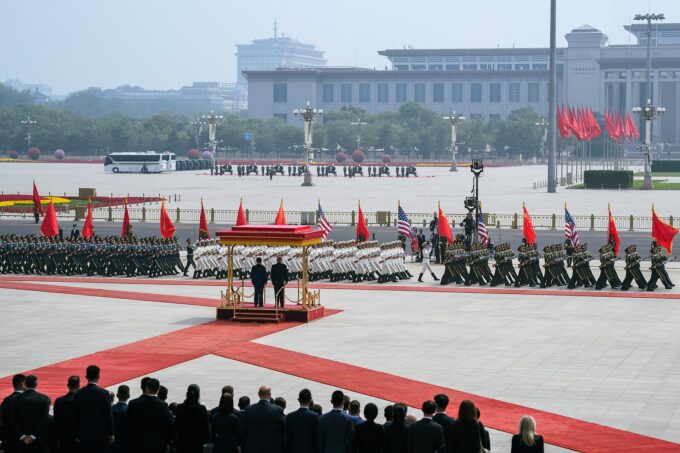
Photograph Source: The White House – Public Domain
The conclusion of the high-stakes Beijing summit between U.S. President Donald Trump and Chinese President Xi Jinping on May 14 marked a critical pivot in the structural architecture of the international system.
This meeting matters profoundly because it introduces an unexpected floor to a relationship that many analysts predicted would enter a terminal downward spiral under a second Trump administration. Rather than a standard diplomatic gridlock, the summit produced a relatively coherent framework for what Beijing is calling constructive strategic stability.
For global policymakers and volatile international markets, the event signals a systemic pause in aggressive economic fracturing, proving that both capitals are currently prioritizing domestic economic insulation over unmanageable geopolitical escalation.
According to the dominant media narrative prior to the summit, Washington and Beijing were marching deterministically toward total economic separation and inevitable military conflict. This view has been proven to be overstated. The Beijing summitrevealed a highly calculated, deeply pragmatic effort by both sides—predominantly by China—to engineer a general reconciliation on virtually all structural matters, with the deliberate exception of Taiwan.
By systematically decoupling trade, technology, and global governance from the combustible issue of cross-strait sovereignty, Beijing has successfully offered the Trump administration a transactional, high-yield partnership. This strategy appeals directly to Washington’s preference for bilateral deal-making while preserving China’s core national red lines. Comprehending this shifting dynamic requires an examination of the systematic mechanics of the reconciliation effort through a clear, analytical framework driven by distinct structural pillars.
The groundwork for this diplomatic pivot was laid well before President Trump arrived at the Great Hall of the People. In a highly deliberate pre-summit statement, President Xi explicitly asked whether China and the United States could overcome the historical “Thucydides trap”—by which a rising power challenges the existing hegemonic power—to create a new paradigm of major-country relations.
This was not mere rhetorical fluff. It was a calculated signal to the incoming American delegation that Beijing was ready to rewrite the rules of engagement. This narrative positioning was rapidly converted into institutional action during the post-summit phase. Foreign Minister Wang Yi outlined the mechanical reality of this new paradigm during his post-summit press briefing, emphasizing that constructive strategic stability requires a positive equilibrium where cooperation remains the mainstay.
By framing the relationship around manageable competition rather than systemic hostility, Beijing provided a diplomatic off-ramp for an American administration that is simultaneously managing a widening conflict in the Middle East.
The most tangible evidence of China’s reconciliation push is found in the economic sphere, where Beijing deployed a massive charm offensive to appeal to the commercial interests of the American delegation. Just days prior to the main event, on May 12 and 13, Vice Premier He Lifeng led an intensive diplomatic effort, holding a targeted bilateral consultation in South Korea to resolve preliminary economic friction points directly with U.S. Treasury Secretary Scott Bessent.
Following the summit, the Chinese Ministry of Commerce announced that these parallel tracks yielded highly positive outcomes. Instead of defensive posturing, Beijing took the initiative by sending multiple high-level trade delegations to buy American agricultural goods, renew U.S. beef export approvals, and propose reciprocal tariff reductions on products of mutual concern. The establishment of a new bilateral trade council and an investment council proves that China is seeking to institutionalize this relationship, shifting away from volatile executive decrees and moving toward structured, predictable commercial bargaining.
The most forward-looking aspect of the summit was the mutual consensus to explore a joint AI global governance body combining the structural power of the United States and China. This development reveals a profound shift in how both empires view technological competition. Although Washington maintains strict export curbs on advanced semiconductors, both capitals realize that unregulated, weaponized artificial intelligence presents a risk to domestic governance and global systemic stability. By establishing a bilateral framework to oversee AI safety standards and deployment, Beijing and Washington are creating a duopoly over the primary engine of the modern global economy, effectively locking out secondary states and creating a structured, institutionalized tech-truce.
This shift completely alters the geopolitical scenario for the time being. The immediate threat of a catastrophic, blanket tariff war is being replaced by a system of managed, sector-specific trade negotiations. From a South Asian vantage point, this elite-level bilateral reconciliation looks very different than it does from Washington or Brussels. For developing economies across the Global South, the sudden stabilization between the world’s two largest markets offers a much-needed sigh of relief, lowering the threat of forced fragmentation in trade and technology standards.
However, it also brings a sharp dose of realism. When Washington and Beijing decide to establish exclusive, bilateral bodies to govern frontiers like artificial intelligence, it signals that the broader international community is being sidelined. This is not a return to a rules-based multilateral order, but rather the birth of a cold, transactional condominium where the two superpowers partition global economic governance to suit their own domestic requirements.
The post-summit reality can thus be divided into five precise dimensions.
First, there is one absolute red line, as China made it explicitly clear that Taiwan remains entirely non-negotiable. Although Beijing is willing to compromise on market access, supply chains, and tariffs, any perceived threat to its cross-strait sovereignty will immediately short-circuit the broader reconciliation.
Second, the framework introduces two parallel economic councils, establishing dedicated trade and investment bodies that provide a structural cushion to manage future industrial shocks, effectively protecting corporate supply chains from sudden political flare-ups.
Third, the agreement secures three years of a strategic runway, as the envisioned path for constructive strategic stability is explicitly designed to guide bilateral relations through the intermediate term, aligning perfectly with the domestic political timelines of both leaders.
Fourth, the architecture relies on four institutional pillars of stability, which Foreign Minister Wang Yi articulated as positive stability, healthy competition, manageable differences, and an enduring promise of peace to prevent accidental military friction.
Fifth, the deal proposes a bilateral technological duopoly, utilizing the joint AI governance body to create a powerful mechanism for the world’s two dominant tech empires to dictate global software and security standards, leaving third-party states with little choice but to adapt to their rules.
Policymakers must not mistake this tactical pause for permanent peace. China’s comprehensive effort to reconcile with the United States on trade, artificial intelligence, and regional security is a highly sophisticated exercise in strategic risk management. By giving the Trump administration immediate, quantifiable economic victories, Beijing has bought the time and space it needs to fortify its internal markets and accelerate its domestic innovation loops.
The ultimate warning for Washington is clear: accepting these short-term transactional wins without a cohesive, long-term strategy will allow China to dictate the terms of the global economic architecture for the next decade. Transactional diplomacy can easily manage an immediate crisis, but it cannot replace a rigorous, long-term grand strategy.
This first appeared on FPIF.
Trump Came to Beijing Hat in Hand, Leaves
with a Handshake from Xi
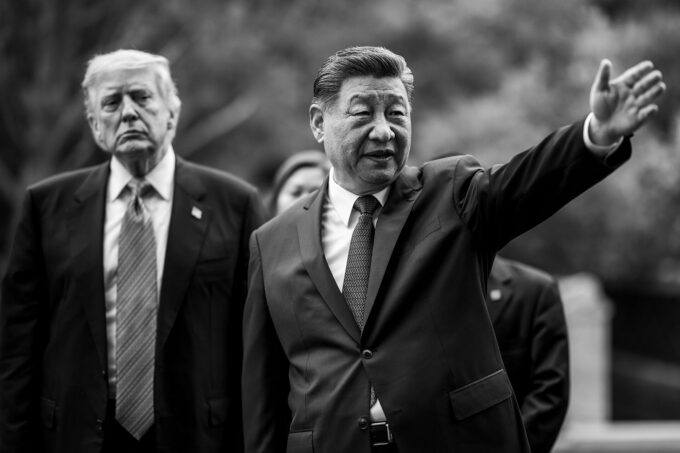
Photograph Source: The White House – Public Domain
The scenes unfolding in Beijing were carefully choreographed, yet politics can never be reduced to mere spectacle. When US President Donald Trump traveled to China for his summit meeting with Xi Jinping, Western media, as it often does, fixated on spectacle: lavish banquets, honor guards, theatrical gestures that were designed to flatter the US president. Yet beneath all this ritual lay another reality, harder and more consequential. The United States did not arrive in Beijing from a position of confidence; it came in a state of vulnerability. Washington arrived burdened by several crises of its own making: a dangerous and illegal confrontation with Iran that Washington had engineered alongside Tel Aviv, global economic instability, deepening diplomatic isolation across much of the Global South, and mounting anxiety over the erosion of US industrial and technological supremacy. Meanwhile, China entered the talks with composure. Beijing did not need dramatic gestures, only to prove that the tide of history has changed.
The summit revealed a truth that many countries in Africa, Asia, and Latin America already understand instinctively: the United States remains militarily dangerous, but it no longer possesses unquestioned political authority. China’s posture at the summit reflected this new global balance. Even establishment Western analysts sensed the shift. The Council on Foreign Relations acknowledged before the meeting that “China will have the upper hand.” For decades, the United States insisted that China remain subordinate to a US-designed world order. In Beijing, however, the reality was reversed. Trump did not arrive to dictate terms; he arrived seeking assistance.
The Iran question exposed this dynamic most clearly. The United States finds itself trapped in a cycle of endless militarism in West Asia. The illegal wars launched over the past quarter century—from Iraq to Syria to the ongoing confrontation with Iran—have weakened the United States strategically while bringing immense suffering to the region. Washington now understands that it cannot stabilise the situation alone. China, because of its economic ties with Iran and its growing diplomatic stature, possesses influence the United States lacks.
Analysts openly described Washington’s dependence. Al Jazeera reported that US officials hoped China would “play a greater role in pushing Iran” toward de-escalation. A Northeastern University analysis noted that observers were watching closely to see “if the US will call on China to help with the ongoing conflict in Iran.” Even Trump’s own summit agenda reflected this dependence, with discussion focusing heavily on the Strait of Hormuz, Iran’s nuclear program, and regional stability. This is the crucial point: the United States, which spent decades proclaiming itself indispensable, now requires Chinese cooperation to manage crises it largely created.
China’s Calmness
China recognised this reality and behaved accordingly. Chinese President Xi Jinping did not posture. He did not issue theatrical threats. He did not engage in the emotional volatility that now characterises much of US political culture. Instead, he projected steadiness.
On Taiwan, Xi was firm without hysteria. According to reports from the summit, he warned that mishandling the issue could lead to “conflicts.” This was not the language of panic; it was the language of strategic clarity. Beijing understands that the greatest danger in world politics today comes not from rising powers demanding respect, but from a declining world power (the United States) that refuses to accept limits. This distinction is profoundly important for the Global South. Many countries across the South have long experience dealing with imperial instability. They know that empires in decline become erratic (that is why Xi raised the issue of the Thucydides Trap—the idea that a declining power becomes aggressive against rising powers—and urged that this be set aside in favour of peaceful development for all). Economic decline often produces militarism; political fragmentation generates external aggression. The contemporary United States exhibits precisely these characteristics. Its elite speak constantly of “competition” and “containment,” while its domestic institutions suffer deep crises of legitimacy.
China’s conduct at the summit therefore offered a political lesson extending far beyond East Asia. Xi demonstrated that it is possible to resist US pressure without capitulation or resorting to theatricality. There was no need for emotional denunciations or symbolic grandstanding. China approached the United States as a sovereign equal and insisted on that equality calmly. This posture matters enormously for countries of the Global South, many of which are attempting to build sovereign development projects under immense pressure. The old model, submission to Washington in exchange for temporary stability, is increasingly discredited. Across Africa, Latin America, and Asia, governments now seek alternatives: regional integration, South-South cooperation, diversified trade relations, and strategic autonomy. The summit illustrated that such autonomy is no longer merely aspirational; it is materially possible.
Trump’s delegation revealed the changing hierarchy of the world economy. The US president arrived accompanied by major corporate executives eager for access to the Chinese market. Discussions around agricultural purchases, Boeing sales, rare earths, and technology reflected a deeper truth: the United States needs China economically in ways that China no longer needs the United States to the same degree. China agreed to expand imports of US agricultural products, a move aimed partly at relieving pressure on US farmers harmed by Trump’s own trade war. This is revealing: the trade war, originally framed by Washington as a demonstration of US strength, has now become a situation in which Washington seeks relief.
Meanwhile, China continues to patiently build long-term industrial capacity, technological advancement, and diplomatic networks across Eurasia, Africa, and Latin America. Beijing’s strategy is not primarily based on military alliances but on infrastructure, trade, finance, and development. One may criticise aspects of this strategy, but it represents a fundamentally different approach to global power than the permanent-warfare doctrine that has dominated US foreign policy since the end of the Cold War.
None of this means that China is without contradictions or that global politics has become benign. It has not. But the summit clarified an essential historical development: the age of uncontested US supremacy is over. The United States still possesses enormous military power. It can inflict catastrophic violence. That dangerous capacity remains real. But the political confidence that once accompanied US power has eroded. Washington increasingly oscillates between threats and appeals, coercion and requests for assistance. The contradictions are visible to everyone.
China’s response at the summit was therefore not merely diplomatic; it was pedagogical. For the Global South, Xi’s calmness offered an example of how to engage an unstable imperialist power: avoid panic, maintain sovereignty, refuse humiliation, build long-term capacity, and recognise that history is moving. The summit in Beijing was not the arrival of a Chinese century, history is more complicated than such slogans, but it revealed a changing world consciousness. More countries now recognise that the future cannot be organised around the anxieties of a declining empire.
The “new mood” across the Global South emerges precisely from this recognition. Nations that were once treated merely as objects of Western policy now increasingly act as subjects of history. They seek partnership rather than domination, development rather than militarisation, dignity rather than dependency. In Beijing, Xi Jinping embodied that mood with remarkable discipline. The United States came asking for help; China remained composed. Much of the Global South watched carefully, hoping that one day they too will be able to engage powers that continue to treat them as inferiors on equal terms.
This article was produced by Globetrotter.
China’s New Era of Constructive Strategic Stability
As President Donald Trump concluded his three-day state visit to China on May 15, the world witnessed the birth of a new diplomatic doctrine: “constructive strategic stability.” In essence, China has offered a lifeline of economic support and diplomatic mediation to a crisis-weary Washington, in exchange for what Beijing has long craved: a definitive de-escalation of the trade war and, more importantly, formal American recognition of China’s strategic space.
With the U.S. economy grappling with the fallout of the Strait of Hormuz closure and the domestic pressure of the 2026 midterms, Trump arrived in Beijing needing “wins” that were both gold-plated and immediate. He needed results that could be communicated in a single headline to a domestic audience worried about inflation and energy prices.
The Chinese side understood this perfectly. The results delivered during this visit were a masterclass in addressing Trump’s specific political sensibilities, replacing vague diplomatic promises with binding, hard quotas. Chief among these deliverables is an initial purchase approval of 200 American-made Boeing aircraft for Chinese airlines. Breaking a painful nine-year drought on major Chinese aerospace orders stretching back to 2017, this tranche is a direct injection of adrenaline designed to support high-paying, high-skilled U.S. manufacturing jobs.
The bounty extends deep into America’s heartland. Beijing has committed to purchasing at least $17 billion per year of U.S. agricultural products spanning 2026, 2027, and 2028. Critically, this massive agricultural baseline exists in addition to the substantial soybean purchase commitments China established in October 2025.
To ensure these targets are hit, Beijing has immediately restored American market access by renewing the expired listings of more than 400 U.S. beef facilities, pledging to dismantle all remaining regulatory suspensions, and resuming poultry imports from states cleared by the USDA. Under the newly negotiated terms, China has also agreed to directly address Washington’s supply chain vulnerabilities by securing the export of critical minerals.
This is the “gold” of the bargain: tangible, quantifiable economic benefits that allow the Trump administration to claim the “art of the deal” is alive and well.
However, the most striking element of this bargain is found in the waters of the Persian Gulf and the security landscape of East Asia. According to the White House Fact Sheet, both leaders explicitly declared that Iran cannot be permitted to possess a nuclear weapon, and they unified against any nation or organization attempting to levy transit tolls on the strategic channel.
For the United States, this was a pragmatic necessity to lower global oil prices. For China, it was a strategic triumph. By stabilizing the energy market that the U.S. military could not unilaterally secure, China earned its seat at the head of the global table. Furthermore, this newly cooperative stability extended to East Asia, where both presidents formally reaffirmed their shared strategic goal to achieve the complete denuclearization of North Korea.
To prevent these sweeping economic agreements from dissolving into future geopolitical bickering, Trump and Xi have fundamentally altered how Washington and Beijing do business. Rather than managing trade via escalatory tariff battles, the two leaders chartered two permanent, government-to-government institutions: the U.S.-China Board of Trade and the U.S.-China Board of Investment. The Board of Trade creates an insulated, permanent mechanism to manage and optimize commerce across non-sensitive goods, effectively carving out a safe zone for trillions of dollars in trade, completely separate from the ongoing technology war. Concurrently, the Board of Investment establishes a structured state-level forum to handle corporate disputes, market access, and capital flows before they trigger political crises.
In return, China receives “constructive strategic stability.” For years, Beijing has argued that the first button of the relationship was misaligned—that the United States viewed China as an existential threat to be decoupled from the global order. Through this summit, China has secured a rhetorical and strategic pivot. The United States has moved away from the language of decoupling in favor of de-escalation grounded in fairness and reciprocity.
By settling on “constructive strategic stability,” they are attempting to realign the entire garment. This is not a reset to the era of blind engagement. It is a managed competition. Both sides have acknowledged that they are near-peers who can neither defeat nor ignore each other. The Chinese briefing captured this perfectly: “The great rejuvenation of the Chinese nation and making America great again can coexist, achieve mutual success, and benefit the world.”
By agreeing to a framework of moderate competition and controllable stability, the Trump administration has implicitly acknowledged that China’s social system and its “Fifteenth Five-Year Plan” are realities that cannot be dismantled through sanctions alone. The U.S. recognition of China’s core interests, particularly regarding the sensitive red line of Taiwan, remains the ultimate strategic space Beijing sought.
However, this is not without its critics. Some warn that this is a transactional peace, built on the personal chemistry and immediate needs of two specific leaders. Trump’s foreign policy is inherently fluid; a “win” in May 2026 could become a leverage point in early 2027. While the White House emphasizes immediate agricultural inflows and factory jobs, many in the U.S. security establishment will view the recognition of China’s “strategic space” and the reliance on Beijing for Middle Eastern mediation as a strategic retreat.
The May 2026 Beijing Summit marks the end of the decoupling era and the beginning of a managed stability. For a world that has spent the last decade holding its breath, fearing a “Thucydides Trap” collision between a rising power and the existing hegemonic power, this visit offers a much-needed gasp of air. The giant ship of China-U.S. relations, as Wang Yi described it, finally has a new navigator and a clearer chart.
This first appeared on FPIF.
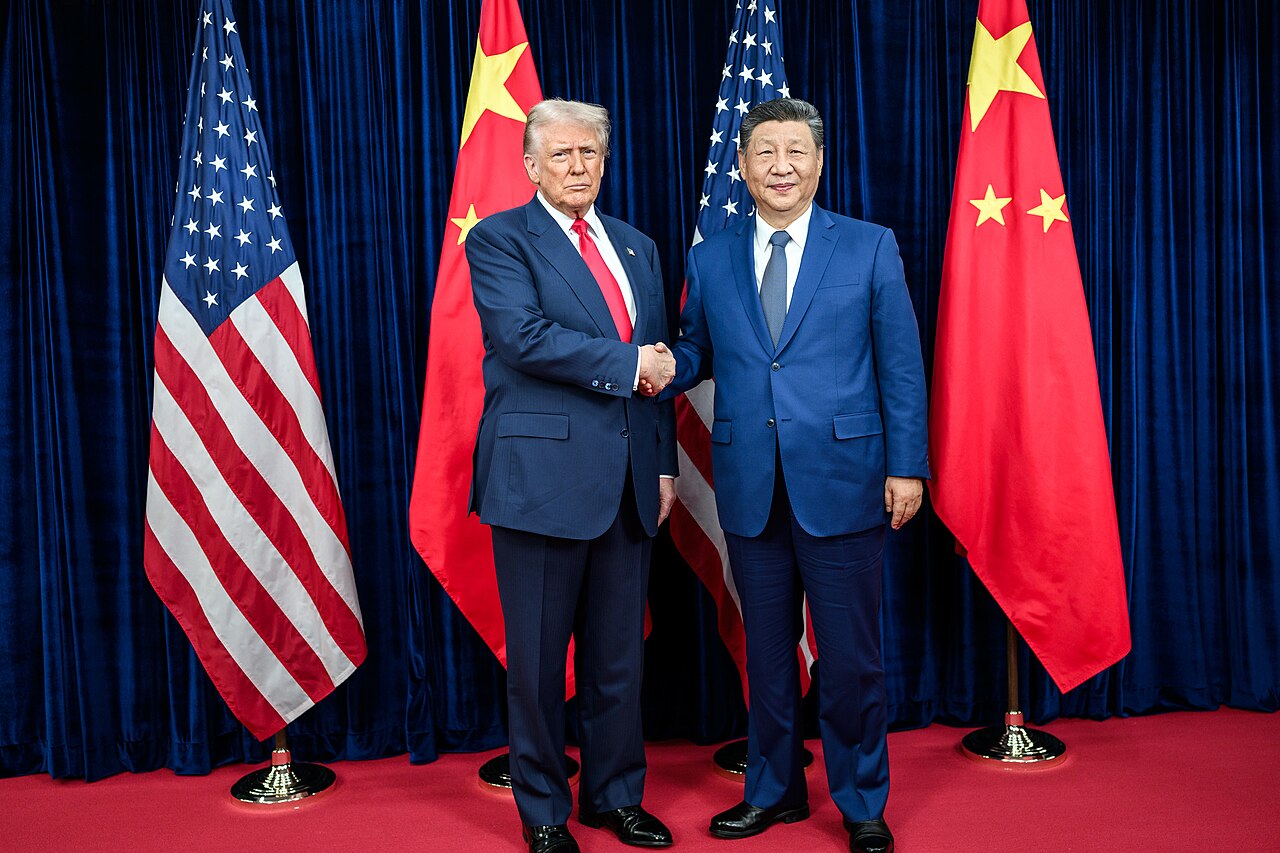
Heralded with much Trumpian pomp before the event, the May 2026 summit between President Xi Jinping of the People’s Republic of China and Donald Trump of the United States of America in Beijing was widely described as a ‘stabilization summit’ rather than a transformational breakthrough. What happened there? Not much, really. And this is precisely why this is big news.
Strategic aims of late memory which have joined the choir invisible
Let us take a step back. The 2017 National Security Strategy of the United States of America under Trump I forms a watershed moment due to the formal admission that the world we inhabit is now one of Great Power Competition rather than a unipolar, U.S.-led, destined-to-be-liberal-democracy-all-over-the-place one, which we might call ‘globalisation with American characteristics’. The 2017 NSS did not mince words: ‘after being dismissed as a phenomenon of an earlier century, great power competition returned. China and Russia began to reassert their influence regionally and globally. Today, they are fielding military capabilities designed to deny America access in times of crisis and to contest our ability to operate freely in critical commercial zones during peacetime. In short, they are contesting our geopolitical advantages and trying to change the international order in their favour’. Under Trump II, the 2025 National Security Strategy of the United States of America somehow manages to mention China 21 times in 29 pages, although in a less obtusely truculent way, focusing on the U.S.-China economic relationship instead, aiming to ‘rebalance America’s economic relationship with China, prioritizing reciprocity and fairness to restore American economic independence’ and hoping that ‘trade with China should be balanced and focused on non-sensitive factors’ while ‘maintaining a genuinely mutually advantageous economic relationship with Beijing’. One presumes this heralds the tariff-centric 2025 U.S.-China Trade War — one which, according to most analysts, the U.S. decisively lost and then proceeded to abandon, for all intents and purposes.
An alternative history of the itinerary to the summit
The 2017 NSS under Trump I started with a bang: ‘three main sets of challengers —the revisionist powers of China and Russia, the rogue states of Iran and North Korea, and transnational threat organizations, particularly jihadist terrorist groups— are actively competing against the United States and our allies and partners’.
Russia, China, Iran, and North Korea. What became of this in the long meantime?
Russia is certainly not losing, and for all intents and purposes is winning, its long war in Ukraine, a war the U.S. Secretary of State Marco Rubio defined in March 2025 as a U.S.-Russia war: ‘frankly, it’s a proxy war between nuclear powers, the United States, helping Ukraine, and Russia’. By the same logic of the U.S. Secretary of State, the United States was defeated in what Rubio calls a U.S.-Russia war, hence the U.S. has partially retreated, leaving Ukraine in the mercy of Europeans and the Russians invested in what they see as a game of patience until Ukraine’s leadership, bereft of proper and full transatlantic support, implodes.
China faced a U.S.-imposed trade war in 2025. It failed, and the trade war was lost. China won. It may now stay calm and carry on.
North Korea is in a state of serenity, or rather geopolitical blessedness: possessing nuclear weapons and the intercontinental ballistic capacity to use them against the U.S. with dubious interception prospects if openly threatened, no one is in any mood to challenge the country; it may stay calm and carry on.
Jihadist terrorist groups? These are now crowned and enthroned in Syria with American blessing, and Ahmed al-Sharaa, erstwhile Emir of Hay’at Tahrir al-Sham and Emir of Al-Nusra Front of al-Qaida pedigree under his nom de guerre Abu Mohammad al-Julani, is now triumphantly received in the White House.
And we are left with Iran; it is from here that an alternative history of the itinerary to the summit unfolds. Following his Venezuelan adventures, President Trump would swiftly effect regime change in Iran, or perhaps ‘obliterate’ the country altogether; after this, he would meet the Chinese president and announce to him that the rules of the game have changed. Following decisive American victories in Venezuela (of minor importance) and in Iran (of extreme importance), Trump’s Chinese counterpart would have to acquiesce to cooperate with the United States on the basis of these newly carved realities.
Yet Goddess Fortune had different plans. As was rather obvious before the Iran war itself, things could go awry, and indeed did go awry. The war went abysmally bad, and is destined to go abysmally worse once it properly resumes; apart from murdering officials, nothing of substance was achieved. Rather than regime change, a younger Ayatollah Khamenei replaced the reposed 86-years-old Ayatollah Khamenei as Leader of the Islamic Revolution; not only does Iran retain its enriched uranium, but it now also controls the Strait of Hormuz, without inflicting oil-related pain on China, for whom the Strait remains effectively open. Just before the summit, it was revealed that 90% of Iran’s missile sites remain intact according to the New York Times. American experts such as Robert A. Pape, professor of political science at the University of Chicago and director of the Chicago Project on Security and Threats, foresee Iran turning into a major world power as a consequence of the U.S./Israeli war on the country (i.e., due to the new status quo on the Strait of Hormuz enabled by Iran’s resilience). Robert Kagan —the Robert Kagan, the arch-hawk that is co-founder of Project for the New American Century, brother of Frederick Kagan, and last but not least the husband of Victoria Nuland—speaks of checkmate in Iran and American defeat, underscores that ‘Washington can’t reverse or control the consequences of losing this war’, notes that ‘the global adjustment to a post-American world is accelerating’, and concludes that ‘America’s once-dominant position in the Gulf is just the first of many casualties’. Can it get worse? Yes indeed: The New York Times, BBC and CNBC publish ominous news on the U.S.’ Iran-related inflation rise.
The Trump-Xi summit was initially scheduled for April 2026. Trump postponed it, in the hope that he would prevail in Iran before the summit would materialise. His hopes were ill-fated.
And it is thusly that we arrived at the Trump-Xi summit.
What really happened in Beijing?
Not much, if at all — and the details confirm precisely this.
The summit took place on 14–15 May 2026 at the Great Hall of the People in Beijing, with Trump also receiving a private lunch and tea with Xi at his personal residence within the Forbidden City compound. The 43 hours of what CNBC described as ‘friendly gestures’ and ‘high-stakes’ pageantry produced a diplomatic framework and very little else.
The headline outcome was a jointly agreed formula: Xi announced that the two leaders had agreed to make ‘a constructive China-U.S. relationship of strategic stability’ the new positioning of their relationship, a framework meant to provide strategic guidance for the next three years and beyond. This was Beijing’s formulation, not Washington’s. Earlier, Trump had attempted to frame the relationship via his ‘G-2’ language on Truth Social; Beijing did not take up that vocabulary, and in March 2026, Wang Yi made the rejection explicit at the Two Sessions press conference, saying China did not subscribe to the logic of ‘major power co-governance’. In Beijing, it was China that provided the rhetorical formula — and the U.S. accepted it. As The Diplomat drily noted: ‘Trump attempted to define the relationship first; Beijing declined’.
On trade, the main American agenda items were, as one analyst put it, ‘Boeings, beef and beans’. Trump claimed that China agreed to buy 200 Boeing aircraft, and U.S. Trade Representative Jamieson Greer said the U.S. expects China to commit to purchasing billions of dollars of U.S. agricultural products; to get trade negotiations off on the right foot, China committed to allow the import of American beef. Yet even the Boeing number was a disappointment: it was much lower than the 500 planes Trump had floated before the summit, and Boeing shares fell 4% on Wall Street accordingly. The country’s last big order with Boeing was during Trump’s November 2017 trip to Beijing, when China agreed to buy 300 Boeing planes; relations soured after that, and Boeing orders from China dried up. Beyond the aircraft pledge, neither side issued many details on trade. By the time Trump left China on Friday, the Boeing deal was the only major deal that was announced — although the Chinese Foreign Ministry declined to confirm even that.
On Iran and the Strait of Hormuz, the issue Trump had hoped to brandish as leverage, Trump left Beijing with only a vague commitment from China —to which the Strait is already very much open indeed— to pressure Iran to lift its blockade of the Strait of Hormuz. Both sides agreed that Iran may not possess a nuclear weapon, which incidentally is something that Iran also agrees to, and agreed to all along.
On Taiwan, Xi reserved his sharpest language, calling it ‘the most important issue in U.S.-China relations’ and warning it could lead to ‘clashes and even conflict’ if not handled properly. In a Fox News interview taped in Beijing, Trump said he would like things between China and Taiwan to ‘stay the same’, and remarked: ‘You know, when you look at the odds, China is a very, very powerful, big country. That’s a very small island. Think of it, it’s 59 miles away. 59 miles. We’re 9,500 miles away. That’s a little bit of a difficult problem’. China’s Foreign Minister Wang Yi subsequently declared that Beijing ‘sensed during the meeting that the U.S. side understands China’s position and attaches importance to China’s concerns, and, like the international community, does not support or accept Taiwan moving toward independence’.
China’s official statements completely omitted mention of fentanyl precursor flows and specific commitments to U.S. agricultural purchases, both of which were highlighted by the U.S. as key discussion points. Beijing maintained its position that it has already done enough regarding fentanyl and framed trade only in general, mutually beneficial terms. The U.S. framed the involvement of American CEOs as a substantive commercial engagement, whereas the Chinese readout diminished their role, framing the meeting as a mere courtesy introduction where Trump asked leaders to present themselves to Xi .
The overall verdict from outside observers was unambiguous. From a U.S. perspective, the immediate outcome was meagre: no grand breakthrough, but a mere stabilization of relations and a broad effort to prevent the superpower rivalry from spiralling further out of control. ‘You don’t get the sense that much has been accomplished’, said Helmut Brandstätter, a liberal Member of the European Parliament from Austria who is well connected with Chinese diplomats. The Washington Post was blunter still: there were no big breakthroughs but also no blunders, and the summit positioned Xi Jinping as a leader at the height of his power, seeking global stability, while allowing him, in the Post’s framing, to ease tensions with Trump without giving ground. The Atlantic’s Franklin Foer was more acerbic: ‘Spare a moment, please, for the lame-duck superpower. It calls itself the leader of the free world, but the free world no longer believes it. When it extends its hand, nobody rushes to accept. When it threatens, nobody trembles. […] In the end, Xi offered nothing of great substance—no solutions to the war in Iran, no sweeping trade deals, no promises of access to rare earth minerals. Xi used the visit to humour the lame-duck president, waiting for his time to pass.’
Daniel W. Drezner, professor of international politics at the Fletcher School of Law and Diplomacy at Tufts University and a non-resident senior fellow at the Chicago Council on Global Affairs, aptly summed all this up:
- ‘Yes, Trump and Xi had a summit;
- No, not much happened at the summit;
- In 2026, we should be grateful for an event involving Trump in which not much happens.’
The summit was historic, precisely because nothing really happened. Among other things, this signals the U.S.’ lack of capacity to dictate terms and to shape reality, insofar as China is concerned (rather than poor Maduro in the U.S.’ backyard). The U.S. may either play along with the currently unfolding global reality and acquiesce to it, or blow everything up via a self-inflicted WWIII, which always remains a possibility.
Avoiding the Thucydides Trap — and avoiding mentioning it for the umpteenth time, please!
It would be a vain exercise to try and count the times the phrase ‘Thucydides Trap’ appeared in international media analyses these days. After all, it is President Xi himself who asked rhetorically, and also asked President Trump, ‘Can China and the United States transcend the so-called “Thucydides Trap” and forge a new paradigm for major-power relations?’ It’s not the first time, of course: the Chinese president had also remarked during his 2015 state visit to the United States while meeting Barack Obama that ‘there is no such thing as the so-called Thucydides Trap in the world. But should major countries time and again make the mistakes of strategic miscalculation, they might create such traps for themselves’.
The first thing to note about the ‘Thucydides Trap’ is that, for all intents and purposes, it has nothing whatsoever to do with Thucydides and his history of the Peloponnesian War. It is Graham Allison, Professor of Government at Harvard Kennedy School, who came up with the phrase, popularised it, and later wrote a book on it, claiming that his own reflections, ideas, approaches, and projections harken back to Thucydides’ wisdom. Calling Graham Allison’s ideas on the U.S.-China competition ‘Thucydides Trap’ certainly lends credence and a certain august aura to the concocted and indeed very American concept Allison came up with, but this does not change the fact that there is little that is actually Thucydidean in it. In essence, and brutally oversimplifying a much more nuanced argument, the Graham Allison Trap prepares the Western and American imaginary and public discourse for an ‘inevitable’ U.S.-China war, under the pacifist guise that it is not inevitable if we actually work hard to prevent it.
Yet President Xi, in his repeated references to the Graham Allison Trap, does not simply signal that China does not want and does not need any war with the U.S. Hidden in the pacifist rhetoric, an emphatic recommendation to the U.S. is articulated: now that the power balance is changing radically and has already shifted, the United States should stay in its lane and enjoy the privileges that history and geography have endowed it with, without remaining fixated on a global hegemony that is destined not to return, since this fixation cannot but engender a war that would be catastrophic for the U.S. as well. If, just as Athens once warred with Sparta, the implication in in Allison’s take is that China’s rise provokes anxiety and potential conflict with the U.S., then the United States should better stay in its lane, abandon megalomaniac ambitions incommensurate with its current trajectory, and —to use the present piece’s favourite phrase— keep calm and carry on.
President Xi spoke of ‘constructive strategic stability’, translated into plain American English as ‘we’ll smile, call you a friend, extend a very warm reception, and continue to do our thing; you would be well-advised not to meddle in our affairs, stay calm, and carry on with your predetermined historical trajectory, which we explicitly consider an inauspicious one’. Trump acquiesced, and then proceeded to tell Taiwan not to nurture unrealistically high hopes of U.S. assistance in any remaining aspirations for independence.
The Graham Allison Trap is not Thucydides Trap. Yet, just for the sake of argument, what would Thucydides’ Trap actually look like? What would Thucydides advise the United States, were he a trapper in our midst? Partly inspired by Dimitris B. Peponis’ readings of Thucydides, we arrived at something which, paradoxically, might be more Thucydidean than the Graham Allison Trap, perhaps. All errors are our own — even if the whole thing is an error:
Thucydides Trap
[Intro]
Yeah.
Thucydides speaking.
Not from Harvard — from the ruins.
Listen carefully, America;
for my rhymes and beats are κτῆμα ἐς αἰεί
[Verse 1]
You quote Melos like it’s scripture in a senate hall,
‘The strong do what they can’ — then stop before the fall.
But fools recite the line and never read the ending,
Hubris got receipts and Time collect the debt with interest pending.
Athens spoke like markets, carriers, ratings agencies,
Called empire ‘order’, called tribute ‘security’.
Every hegemon rename dominion as defence,
Till allies start hearing chains inside the rhetoric.
Corinth told the Greeks:
‘Friendship follow victory’.
States switch camps fast when survival shape the liturgy.
No permanent allies, only pressure and position,
That’s realism — not slogans for a television mission.
You left your friends exposed, now they searching other patrons,
Then call them ‘traitors’ when they pivot from your sanctions.
But treaties break first when the guarantor retreat,
Power writes the oath — weakness tear the paper sheets.
[Hook]
Fear. Honor. Interest.
Still govern every state.
But hubris plant the tyrant and invite a darker fate.
You can rule for a season, make the whole world kneel,
But Time is undefeated and Nemesis is real.
This ain’t liberal dreams, this ain’t moral theater,
This the cold logic underneath every world leader.
Empires die convinced they still control the storm,
Then wake up one day finding history transformed.
[Verse 2]
Mytilene watched Athens slowly change its face,
From liberating Greeks to managing a prison state.
Started with protection, ended with extraction,
That’s how maritime empires drift toward contradiction.
‘We joined you for freedom’ — then the freedom got rationed,
Every alliance equal till one side got advantage.
Once fear fade, empire seek profit from the route,
Then the allies look around like: ‘Who gon’ save us now?’
You got fleets in every sea lane, bases near every shore,
Then ask why rivals building missiles by the score.
Security dilemma — tragic, not absurd,
Every shield look like a sword depending where observed.
And don’t mistake restraint for weakness in transition,
A rising power move patient when it trust the long position.
China read your system like Corinth read the tide,
Knowing overstretched powers decay from the inside.
[Hook]
Fear. Honor. Interest.
That triangle still spin.
But the fatal flaw of empires is believing they can’t dim.
The strong impose today till the balance rearrange,
Then yesterday’s dominion become tomorrow’s chains.
[Bridge]
You thought the trap was war between the old and new,
Nah — the trap is when a fading power can’t face the truth.
Athens didn’t fall because the gods were unfair,
Athens fell believing force exempted it from measure.
Sicily wasn’t madness — it was arrogance normalized,
Applause drowning out strategic decline.
Democracies intoxicated by prestige and reach
Always call expansion “peace.”
[Verse 3]
So hear me, Washington, before the cycle tighten:
The sea power always fear another horizon rising.
But wisdom ain’t dominance stretched beyond capacity,
Wisdom is surviving history without insanity.
Corinth understood alliances built on utility,
Sparta understood limits, Athens worshipped ability.
And every age repeat the pattern with new flags,
New currencies, new drones, same ambitions in the bag.
You sanction half the planet, call it ‘international law’,
But law without balance just accelerate revolt.
The more coercion used to preserve declining primacy,
The faster multipolarity harden into reality.
[Final Hook]
Hubris plant the tyrant — Hesiod said it clean,
Then Dike walk behind him unseen.
Nemesis ain’t magic, she move through Time itself,
Turning mighty empires into studies on a shelf.
So quote Melos fully, not selectively for pride.
The strong rule briefly.
Time rules all sides.
[Outro]
The powerful of the past
Become the weak of the present.
The powerful of the present
Become the weak of the future.
That is the law above empires.
Clearly I spoke and I am not for blames,
Thucydides drops the mic in flames.
Now we can all agree we are grateful there was no trap music in the time of Thucydides.
Secretary Rubio was spot on, in spite of himself
Let’s return to 2025. American Secretary of State Marco Rubio gave an important interview upon assuming office in January 2025 — an interview which still reverberates today, with its famous ‘it’s not normal for the world to simply have a unipolar power, that was an anomaly’ multipolar quote. In it, he explained: ‘China’s perception of the world is that they are inevitably going to be the world’s greatest power by 2035, 2050. Whatever date they’ve set in their mind, they believe that they are on an irreversible rise and we are in inevitable decline, that the West at large, but the U.S. in specific, is a tired, spent, former great power in inevitable decline. And they believe the foreign policy is about managing our decline and their rise, and they want nothing to interrupt it. That’s how they view the West writ large and the United States in particular’.
The assumption behind the reference was that President Donald J. Trump will prove the Chinese wrong.
He did not.
And he does not look like he’ll prove them wrong anytime soon.
In light of all this, Secretary Rubio’s words seem to stand today as an accurate and precise depiction of our world — rather than of China’s erroneous perception of it.
And the proof is indeed in the pudding. What could possibly qualify Secretary Rubio’s words more eloquently than a Trump-Xi summit in which nothing of real consequence really happens — in which, that is, the ascending power is simply trying to mind its own business while successfully keeping the old hegemon calm, pliant and, if remotely possible, pleasant?
In this case, no news is big news, to those that have eyes to see.

.jpg)
The Origins and Modern Relevance of the Thucydides Trap
Photograph Source: The White House – Public Domain
During Donald Trump’s embarrassing trip to China, China’s Secretary General Xi Jinping made a speech, in which he said, “We must not be caught in the Thucydides Trap”. It’s notable in that it places the US and China on the same level, and as facing the same danger (the Chinese expression that was translated as “we”, translated literally, becomes “America and China”, which makes it slightly clearer just who is in danger of this entrapment). And it’s a useful, if obvious, statement that, in order to avoid this trap, these two superpowers must find a way to cooperate.
But what is the Thucydides Trap? The expression was coined by novelist Herman Wouk (The Caine Mutiny) in a talk at the Naval War College during the Cold War (16 April, 1980). It was revived by political scientist Graham Allison in 2017. It refers to a statement in Thucydides’ The Peloponnesian War, that the true cause of that war was the rising power of Athens. Allison argued that this phenomenon–where the challenge to a hegemon by an upstart power leads to war–occurs often enough to deserve a name, and so named it The Thucydides Trap.
As a candidate for a Law of Politics, The Thucydides Trap has received much criticism. Each of the wars Allison gave as examples of countries having fallen into this trap has too many peculiarities to be explained by a single causal factor. And stripped of those peculiarities, the Law is reduced to something close to a tautology, about as useful as “quarrels often precede fights”. Moreover, it lends support to the notion that wars are caused by structural factors, something that “break out”, rather than something caused by human agency, leading to the corollary that the people who facilitate them need not feel responsible for what they have done. Moreover, understanding that “if things go on like this, it could lead to war” is not a dependable deterrent, if the policymakers in the quarreling countries are confident that they would win that war (hubris).
But most certainly we need to avoid falling into that trap, and to that end I think we need to look more carefully at what the Historian himself had to say about it. Thucydides never used the word “trap”, put great emphasis on human agency (arguably was the inspiration for Hannah Arendt’s notion of “action”) and had a way of spreading out his messages all through the book in such a way that many readers fail to notice the connections among them. Several years ago, in my book Radical Democracy (Cornell, 1996), I devoted some pages to searching out those connections.
Below is an extraction of those pages.
Democratic Empire Athens
Few contemporary writings in praise of Athenian democracy have survived. Historians rely heavily on the Funeral Oration of Pericles, as recorded by Thucydides. Textbooks often refer to this speech, typically referring to the paragraph on the constitution and on the spirit of equal justice and mutual tolerance that prevailed among the citizens. It is important, however, to read this paragraph in the context of the whole speech, and moreover to consider the speech in the context of the entire work of Thucydides. In that context, the historian intends the speech to explain not so much Athens’s domestic happiness or justice as its extraordinary and unprecedented form of power.
Thucydides, the first political historian (arguably the first historian) in the West, begins his work by seeking to demonstrate that the war he is chronicling is “a great war, and more worthy of relation than any that had preceded it.”Not only is it the greatest war, but “the greatest movement yet known in history, not only of the Hellenes but of a large part of the barbarian world – I had almost said of mankind.” He does not simply make this point in passing, but argues it at length. In ancient times, he says, there was nothing to compare to this war: “Before the Trojan War there is no indication of any common action in Hellas.” Agamemnon’s expedition against Troy “ may be pronounced on the evidence of what it effected to have been inferior to its renown and to the current opinion about it formed about it under the tuition of the poets.”As for the tyrants, “their habit of providing simply for themselves, of looking solely to their personal comfort and family aggrandizement, made safety the great aim of their policy, and prevented anything great proceeding from them.
Finally, the historian says, the tyrants were overthrown and two great powers emerged. The first of these he introduces by reference to its political institutions: Lacedaemon had “enjoyed freedom from tyrants which was unbroken; it has possessed the same form of government for more than four hundred years . . . and has thus been in a position to arrange the affairs of other states”.
The other power was Athens, but here the historian says nothing about the form of government of the polis. Instead, he introduces the Athenians by telling of something they did: at the time of the second Persian invasion “the Athenians, having made up their minds to abandon their city, broke up their homes, threw themselves into their ships, and became a naval people.
In modern times we have examples of peoples abandoning their cities in the face of enemy invasion but always in the form of streams of fleeing refugees, taking with them as many of their possessions as they can carry. The transformation of citizens into refugees also amounts to a kind of political change of state: the dissolution of the city as a political entity. The Athenians, Thucydides tells us, left architectural Athens behind them, even destroying the buildings so as to emphasize the point, but brought the polis with them. Let us admit that Thucydides is exaggerating (in fact some Athenians stayed behind) , as he sometimes does to make his idea clear. What he has done in this short sentence is to give us a brilliant image with which to grasp the unprecedented nature of the power generated by this fusion reaction called Athens.
Thucydides details the many circumstances that led to the war, but the “real cause”, he says, was “the one which was formally most kept out of sight.” This was “the growth in the power of Athens”. [This is the passage on which the Thucydides Trap hypothesis has been founded.] Thucydides does not romanticize what the Athenians did: the war was “without parallel for the misfortunes that it brought upon Hellas” and the book’s descriptions of the horrors of war are without parallel in historical writing. At the same time it is the power of the Athenians that gives the historian a tale to tell.
Thucydides tells us that one of his historiographical innovations was “computing by summers and winters” rather than by using genealogies or the names of magistrates as the way of ordering the events in time. This method was not simply a clever new discovery that earlier historians had not hit upon. The point of Thucydides’ opening paragraphs is to tell us that until now the method of ordering the events of Hellas according to summers and winters would not have yielded a story. Chroniclers up to then had told the different stories of different cities, for which the genealogies of the leading families were adequate to order the events. Thucydides’ narrative is “more worthy of relation” than any other because this is the first time that all Greece was entangled in public events on such a scale. It is the first time that public events on that scale had been ordered so as to be tellable. Thucydides is able to be the first political historian because the world itself was forcibly reordered into “historical” form. And, says Thucydides, what forced the world into that form was Athenian power. All Greeks had to be either participants or audience: the leading cities joined one side or the other, “while the rest of Hellas stood straining with excitement”.
This history forms the context for Pericles’ speech. Seen in that context, some of the sections we might tend to dismiss as mere bombast take on new meaning. Thucydides, who has already said that his book will be “a possession for all time”, has Pericles say,
The admiration of the present and succeeding ages will be ours, since we have not left our power without witness, but have shown it with mighty proofs; and far from needing a Homer for our panegyrist, or others of his craft whose verses might charm for the moment only for the impression which they gave to melt at the touch of fact, we have forced every sea and land to be the highway of our daring, and everywhere, whether for evil or for good, have imperishable monuments behind us.
State of Democracy/State of Plague
We should to forget that this speech was given at a funeral. The bodies of the first young men to die in the war had been laid out for three days in public, there had been a procession with wailing, the bodies had been buried. Before Pericles stand the parents, sisters, brothers, wives, children of these dead young men; his task is to induce them to shift their attention from the brute fact of the dead bodies which they have just seen go into the ground to the political body for which the men have died. In this it is a classic wartime speech, a kind of battle between the eye and the ear, in which Pericles works to convince his audience to grant less credibility to what they have seen to what they can hear: his words. “You must yourselves realize the power of Athens, and feed your eyes upon her from day to day, till love of her fills your hearts [and] all her greatness shall break upon you”.
The speech is a brilliant success, it is all that its reputation says it is. One can sense that Pericles knows that he has done his job well when he concludes, “And now that you have brought to a close your lamentations for your relatives, you may depart.”
In the very next paragraph, Thucydides tells us that soon after this speech, the plague appeared in Athens. Let us assume that it is no coincidence that this subtile historian placed his descriptions of the Funeral Oration and of the plague back to back. For the description of the plague is precisely the logic of the Funeral Oration turned on its head. It is as if the repressed body has returned to take vengeance on Athens for having been slighted and to remind the Athenians that from its logic, death is merely death. If Pericles’ speech is a triumph of the mind over the body, the plague “first settled in the head, [and] ran its course from thence through the whole of the body.” Against the blank absurdity of death, Pericles has set the beautiful order of the city, an order in which a just relation of cause and effect is guaranteed: sound policies bring good results, virtue is recognized and rewarded, and the future is guaranteed as a space in which actions in the present will continue to ramify and in which they will be remembered. The Plague, Thucydides tells us, overturns this logic of cause and effect. The disease itself, he says, had “no ostensible cause”. Moreover, no sort of medical treatment had any effect on it. “Some died in neglect, others in the midst of every attention. No remedy was found that could be used as a specific; for what did good in one case, did harm in another. Strong and weak constitutions proved equally incapable of resistance, all alike being swept away.” And if wisdom brought no result, neither did virtue gain a reward. “There was the awful spectacle of men dying like sheep. through having caught the infection in nursing each other. ….. This was especially the case with such as made any pretensions to goodness”.
With no reasonable relation between cause and effect, the future disappears as an intelligible category, and neither nor virtue remain as sensible guides to action…..
Fear of gods or law of man there was none to restrain them. As for the former, they judged it to be just the same whether they worshipped them or not, as they saw all alike perishing; and as for the last, no one expected to be brought to trial for his offenses, but each felt that a far severer sentence had been already passed upon them and hung over their heads, and before this fell it was only reasonable to enjoy life a little…..
Finally, as though the plague were determined to drag the logic of the Funeral Oration down to its final degradation, it made even proper funerals impossible.
All the burial rites before in use were entirely upset and they buried the bodies as best they could. Many, from want of the proper appliances, through so many of their friends having died already, had recourse to the most shameless sepultures: sometimes getting the start on those who had raised a pile, they threw heir own dead body upon the strangers’s pyle and ignited it; sometimes they tossed the corpse which they were carrying on top of another that was burning and so went off.
Earlier in his scientific description of the disease, Thucydides notes,
All the birds and beasts that prey upon human bodies, either abstained from touching them (though there were many lying unburied) or died after tasting them, In Sophocles’ Antigone the most extreme expression of the pollution brought down on Thebes by Creon’s refusal to bury Polyneices was that domestic dogs ate of the body and “brought the stench of [his] great crime to each hearth.
With what extraordinary dry restraint does Thucydides conclude the previous passage: “But of course the effects which I have mentioned could be best studied in a domestic animal like the dog”.
+++
Athens’ state of democracy, as Pericles describes it, and the state of plague are mirror images of one another. The latter is the deconstruction of the former, which help us to see what it is made of. …. But Thucydides is no objective social scientist; he has a moral tale to tell as well. And the state of democracy in in Athens is not only democracy, it is democracy-at-war, democratic empire, “to speak somewhat plainly, a tyranny”, as Pericles says later. The absolute sacrifice of the body which Pericles calls for in the name of democracy is actually needed to protect and expand the empire. Athens is a fusion reaction without a vessel to contain it. While political virtue and their laws keep the Athenians mostly just to one another, outside the polis is a moral void, with little to slow them down. The Athenians are pure action, “they were born into the world to take no rest for themselves and to give none to others, said a Corinthian speaker at the beginning of the war; “We cannot fix the exact point at which our empire shall stop”, says Alcibiades toward the end.
Yet Thucydides suggests that there is something, a kind of rudimentary principle of international justice, which the Athenians could have used to contain their endless expansion. He mentions it several times, most forcibly through the lips of the people of the tiny island of Melos.
From the Island to the River
You will remember the story. It is a time of truce between Athens and Sparta. The Athenians have landed on Melos, and invited the citizens to show them why they should have any choices other than to surrender or to die. In an eerie parody of the Socratic method, the Athenians propose that instead of exchanging speeches, the two sides could better get to the truth of the matter by engaging in a dialogue : “Take us up at whatever you don’t like and settle that before going any farther.” The Athenians further propose the both sides dispense with “specious pretenses”: the Athenians will not argue that they have a right to their empire, and in return the Malians should not argue that they have done the Athenians no wrong, “since you know as well as we do that right, as the world goes, is only a question between equals in power, while the strong do what they can and the weak suffer what they must”.
In response, the Melians, under the Athenian demand that they speak only from interest and never from justice, argue that the Athenians would find it expedient that they “should not destroy our common protection, the privilege of being allowed in danger to invoke what is fair and right, and even to profit by arguments not strictly valid if they can be got to pass current”. The argument is remarkable. In the international (or strictly speaking , “interpolitical”) arena, there is no law. Fairness and right do not exist, but it is expedient to act as if they do. For whom is it expedient? Fairness and right, apparently, are useful only for the weak. But the Melians argue that the strong, even when they have the power to ignore and destroy these principles, should not, but should leave them as a “common protection”. They should do that because of the factor of fortune which is “is sometimes more impartial than the disproportion of numbers might lead one to suppose”. You are the stronger, but you cannot know that you will be the stronger forever. So even the Athenians ought leave those principles intact, against the day when their power may fail them. Or rather, especially the Athenians, “as your fall would be a signal for the heaviest vengeance and an example for the world to meditate upon”.
But the Athenians’ power is too great for them to take such a possibility seriously. They cannot form an image of themselves reduced to the position of pleading for just treatment. One can almost hear the amused contempt in their voices when they reply to the Melians, “This …. is a risk we are content to take.”
After more fruitless exchange, the dialogue ends, the Melians resolve to fight, and the siege of Melos begins. The Melians soon surrender to the Athenians, “who put to death all the grown men they took, sold all the women and children for slaves, and subsequently sent out five hundred colonists and occupied the place themselves”.
What is this grisly little tale about? We are not told that the capture of Melos was of any particular strategic importance in the war. As for the dialogue itself, there is no clear winner, both sides use flawed reasoning; what lesson, if any, does the historian want us to draw from these events? For many modern scholars, the lesson is that there is no lesson, if “lesson” means a solution to the dilemma posed by the moral void at the center of international politics. The historian, however, at least in this case has a different take on the question ; for him the story is not over yet. This is shown by the way he has located this dialogue in his narrative. As with the Funeral Oration, the meaning of the Melian Dialogue is revealed in the sentence that immediately follows it. The sentence is, “”That same winter the Athenians resolved to sail again to Sicily”.
The Melians were not sentimentalists, but seers. In the dialogue they give an accurate prophesy of the Athenians’ fate , and in the Athenians’ inability to conceive of such a fate we are given an accurate measure of their hubris. Thucydides hammers this point home. He has already told us that this war was the greatest movement in history; of the Athenian defeat in Syracuse he says: “This was the greatest Hellenic achievement of any in this war or, in my opinion, in Hellenic history; at once the most glorious to the victors and the most calamitous to the conquered. They were beaten at all points and altogether; all that they suffered was great; they were destroyed, as the saying is, with a total destruction, their fleet, their army-everything was destroyed, and few out of many returned home.”
The historian’s description of the last battle is a vision of ultimate human horror. If the final degradation of the State of Plague is the pollution of the dogs, at Syracuse the Athenians themselves are reduced to the level of the dogs. In an agony of thirst they are driven into a river, where the Syracusan and Pelopponesian soldiers “came down and butchered them, especially those in the water, which was then immediately spoiled, but which they went on drinking just the same, mud and all, bloody as it was, most even fighting to have it.
This, I believe, is the true image of the Thucydides Trap, according to Thucydides.
No comments:
Post a Comment