I Was Already Suspicious of the Data Center Boom. Then I Stood In Data Center Alley
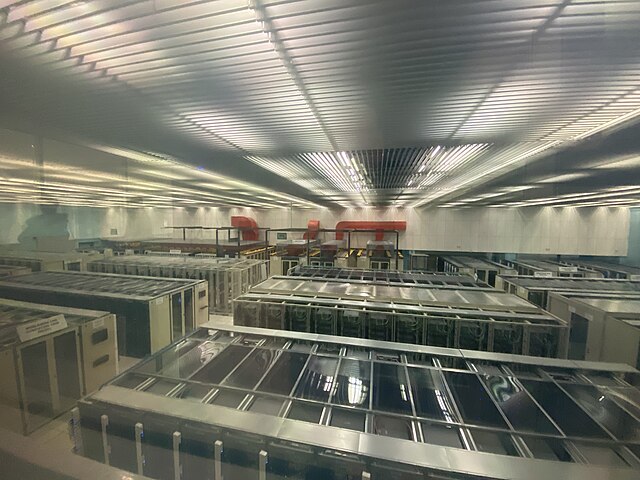
Even if you’ve never stood next to a data center, you’ve probably felt its impacts. For instance, if you’re one of the 65 million people served by regional transmission giant PJM in the eastern United States, a huge spike in projected demand for electricity, driven almost entirely by proposed data centers, has raised your electric bills. But standing next to a data center — or worse, living next to one — is where you can really feel the totality of its impact. I didn’t fully realize this until I spent time in the belly of the beast.
In January, I took a trip to Loudoun County, Virginia, home of the notorious Data Center Alley, to do research for my new podcast project for the Institute for Local Self-Reliance called “The Data Centers Are Coming.” I wanted to learn about how ever-expanding data center facilities impact their neighbors. Nothing could have prepared me for what I saw as I crested a rise on the freeway: 199 operational data centers laid out before me and around 100 more under construction, densely packed together and sprawling to the horizon. So much digging and building left everything covered in red dust, giving the whole scene an eerie, Martian feel. The noise was unbelievable, clanking metal and chugging diesel engines all atop a deep industrial hum.
The people that live here are experiencing negative health effects stemming from pollution and chronic severe noise exposure. I talked to people in neighborhoods where folks no longer hang out in their yards because of the noise, in turn becoming isolated from their neighbors. I heard about people spending thousands on renovations just so they can sleep through the noise. One Loudoun County resident measured the noise at 70 dB on his front porch — equivalent to a vacuum cleaner that never turns off.
People die here, too. I visited Tippets Hill Cemetery, a historic Black burial ground dating to before the Civil War, now surrounded on three sides by monumental, noisy data centers. It was like nothing I’d ever seen or heard.
This is Big Tech’s vision for America. Their behavior reveals an air of entitlement to turn any community they choose into another Data Center Alley, extracting massive resources and tax breaks in the process. Elon Musk built what he called the world’s biggest supercomputer next to the Boxtown neighborhood in Memphis, Tennessee. Dismayed at the idea of waiting for a grid connection to power his massive electricity needs, he plopped more than 30 huge generators in the parking lots next to his Colossus data center, essentially building an unregulated gas power plant himself. This, of course, circumvented any regulatory processes, spewing dangerous pollution into adjacent Boxtown.
It’s worth noting that Boxtown is a historically Black neighborhood, founded by freedmen after the Civil War. But according to the logic of data center proponents, the land was already a lost cause. One podcast guest said, “Elon, what he did with Memphis is objectively somewhat dirty, but he’s also doing it in an area where there’s like, a bigger natural gas plant right next door and like, a wastewater treatment and a garbage dump nearby, right?” By this logic, the presence of other polluting facilities somehow gives data centers permission to pollute more. Industry has already colonized these communities, so what’s a bit more colonization?
My research travels also took me to remote, mountainous Tucker County, West Virginia, home to a few idyllic small towns and a thriving outdoor recreation economy. A mysterious shell company, Fundamental Data, is trying to build a data center and power plant next to the landfill between the towns of Davis and Thomas. Many residents there have concluded that Fundamental Data saw old strip-mined land behind a landfill and considered it theirs to extract from.
Nikki Forrester is one such resident refusing to accept this data center land grab. An organizer with Tucker United, she argues that thinking the only use for old strip-mined land is industrial development is a failure of imagination: “You could do a lot of restoration and trail development and all sorts of stuff on old strip mine land. We bike on awesome bike trails through old strip mines all the time.” Restoring this land for outdoor recreation would keep with what people love about Tucker County, not to mention what drives much of the local economy. Building a data center on that land threatens all of that.
The story of companies seeing community resources and assuming that they can easily extract them because “nobody is using them anyway” is not new. Indeed, such thinking runs beneath America’s 250-year history and beyond, from the seizure of Indigenous lands to highway expansion, from industrial agriculture to today’s data center boom. But another undercurrent of American history is localized resistance to corporate power and extraction, from the Boston Tea Party to the West Virginia Mine Wars, from the Great Railroad Strike to the successful unionization at Amazon’s JFK8 warehouse in Staten Island.
We see that resistance today as vibrant and fearless coalitions form across the country to resist the corporate extraction of data center construction. These coalitions are so strong in part because people of all stripes, across the political spectrum, resent the idea of tech corporations feeling entitled to their local resources. As West Virginia advocate and researcher Cathy Cunkel told me, the data center issue “isn’t about Left vs. Right, it’s about Up vs. Down.”
When framed this way — the powerful and rich vs. the people they’re trying to extract resources from — the data center fight becomes another chapter in a long American history of resisting corporate extraction enabled by feckless, unimaginative politicians.
The Dark Side of the Data Center Boom
Photograph Source: Christopher Bowns – CC BY-SA 2.0
Across the country, resistance to data centers is rising even as plans are steadily being made to build new ones.
According to the Pew Research Center, a majority of new data centers — 67 percent — are being built in rural areas. And three-quarters of those are in Midwestern and Southern towns.
The negative effects do not go unnoticed in these communities. A new data center in Southaven, Mississippi, for example, is reportedly terrorizing the community with high levels of noise and air pollution, and residents are now regretting its existence.
But it’s not just the pollution, the depletion of water systems, and the increased energy costs to consumers that should lead communities to resist data centers. When you dig a little deeper, you begin to see how data centers are built on exploitation that goes far beyond small-town USA.
Data centers are both products and producers of wars that kill people and destroy the planet on a global scale. The rapid expansion of these data centers requires raw materials, especially fossil fuels — resources often obtained through violence — and they fuel a technology that is increasingly used to commit war crimes.
Fossil fuels provide almost 60 percent of the power for data centers, especially for “emergency generators.” AI data centers run almost 24/7, so these “emergency” generators are consistently operating.
Control over fossil fuels, of course, is a driving factor behind the U.S. regime change efforts in Iran, Venezuela, and other resource-rich regions. And the extraction of other needed minerals — like silicon, gallium, lithium, and cobalt — requires both the destabilization of the sovereign regions in which they are found and inhumane mining practices, including the use of child labor.
Then there is the question of the moral and ethical use of generative AI. The expansion of data centers comes at a time when AI and LLMs (large language models) are increasingly being used by the Pentagon for militarism domestically and internationally.
The Pentagon recently agreed to massive deals with both Palantir and OpenAI. The employment of AI in military operations has already resulted in war crimes. For instance, Anthropic’s Claude was used in the bombing of the girls’ school in Minab, Iran, which killed around 170 students and teachers. Do towns that pride themselves on family values want to be behind a killing machine capable of murdering young girls?
It’s easy to understand why the announcement of these data centers can seem like good news for areas facing dire economic conditions. Existing low-wage jobs are difficult to survive on. But the evidence suggests data centers create very few local jobsin the towns where they’re built. Should this small number of jobs come at the expense of people and the future of our planet?
The state officials brokering these deals with tech companies could instead work on bringing jobs that design, install, and maintain renewable energy systems to replace fossil fuel reliance. They could sign contracts with companies that manage and protect the beautiful natural ecosystems, habitats, and biodiversity that often surround rural towns.
We need jobs that sustain the heartbeat of the Midwest and the charm and hospitality of the South — not jobs in an industry that terrorizes communities and kills people.
Data centers are not just toxic installations in communities’ backyards — they are a driving force behind wars and instability, and they keep American workers tied to the endless cycle of wars for fossil fuels.
In defense of the planet, our communities, and communities around the world, I hope urban and rural communities alike can unite to stop data center projects — especially across the Midwest and the South, where they have so much beauty and love to protect.
Rural communities’ future is not AI. We should be investing in what makes us great: the people and the land.
No comments:
Post a Comment