Op-Ed
Trump’s Violent Memes Expose Long-Simmering Truths About US Imperialism

Trump’s white nationalist revanchism is on display as he turns state violence into entertainment.
By Michelle Chen ,
Trump’s Violent Memes Expose Long-Simmering Truths About US Imperialism

By Michelle Chen ,
May 31, 2026
It seemed on brand for our meme-obsessed President that the U.S. launched Operation Epic Fury with an epic video mashup. While Trump never bothered to articulate a real justification for waging war on Iran, he gestured toward a righteous mission with a montage of dramatic violent scenes, featuring heroic and antiheroic characters from Braveheart to Walter White of “Breaking Bad,” spliced like a Hollywood trailer under a banner proclaiming “JUSTICE THE AMERICAN WAY.” The cinematic celebration of American “justice” came about a week after about 155 people, mostly children, were killed by a U.S. strike on a school in Minab, in a spate of bombings aimed at schools and hospitals across Iran.
The valorization of military power as a force of justice has always colored the nation’s imperial imaginary. Around 130 years ago, Puck magazine promoted the Spanish-American War to readers with “The Cuban Melodrama,” a cartoon depicting a gallant Uncle Sam in a feathered cap and star-print pantaloons shielding a damsel in distress with a pro-U.S.-annexation flag emblazoned on her hip, while her swarthy Spanish colonial master scowled behind a bandit’s cloak. People in the U.S. continue to see Cuba through media spectacle, detached from the reality of the war back then, and from the cruel U.S. economic siege of the island now. The White House has fired off many such spectacles to glorify or sanitize U.S. and Israeli military operations, including an action-movie–style video depicting the kidnapping of Venezuelan President Nicolas Maduro and a grotesquely surreal AI-slop showcase of a genocide-ravaged Gaza rebranded as Palestine’s Vegas Strip.
The aestheticization of military brutality is not limited to warfare abroad. The administration has posted propaganda videos of immigration raids in Black and Brown communities, lionizing the ferocity with which ICE agents are tearing apart families.
Never miss another story
Get the news you want, delivered to your inbox every day.
Email*
Trump’s treatment of state violence as entertainment speaks to a longstanding animating force behind U.S. jingoism and militarism: the lust for empire has been as much about projecting dominance as it is about grappling with the U.S.’s internal racial and class tensions and the surrounding infrastructure of oppression.
American Injustice
Trump’s boorish war cheerleading recalls past symbols of U.S. empire as providence, a political and media narrative that lashed the nation’s fate to the expansion of slavery, and the dispossession of Indigenous lands under the halo of “Manifest Destiny.” It also evokes the image the nation has long projected as a crusader for “freedom” while imposing its economic and political hegemony abroad. The current warmongering overseas accompanied by domestic anti-immigrant crackdowns represent twin faces of settler colonial violence, both constitutive of the nation’s founding myth: that the U.S.’s destiny is to grow — to expand westward, to open new markets, or, as Trump mused about Venezuela and Iran, to “take the oil.”
Related Story
Op-Ed |
War & Peace
Trump Has Made the US War Machine a Spectacle – and It’s Spectacularly Unpopular
Trump has brought the full extent of the war machine out into the open. Let’s channel public anger into organizing.
By Khury Petersen-Smith & Azadeh Shahshahani , Truthout/InTheseTimesMarch 3, 2026
As historian Nikhil Pal Singh noted in a recent talk with fellow historian Greg Grandin (a talk hosted by Democratic Socialists of America Academy in New York City that I helped to organize), Trump’s brand of imperialism departs from the Cold War “liberal” order, which nominally enshrined civil rights and racial equality in a framework of egalitarian, free-market capitalism. Instead, Trump pushes a revanchist, white supremacist ideology that the U.S. is what Singh described as “a nation based upon a particularistic ethno-racial conception of heritage or ancestry.”
Fueling Trump’s neoimperialist adventures, Singh explained, is a drive to “revalorize white supremacy as the basis of U.S. citizenship.” The White House and the MAGA movement have channeled their white nationalist fervor into “a project of mass deportation,” to roll back the whole edifice of civil rights legality” that buttressed the liberal ideal of “a nation of equals.” But in breaking from the veneer of egalitarian democracy, Trump lets the mask slip on the brutality underwriting the American Dream.
While the conventional narrative myth of U.S. society emphasizes inclusive democracy, the ideal of liberal values has always belied a paradox of colonial and imperial oppression. As Grandin explained, “what we think of as liberalism, all the great progressive advances … has all been in many ways achieved through a trade off with empire, with expansion. Andrew Jackson’s extension of suffrage of white men was tied to indigenous dispossession. … During the Cold War, the expansion of civil rights was a tradeoff for support of containment [of Communism].”
The prosperity that came with industrialization and global commerce was premised on the entrenchment of wage capitalism and the exploitation of Black and migrant labor, which in turn paralleled the marginalization and eventual exclusion of “undesirable” foreigners who were deemed biologically and morally deficient. Today, the perception of immigrants, particularly those who are not white or Christian, as dangerous social parasites, is key to the Trump administration’s narrative of “securing” the border. Sidestepping the fact that the U.S. has in many cases exacerbated the “migrant crisis” by political intervention and economic destabilization of countries in the Global South, Trump adviser Stephen Miller warned that “migrants and their descendants recreate the conditions, and terrors, of their broken homelands.”
The Long History of U.S. Nativism
Since the 19th century, the systematic exclusion and criminalization of “aliens” has been integral to the enforcement of the boundaries of whiteness (even though the category derives its power largely from its arbitrariness), giving rise to the security apparatus built along the Southern border, along with restrictive ethnic quotas that privileged white Western Europeans.
The globalization of white nationalism under Trump and other right-wing leaders reflects the enduring concept of “herrenvolk democracy,” (a reference to the Nazi “Master Race” idea) which frames democratic rights as the province of a racial in-group. In politics and culture, historian Cristina Beltrán writes, “herrenvolk democracy was a mass-based, participatory endeavor, reproduced and administered from both above and below.”
Both herrenvolk nativism and imperialism derive from the overarching concept of a nation built on the freedom of some to subjugate others, whether they live down the street or across an ocean. In enforcing the boundaries of empire and the internal social borders of race and class, a pattern of dehumanization through institutionalized violence has spanned the globe, extending from the Black Codes and racial pogroms in the post–Civil War South, to the U.S.’s first colony in Asia a generation later. It was in the Philippine-American War that the modern torture technique of waterboarding was first routinely used by U.S. soldiers on Filipino people before becoming an officially authorized practice in the U.S. “war on terror.” During the U.S. occupation of the archipelago, during which U.S. troops committed many acts of torture and sexual abuse, a soldier wrote that the land “won’t be pacified until the [anti-Black slur] are killed off like Indians.” Invoking an anti-Black slur to refer to Filipinos, he seems subconsciously to grasp that he is fighting a much deeper war, which traces its lineage from the cleansing of North America of its Indigenous inhabitants, to the enslavement of Africans, and to the suppression of so-called “savages” in newly colonized land across the Pacific.
Under Trump, the crusade to bolster U.S. hegemony continues with an added boost of racial panic. The Trump administration is pushing the narrative that white men’s dominion is existentially endangered: the white share of the population is shrinking amid broader demographic shifts, while the U.S.’s superpower status appears to be waning, at least in Trump’s narrative of populist grievance, stoking paranoia about national decline and “white replacement.”
The fusion of authoritarian repression with imperial power dynamics is evident in the chaotic expansion of Immigration and Customs Enforcement (ICE) as a paramilitary-like force. In recruiting some 12,000 new agents, the Department of Homeland Security (DHS) has lowered training standards systematically, reducing the length of its course for new recruits from 22 weeks to just eight weeks and centering the curriculum on “more tactical and operational drills” rather than studying the immigration laws they are supposed to be enforcing. The barrage of social media posts vilifying immigrants as alleged criminals and flashy videos of vicious ICE raids formed the backdrop to DHS’s claims that the killings of two individuals during protests in Minnesota, Renee Good and Alex Pretti, were somehow justified. The brazen aggression, directed in this case at white citizens, suggests that a so-called imperial “boomerang” may be in play, in which the practices of right-wing authoritarian militarism and repression in the Global South, often supported covertly by the U.S., are now mirrored within the homeland.
Anti-Imperialism From Within
Yet the historical resonance of Trump’s domestic and international tyranny points to a history of anti-imperialist, anti-fascist resistance from within. The Black Power and Third World movements of the late 1960s understood the U.S.’s racial hierarchy as an imperial project and oppressed communities as internally colonized peoples.
As the Black radical organizer Kwame Ture (who then went by the name Stokely Carmichael) explained in his 1967 address to the Organization of Latin American Solidarity in Havana, Black power was the domestic battlefront against a white supremacist empire. “Our people are a colony within the United States,” he told the gathering of liberation movement activists from across Latin America. “You are colonies outside the United States. It is more than a figure of speech to say that the Black communities in America are the victims of white imperialism and colonial exploitation.” But the connective tissue of oppression could also be a source of empowerment, he added, saying:
Black power means that we see ourselves as part of the Third World; that we see our struggle as closely related to liberation struggles around the world…. We must, for example, ask ourselves: When Black people in Africa begin to storm Johannesburg, when Latin Americans revolt, what will be the role of the United States and that of African Americans?
What would a movement for democracy and self-determination look like for working-class and oppressed communities in this country? Such a movement might emerge from the grassroots coalitions and ideological connections being forged as communities confront ICE assaults on immigrants and constitutional rights.
The Sunrise Movement, for example, incorporates ICE resistance into a global agenda for environmental and economic justice, connecting the crackdown on immigrants to the fossil fuel industry’s global expansionism. The organization targets a “self-sustaining cycle” in which fossil fuel corporations collaborate with governments to pursue mineral extraction, economic coercion, imperialist expansion abroad, and the corruption of democracy at home. Under the convergence of state and corporate oppression, “extraction drives instability, and enforcement manages the consequences.”
The United Electrical, Radio & Machine Workers Union of America (UE) — which has for years organized cross-border labor solidarity campaigns — has condemned Trump’s assaults on immigrant communities within a broader critique of U.S. foreign policy and trade policy, especially as migration is oftena response to political and economic crises fomented by Washington. In its recent statement calling for a pro-worker foreign policy, the union argued, “The biggest threat to the people of the U.S. is not Iran, China, or military invasions from other countries, but a rapacious military-industrial complex, which fails to provide living-wage jobs, affordable healthcare, education, housing, and necessary social services…. Further, we must recognize our responsibility, as workers in the U.S., to workers elsewhere who are affected by U.S. foreign and military policies.”
What responsibility do denizens of an empire bear toward subjects of neocolonial oppression, whether they are being attacked abroad or exploited at home? Amid the wars raging inside and outside U.S. borders, working-class communities are realizing that the fight against empire starts at home, and the homeland itself must be liberated from the imperial framework behind its myth of liberal democracy. Turning away from brutal spectacles of “Justice the American Way,” we can start to envision a society built not on dominion, but on equity and dignity for all.
This article is licensed under Creative Commons (CC BY-NC-ND 4.0), and you are free to share and republish under the terms of the license.
Michelle Chen is a contributing editor at Dissent Magazine, and a contributing writer at The Nation, In These Times and Truthout. She is also a co-producer of the “Asia Pacific Forum” podcast and Dissent Magazine’s “Belabored” podcast, and teaches history at the City University of New York. Follow her on Twitter: @meeshellchen.
The valorization of military power as a force of justice has always colored the nation’s imperial imaginary. Around 130 years ago, Puck magazine promoted the Spanish-American War to readers with “The Cuban Melodrama,” a cartoon depicting a gallant Uncle Sam in a feathered cap and star-print pantaloons shielding a damsel in distress with a pro-U.S.-annexation flag emblazoned on her hip, while her swarthy Spanish colonial master scowled behind a bandit’s cloak. People in the U.S. continue to see Cuba through media spectacle, detached from the reality of the war back then, and from the cruel U.S. economic siege of the island now. The White House has fired off many such spectacles to glorify or sanitize U.S. and Israeli military operations, including an action-movie–style video depicting the kidnapping of Venezuelan President Nicolas Maduro and a grotesquely surreal AI-slop showcase of a genocide-ravaged Gaza rebranded as Palestine’s Vegas Strip.
The aestheticization of military brutality is not limited to warfare abroad. The administration has posted propaganda videos of immigration raids in Black and Brown communities, lionizing the ferocity with which ICE agents are tearing apart families.
Never miss another story
Get the news you want, delivered to your inbox every day.
Email*
Trump’s treatment of state violence as entertainment speaks to a longstanding animating force behind U.S. jingoism and militarism: the lust for empire has been as much about projecting dominance as it is about grappling with the U.S.’s internal racial and class tensions and the surrounding infrastructure of oppression.
American Injustice
Trump’s boorish war cheerleading recalls past symbols of U.S. empire as providence, a political and media narrative that lashed the nation’s fate to the expansion of slavery, and the dispossession of Indigenous lands under the halo of “Manifest Destiny.” It also evokes the image the nation has long projected as a crusader for “freedom” while imposing its economic and political hegemony abroad. The current warmongering overseas accompanied by domestic anti-immigrant crackdowns represent twin faces of settler colonial violence, both constitutive of the nation’s founding myth: that the U.S.’s destiny is to grow — to expand westward, to open new markets, or, as Trump mused about Venezuela and Iran, to “take the oil.”
Related Story
Op-Ed |
War & Peace
Trump Has Made the US War Machine a Spectacle – and It’s Spectacularly Unpopular
Trump has brought the full extent of the war machine out into the open. Let’s channel public anger into organizing.
By Khury Petersen-Smith & Azadeh Shahshahani , Truthout/InTheseTimesMarch 3, 2026
As historian Nikhil Pal Singh noted in a recent talk with fellow historian Greg Grandin (a talk hosted by Democratic Socialists of America Academy in New York City that I helped to organize), Trump’s brand of imperialism departs from the Cold War “liberal” order, which nominally enshrined civil rights and racial equality in a framework of egalitarian, free-market capitalism. Instead, Trump pushes a revanchist, white supremacist ideology that the U.S. is what Singh described as “a nation based upon a particularistic ethno-racial conception of heritage or ancestry.”
Fueling Trump’s neoimperialist adventures, Singh explained, is a drive to “revalorize white supremacy as the basis of U.S. citizenship.” The White House and the MAGA movement have channeled their white nationalist fervor into “a project of mass deportation,” to roll back the whole edifice of civil rights legality” that buttressed the liberal ideal of “a nation of equals.” But in breaking from the veneer of egalitarian democracy, Trump lets the mask slip on the brutality underwriting the American Dream.
While the conventional narrative myth of U.S. society emphasizes inclusive democracy, the ideal of liberal values has always belied a paradox of colonial and imperial oppression. As Grandin explained, “what we think of as liberalism, all the great progressive advances … has all been in many ways achieved through a trade off with empire, with expansion. Andrew Jackson’s extension of suffrage of white men was tied to indigenous dispossession. … During the Cold War, the expansion of civil rights was a tradeoff for support of containment [of Communism].”
The prosperity that came with industrialization and global commerce was premised on the entrenchment of wage capitalism and the exploitation of Black and migrant labor, which in turn paralleled the marginalization and eventual exclusion of “undesirable” foreigners who were deemed biologically and morally deficient. Today, the perception of immigrants, particularly those who are not white or Christian, as dangerous social parasites, is key to the Trump administration’s narrative of “securing” the border. Sidestepping the fact that the U.S. has in many cases exacerbated the “migrant crisis” by political intervention and economic destabilization of countries in the Global South, Trump adviser Stephen Miller warned that “migrants and their descendants recreate the conditions, and terrors, of their broken homelands.”
The Long History of U.S. Nativism
Since the 19th century, the systematic exclusion and criminalization of “aliens” has been integral to the enforcement of the boundaries of whiteness (even though the category derives its power largely from its arbitrariness), giving rise to the security apparatus built along the Southern border, along with restrictive ethnic quotas that privileged white Western Europeans.
The globalization of white nationalism under Trump and other right-wing leaders reflects the enduring concept of “herrenvolk democracy,” (a reference to the Nazi “Master Race” idea) which frames democratic rights as the province of a racial in-group. In politics and culture, historian Cristina Beltrán writes, “herrenvolk democracy was a mass-based, participatory endeavor, reproduced and administered from both above and below.”
Both herrenvolk nativism and imperialism derive from the overarching concept of a nation built on the freedom of some to subjugate others, whether they live down the street or across an ocean. In enforcing the boundaries of empire and the internal social borders of race and class, a pattern of dehumanization through institutionalized violence has spanned the globe, extending from the Black Codes and racial pogroms in the post–Civil War South, to the U.S.’s first colony in Asia a generation later. It was in the Philippine-American War that the modern torture technique of waterboarding was first routinely used by U.S. soldiers on Filipino people before becoming an officially authorized practice in the U.S. “war on terror.” During the U.S. occupation of the archipelago, during which U.S. troops committed many acts of torture and sexual abuse, a soldier wrote that the land “won’t be pacified until the [anti-Black slur] are killed off like Indians.” Invoking an anti-Black slur to refer to Filipinos, he seems subconsciously to grasp that he is fighting a much deeper war, which traces its lineage from the cleansing of North America of its Indigenous inhabitants, to the enslavement of Africans, and to the suppression of so-called “savages” in newly colonized land across the Pacific.
Under Trump, the crusade to bolster U.S. hegemony continues with an added boost of racial panic. The Trump administration is pushing the narrative that white men’s dominion is existentially endangered: the white share of the population is shrinking amid broader demographic shifts, while the U.S.’s superpower status appears to be waning, at least in Trump’s narrative of populist grievance, stoking paranoia about national decline and “white replacement.”
The fusion of authoritarian repression with imperial power dynamics is evident in the chaotic expansion of Immigration and Customs Enforcement (ICE) as a paramilitary-like force. In recruiting some 12,000 new agents, the Department of Homeland Security (DHS) has lowered training standards systematically, reducing the length of its course for new recruits from 22 weeks to just eight weeks and centering the curriculum on “more tactical and operational drills” rather than studying the immigration laws they are supposed to be enforcing. The barrage of social media posts vilifying immigrants as alleged criminals and flashy videos of vicious ICE raids formed the backdrop to DHS’s claims that the killings of two individuals during protests in Minnesota, Renee Good and Alex Pretti, were somehow justified. The brazen aggression, directed in this case at white citizens, suggests that a so-called imperial “boomerang” may be in play, in which the practices of right-wing authoritarian militarism and repression in the Global South, often supported covertly by the U.S., are now mirrored within the homeland.
Anti-Imperialism From Within
Yet the historical resonance of Trump’s domestic and international tyranny points to a history of anti-imperialist, anti-fascist resistance from within. The Black Power and Third World movements of the late 1960s understood the U.S.’s racial hierarchy as an imperial project and oppressed communities as internally colonized peoples.
As the Black radical organizer Kwame Ture (who then went by the name Stokely Carmichael) explained in his 1967 address to the Organization of Latin American Solidarity in Havana, Black power was the domestic battlefront against a white supremacist empire. “Our people are a colony within the United States,” he told the gathering of liberation movement activists from across Latin America. “You are colonies outside the United States. It is more than a figure of speech to say that the Black communities in America are the victims of white imperialism and colonial exploitation.” But the connective tissue of oppression could also be a source of empowerment, he added, saying:
Black power means that we see ourselves as part of the Third World; that we see our struggle as closely related to liberation struggles around the world…. We must, for example, ask ourselves: When Black people in Africa begin to storm Johannesburg, when Latin Americans revolt, what will be the role of the United States and that of African Americans?
What would a movement for democracy and self-determination look like for working-class and oppressed communities in this country? Such a movement might emerge from the grassroots coalitions and ideological connections being forged as communities confront ICE assaults on immigrants and constitutional rights.
The Sunrise Movement, for example, incorporates ICE resistance into a global agenda for environmental and economic justice, connecting the crackdown on immigrants to the fossil fuel industry’s global expansionism. The organization targets a “self-sustaining cycle” in which fossil fuel corporations collaborate with governments to pursue mineral extraction, economic coercion, imperialist expansion abroad, and the corruption of democracy at home. Under the convergence of state and corporate oppression, “extraction drives instability, and enforcement manages the consequences.”
The United Electrical, Radio & Machine Workers Union of America (UE) — which has for years organized cross-border labor solidarity campaigns — has condemned Trump’s assaults on immigrant communities within a broader critique of U.S. foreign policy and trade policy, especially as migration is oftena response to political and economic crises fomented by Washington. In its recent statement calling for a pro-worker foreign policy, the union argued, “The biggest threat to the people of the U.S. is not Iran, China, or military invasions from other countries, but a rapacious military-industrial complex, which fails to provide living-wage jobs, affordable healthcare, education, housing, and necessary social services…. Further, we must recognize our responsibility, as workers in the U.S., to workers elsewhere who are affected by U.S. foreign and military policies.”
What responsibility do denizens of an empire bear toward subjects of neocolonial oppression, whether they are being attacked abroad or exploited at home? Amid the wars raging inside and outside U.S. borders, working-class communities are realizing that the fight against empire starts at home, and the homeland itself must be liberated from the imperial framework behind its myth of liberal democracy. Turning away from brutal spectacles of “Justice the American Way,” we can start to envision a society built not on dominion, but on equity and dignity for all.
This article is licensed under Creative Commons (CC BY-NC-ND 4.0), and you are free to share and republish under the terms of the license.
Michelle Chen is a contributing editor at Dissent Magazine, and a contributing writer at The Nation, In These Times and Truthout. She is also a co-producer of the “Asia Pacific Forum” podcast and Dissent Magazine’s “Belabored” podcast, and teaches history at the City University of New York. Follow her on Twitter: @meeshellchen.
David McAfee
May 30, 2026
RAW STORY
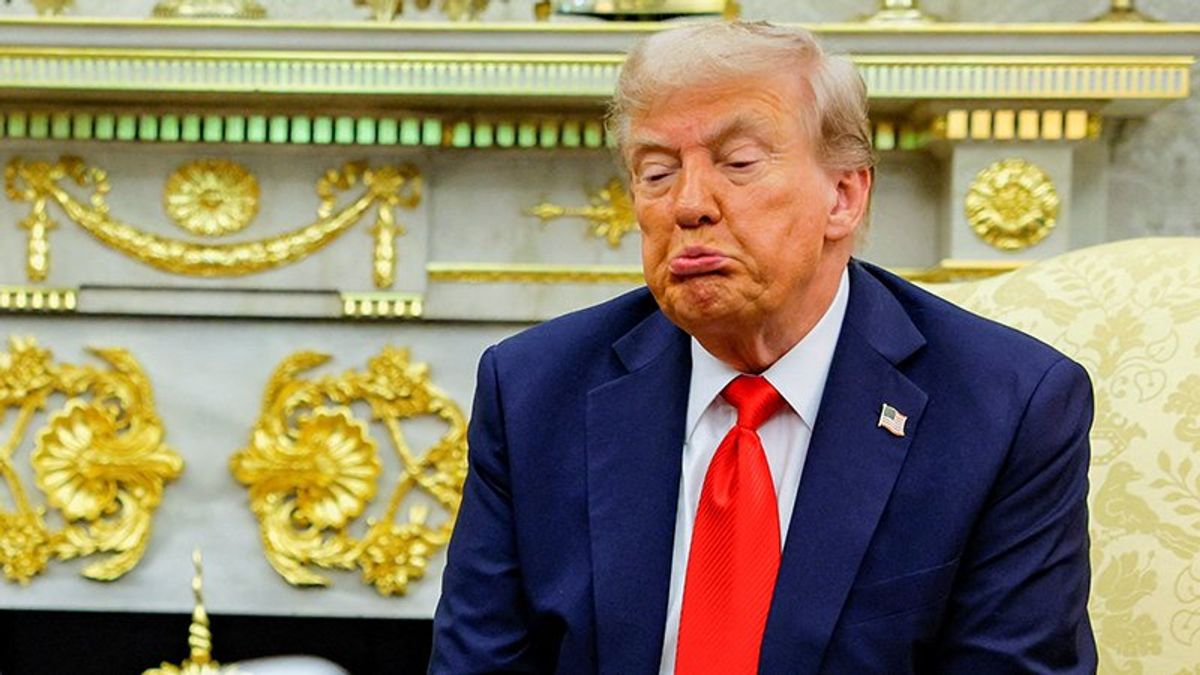
U.S. President Donald Trump reacts while sitting next to the President of Poland Karol Nawrocki during a meeting in the Oval Office at the White House in Washington, D.C., U.S., September 3, 2025. REUTERS/Brian Snyder
Donald Trump lit up Truth Social on Saturday afternoon with a stream of posts that left onlookers across the political spectrum questioning his state of mind, ranging from a drone port rendering on top of the White House to an AI image of himself appearing to blow his nose on an American flag.
The spree drew immediate reaction from all corners of social media sites. "Trump's Truth Social posting over the last hour or so is completely bats--- insane," independent journalist Aaron Rupar wrote on X. "Get a load of this nonstop nuttery."
In a later post, Rupar declared, "Trump’s behavior on social media today is so unhinged even by his standards that I can’t help but wonder what the doctors really told him the other day. This is a deeply unwell person."
Among the posts, Trump shared attacks on judges, criticisms of musical performers who bailed on his event, and a rendering of what he called a "DronePort" on the roof of his proposed White House ballroom. Regarding the latter, Bill Kristol, the veteran Republican commentator, noted the structure would also include a bunker underneath. "It's not just a childish extravagance," Kristol wrote. "It will be a kind of military encampment. All the more reason, obviously, for Congress to stop it."
Trump also posted a meme depicting Rep. Lauren Boebert and several other Republican lawmakers in a vehicle captioned "GET IN LOSER, WE'RE GOING LOSING" — this despite the fact that Boebert had recently pushed for the release of the Epstein files, a cause popular with the MAGA base.
Separately, Trump posted an AI-generated watercolor image of himself clutching the American flag to his face in a pose that critics immediately compared to using it as a tissue.
He also reshared an old post of himself declaring, "I just want to stop the world from killing itself," which prompted the PatriotTakes account to reply: "Says the guy who bombed a girls elementary school."
Political analyst Molly Jong-Fast offered a dry summary: "He's probably fine, right?"
Former Ambassador Dan Shapiro kept it simple: "It's a beautiful day in Washington. Wish he would go outside and touch grass."
Spanish-language commentator Dr. Mario Muñoz offered a blunt diagnosis of the afternoon's activity. "The gentleman with dementia who lives in the White House is bored," he wrote on X, according to a translation.
Melanie D'Arrigo, a progressive activist and former congressional candidate, similarly connected the dots between the posting spree and broader questions about Trump's fitness for office. "When a President is posting insane stuff like this, it really doesn't matter how many dementia tests he passes to tell that he's not mentally fit for office," she wrote.
'Such a baby': Trump ridiculed after 'crash out' over Kennedy Center 'narcissistic injury'
David McAfee
May 30, 2026
David McAfee
May 30, 2026
RAW STORY
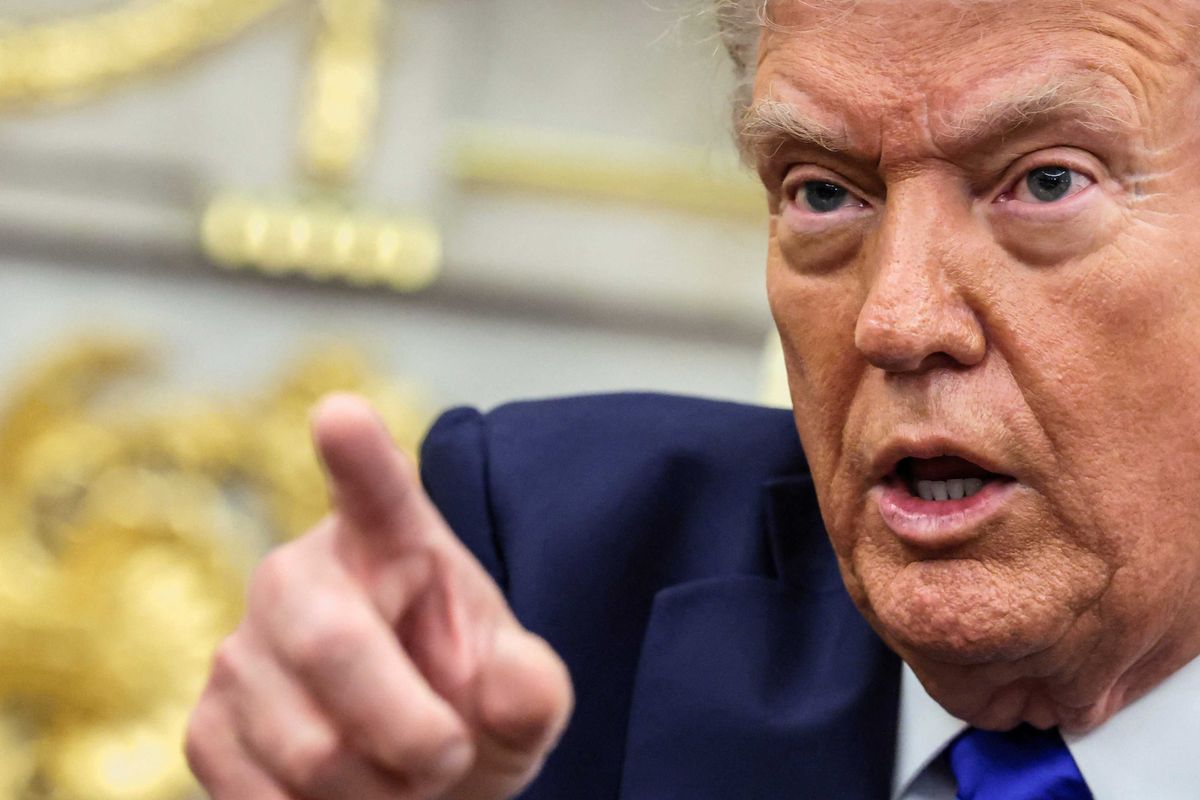
President Donald Trump points a finger during a meeting with Canada's Prime Minister Mark Carney (not pictured) in the Oval Office at the White House in Washington, D.C. on Oct. 7, 2025. REUTERS/Evelyn Hockstein
Donald Trump's Saturday Truth Social spiral drew swift mockery from critics across the political spectrum, with a prominent journalist declaring the president was "really crashing out" and a former Republican congressman summing it up in three words.
Trump said Saturday:
"We should have a giant MAKE AMERICA GREAT AGAIN RALLY, for 250, instead of having overpriced singers, who nobody wants to hear, whose music is boring, and yet who do nothing but complain. Cancel it, just like I canceled my involvement with the failing and unsafe to be in Kennedy Center, because a Highly Conflicted, Crooked Federal Judge, said that I should not be allowed to spend my time and money in order to MAKE THE CENTER GREAT AGAIN, actually, far greater than it ever was before! It would have also been nice to see a Republican/Democrat union bring it back to life. The Kennedy Center is broken, unsafe, and $busted, and has been for many years! Judge Cooper also stated that the highly prestigious Board of the Center was not authorized to add on the name 'TRUMP' despite the fact that hundreds of millions of dollars of my time and money will be necessary for its successful reincarnation. So now, the Kennedy Center will collapse, both structurally and financially. Judge Cooper and his wife, Amy Jeffress (obfuscation anyone?), should be ashamed of themselves. Judge Cooper, like numerous other Crooked Judges on my cases, should be IMPEACHED."
Aaron Rupar, who has built a large following tracking Trump's online behavior, quoted Trump's lengthy rant calling for a MAGA rally to replace the America 250 concert and his threats that the Kennedy Center would collapse without him. "Holy s---, Trump is really crashing out," Rupar wrote.
Adam Kinzinger, the former Illinois Republican congressman who voted to impeach Trump and has since become one of his most outspoken GOP critics, had a shorter take. Quoting Rupar's post, Kinzinger wrote simply: "Such a baby."
Author Jennifer Erin Valent chimed in, "His notorious self obsession has reached the stage of derangement, and still, no one seems inclined to do a thing about it. The dereliction of duty in our time is truly staggering."
Academic Karen Piper said, "This is called a narcissistic injury."
The posts came as part of a broader meltdown that included Trump unveiling a drone port rendering for the White House roof, posting an AI image of himself appearing to use the American flag as a tissue, calling Republican allies "losers," and demanding that Judge Christopher Cooper be impeached after the jurist ordered Trump's name removed from the Kennedy Center.
President Donald Trump points a finger during a meeting with Canada's Prime Minister Mark Carney (not pictured) in the Oval Office at the White House in Washington, D.C. on Oct. 7, 2025. REUTERS/Evelyn Hockstein
Donald Trump's Saturday Truth Social spiral drew swift mockery from critics across the political spectrum, with a prominent journalist declaring the president was "really crashing out" and a former Republican congressman summing it up in three words.
Trump said Saturday:
"We should have a giant MAKE AMERICA GREAT AGAIN RALLY, for 250, instead of having overpriced singers, who nobody wants to hear, whose music is boring, and yet who do nothing but complain. Cancel it, just like I canceled my involvement with the failing and unsafe to be in Kennedy Center, because a Highly Conflicted, Crooked Federal Judge, said that I should not be allowed to spend my time and money in order to MAKE THE CENTER GREAT AGAIN, actually, far greater than it ever was before! It would have also been nice to see a Republican/Democrat union bring it back to life. The Kennedy Center is broken, unsafe, and $busted, and has been for many years! Judge Cooper also stated that the highly prestigious Board of the Center was not authorized to add on the name 'TRUMP' despite the fact that hundreds of millions of dollars of my time and money will be necessary for its successful reincarnation. So now, the Kennedy Center will collapse, both structurally and financially. Judge Cooper and his wife, Amy Jeffress (obfuscation anyone?), should be ashamed of themselves. Judge Cooper, like numerous other Crooked Judges on my cases, should be IMPEACHED."
Aaron Rupar, who has built a large following tracking Trump's online behavior, quoted Trump's lengthy rant calling for a MAGA rally to replace the America 250 concert and his threats that the Kennedy Center would collapse without him. "Holy s---, Trump is really crashing out," Rupar wrote.
Adam Kinzinger, the former Illinois Republican congressman who voted to impeach Trump and has since become one of his most outspoken GOP critics, had a shorter take. Quoting Rupar's post, Kinzinger wrote simply: "Such a baby."
Author Jennifer Erin Valent chimed in, "His notorious self obsession has reached the stage of derangement, and still, no one seems inclined to do a thing about it. The dereliction of duty in our time is truly staggering."
Academic Karen Piper said, "This is called a narcissistic injury."
The posts came as part of a broader meltdown that included Trump unveiling a drone port rendering for the White House roof, posting an AI image of himself appearing to use the American flag as a tissue, calling Republican allies "losers," and demanding that Judge Christopher Cooper be impeached after the jurist ordered Trump's name removed from the Kennedy Center.
No comments:
Post a Comment