World Nuclear News
US enrichment plant begins accelerated review
(Orano)_63508.jpg)
Orano submitted the technical licensing documentation and Environmental Report for the gas centrifuge uranium enrichment facility planned for Oak Ridge, Tennessee, to the Nuclear Regulatory Commission (NRC) earlier this year. The regulator's formal acceptance means that the application moves into full technical review for granting a licence to begin construction and then to operate the facility.
The NRC has set an expedited review schedule for the project, with an estimated completion date of 30 April 2027. This, the NRC says, reflects its broader push to modernise its licensing processes under Executive Order 14300, Ordering Reform of the Nuclear Regulatory Commission, signed last year by President Donald Trump.
Orano's licence application incorporates experience from years of successful commercial operations with uranium enrichment centrifuges at the company's Georges Besse 2 facility in France: the company said it is also leveraging its construction experience with the ongoing 30% expansion in capacity underway at Georges Besse 2.
The licensing effort will also leverage the licensing application from the Eagle Rock Enrichment Facility, a centrifuge plant Orano's forerunner company Areva had previously planned to build at Idaho Falls. The NRC issued a licence in 2011 for Eagle Rock, but the licence was terminated - at the request of the company - in 2018. Orano has committed to provide the NRC with a detailed "crosswalk" comparing the Project IKE application to Eagle Rock, which the NRC says is to "leverage the precedent" from the earlier safety evaluation. "While the staff will rely on the similarities between the two facilities to support scheduled efficiencies, the staff will perform a complete regulatory review of the Project Ike application, and the accelerated schedule assumes those similarities can be effectively leveraged," the NRC said in its acceptance of Orano's application.
"NRC is safely enabling America's efforts to reduce US dependency on foreign enrichment," the regulator's Chairman Ho Nieh said. "Credible, predictable and timely safety reviews - this is how NRC supports American leadership in nuclear energy."
Project IKE - which will be located on unused former Manhattan Project land - represents one of the largest capital developments in Tennessee's history. It is expected to create more than 1,000 construction jobs and 300 long-term career positions, plus an extensive supply chain based in the East Tennessee region, as well as playing a key role in strengthening US energy security: according to Orano, the output from the Project IKE facility alone would be able to replace the enriched uranium America is currently importing from Russia.
"For 15 years Orano has used ETC centrifuges in France to reliably enrich and supply uranium for powering American reactors. Now, we are planning to generate that same secure nuclear fuel supply using the same proven technology and processes at our Project IKE facility in Oak Ridge, Tennessee," Jean-Luc Palayer, CEO of Orano USA, said. (ETC - Enrichment Technology Company - is a joint venture of Orano and Urenco which develops, manufactures and installs gas centrifuges for uranium enrichment.)
"With the NRC's 12-month timeline and Orano's expertise, we are on a good path to begin enriching a significant amount of uranium at Project IKE in time to supply America's quickly increasing nuclear energy needs," he added.
Atucha II granted 10-year licence renewal
_38085.jpg)
The renewal process included the submission of technical documentation, and regulatory evaluations and inspections aimed at verifying the meeting of conditions to guarantee safe and reliable operation of the plant during the 10-year period.
The president of Nucleoeléctrica, Juan Martín Campos, said "the renewal of this licence represents a recognition of the technical and operational capabilities developed by Nucleoeléctrica to guarantee a safe, reliable operation aligned with the highest regulatory standards ... this new licensing period allows us to further consolidate the strategic role of Atucha II within the Argentine energy system and to project the development of the national nuclear sector in a context of growing global energy demand".
Background
Atucha II is a 693 MWe pressurised heavy water reactor and was ordered in 1979. It was a Siemens design, a larger version of the first unit at Atucha, and construction started in 1981 by a joint venture of Argentina's National Atomic Energy Commission and Germany's Siemens-Kraftwerk Union. However, work proceeded slowly due to lack of funds and was suspended in 1994 with the plant 81% complete.
In 1994, Nucleoeléctrica Argentina was set up to take over the nuclear power plants from CNEA and oversee construction of Atucha II. In 2003, plans for completing Atucha II were presented to the government. The government announced a strategic plan in August 2006 for the country's nuclear power sector, including completion of Atucha II. The unit was effectively completed in September 2011. First criticality was achieved early in June 2014, and grid connection was later that month, with full power in February 2015.
In December 2015 the Autoridad Regulatoria Nuclear (ARN) granted a conditional operating licence for Atucha II until May 2016, and issued its initial five year licence on 26 May 2016 following the completion of a programme of testing, training and other actions. The first, two year, extension was granted in May 2021 but the unit was shut down from October 2022 for repairs after the discovery that one of the four internal supports of the reactor had detached and moved from its design location.
That led to ARN issuing a second short-term extension to 26 May 2024, so that Nucleoeléctrica Argentina, could "implement corrective improvement actions". After verifying that Nucleoeléctrica had implemented these actions "in compliance with the established safety requirements" the regulator authorised the unit's entry back into service in August 2023, following a 10 month shutdown. In March 2024 it issued a renewed licence to Nucleoeléctrica Argentina for the operation of the second unit of the Atucha nuclear power plant until 26 May 2026, marking its first 10 years of commercial operation.
Kazakhstan outlines localisation plans
_35252.jpg)
The Comprehensive Plan for Developing Localisation in the Nuclear Industry for 2026–2030 was developed by Kazakhstan's Atomic Energy Agency, jointly with Kazakhstan Nuclear Power Plants LLP, interested central government agencies, and the National Chamber of Entrepreneurs of the Republic of Kazakhstan "Atameken", the Atomic Energy Agency said. It was approved by the government on 14 May.
The document provides for the phased preparation of Kazakh enterprises for participation in nuclear projects, taking into account international safety and quality requirements. It covers four key areas: developing a regulatory framework, analysing the needs and potential of the domestic market, modernising and establishing production facilities, and the digitalisation of processes. According to press reports, the goal is to boost "local content" - which can currently meet about 20-22% of the nuclear industry's demands - to around 30% by the time construction of the country's first nuclear power plant begins, representing a market value of around USD4 billion to USD4.5 billion.
Kazakhstan is the world's leading producer of uranium. In June last year, Russia's Rosatom was selected as the leader of an international consortium to build Kazakhstan's first planned nuclear power plant - to be called the Balkhash plant - in the village of Ulken, in Zhambyl district, on the shore of Lake Balkhash. The Atomic Energy Agency's strategy for the Development of the Nuclear Industry in Kazakhstan sees at least three nuclear power plants operating by 2050, with a project for a fourth one possible.
"To ensure the quality, safety, and transparency of NPP project implementation, it is planned to introduce a registry of suppliers of goods, works, and services. Inclusion in the registry will be a mandatory requirement for participation in the project and will enable the pre-selection of qualified and reliable companies, support domestic producers, including small and medium-sized businesses, and minimise corruption risks through transparent procedures and regular monitoring of participants," the Atomic Energy Agency said.
The implementation of the plan is expected to "help create a sustainable production ecosystem for the nuclear industry, attract investment in the industry, develop new products, and ensure the participation of Kazakhstani enterprises in major infrastructure projects across the country", it added.
Kursk II's first VVER-TOI 'has generated 2 billion kWh'
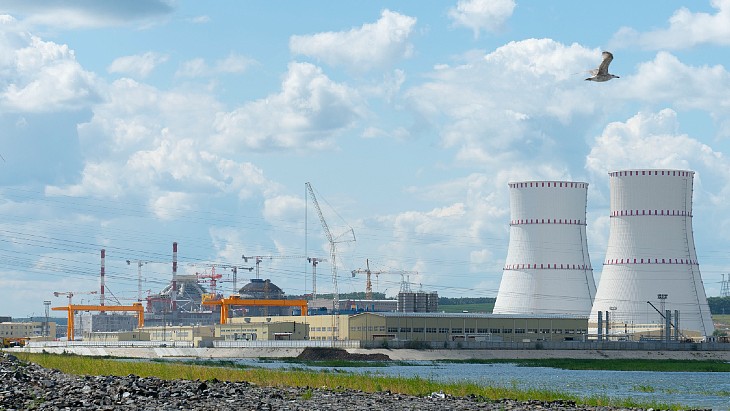
The VVER-TOI is Russia's most powerful nuclear power unit. It was commissioned and officially transferred to operational status and entered the energy and capacity market and began supplying Russia's Unified Energy System at the start of the month.
Kursk Nuclear Power Plant Director Alexander Uvakin said: "Thanks to the VVER-TOI, the Kursk NPP has joined the ranks of Russia's largest nuclear power plants, operating at over 3,000 MW. Every billion kWh contributes to energy independence, industrial development, and the comfort of tens of thousands of families."
Construction is under way on units 2 and 3, which will also be VVER-TOI reactors. The plan is for there to be four units at the plant, providing a total capacity of 5,000 MW.
Rosatom says that more than 90,000 people and about 250 contractors and subcontractors took part in the project for the first new unit.
The start of commercial operation followed a period of pilot industrial operation - and the conducting of more than 1,500 tests of the power unit's systems and equipment - before the go-ahead from regulator Rostekhnadzor was issued 27 April.
Background
Kursk II is being built near the existing Kursk nuclear power plant in western Russia, about 60 kilometres (37.5 miles) from the Ukraine border. It will feature four of the new VVER-TOI reactors, the latest version of Russia's large light-water designs. They have upgraded pressure vessels and a power rating of 1,250 MW.
Construction of the first unit began in 2018, its polar crane was installed in October 2021 and the reactor vessel was put in place in June 2022. Concreting of the outer dome of the first unit was completed in August 2023. With the second and third units also under construction, the target is for all four units to be in operation by 2034.
Rosatom says the service life of the main equipment has doubled, and that the VVER-TOI units feature a mix of passive and active safety systems and include a core meltdown localiser. It can also operate with 100% mixed oxide fuel containing uranium and plutonium (MOX fuel).
The new units at Kursk II will replace the four units at the existing, nearby nuclear power plant, which are scheduled to all have shut by 2031.
The first unit was shut down after 45 years of operation in December 2021 and the second unit followed in January 2024. The original design life for the four RBMK-1000 reactors at the plant was for 30 years but had been extended by 15 years following life extension programmes.
Antares signs long-term HALEU supply deal with Urenco
_13284_2_95976_24064.jpg)
Magnus Mori, Head of Advanced Fuels for Urenco, said it was "the world’s first multi-year contract for the supply of HALEU (high-assay low-enriched uranium), which marks an important milestone in the maturation of this new market".
The fuel is to be produced at Urenco's HALEU enrichment facility in the UK, which is scheduled to come online in 2031.
Jordan Bramble, CEO of Antares, said: "This partnership ensures that when we scale beyond material allocated by the federal government, we will have commercial supply ready to meet our needs."
Antares, founded in 2023, says it is on track to conduct a reactor demonstration in 2026 and test its first electricity-producing reactor in 2027, with initial production deployments beginning in 2028. The company is in the final phase of the Department of Energy's Reactor Pilot Program to build a reactor that achieves criticality before 4 July this year. BWX Technologies began fabrication of the TRISO fuel for the company's initial reactors last October.
HALEU - uranium enriched to between 5% and 20% uranium-235 - will be used in the advanced nuclear fuel required for most of the next-generation reactor designs currently under development. In 2024, when only Russia and China had the infrastructure to produce HALEU at scale, the UK Government announced funding of GBP196 million (about USD263 million) to Urenco to support the build of a HALEU fuels facility at its Capenhurst enrichment site in the northwest of England.
Licensing milestone for Texas SMR plant
_19025.jpg)
This marks a key milestone in the review process for the proposed project which would see four X-energy Xe-100 high-temperature gas reactor units built at Dow's Seadrift site, the US Nuclear Regulatory Commission (NRC) said.
Long Mott Energy LLC - a wholly owned subsidiary of Dow - submitted the construction licence application in March 2025, and the NRC began its environmental review in June. The regulator - which is working to streamline the route to deployment of advanced reactor technologies at the direction of executive orders signed by President Donald Trump last year - determined that an environmental assessment (EA), rather than a more extensive environmental impact statement (EIS), better addresses the project's limited environmental footprint at an existing industrial location. This approach allows for a more efficient review while maintaining rigorous environmental standards, the NRC said.
"This milestone demonstrates that we can complete our reviews efficiently, enabling new reactor projects while upholding our responsibility to protect people and the environment," said NRC Executive Director for Operations Mike King. "Using an environmental assessment in this case reflects the project's relatively low potential for environmental impacts and helps provide a more predictable path forward."
The NRC concluded that the potential environmental impacts from the construction of the Long Mott Generating Station "would not be significant" and has determined that a "Finding of No Significant Impact is warranted, and … the preparation of an EIS is not required".
The Finding of No Significant Impact conclusion on the environmental assessment follows an extensive independent analysis by NRC staff, evaluating potential impacts to air quality, water resources, and local species habitats under globally recognised safety and environmental standards. The NRC's environmental review, completed in less than a year, benefitted from X-energy's pre-licensing work on the Xe-100 and the comprehensive construction permit application which included an in-depth environmental report supported year-long field surveys, groundwater monitoring wells with 12 months of water quality measurements, and engagement with multiple state agencies including the Texas Historical Commission, Texas Parks and Wildlife Department, and Texas General Land Office, X-energy said.
"This is a significant milestone for the Long Mott Energy project and we appreciate the comprehensive and efficient manner in which the NRC conducted its assessment," said Edward Stones, business vice president, Energy & Climate, Dow. "We are another step closer to expanding access to safe, clean, reliable, cost-competitive nuclear energy in the US."
The NRC said it expects to complete its safety review of the construction permit application later this year, consistent with the 18-month timeline required by Executive Order 14300. A final agency decision on the permit would follow. The construction permit would authorise building the facility, but the company would need to submit a separate application for licences to operate the plant.
Long Mott Generating Station is tipped to be the first grid-scale advanced nuclear reactor deployed to serve an industrial site in North America. The Xe-100 units are engineered to operate as a single 80MW electric unit, and are optimised as a four-unit plant delivering 320 MWe: the reactor can provide baseload power to an electricity system or support industrial applications with 200 MW thermal output per unit of high-pressure, high-temperature steam.
Dow is one of several tech giants and other major energy users to have signed the Large Energy End Users Pledge, supporting the goal of at least tripling nuclear energy by 2050. The Long Mott project is expected to reduce emissions from the Seadrift site - which manufactures more than 4,000,000 pounds (1816 tonnes) of materials per year for use in applications such as food packaging, footwear, wire and cable insulation, solar cell membranes and packaging for pharmaceutical products - by about the equivalent of 440,000 tonnes of carbon dioxide per year.
No comments:
Post a Comment