With no recorded cases of Ebola, many Kenyans are struggling to understand why their government is allowing the United States to build an Ebola facility in their country to treat US citizens. Despite protests and criticism, the Kenyan government has vowed to press on.
Issued on: 06/06/2026 - RFI

The centre at Nanyuki, near the Laikipia military base 190km north of Nairobi, is set to quarantine Americans arriving from neighbouring Democratic Republic of Congo, which is battling a major Ebola outbreak.
The facility will have 50 isolation beds and be managed by US staff. A US diplomatic source said it was nearing completion and currently had no patients.
Hundreds of Kenyans have taken to the streets in recent weeks to protest against the plan, arguing that the country should not be asked to host people exposed to a disease it has never recorded.
Public anger
"Kenya is not an American colony!" protesters chanted on Tuesday as they carried an Ebola coffin to the health ministry.
"If Ebola is too dangerous for Americans, it's also too dangerous for us," protesters from Nanyuki told RFI.
Two people were killed in central Kenya after police opened fire on Tuesday, Patrick Wahome, one of the organisers of the march, said. A security source also said two people had died but did not specify the cause of death.
There is also anger over what critics see as the neo-colonial nature of the project, with Washington refusing to allow Ebola patients into its own territory while sending them to Kenya.

Laikipia is already home to a long-standing British army base that has brought prosperity to the area but has also been linked to incidents of rape and murder involving local women.
"The proposed establishment of the Ebola quarantine hospital in Laikipia is against the Madaraka [self-governance] principle... That is neo-colonialism," Laikipia Governor Mutula Kilonzo Junior said in a speech.
Kahura Mundia, deputy chairperson of the Kenya Medical Practitioners, Pharmacists and Dentists Union, told Citizen TV that allowing Ebola patients to travel beyond the borders of the DRC and Uganda could contribute to spreading the disease further if countries were not properly prepared.
Opposition MP Willis Evans Otieno questioned Kenya's decision to host suspected Ebola cases, saying that "the powers pushing for this arrangement will be the first to restrict our movements" if a case were detected.
Court challenge
A Kenyan court temporarily suspended the plan on 28 May following a complaint by civil society organisation Katiba Institute – a legal advocacy group.
On Tuesday, Kenya's High Court blocked the proposed facility for another three weeks, and ordered the government to disclose its agreement with Washington.
Judge Patricia Nyaundi barred the government from taking any steps to build or begin operating the facility before the case is resolved.
The judge also ordered the government to disclose all agreements and operating protocols related to the facility within seven days and scheduled the next hearing for 23 June.

Conflicting accounts
The US government says it is continuing to build the facility despite the protests and court rulings.
US military aircraft have continued flying in staff and equipment in recent days, US officials and diplomatic sources said. Data from flight-tracking website Flightradar24 showed at least nine aircraft had arrived since 24 May.
The facility is intended for Americans who have been exposed to the virus but do not have symptoms. US officials said patients who develop symptoms would be transferred to other countries for treatment.
Health Minister Aden Duale told parliament on Wednesday that the centre would go ahead and would serve both Kenyans and Americans, rejecting claims that it would be exclusive.
"Quarantine is not only for Americans. Even Kenyans will be isolated at the facility," Duale said. "Laikipia air base is one of the 23 quarantine isolation centres we are building. And we will not stop it."
Disputed purpose
However, a US official speaking on condition of anonymity told Reuters the facility would only treat US citizens.
During a state visit to South Africa on Thursday, President William Ruto defended the decision to allow the US to build the centre.
"It would be most unfortunate if on one request by the Americans to set up a facility at their cost, we would refuse, we would look very inhuman," he told a press conference.
The US intends to provide $13.5 million for Kenya's Ebola preparedness efforts.
The outbreak of the rare Bundibugyo strain of Ebola is centred in eastern Congo and several cases have spread into neighbouring Uganda.
There have been at least 344 confirmed Ebola cases in Congo, including 48 deaths, and 116 suspected cases, according to the World Health Organization. Uganda has recorded at least 15 confirmed cases.
(with newswires)
The deadly Ebola outbreak isn't the only thing causing concern for health workers in Congo. Rumors and disinformation are hindering efforts to contain the virus. The patterns are well-known — and could be confronted.

Three weeks since the start of the latest Ebola epidemic in the Democratic Republic of Congo, there have been 397 confirmed cases, including 63 confirmed deaths, according to the latest figures reported by the African Union's Africa Centres for Disease Control and Prevention.
And yet: "The community does not believe in this disease. Despite the deaths, people don't believe in it," said John Tumujimbe, head of a team for dignified and safe burials in the small town of Mongbwalu, one of the epicenters of the Ebola epidemic in the Congo's northeastern Ituri province.
"We initially thought of malaria, typhoid or diarrheal diseases," Tumujimbe said. "But, after so many deaths, we sent samples to the INRB."
The INRB — Congo's National Institute for Biomedical Research in the capital, Kinshasa — confirmed that these were indeed cases of Ebola. This led health officials to announce the 17th Ebola epidemic to be recorded in Congo since the virus was first discovered in 1976.
Ebola rumors lead to arson attacks
But health officials say many residents in Mongbwalu rejected this scientific answer.
"When there were the first deaths, there was talk that the coffins were a problem, that it spread from there," said one Mongbwalu resident, who did not want to be named.
Tumujimbe also heard this rumor. "That's how it started: people talked about a coffin that kills people. And then more people died."
Another rumor: Aid workers and paramedics were spreading the virus via the antennas of their vehicles.
At the end of May, an angry crowd gathered at Mongbwalu's general hospital. They demanded that authorities return the bodies of their deceased, eventually setting fire to a tent belonging to the aid organization Doctors Without Borders. The organization had to withdraw its staff.
"There was a panic," hospital director Richard Lokudi told DW. "This allowed several suspected cases to escape. Eighteen patients who were under observation have disappeared."
The health workers worry suspected Ebola patients could have passed the disease on to the people who were sheltering them. There is still no vaccine for the Bundibugyo variant of the Ebola virus now circulating.
Familiar rumors blunt Ebola response
Christopher Nehring specializes in researching disinformation, and co-authored a report on the current Ebola epidemic for the Konrad Adenauer Foundation. He said similar rumors pop up in every health emergency.
"They say the disease comes from the lab as a bioweapon; that the vaccination is more harmful than the virus; that there is a simple cure that is being concealed; that the disease is not real. Big Pharma is mentioned either as the profiteer of the crisis or as the ones who originated it," Nehring told DW.
"It's all been known for decades. And it varies, there are 100 different variations of these narratives."
For the report, Nehring sought information from Congolese fact checkers. One of them is Ange Kasongo, founder of Balobaki Check, based in Kinshasa. Talking with DW, she recalled conversations she had with miners — gold mining is important for the economy in the province of Ituri.
"They said that the rumors and myths about death were circulating, but that the people there didn't believe them," Kasongo said.
The explanation she was given went: "If a trader wants to earn or mine a lot of gold, he may also resort to mystical acts to eliminate his competitors."
This suggests that economic pressure is also preventing the epidemic from being dealt with openly.
Kasongo highlights another rumor: Private messages circulating on WhatsApp have claimed a conspiracy between Congolese President Felix Tshisekedi and renowned virologist Jean-Jacques Muyembe — who discovered the virus 50 years ago — to wipe out the population in eastern Congo
The Balobaki Check team was unable to find any supporting evidence of this claim.
Without reliable media, disinformation spreads easily
The global community is making significantly less money available for emergency aid measures, which makes fighting Ebola harder.
US President Donald Trump withdrew the United States from the World Health Organization in 2025, and ordered massive cuts to USAID and the crisis management program at the US Centers for Disease Control and Prevention.
European governments have also cut funding, partly due to the cost of militarization efforts in the wake of the war in Ukraine.
For Nehring, this situation has also encouraged the spread of fake news. "If the money for health aid has already been cut, then you can't talk about bigger budgets for health communication either," said Nehring.
Nevertheless, Ange Kasongo pointed out the authorities were making every effort to communicate clearly. But she also told DW this had its limits. "How can we ensure that information is passed on orally — not just in French, not just in the four national languages?"
According to Kasongo, it;s important to get community leaders on board and give them access to reliable information.
Rachidi Kudra contributed reporting.
This article was originally written in German.

Philipp Sandner Editor
.jpg)
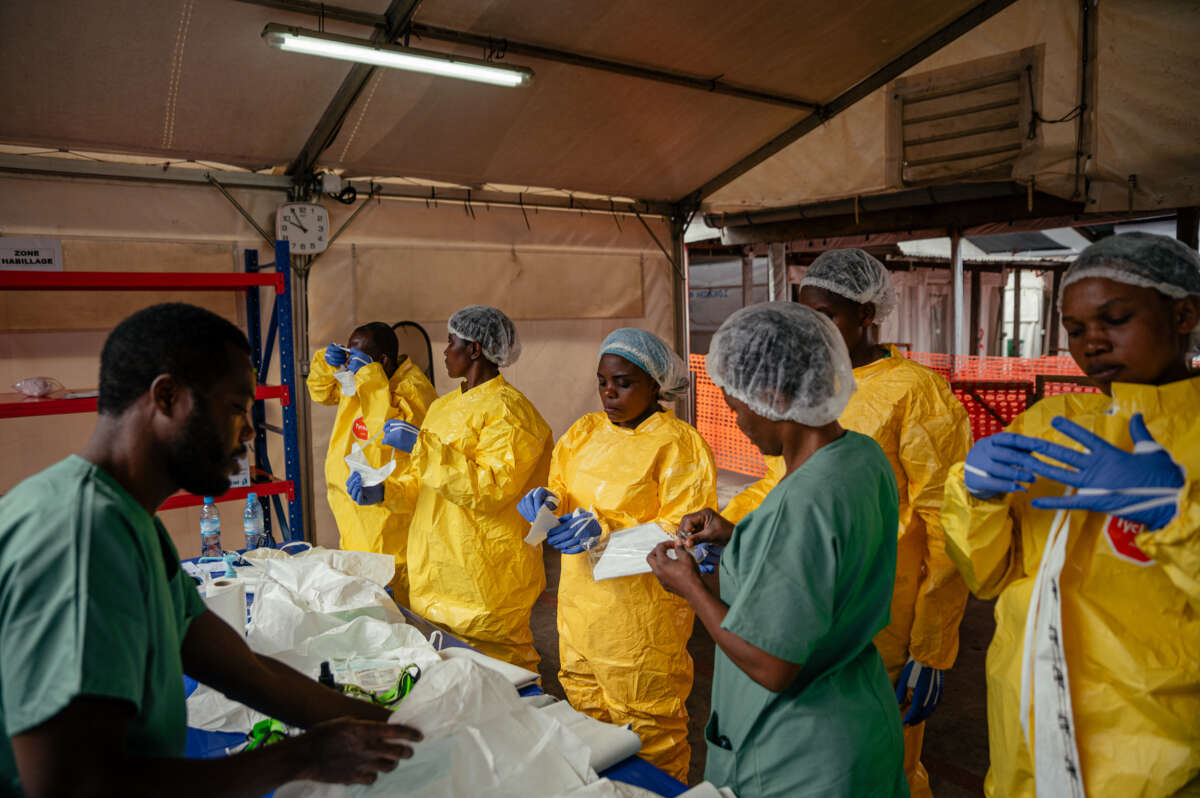
Health teams in personal protective equipment (PPE) respond to the Ebola outbreak in eastern DR Congo. Photo Credit: WHO/Joël Lumbala
June 6, 2026
UN News
By Vibhu Mishra and Cristina Silveiro
In a village in eastern Democratic Republic of the Congo (DRC), health workers arrived a few days ago to help bury a person who had died from Ebola. Instead, they were threatened, told armed rebels would be called if they stayed, and forced to leave.
The family carried out the burial themselves – potentially exposing dozens more people to the virus.
The incident offers a stark illustration of one of the biggest obstacles facing efforts to contain the latest deadly epidemic, which has infected 381 people and claimed 64 lives in DRC as of 3 June.
For Marie Roseline Belizaire, the World Health Organization’s (WHO) Emergency Preparedness and Response Director for Africa, the most challenging part is not always the virus itself – it can be sitting with families who believe the disease is caused by witchcraft, persuading traditional healers to work alongside health teams or health teams returning to communities that threatened them – only days earlier.
“We are not trying to overcome their culture,” she said. “We’re trying to involve the science in their own belief.”
Progress, but not yet control
The outbreak, caused by the rare Bundibugyo strain of Ebola virus – for which there is no vaccine or treatment – continues to spread in eastern DRC while cases have also been reported across the border in Uganda.
Speaking to UN News from Bunia, in Ituri province, Dr. Belizaire said the response has made significant gains in recent weeks, particularly in testing capacity.
At the start of the outbreak, laboratories could process about 40 tests a day. That capacity has now expanded to 800 daily tests, allowing suspected cases to be confirmed or ruled out much more quickly.
“All the tests that we are receiving, we are rolling them out at the same day, almost,” she said. “The time to expect your result has been reduced. Twenty-four, maximum 48 hours you have the result.”
Community alerts are first investigated in the field, with those meeting the outbreak’s case definition tested and either confirmed or ruled out – allowing suspected cases to be cleared from the system more quickly than at the start of the outbreak.
Firmer trace
Contact tracing rates have improved from around 25 per cent to 45 per cent, but that remains far below the 90 to 95 per cent coverage needed to effectively contain transmission.
“We still have a lot of challenges,” she said, adding that the outbreak’s regional dimensions remain a concern.
Uganda has recorded 15 confirmed cases and one probable case linked to the outbreak. One Congolese national also travelled through the United Arab Emirates before arriving in Uganda, highlighting how quickly infectious diseases can move across borders.
“When there is an outbreak and you have mobility, it is always a concern,” Dr. Belizaire said, stressing however that mechanisms such as WHO’s International Health Regulations help countries share information rapidly and coordinate responses.
Trust in public health
For WHO teams on the ground, one of the most complex tasks is building trust. Many communities in affected areas have experienced years of conflict and insecurity. Cultural beliefs and misinformation can also shape how people interpret illness and death.
“The disease symptoms are very malaria-like in the community,” Dr. Belizaire explained.
Some families attribute deaths to witchcraft or poisoning rather than infection.
Health workers therefore focus on coexistence rather than confrontation.
“We don’t stop them to believe in witchcraft, to believe any other things in their culture,” she said. “We just ask them to simultaneously believe in the disease existence also.”
Ancient and modern
Traditional healers are also being engaged as partners rather than excluded.
“We don’t stop them going to traditional healers,” she said. “We ask [the healers], if you see someone with those symptoms, refer it also to us.”
The approach reflects lessons learned from previous Ebola outbreaks, where mistrust often proved as dangerous as the virus itself.
WHO Director-General Tedros Adhanom Ghebreyesus, who recently visited the outbreak’s epicentre, warned that “misinformation is almost as dangerous as the virus itself, and spreads just as fast.”
Reasons for hope
Despite the difficulties, there have been encouraging signs. Seven people have recovered from Ebola, including six healthcare workers.
Most sought treatment early and received intensive supportive care, including rehydration and treatment for symptoms while their immune systems fought the infection.
“They recovered because they went early to the hospital,” Dr. Belizaire said.
Candidate vaccines under development
There is currently no licensed vaccine or approved treatment for the Bundibugyo strain, although candidate vaccines are under development.
But Dr. Belizaire stressed that even a vaccine would not replace the need for early detection and treatment.
“The key is, as soon as you have symptoms, you go to the healthcare centre,” she said.
A survivor’s determination
Among the encounters that have stayed with Dr. Belizaire most is that of a healthcare worker who contracted Ebola while caring for a patient. The female medic later recovered.
Rather than leaving the profession, she said she intends to continue serving others.
“She said she will not stop,” Dr. Belizaire recalled. “She said she was born to give care to others, and it is what she will continue doing.”
That story reflects the resilience of health workers and communities confronting the outbreak every day.
U.S. warns Ebola outbreak on scale of largest ‘is possible’

The U.S. CDC on Friday urged strong public health interventions against the current Ebola outbreak, citing their models that show it could otherwise rival the scale of the 2014 West Africa outbreak.
That eruption of the virus resulted in more than 28,000 cases and more than 11,000 deaths.
“That scale is possible,” said Jason Asher, director of CDC’s Center for Forecasting and Outbreak Analytics, during a press briefing.
The US projections from the Centers for Disease Control and Prevention were part of Morbidity and Mortality Weekly Report documents published Friday.
The worst outcomes could be avoided if “a larger proportion of patients were identified, isolated, and treated,” the agency said in its reports.
But “the public health response to control this outbreak will likely need to be of similar magnitude to the response for the 2014-2016 West Africa Ebola outbreak.”
Asher emphasized the models were “not a forecast” but “a planning tool.”
“They’re designed to support action, not to generate alarm.”
They are based on four possible intervention scenarios ranging from poor (20 percent) to extremely high (95 percent) levels of isolation and treatment.
If isolation levels are what the CDC would consider poor, with no other interventions there is a 65 percent chance cases will top 20,000 within three months, according to the agency.
Satish Pillai, the CDC manager for the Ebola response, said “the total individuals that are infected and requiring isolation remains unclear.”
But he said the situation on the ground would indicate levels of isolation are currently on the lower end.
Also on Friday the World Health Organization and the African Union’s public health agency said $518 million was needed across the next six months to combat the deadly Ebola outbreak in the DR Congo and its neighbors.
The outbreak was declared on May 15 in northeastern DR Congo, but the rare Bundibugyo species of the Ebola virus is believed to have spread for some time beforehand.
According to the WHO’s latest figures, there are 381 confirmed cases in the DRC, including 64 deaths.
The outbreak has hit three provinces, with the epicenter in Ituri, which the Africa CDC says accounts for 90 percent of confirmed cases and 76 percent of confirmed deaths.
Across the northeastern border in Uganda, there have been 16 confirmed cases, including one death.
Seven Ebola patients in the DRC and two in Uganda have recovered.
Trump slashed more than 30 CDC experts and 140 USAID staff who managed the 2018 Ebola outbreak on the ground in the DRC.
By Sasha Abramsky ,
In 2018, when the Democratic Republic of the Congo (DRC) experienced a severe Ebola outbreak, more than 30 experts from the Centers for Disease Control and Prevention (CDC), close to 20 disaster-response specialists from the U.S. Agency for International Development (USAID), and 120 additional USAID staff were on the ground attempting to manage the outbreak, according to estimates from Friends of USAID, an advocacy organization mainly made up of ex-USAID staffers. With that level of staffing in 2018, by and large, they succeeded in limiting the extent to which the disease spread.
This year, as a particularly virulent strain of the Ebola virus — the Bundibugyo strain, against which there is no approved vaccine and for which there are no medicinal cures — runs rampant in the Democratic Republic of the Congo, Friends of USAID estimate there is only one CDC staffer on the ground there, along with five additional State Department personnel. There are of course no USAID workers present, since the Trump administration dismantled USAID during the purges led by the so-called “Department of Government Efficiency” (DOGE) in 2025, summarily firing local health care contractors around the world, including in countries with extreme poverty rates such as the Democratic Republic of the Congo.
In addition, since Donald Trump signed an executive order pulling the U.S. out of the World Health Organization in early 2025 — a pullout that was completed in January of this year — CDC experts are no longer allowed to communicate with World Health Organization personnel. And despite a waiver having been granted for Ebola-related correspondence, in practice there has been a significant breakdown in communication between the two agencies over the past year — a breakdown promoted by the Trump administration, which recently sent out an email reminder to CDC staff not to correspond with the World Health Organization.
The consequences have already been devastating. In past Ebola outbreaks, even before mass testing of disease victims got underway, the CDC and USAID were able to tell when an epidemic was picking up steam based on on-the-ground medical observations and data about excess mortality figures. And, in response, they were able to position medical resources effectively.
In the current outbreak, the decimated remnants of the CDC were caught unawares, only finding out about the outbreak once hundreds, and possibly thousands, of people had already been infected — thus making it far more likely that this outbreak will prove particularly difficult to corral.

Trump Admin Cuts to USAID, WHO, Likely Stalled Response to Ebola, Experts Warn
“Facilities in affected areas are operating without basic protective supplies” due to cuts to USAID, one expert said. By Chris Walker , Truthout May 26, 2026
Because so many experts have been fired over the past 16 months, and because political overseers have been limiting what the remaining scientists can say and write, “the CDC is not really functional anymore,” Angela Rasmussen, professor of virology at the University of Saskatchewan in Canada, told Truthout. Rasmussen, who also serves as science chair for the Save America Movement, a nonpartisan organization that works to stop ongoing assaults on public health, added that the administration was no longer bothering to consult remaining CDC experts when making policy to respond to the outbreak. “It used to be an evidence-driven process and now it’s a political-driven process,” Rasmussen said.
“I equate it to having the mayor’s office taking on a fire without having a fire department or a fire hose.”
“I equate it to having the mayor’s office taking on a fire without having a fire department or a fire hose,” Demetre Daskalakis, former director of the CDC’s National Center for Immunization and Respiratory Diseases, told Truthout. Daskalakis, who resigned last August because he was so concerned about the direction that the Department of Health and Human Services was taking under Robert F. Kennedy Jr.’s leadership, says that when faced with grave public health challenges, the administration is simply resorting to “a lot of posturing, with, I think, bad consequences.”
Faced with the twin public health emergencies of the Ebola virus outbreak in the Democratic Republic of the Congo and Uganda, alongside the hantavirus outbreak on a cruise ship from which people disembarked to the four corners of the Earth, the Trump administration’s response has been, at best, ad hoc. Instead of implementing expert-driven protocols, it has leaned on its nativist instincts to simply attempt to lock the virus out. That attempt proved a colossal failure during the early days of the COVID-19 pandemic. And, according to Rasmussen and Daskalakis, the signs are not auspicious for it being a successful strategy against the global health crises of 2026.
For U.S. residents exposed to hantavirus, the Trump administration has ordered mandatory 42-day quarantines in a secure facility in Omaha, Nebraska — despite the fact that experts say the virus doesn’t spread easily and that home quarantine would be just as effective. For U.S. residents exposed to the Ebola virus in Africa, the response has been to refuse them entry back into the United States and to instead have them isolated and, if need be, treated in Kenya — a situation that Rasmussen and other experts say makes little sense given the huge investments made over the past decade in secure biocontainment units in the U.S. “They’re throwing evidence-based risk assessment out the window, and are trampling people’s 14th Amendment rights,” Rasmussen told Truthout. “If we’re going to take Americans’ freedom away, there should be a real basis for that — and there’s not.”
Telling people in the U.S. that if they get exposed to the Ebola virus, they won’t be allowed back into their home country for months is, experts believe, a surefire way to discourage U.S. doctors and public health professionals from heading to Africa to try to contain the outbreak. In other words, it is a strategy all but guaranteed to make a bad situation worse.
“It took so long for the CDC to say anything about hantavirus or to hear from the DRC about Ebola. Relationships that took decades to build have simply disappeared.”
At the same time, African victims of the disease, who could certainly benefit from access to the treatment center being established in Kenya, are being deliberately excluded from it. “There’s an equity issue,” Daskalakis says of this policy. This, too, will end up hurting public health, as the Ebola patients denied access to the Kenyan facility will, in all likelihood, end up spreading the disease further in their communities or in poorly resourced medical facilities to which some eventually may turn.
Aryn Backus, a CDC employee who has been on administrative leave for more than a year since her job was targeted by DOGE, and who is now deputy executive director of the National Public Health Coalition, told Truthout that the ham-handed U.S. response to the outbreak overseas makes it more likely that the disease will ultimately find its way to the United States. “Diseases don’t understand borders,” she said. And, without detailed international coordination, the likelihood of their spreading far and wide grows.
“We are seemingly not at the table anymore,” Daskalakis added, as he detailed the myriad ways that the U.S.’s role as global public health leader has been corroded. “It took so long for the CDC to say anything about hantavirus or to hear from the DRC about Ebola. Relationships that took decades to build have simply disappeared.”
No comments:
Post a Comment