Bolivia into the abyss
First published at NACLA.
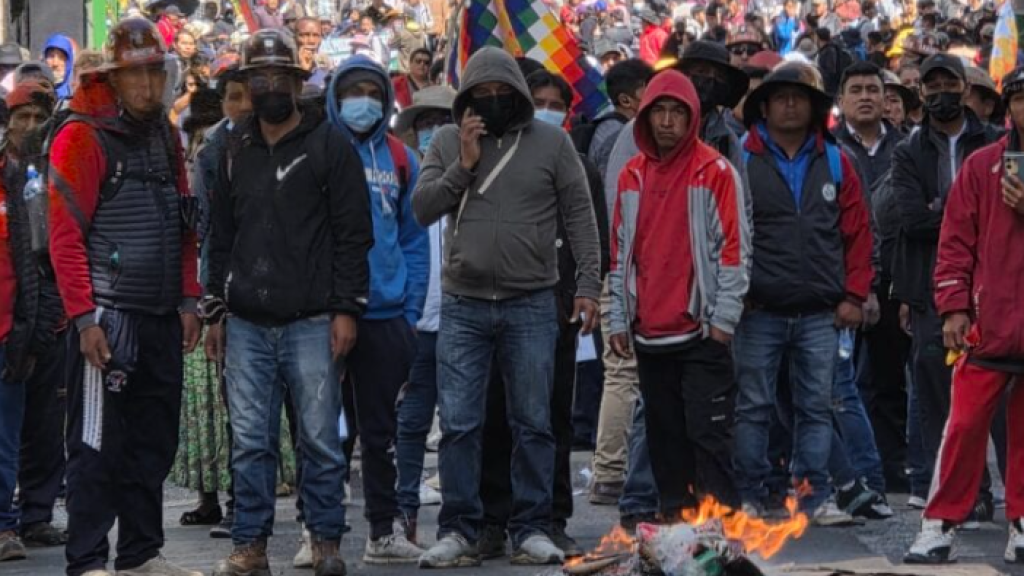
In May 2026, Bolivia once again found itself staring into the precipice of a deep economic and political crisis. Blockades from various social sectors shut down vital highways, leading to food and fuel shortages. The Bolivian Workers’ Confederation (COB), the Ponchos Rojos militant highland Indigenous movement, supporters of former Movement Towards Socialism (MAS) president Evo Morales, and residents from the city of El Alto all marched on La Paz, demanding the resignation of center-right President Rodrigo Paz, who was inaugurated last November. They were joined by cooperative miners, rural and urban teachers, and a campesino march that arrived from the Pando department in the northern reaches of Bolivia in early May. For their part, residents from the “rebel” city of El Alto shut down the major thoroughfares in and out of La Paz and the area around the gas refinery in Senkata.
The tell-tale sounds of dynamite explosions and petardos echoed through the mountainous bowl of La Paz as protesters battled with the police. The acrid smell of tear gas accompanied this soundtrack of protest as the economic crisis that began before the Covid-19 pandemic assumed political form.
Some on the international left hailed these protests as a renewed round of anti-neoliberal protests, a rerun of the 2000 to 2005 cycle of social movement protest that captured the hearts and minds of the anti-globalization movement. On the other side of the political divide, former conservative Latin American leaders, members of Donald Trump’s newly formed “Shield of the Americas,” and domestic right-wing figures decried the alleged overthrow of Bolivian democracy.
Unsurprisingly, neither of these two positions accurately reflect the on-the-ground reality of events. The blockades are not part of a wider national project, nor are they driven by a collation of social forces capable of leading and dominating. They represent the socio-political response to crisis in a context where large swathes of the Bolivian population lack representation in formal political institutions and social movements are fragmented. Let’s turn to each of these facets of the protests in turn.
Economic crisis
The economic crisis confronting Bolivia is due, in large part, to the collapse of state-led capital accumulation in the hydrocarbons sector. From 2014 onwards, a fall in international commodity prices, the exhaustion of the four mega gas fields underpinning Bolivian gas production, and the discovery of non-conventional hydrocarbon deposits in its two export markets, Argentina and Brazil, significantly reduced the fiscal revenue of the Bolivian state. The lithium sector has, thus far, failed to get off the ground, while agribusiness, the heart of elite capital accumulation in the eastern lowlands, does not produce dollar reserves for the Bolivian state to the same extent as hydrocarbons. Neither, for that matter, does the mining sector, which has much lower royalty and taxation rates both in the industrial segment led by transnational capital and in the small-scale cooperative segment.
The MAS government of Luis Arce Catacora (2020–2025) attempted to stave off inflation in the wake of the Covid-19 pandemic by spending its dollar reserves to maintain Bolivia’s de facto dollar peg. Hydrocarbon imports ironically ate further and further into the fiscal deficit thanks to fuel subsidies that proved politically impossible to remove. By last year, the country’s mounting economic crisis had crystallized in acute shortages of fuel and dollars, alongside the emergence of a black-market dollar exchange rate double that of the official rate.
While the dollar shortage has eased somewhat in recent months and the black-market exchange rate is much closer to the official rate of 7.90 Bolivianos to the dollar, inflation is eroding Bolivians’ purchasing power. The Paz government has attempted to introduce a series of measures to tackle the crisis. However, his government has proved incompetent, attempting to pass a raft of measures amounting to a neoliberal economic program in a single Supreme Decree 5503 with over 100 articles. The decree was littered with errors and omissions, and was eventually rescinded following weeks of protest at the turn of the year. In early 2026, the Bolivian state-controlled petroleum company (YPFB) imported cheap, contaminated gasoline that damaged engines, leading to a national scandal and angering social sectors dependent on motor vehicles for their livelihoods.
It is this threat to livelihoods and the rising cost of social reproduction that forms the backdrop of the unrest. Across a wide range of heterogeneous social sectors, Bolivians feel poorer. The high rate of employment in the popular economy where most Bolivians work means that the majority of the population is very exposed to the effects of the crisis. The scant social safety net provided by the Bolivian state also offers little respite from the mounting economic pain, further exacerbating precarity.
From economic to political crisis
The incompetence of the Paz government has been compounded by its class character. Last October’s elections went off relatively smoothly, without mass protests. However, this obscured cracks in the system. Several candidates that would have represented popular sectors, including Morales, were struck off the electoral roll and prevented from running. The collapse of the MAS in the wake of infighting between Arce and Morales left a political vacuum that split the popular vote. The result was a final round run-off between two candidates representing the traditional political elite, which forced popular sectors to hold their nose and vote strategically. Paz, the beneficiary of being the “least worse” candidate, took this as a popular mandate to govern for his class. Paz’s first act was to remove an inheritance tax, a move that benefited a small sector of elite and middle-class groups. His first port of call was Santa Cruz and a meeting with the conservative city’s Chamber of Industry, Commerce, Services and Tourism (CAINCO), signaling that this was a government for private capital.
As alteño sociologist Pablo Mamani astutely states, the Indigenous population “has already been part of the government; there is no going back… No government is viable without [them].” The exclusion of popular sectors and agendas from formal politics has curtailed representation and closed institutional fora where the polyphonic voices of Bolivia’s heterogeneous society are heard. In this context, the only outlet for political frustrations in times of crisis is the street. In a sense, it should come as no surprise that blockades and marches have become, once again, the modus operandi of popular politics.
Social fragmentation
This is, however, only half of the story. While a vibrant civil society, particularly in a society marked by de facto apartheid only three decades earlier, is an essential part of democracy in Bolivia, these protests do not represent a political flourishing or alternative project. On the one hand, the recent demonstrations do not represent a unified movement. They are more akin to a cascade of sectoral protests in the context of crisis.
The protests began with heavy transport blockading roads to demand a resolution to fuel shortages and the issues caused by poor quality gasoline. They were joined by peasant sectors, particularly the coca growers in the Yungas, some of whom extended their blockades after the government had reached a deal with their sectoral representatives until the government sent machinery to repave the roads. Urban teachers were the first working class sector to protest in La Paz over inflation and the falling purchasing power of their salaries. They were eventually joined by the COB, but only after weeks of protest. The COB quickly radicalized and moved from demanding higher wages to the president’s resignation. Cooperative miners have also been in La Paz protesting the lack of fuel and dynamite, and demanding a loosening of regulations around new gold mining sites and recognition as an economic, rather than social, sector.
Parallel to working-class and petit bourgeois sectors, Indigenous and peasant groups have been protesting the introduction in April of a new land Law 1720. This would have eliminated the land regularization process, making it harder to make small-scale individual and collective claims on territory and easier for wealthier landowners to transform small-scale property into medium property to increase their access to credit. Critics highlighted how the law would facilitate the concentration of landownership and rollback protections for collectively held land. A 28-day march from the northern Pando department garnered support from the “Tupak Katari” Federation of Peasant Workers of La Paz and was welcomed by the COB upon its arrival in La Paz. The march successfully forced the abrogation of Law 1720, but many of the protesters were not placated and called for Paz to go. Their efforts were undercut, however, when the Confederation of Indigenous Peoples of Eastern Bolivia (CIDOB) reached a separate agreement with Paz’s government over the law while the march was still underway, a move many participants viewed as a betrayal.
Many of the blockades have been concentrated in El Alto, with marches descending from the Ceja toward Plaza Murillo, the seat of government in La Paz. The military and police forcefully broke these blockades on May 16, using violence against protesters. The crackdown evoked memories of the state violence unleashed against alteños during the 2003 Gas War and following the November 2019 coup d’état. Yet, as in those earlier moments, residents of El Alto emerged from the dust of the military operation to reinstate the blockades autonomously. El Alto, initially conspicuous in its absence from the struggle, was the final actor to join the protests.
What this picture demonstrates is that, despite the threads that tie some of these movements together, they remain fragmented. There is no articulating demand like there was in 2003: no “nationalization of gas” or “constituent assembly” to channel popular anger. What about “resign” Rodrigo Paz? There is no political organization to direct popular rejection into a generative political force. Some of the sectors are not even what we would call progressive. The cooperative miners are stratified along class lines and responsible for socio-environmental destruction in the Amazonian regions of northern La Paz, the Beni and Pando. While it is difficult to generalize, their representative, the National Federation of Cooperative Miners (FENCOMIN), is pursuing sectoral interests above all else. As are the COB and the urban and rural teachers, although the latter have entered into alliance with the peasant movement. Moreover, other social actors are actively working to break the blockades, either through clearing the barriers in El Alto or marching in “defence of democracy” in Santa Cruz.
This fragmented political scene does not have a political force capable of replacing Paz — although it may prove capable of removing him. They have no proposals to confront the crisis, let alone resolve it. Without a unifying political project or an institutional vehicle, there is a real danger that these movements create a political vacuum they are unable to fill, paving the way for further instability. Reports that the CIA is working behind the scenes to capture Morales — who was once again targeted with an arrest warrant by the Paz government in early May — would prove to be a troubling development if confirmed. One possible exit to the current crisis is a military coup d’état, a scenario all too familiar in Bolivian history.
In short, the current protests in Bolivia are not a unified anti-neoliberal movement. They represent a disorganized, largely sectoral response to the current economic crisis. This fragmentation is largely due to the legacies of social movement incorporation and repression under the MAS governments, which used organizations supportive of its policies as an important political vehicle in civil society. The lack of Indigenous, working-class, or peasant representation in last October’s presidential elections closed off channels for popular discontent in formal political spheres. Popular anger and concern in the midst of crisis have, in this context, spilled over into the streets. As of yet, no new political movement has emerged capable of presenting a genuine political alternative. There is no MAS-equivalent able to capture and direct popular protest and no apparent exit to this political and economic crisis in sight.
Angus McNelly is a Lecture in International Development at King’s College London, UK. He is the author of “Now We Are in Power: The Politics of Passive Revolution in Twenty First Century Bolivia” (University of Pittsburgh Press, 2023), and is currently researching the longue durée of natural resource led development in Bolivia.
Popular Uprising Sets Hard Limits On Bolivian Government
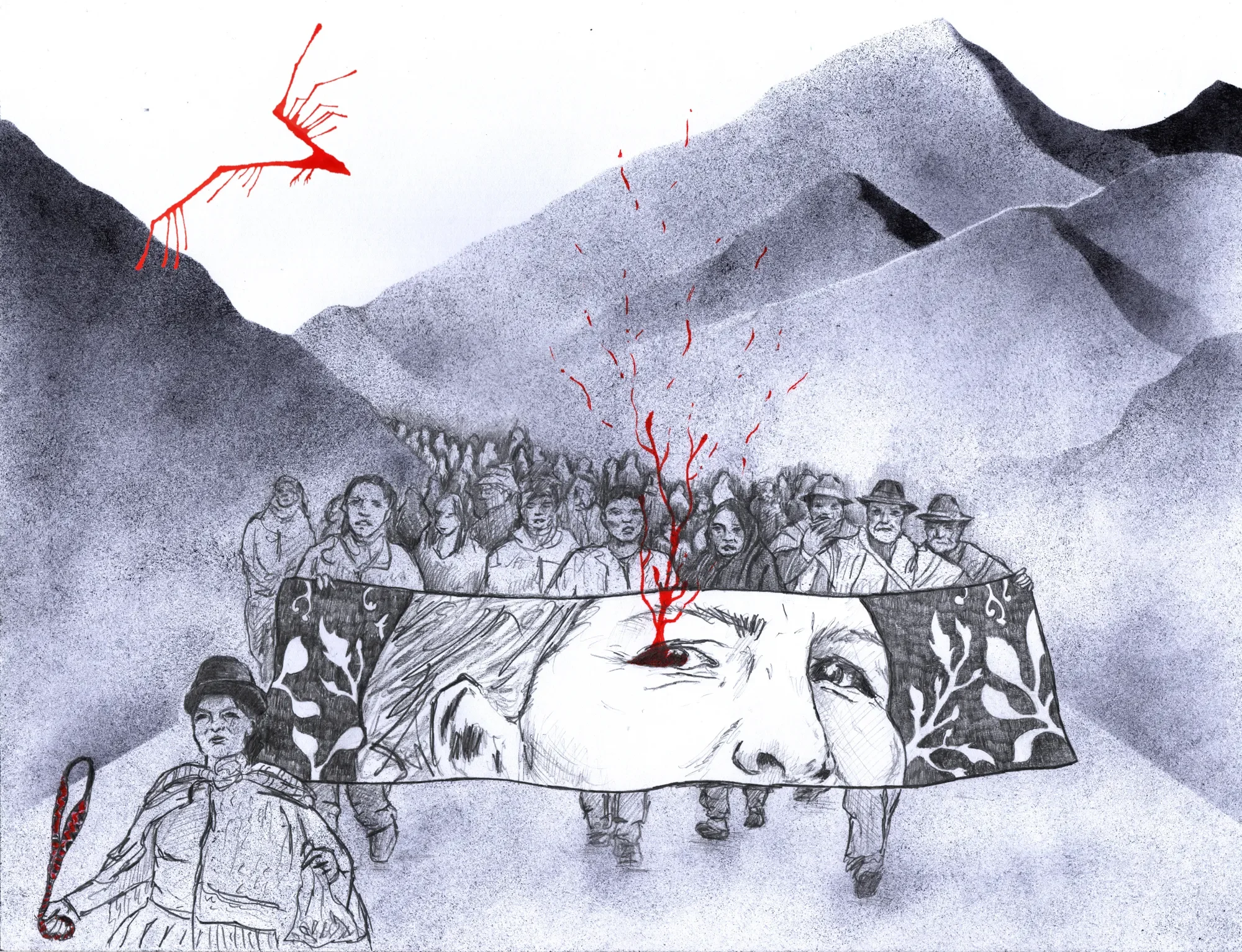
Bolivia is experiencing a period of unrest, tension, and exhaustion. There are more than 50 active roadblocks across the country; shortages have been reported in several cities. At least six people have died in connection with the protests—some due to state repression, others due to roadblocks—dozens more have been injured, and almost 90 arrested.
The first part of the protest began on April 8, when an Indigenous and peasant march left Porvenir, in the lowland province of Pando, toward the capital, La Paz. The initial protest was against land privatization Law 1720, and it the march kicked off the same day the law was enacted by President Rodrigo Paz.
On May 1, the Bolivian Workers’ Union called a general strike, and the demands of protesters broadened to include opposition to Paz’s economic package and fuel shortages.
On May 13, the government relented, repealing Law 1720, but the fire had already been lit. The lowland marchers disbanded, but roadblocks remained and began to intensify as demands for the president’s resignation gained traction.
On May 18, violent clashes took place in the city of La Paz, and arrest warrants were issued against the leaders of some of the mobilized organizations. On the 24th, an operation involving nearly 3,000 troops in Calamarca left at least one protester dead from a gunshot wound. And there has yet to be dialogue.
The question raised by these weeks of protests and blockades is whether Paz, after a mere six months in office, will stay or go.
There are compelling reasons why this has become the rallying cry. But as the uprising is framed by this dilemma, the crisis drags on.
In this context, it is important to recognize that what these protests have brought to the table goes beyond Paz’s resignation.
Today, the mobilizations align intermittently and in flux, having failed to coalesce into a unified movement. Collectively, they have set a limit from below around what the Bolivian state can and cannot do.
Bolivia’s working class has been bearing the brunt of a deepening crisis for at least three years. Skyward inflation, the scarcity of dollars, and chronic fuel shortages have led to a severe deterioration in living conditions.
The current crisis is rooted in the exhaustion of the primary-export model that sustained the gas boom from 2005 to 2014, and which serves as the backdrop for Bolivia’s current juncture. The protracted nature of this uprising is due, in large measure, to the Paz government’s handling of the situation.
Grounds for legitimate outrage
During his election campaign, Paz promised to look out for working-class communities, including maintaining public transport subsidies. In practice, he did the opposite, implementingneoliberal economic reforms and shifting heavy cost burdens onto the most vulnerable. In doing so, he failed to alleviate even the most pressing problems.
The most illustrative case is that of fuel. As the government raised prices, lines at the pumps continued. To make matters worse, the importation of lower-quality gasoline damaged thousands of vehicles.
Shortly after taking office in December 2025, Paz launched a series of economic measures to benefit the banking sector, agribusiness, and private and cooperative mining.
Supreme Decree No. 5503 hiked fuel prices and included 100 provisions ceding foreign control over strategic resources. It also liberalized agro-industrial exports and granted extraordinary tax benefits to big business.
Next came Law 1720, which aimed to convert small agricultural properties, constitutionally exempt from seizure, into medium-sized properties that could be bought and sold as financial assets. This last measure is what triggered the current cycle of protests. Minimum wage has remained frozen, and real wages continue to fall.
Then there is the President’s open display of contempt towards voters, which is by no means a minor issue. Paz won the presidential runoff with a large share of the popular vote. Many sectors voted for him in rejection of thedegraded Movement Toward Socialism (MAS) and an electoral landscape dominated by right- and far-right candidates like Samuel Doria Medina and Tuto Quiroga. His running mate, Edman Lara, played a decisive role in capturing the popular vote.
Once in power, the government of Paz released itself from that mandate, instead governing openly with the same men he had opposed at the polls.
What’s more, he did so in disregard to the existence of the very sectors that had voted him in. The message he sent to voters was that their role is to obey and be grateful.
Since taking office on November 8, Paz has governed more in line with instructions from Washington and the international organizations that oversee the economic crisis, than with the urgent needs of the people that voted for him.
Systematic disregard for the working-class has compounded the impacts of austerity, and symbolically exacerbates them. Dealing with rising costs is one thing, but doing so while being told you do not exist is another.
Setting limits from the ground up
Today, the deepest issue in Bolivia is centered around the terms under which the Bolivian government—this one, or the one that comes after it—will address the economic crisis, and on the position social organizations will take with regards to power.
This turbulent moment emerges in the context of a fraying social fabric, dismantled by 20 years of progressivism that exploited and sought to dismantle social organizations, leaving a difficult legacy in its wake. That legacy includes a culture of clientelistic leadership, public policies subsumed to electoral calculations, and political horizons defined by the party rather than by the organizations themselves.
Thegeneral elections in 2025 and local elections in March 2026 made clear that a significant portion of these organizations have lost their ability to influence policy and are trapped between electoral calculations and potential alliances with both left and right parties.
These circumstances have given rise to a growing capacity for the resistance that is reemerging in new forms: less organized than in previous cycles, more reactive than proactive, and, to date, lacking unified demands.
In spite of it all, resistance exists. And it is producing tangible effects that are profoundly disrupting national politics.
Organizations are looking inward and regaining their own strength at a time when the MAS—or what remains of it—continues to see its role in mobilizing popular politics shrink.
Attempts to co-opt the uprising
The composition of this uprising—lacking in singular leadership, diverse and multifaceted, and emerging from weakened organizational frameworks—leaves no room for romantic, reductionist, or polarizing takes.
If we have learned anything from 20 years of progressivism, it is that pointing out weaknesses and naming threats is not playing into the hands of the right. Rather, it focuses attention and energy on the strength we want to protect and grow.
There is no denying thatEvo Morales and the new party organization he has built, EvoPueblo, intend to capitalize on the unrest currently sweeping Bolivia.
For their part, numerous mobilizing organizations and a significant portion of critical voices have made it clear that what drives them is not—by any means—a desire to prop up the coca-growing leader.
Morales and his followers are not interested in the government being held accountable to the demands of Bolivian society, but rather in opening, by hook or by crook, a path of return to the presidency. This could happen if the Paz government ultimately falls.
Other maneuvers to instrumentalize collective efforts have taken place by mining cooperativists in the name of the people, and have employed revolutionary veneer and rhetoric.
Over the last 20 years, this sector has been consolidated into a bourgeoisie linked to networks of foreign capital and to predatory operations in protected areas that engage in increasingly violent practices. It seized on these mobilizations to extract government concessions regarding taxes, forgiveness of debts to the social security system (as outlined in Decree 5618), and the opening of protected areas to mining.
The fact that both Morales and the gold-mining cooperatives are attempting to seize the moment confirms the importance of this uprising’s outcome. The terms of the order being imposed from below could allow, or deny, the conditions of success for their political strategies.
What lies ahead
At this point, the main achievement of the ongoing protest in Bolivia lies in the limits it has already established, whether Paz falls or not.
If Paz does not resign, new limits will circumscribe anything the executive branch might attempt. That said, there is also reason to think the cornered government will double down on its positions. It may try to divide the movement, seek to wear down social organizations over time, and intensify repression when it calculates it can do so without paying too high a political cost.
If the government falls, the incoming government will have to govern from that baseline, knowing full well how far it can go and who is willing to take to the streets to constrain it. A new, exhausting electoral circus would begin.
In both scenarios, what matters is what the people who are mobilized can sustain, while building upon what’s already been achieved.
The urgent and open question is not just about how to confront the economic crisis without pandering to the banking sector, agribusiness, and mining. We must ask how to do so while placing the reproduction of human and non-human life—which is what capital and extractivism systematically subordinates, disdains, and destroys—at the center.
No comments:
Post a Comment