Colombia’s Democracy is Under Attack: We are Going Back to Defend It
Dear friend,
This week, Donald Trump made his most direct intervention yet in Colombia’s democratic process.
“Congratulations to Colombian presidential candidate El Tigre, Abelardo de la Espriella,” Trump said of the country’s far-right candidate. “As president, Abelardo would Restore LAW AND ORDER!”
The runoff is on June 21. And the full weight of the United States government has just been thrown onto the scale.
This is why we built the Observatory — and why we are going back to Bogotá.
Who is Abelardo de la Espriella — and how did we get here
Abelardo de la Espriella — “El Tigre,” the Tiger, as he likes to call himself — is a 47-year-old lawyer from Barranquilla who has never held elected office.
He built his public profile as a celebrity defense attorney for many of Colombia’s most nefarious characters — and he built his political profile on a platform of iron-fist security, alliance with the United States, loyalty to Israel, and explicit hostility to the four years of progressive reform under President Gustavo Petro.
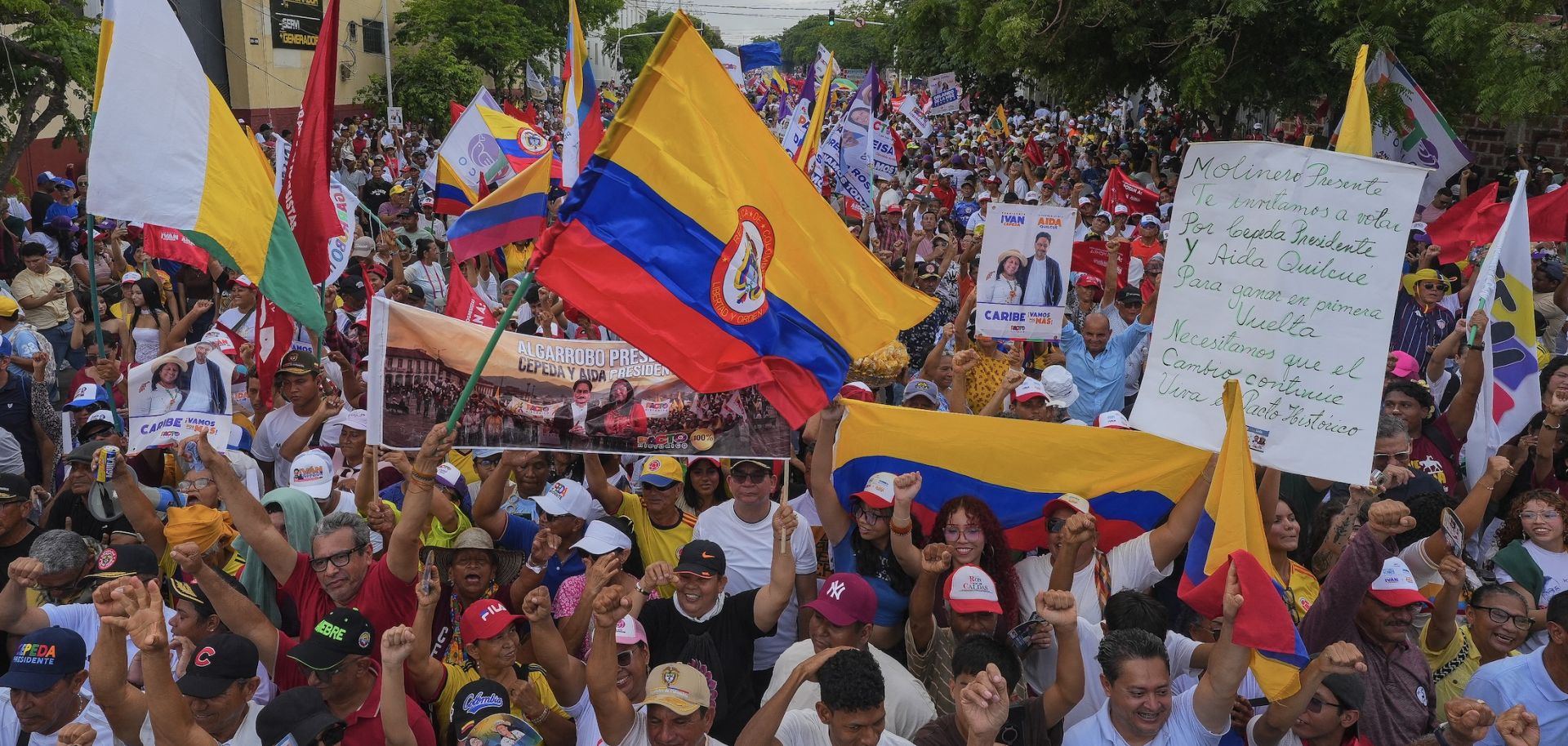
On May 31, the first round of Colombia’s presidential election produced a result that surprised virtually every pollster: De la Espriella came first with nearly 44% of the vote, beating left-wing Senator Iván Cepeda — the candidate of Petro’s Pacto Histórico coalition — who took just under 41%. The runoff is now set for June 21.
Abelardo’s surprise result did not emerge from nowhere. It emerged from a campaign in which the United States had been putting its thumb on the scale for months.
The pattern of intervention — and what our Observatory documented
The Observatory was in Bogotá for the first round. What we documented was not a normal election.
Before a single vote was cast, Republican Senator Bernie Moreno — one of Trump’s closest foreign policy allies on Latin America — traveled to Bogotá as part of an extraordinary 86-person US Embassy observer delegation.
But Moreno did not limit himself to observation. Colombia’s electoral law — including the Consejo Nacional Electoral’s Resolución 09458 of 2025 — is explicit: accredited observers are prohibited from any activity of “party-political character.”
Senator Moreno violated this law. Our Observatory documented his plot to facilitate a political alliance between the two right-wing candidates ahead of a potential runoff.
Before arriving in Colombia, Moreno had also called publicly on Colombia’s electoral authority to disqualify votes from regions he deemed “not secure” — a targeting that mapped precisely onto strongholds of Cepeda’s support.
And it did not stop at Moreno. The company that administers the National Registry’s electoral software has owners with documented fraud convictions in the United States and active fraud charges in Mexico. Earlier this year, Colombia’s former intelligence chief confirmed that a meeting between that company’s principals and de la Espriella himself had been investigated.
De la Espriella has a prior history: in 2011, Colombia’s Supreme Court opened an investigation after a paramilitary leader testified to having paid him millions. The case closed without conclusive findings. De la Espriella—for decades a close friend of convicted mass murderer, drug trafficker, and warlord Salvatore Mancuso—has made his career defending and rehabilitating Colombia’s murderous paramilitary forces.
This is the man Trump called “a smart, strong, and tenacious leader.”
What happens on June 21 matters for everyone
If de la Espriella wins the runoff, Colombia becomes the next domino in Trump’s “Donroe Doctrine” — the systematic replacement of progressive governments across Latin America with administrations aligned to Washington’s security, economic, and political agenda. Following Ecuador, Argentina, and El Salvador, it would represent a fundamental reordering of the hemisphere.
If Cepeda wins, Colombia’s four years of historic progressive reform — on land reform, workers’ rights, higher wages, expanded public pensions, ambitious climate policy, and dignity for all Colombians — have a chance to consolidate and continue.
No comments:
Post a Comment