France moves closer to ocean goals with three new marine protection zones
The French government has announced three new marine protected areas, bringing it a step closer to goals established at the 2025 United Nations Ocean Summit. These "strong protection" zones are situated in mainland France, in the French West Indies and the French Southern and Antarctic Lands.
Issued on: 09/06/2026 - RFI
This brings to 14.68 percent the proportion of French maritime waters under strict protection, a designation that prohibits or strictly limits activities such as fishing, extraction, and tourism.
"We are moving much closer to the objective we set for ourselves at the UNOC (the United Nations Ocean Conference in June 2025) of reaching 14.8 percent by the end of this year," according to the Minister for Ecological Transition, Monique Barbut, who made the announcement alongside the Minister Delegate for the Sea and Fisheries, Catherine Chabaud.
Barbut was speaking at the opening of the "Neptune Forum," which aims to be the "Davos of ocean exploration," and which brought together scientific experts, diplomats, representatives of NGOs, and institutional leaders, on Monday in Paris.
It coincided with the UN World Oceans Day which carried the theme 'Reimagine: Beyond the world we know, a new relationship with our ocean'.
The three new marine zones encompass diverse parts of France's wide-reaching territory, including parts of the French Southern and Antarctic Lands (TAAF), where the seabed lies beyond 2,500 metres.
In Guadeloupe, the zone will protect coral reefs, home to sea turtles, while in the Bay of Audierne, off the coast of Finistère, the measures will protect a bird species known as the Kentish plover.
UN Summit advances ocean protection, vows to defend seabed
In December, France launched the "strong marine protection zones" label for 63 sites in its waters – taking a concrete step towards a pledge made in June 2025 at the UN Ocean Summit in Nice.
The sites include the Cordelière Bank in the Scattered Islands in the Mozambique Channel, the marine core of Port-Cros National Park in the Mediterranean and a reserve off the Île de Ré on the Atlantic coast.
Tackling plastic pollution
The Nice summit concluded with the ratification by 50 countries of the High Seas Treaty (known as the BBNJ), an international agreement designed to better protect international waters, representing half the planet.
"Today we have more than 90" signatory countries, stated French Ambassador for Oceans and Polar Affairs Olivier Poivre d'Arvor on Monday at the forum.
France rolls out 'strong protection' label for 63 marine areas
"Our goal (...) is to ensure that on January 11, 2027, in New York, at the United Nations, during the first COP of the Ocean, the COP of the High Seas, we have more than 120 countries around the table," he added.
Barbut and Chabaud also presented an action plan for combating plastic waste for the years 2026 to 2030.
"Every year, nearly 12 million tons of plastic end up in our oceans. The fight against plastic waste at sea was therefore one of the priorities of UNOC-3 and is a major issue for the health of marine ecosystems, from inland to coastal areas," according to a statement from the Ministry of Ecological Transition.
Divers made the first video ever of this shark in the Med - then got back to work on the real threat
Volunteer divers had the astonishing encounter while retrieving abandoned fishing nets from a shipwreck.
When Derk Remmers and other volunteer technical divers went on a mission to clear a ghost net-entangled shipwreck in the Mediterranean, they witnessed something astonishing.
As they descended roughly 40 metres between Sicily and Tunisia, a large great white shark emerged from the blue.
Derk scrambled for his camera, capturing what is believed to be the first underwater footage of an adult great white shark ever filmed in the Mediterranean in its natural habitat. Rare surface sightings have occasionally been recorded in the region, but underwater encounters filmed by divers have never previously been known.
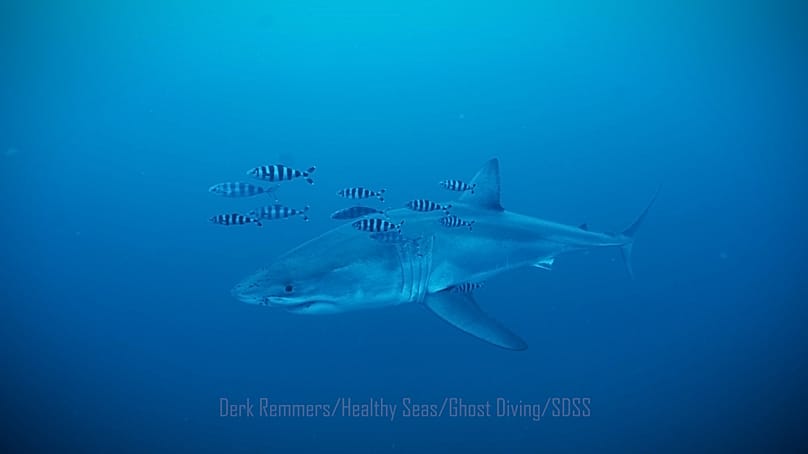
The unique encounter occurred during a ghost net removal mission organised by the Healthy Seas Foundation together with Ghost Diving and the Society for Documentation of Submerged Sites (SDSS), who shared the footage with Euronews Earth.
"We were all a bit shocked - and amazed," Derk Remmers, a volunteer technical diver and head of Ghost Diving's German chapter, tells Euronews Earth. "My fingers were trembling, that's for sure - it was a big animal and we didn't expect this at all."
The shark circled the group before apparently losing interest. "He swam by and then he turned around and faced us and came back. It seemed clear that he was curious and not aggressive - he was really laid back, like he had the attitude of being the boss down there. And when we started releasing a few bubbles from our mouth, he started speeding up a little bit and vanished into the blue," recalls Derk.
Marine biologists consulted after the mission described the sighting as highly unusual and scientifically valuable. "Most of our knowledge on white sharks in the Mediterranean comes from records of dead specimens caught by fishing operations. Observations like this are extremely valuable for improving our understanding of the distribution, habits, and behaviour of this critically endangered species," said Dr Carlo Cattano, researcher at the Sicily Marine Centre of the Stazione Zoologica Anton Dohrn, in a statement released by Healthy Seas.
Ghost nets: A silent killer
The shark was extraordinary. The reason the divers were there was - sadly - not.
The Strait of Sicily is one of the most heavily exploited fishing areas in the Mediterranean, and the shipwreck the team was targeting had been accumulating ghost nets - fishing gear lost or abandoned at sea - for years.
Ghost nets do not stop fishing simply because no one is pulling them. Entangled on underwater structures like reefs and wrecks, they continue to trap and kill marine life indefinitely.
"They are made to kill fish and they still do that when they're not attached to the fishing boat anymore," Derk tells Euronews Earth. "Year by year, the amount of nets caught on this wreck gets bigger and bigger."
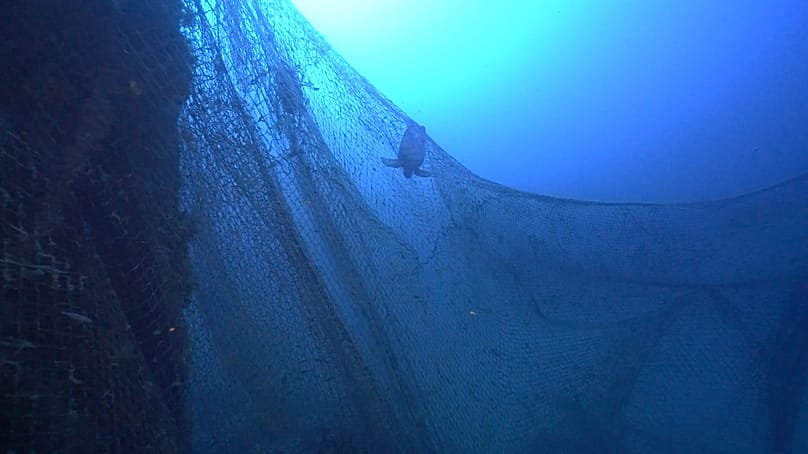
Previous dives at the site had already documented loggerhead sea turtles and large fish species trapped in abandoned gear. The team recovered sections of net on this mission as well, which will either be discarded safely or, where possible, recycled.
The scale of the problem extends far beyond any single wreck. "Between one to 10 per cent of all fishing gear of all fishing vessels in the world gets lost every given year," says Derk. "This might add up to more than half a million tonnes per year."
The shark's presence was a stark reminder of the scope of this threat, which echos through the entire marine food web.
"We feel somehow blessed to have this encounter, which also shows us the importance of our work," says Derk. "Because if a predator like that is hunting close to this wreck, that also means that there's a big amount of fish and a big amount of animals he could hunt there. And if they are trapped, there's also a chance we trap some of these predators. And if we trap them - there are only very few around there - that would be a big disaster."
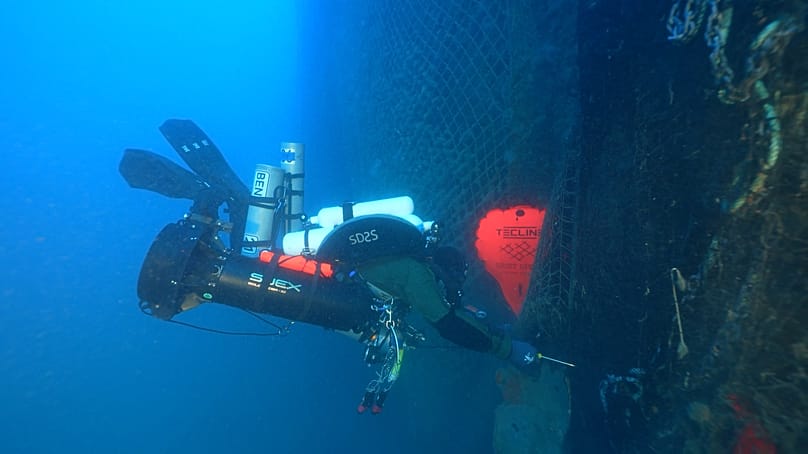
A problem that needs more than divers
Derk is clear that volunteer clean-up operations alone cannot solve the ghost net crisis. "We can only do so much - we are only a few people," he tells Euronews Earth. "One thing is to remove the nets, which is the least we could do as humans. But it's also our idea to inform the public about this problem, so that work can be done before we need to collect the nets."
That upstream work, he argues, means confronting illegal and large-scale industrial fishing head-on. Family-run fishing businesses, he notes, have strong incentives not to lose gear - a lost net is an economic disaster for a small operation. It is industrial and illegal actors, operating at scale, who pose the greatest threat to the ecosystem.
"We should, as humans and as Europeans, try to enable our politicians to work against this threat and be more careful about our environment underwater," urges Derk.
The mission also included environmental DNA sampling and underwater monitoring to improve understanding of the species present around the wreck. Further analysis is expected in the coming months, with additional footage and scientific material to be released.
No comments:
Post a Comment