Opinion
The World Cup in the age of Trumpian transaction
June 8, 2026

A view of Levi’s Stadium ahead of 2026 FIFA World Cup of San Francisco Bay Area in Santa Clara, California, United States on May 28, 2026. [Tayfun Coşkun – Anadolu Agency]
No matter how intently we listen to FIFA President Gianni Infantino’s repetitive hymns extolling the “purity of the game” and its pristine detachment from politics, reality strikes back with a naked truth: football is no longer just a sport. It has morphed into a fierce breed of modern politics, serving simultaneously as an instrument of both soft and hard power. As the World Cup approaches, this reality takes on a more radical dimension. This time, the tournament unfolds within the domain of Donald Trump—a man who views the world strictly through a transactional prism, treating every political or ideological stance as a mere line item in a commercial contract, ripe for buying or selling.
When it comes to deep, self-defining concepts of nationhood, the press seldom hesitates to speak with a unified, resounding voice—a phenomenon that reflects genuine cultural resonance rather than mere media propaganda. This is precisely why the British press treats the England national team as a living expression of a unified England. As a collective, these athletes often appear far more representative of the public than British politicians, whom The Guardian once memorably likened to “rats fighting in a sack.”
Admittedly, football offers no ready-made solutions to deep-seated political crises or social malaise. Yet, the pitch remains the most vivid mirror of a nation. Politicians and pundits scrutinize players and their performances not for sheer technical prowess, but to decode the inner mechanics of society itself.
Historically, the media has blundered by fabricating idealized models of national unity where none exist in reality. Consider contemporary Belgium, a nation fractured along deep ethnic, political, and linguistic lines, where the national team stands as a solitary, stubborn bulwark against division.
Similarly in France, where racial tensions routinely threaten the social fabric, the multi-ethnic squad—composed of players of North African, Sub-Saharan, and French heritage—is viewed by the media and President Emmanuel Macron alike as an indispensable “antidote.” There is simply no other narrative available. In the United Kingdom, the British press has often embraced the England team as a progressive triumph against populists seeking to isolate Britain from its European neighbors. This unified diversity is framed as a refuge from the cynicism generated by politicians playing their own brand of “political football.”
Yet, running parallel to this symbolic weaponization is the cautionary advice of author Simon Kuper. For an enjoyable viewing experience, Kuper reminds us that “luck rarely plays as large a role in any other sport as it does in football.” With dry pragmatism, he writes: “Enjoy the tournament, but do not take it too seriously. Do not imagine that World Cup matches affect real life. Despite the hyperbole, a successful tournament cannot keep a president in power, or create racial harmony… The World Cup vanishes like a dream. It often reflects social reality, but it does not shape it.”
While Kuper’s skepticism is well-founded, it overlooks the continuous political drama that transforms football into a vital investment arm and geopolitical lever for governments. Ignore the sugary diplomatic platitudes exchanged between world leaders when their teams lose—those clichéd assurances that “it’s only a game.” Such rhetoric is merely a diplomatic sedative designed to defuse the anger of rival fanbases.
At its core, football is a vehicle for deep political rivalry, whether it manifests violently—as it did in the 1985 Heysel Stadium disaster in Brussels, where deadly rioting between Liverpool and Juventus fans forced coaches to retreat and prompted Prime Minister Margaret Thatcher to denounce the perpetrators as a “mob”—or remains confined to xenophobic chants in the terraces.
When France won the 2018 World Cup, right-wing nativists balked at the idea of a non-white national symbol. The squad’s predominantly African heritage prompted American comedian Trevor Noah to joke that “Africa won the World Cup”—a heavy political satire that exposed the fragile nerves of Western multiculturalism.
Even the swift, ferocious political condemnation that crushed Europe’s elite clubs when they signed up for the European Super League project was driven by state protectionism, not a sudden love for the purity of the sport.
Today, we enter a World Cup governed by the logic of Donald Trump. Trump does not view ethnic diversity as a “progressive triumph” in the manner of the British press, nor does he see the World Cup as a democratic oasis. To him, football is an asset—the ultimate platform for brokering deals, projecting economic supremacy, and recalibrating American geopolitical leverage.
No head of state truly possesses the power to isolate politics from football, much as we, as purists, might wish otherwise. But in the arena of the ultimate dealmaker, the beautiful game will become the precise mirror of our contemporary world: an environment that disregards sportsmanship, fixates on the scoreboard, and defers entirely to whoever owns the right to buy the stadium.
The views expressed in this article belong to the author and do not necessarily reflect the editorial policy of Middle East Monitor.
The dark side of the 2026 World Cup: Record-breaking emissions and thousands of flights
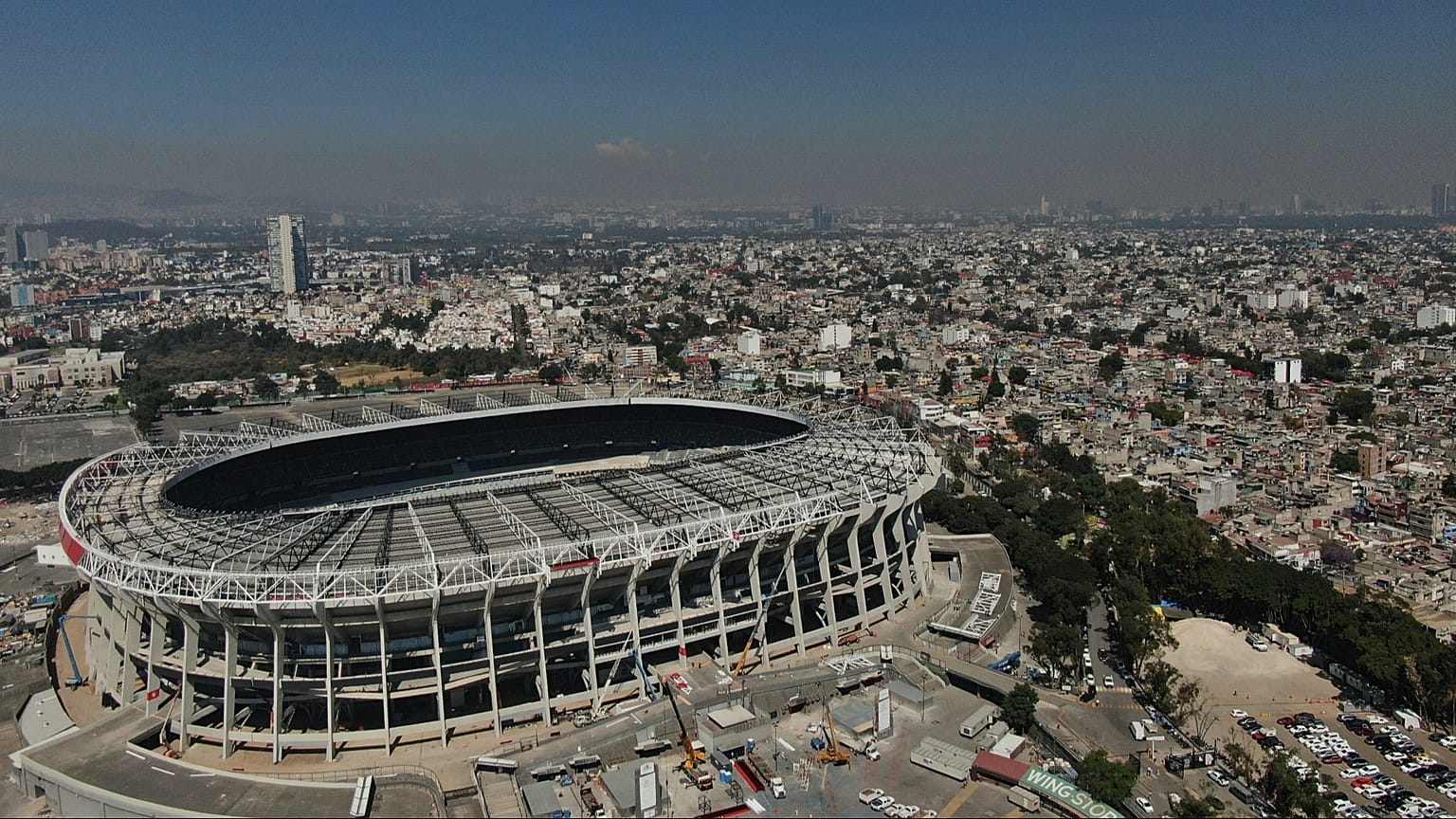
A report warns that the tournament in the US, Canada and Mexico could produce twice the emissions of previous editions.
The 2026 World Cup, to be held in the US, Canada and Mexico, could become the most polluting tournament in football history. That is the warning from FIFA's Climate Blind Spot, a report outlining how the expanded format, geographical spread and reliance on air travel will sharply increase its climate impact.
According to the study, produced by the New Weather Institute, this year's World Cup will generate at least nine million tonnes of CO₂ equivalent, almost double the average for tournaments held between 2010 and 2022, which was around 4.7 million. In broader scenarios, that figure could rise to 15 million tonnes, making the event one of the most polluting in the history of sport.
More teams, more matches, more emissions
One of the key factors is the change in format. The 2026 World Cup will feature 48 teams and 104 matches, a 63 per cent increase on previous editions. This expansion means more travel, more fans and greater pressure on infrastructure. The report stresses that this growth will lead to a significant increase in emissions, especially from air travel, which is already the tournament’s main source of pollution.
The most critical issue is logistics. Unlike other tournaments concentrated in a single country, the 2026 World Cup will be played in 16 cities spread across the North American continent, separated by thousands of kilometres. This will mean that teams, journalists and millions of fans will depend almost entirely on planes. In fact, the report estimates that air travel will generate more than 7.7 million tonnes of CO₂.
In addition, emissions linked to flights could rise by between 160 per cent and 325 per cent compared with previous tournaments, cementing transport as the event’s main climate problem.
A model that is hard to justify
Although the tournament will not require the mass construction of new stadiums, which partly reduces its impact, the report argues that the real problem is structural: a competition model that is ever larger, more global and more dependent on long-distance travel.
This is compounded by the lack of sustainable alternatives. Unlike Europe or Asia, North America does not have extensive high-speed rail networks that would help cut the carbon footprint of transport.
The report also questions FIFA’s climate strategy, accusing the body of having a "blind spot" when it comes to the environmental crisis. According to the authors, there is a clear gap between the organisation’s sustainability pledges and the reality of its decisions, such as expanding the tournament or choosing widely scattered host cities.
They warn that the 2026 World Cup could worsen the climate crisis, at a time when the world is calling for urgent cuts in emissions.
What does FIFA say?
The Fédération Internationale de Football Association (FIFA), for its part, insists that the 2026 World Cup will be accompanied by a sustainability strategy focused on reducing environmental impacts and leaving a "positive legacy" in the host cities. On its website, the organisation says it will promote sustainable construction standards in stadiums and temporary infrastructure, encourage the use of public transport and seek to cut waste, energy consumption and emissions associated with the tournament.
It also maintains that the host cities will be key to implementing long-term climate measures and promoting more sustainable practices beyond the competition itself. However, the report, produced in partnership with Scientists for Global Responsibility, Environmental Defense Fund and The Sport for Climate Action Network, warns that these measures are unlikely to offset the tournament’s structural impact.
No comments:
Post a Comment