Thursday 11 June 2026, by Antonio Louçã
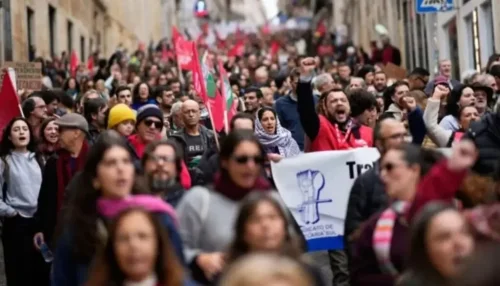
The general strike of June 3rd paralysed a significant number of businesses and services. There is a widespread awareness among the working class that the package of dozens of labour laws represents a mortal threat to their future.
The tourism industry was severely affected by the cancellation of numerous flights at Lisbon, Porto and Faro airports; public transport was paralysed in the major cities, with the exception of minimal bus services and some rail connections between the centre and the outskirts of Lisbon; schools were paralysed in the middle of exam season and public hospitals only operated for emergencies. The big news was the significant participation from the private sector, clearly higher than that seen in the general strike in December, with stoppage rates that the CGTP (Confederação Geral dos Trabalhadores Portugueses or General Confederation of Portuguese Workers, the largest trade union federation) estimated at 100% for companies like Sovena and Cimpor, 95% for Bosch and 88% for Glavidro. [1]
The working class was not swayed by the siren songs that guaranteed the rejection of the "package" in the parliamentary vote. The previous strike, in December, had been strong enough to force the neo-fascist Chega party to change its voting position and announce its opposition to the approval of the bill promoted by the (minority) conservative right-wing government. But Chega’s about-face was, and remains, one of its many opportunistic manoeuvres, and no one can trust it to stick to its position. The struggle had to continue, and the call for a new general strike, despite all the postponements and vacillations by the CGTP, offered the working class the opportunity to make its position clear. And that opportunity was seized decisively.
In addition to rejecting illusions about the uncertain outcome of the parliamentary vote, the working class resisted the highly demobilising effect of the five-month interval between the general strike in December and this one in June. During that time, employers and the Government negotiated in the forum known as "Social Concertation" with the social democratic trade union federation UGT (União Geral de Trabalhadores or General Union of Workers), excluding the CGTP, in its majority tied to the communist party. Excluded from negotiations, they did not use that time to mobilise within companies, warning about the danger posed by the government project, but instead went around in circles until calling for a new general strike on June 3.
When the Government’s intransigence forced the UGT itself to refuse to agree to the package, the CGTP had a golden opportunity to promote assemblies in the companies that would eventually drag the UGT into joining the strike. In fact, even without that pressure from below, several UGT unions gave their members the green light to join the strike called by the rival union. However, the CGTP preferred to issue a top-down call, emphasising the UGT’s "yellow" nature and avoiding opening the Pandora’s box of a widespread workplace assembly process that could potentially sustain the struggle in the coming weeks and months.
The absence of assemblies resulted in a very uneven distribution of picket lines. In many workplaces, the union bureaucracy left the mornings free for strikers to stay home or go to the beach and simply called for afternoon demonstrations in each city. Thus, workplaces with a long tradition of assemblies and pickets were now deprived of both. The strike’s coincidence—anything but accidental—with a public holiday the following day, and with a Friday that invited long weekends, exponentially worsened the demobilisation. In Lisbon, the afternoon demonstration was less attended than the one in December 2025.
On June 3, 2026, the working class made its mark with a powerful strike. But there is no strategy or leadership that can guarantee the defeat of the labour package. We are still far from defining that strategy and building that leadership.
5 June 2026
Translated by David Fagan for International Viewpoint from Huella del Sur.
Footnotes
[1] Sovena Group is one of the largest Portuguese agribusiness holding companies, with its own farmyards in Portugal and several other countries. Cimpor - Cimentos de Portugal is the largest Portuguese cement group. Glavidro manufactures glass for industrial and construction purposes.
No comments:
Post a Comment