World Nuclear News
IAEA produces global mapping tool of used nuclear fuel
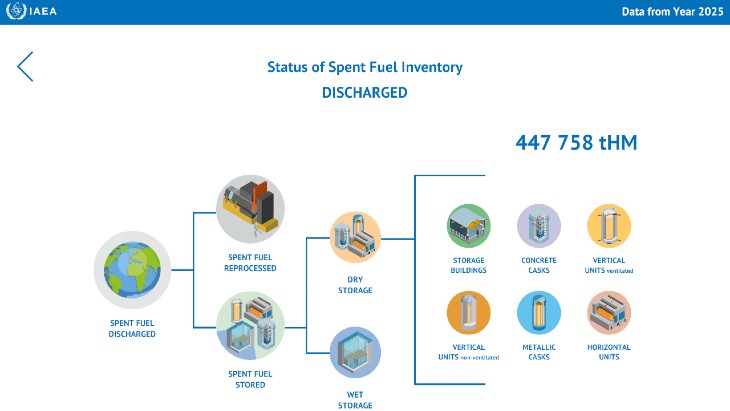
The agency says that 41% of used nuclear fuel is in wet storage, "mainly the pools that cool … [it] after it leaves the reactor and other centralised pools. Another 31% is in dry storage which are the casks, buildings, and modular systems used for keeping spent fuel under dry conditions".
The figures for the interactive map - which allows people to look by country, by region and by storage type - comes from the Contracting Parties to the Joint Convention, which is "the principal international legal instrument to address the safety of spent fuel and radioactive waste management on a global scale". It is the second edition of the International Atomic Energy Agency's (IAEA) Global Spent Nuclear Fuel Inventory.
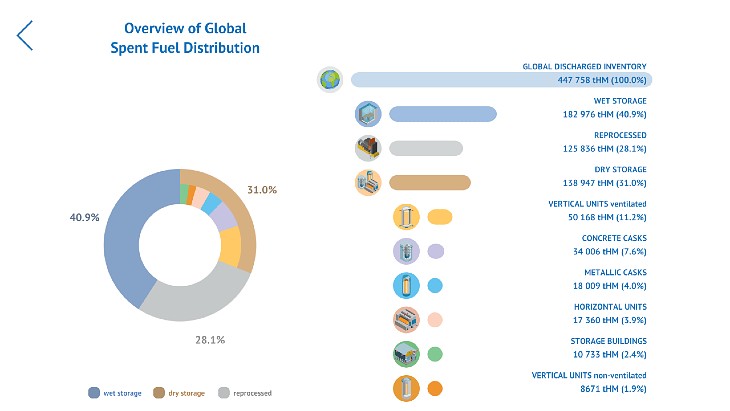
The data was submitted under the 2025 reporting cycle and the IAEA says it was supplemented by other publicly available information. The first edition, in 2019, did not include the interactive tool.
It reports that about 126,000 tonnes of heavy metal - the standard unit for the uranium and other heavy elements in power reactor fuel - has been reprocessed, which can allow its usable materials to be made into new fuel, reducing waste and the amount of natural uranium needed.
spent_fuel_IAEA_730_2_0b8eddbd.png)
Amparo Gonzalez Espartero, Technical Lead in the IAEA Division of Nuclear Fuel Cycle and Waste Technology, said: "By displaying information on worldwide spent fuel inventories in a structured manner, including reprocessed and stored spent fuel in different storage systems, the tool benefits technical analysis, and facilitates informed discussions on long-term spent fuel management strategies among countries and interested stakeholders."
You can find the IAEA's Global Spent Nuclear Fuel Inventory here.
Major component milestone for Indian reactor
Nuclear Power Corporation of India Ltd says the successful unloading of the first End Shield is a major milestone for the Kaiga 5 and 6 construction project.
_65655.jpg)
Manufactured by L&T Heavy Engineering, the manufacturing arm of Larsen & Toubro, at its Hazira facility, the component weighs 107 tonnes and is about 9.3 metres across with a thickness of nearly a metre. "The complex unloading operation was executed flawlessly through meticulous planning and seamless coordination using a 500-tonne crane, 70-tonne crane and 10-tonne chain pulley block," Nuclear Power Corporation of India Ltd said.
The End Shield is the first major piece of equipment of the reactor core, NPCIL said. It provides structural support to coolant channel assemblies, facilitates on-power refuelling and forms an integral part of the calandria vault enclosure.
_950b3bdd.jpg)
(Image: NPCIL)
Kaiga units 5 and 6 are Indian-designed 700 MW pressurised heavy water reactors, ten of which NPCIL is planning to build in "fleet mode". Excavation works for the units began in May 2022. A ceremony to mark the first pouring of concrete - which marks the point at which a project becomes a nuclear power unit under construction - was held earlier this year. The aim is for the first new unit at the Kaiga nuclear power plant to achieve criticality in five years.
Larsen & Toubro has already manufactured and dispatched four of the eight steam generators for the units.
Flushing work under way for Changjiang unit 4
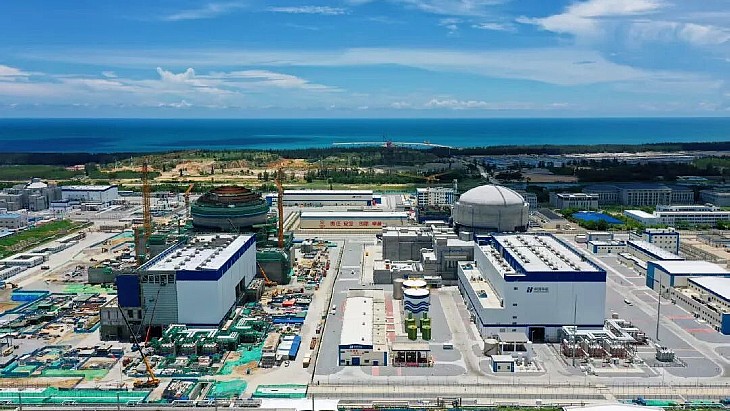
The flushing process is a key stage before cold and hot testing during the commissioning steps taken for a new nuclear power unit.
It involves the core pipelines and equipment, including the reactor coolant system, residual heat removal system and the safety systems. The flushing removes debris from inside pipelines, verifies flow capacity, and checks leak tightness and that everything has been installed correctly.
China National Nuclear Corporation said: "It is a crucial preliminary process for maintaining nuclear safety and ensuring the long-term stable operation of the unit.
"This flushing task has a tight schedule, frequent cross-operations of multiple systems, and stringent cleanliness acceptance standards. The Hainan Changjiang Nuclear Power Project Department, in collaboration with the owner, supervisor, general contractor, and other construction units, refined specialised construction plans and optimised on-site work procedures … preemptive hazard identification and mitigation were conducted to ensure the smooth, safe, and standardised implementation of flushing operations."
Two Hualong One reactors are being constructed in the second phase of the Changjiang plant. First concrete was poured for the base slab of unit 3's nuclear island in March 2021, with that of unit 4 being poured in the December of that year. Changjiang Phase II - units 3 and 4 - represents a total estimated investment of CNY40 billion (USD5.9 billion), according to China Huaneng, which holds a 51% share in the project. The outer dome was installed on unit 4 in April. The construction period is expected to be 60 months. Both units are scheduled to be fully operational in early 2027.
The Changjiang nuclear site is already home to two operating CNP-600 pressurised water reactors (PWRs) - Changjiang 1 and 2 - which entered commercial operation in 2015 and 2016, respectively. In 2021, CNNC also began construction of a demonstration ACP100 small modular reactor at the site. The multi-purpose 125 MWe PWR - also referred to as the Linglong One - is designed for electricity production, heating, steam production or seawater desalination. It is currently undergoing pre-commissioning tests.
The island province of Hainan is China's southernmost point. Energy policies published in 2019 by Hainan Province Development and Reform Commission specify that nuclear power will become the primary source of electricity for the island, which has a population of close to 10 million.
Cold hydraulic tests under way at Turkey's Akkuyu 1
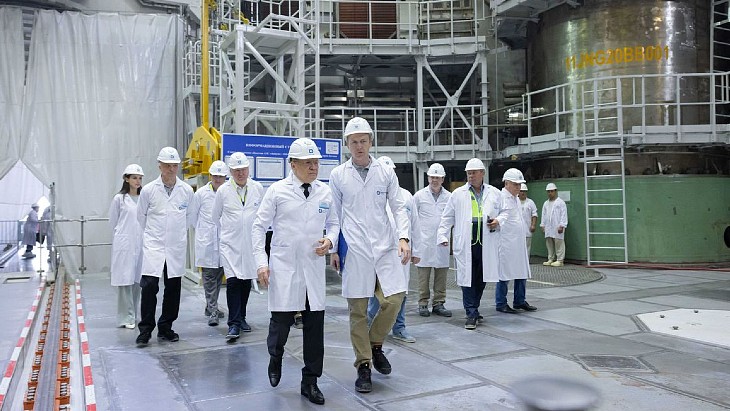
Alexei Likhachev, director general of Russia's state nuclear corporation, visited the site on Monday (see picture above) to review the progress of commissioning work. The visit came the week after the successful loading of dummy fuel assemblies into the reactor.
He said: "We are celebrating the completion of construction work. Cold hydraulic tests of the reactor began last night, and this work will be completed within a few weeks. Just a few weeks remain until the start-up operations begin, and based on the results of all the work completed, an inspection will be conducted and adjustments will be made for the final stage. Unit 1 has a staff of 1,930 people, more than 40% of whom are Turkish citizens. We are proud that these are graduates of our universities, who are now undergoing training and practical experience on Russian simulators and nuclear power plants."
The cold hydraulic tests confirm the "the tightness and strength of the reactor system components, perform circulation flushing of the primary and secondary circuits, establish water chemistry, and check the thermal-hydraulic, strength, vibration, and dynamic characteristics of the reactor system and primary circuit equipment for compliance with design values".
This will be followed by the hot tests to confirm that equipment and systems are ready for operating conditions, including checking the operation of the four main circulation pumps at temperatures of at least 260 degrees Celsius. Both cold and hot tests take place before the loading of nuclear fuel in the commissioning process.
Background
Akkuyu, in the southern Mersin province, is Turkey's first nuclear power plant. Rosatom is building four VVER-1200 reactors, under a so-called BOO (build-own-operate) model. According to the terms of the 2010 Intergovernmental Agreement between the Russian Federation and the Republic of Turkey, the aim was for the commissioning of the first power unit of the nuclear power plant to take place within seven years from receipt of all permits for the construction of the unit.
The licence for the construction of the first unit was issued in 2018, with construction work beginning that year. The first steam generators were shipped to the site - for unit 1 - in August 2020. Nuclear fuel was delivered to the site in April 2023. The aim is for unit 1 to begin supplying Turkey's energy system during 2026.
When the 4,800 MWe plant is completed, it is expected to meet about 10% of Turkey's electricity needs.
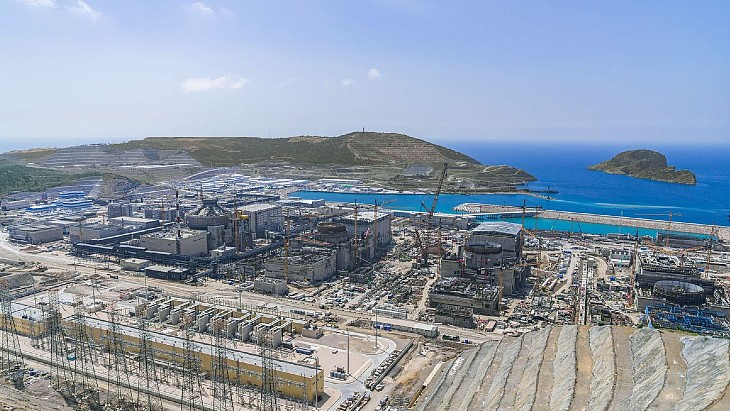
Work is taking place on all four units - first concrete for unit 4 (right) was poured in August 2023 (Image: Akkuyu Nuclear)
Turkey has plans for a second nuclear power plant, at Sinop, and has also been in talks with China about plans for a third plant, in the Thrace region in the country's north-west.
The country is also developing plans for small modular reactors, with the aim of adding 5 GWe of capacity by 2050 - which would mean the equivalent of at least 16 individual SMRs.
No comments:
Post a Comment