It’s possible that I shall make an ass of myself. But in that case one can always get out of it with a little dialectic. I have, of course, so worded my proposition as to be right either way (K.Marx, Letter to F.Engels on the Indian Mutiny)
Tuesday, July 07, 2026
AI data centres are becoming the workhorses of the internet, but cities aren’t sure what to do with them. Here’s why
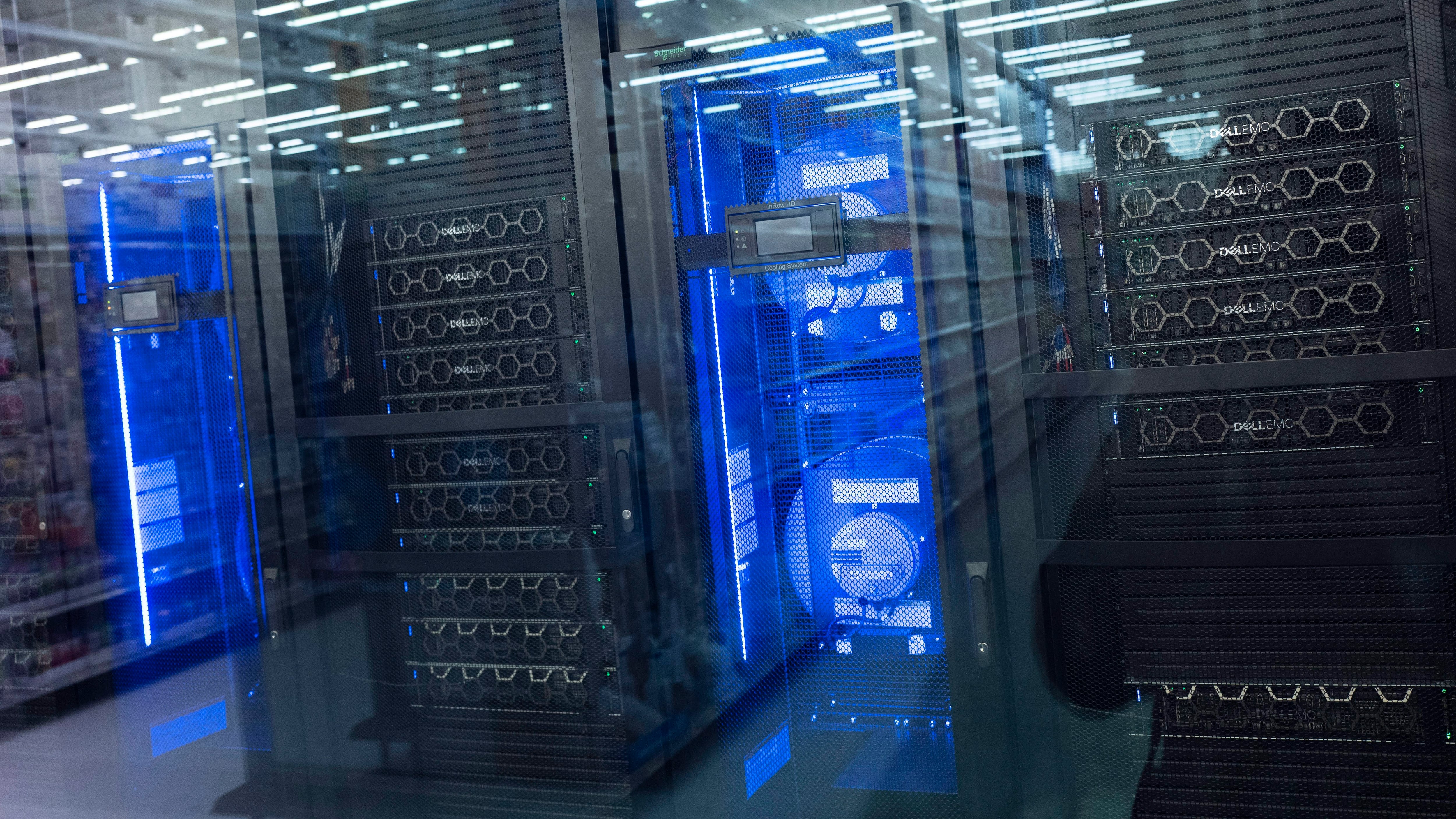
The Intelligent Retail Lab is located in the Walmart Neighborhood Market, Wednesday, April 24, 2019, in Levittown, N.Y. Shoppers can see the massive data center where nine cooling towers, 100 servers and other computer equipment that process the 1.6 terrabytes of data per second that is coming from cameras, and other equipment. (AP Photo/Mark Lennihan)
Around two months ago, Coun. Dianne Saxe noticed an unusual warning issued by a regulatory organization tasked with protecting North America’s power grid from problems.
The North American Electric Reliability Corporation (NERC) issued an urgent level-3 alert over dangers posed to the power grid by “computational load entities” – a fancy term to refer to users such as AI data centres, cryptocurrency mining operations and traditional data centres.
The organization warned that hydro customers in the mushrooming new category “generally did not have sufficient processes, procedures, or methods to address risks associated with computational loads” and urged them to take a number of steps to urgently address the vulnerabilities they pose to the grid.
Saxe, who is also a member of the Toronto Hydro Board and someone who has followed energy and sustainability issues for many years as an environmental lawyer, likened the warning to a “3-alarm fire” from an organization that does not typically send up flares.
She said the organization was “basically arm-waving to say we urgently, immediately need much better management of data centres.”
The risks have also included costly fires associated with data centres in the past, Saxe said.
She pointed out network equipment designed to protect AI data centres from power fluctuations can have a massive impact on the grid even from small fluctuations, such as a car crashing into an electric pole.
“Your lights wouldn’t even flicker (from the disturbance), but when you have six or seven large data centres in the same area, and they all sense the same little fluctuation at the same time, and they all trip off in 20 milliseconds (they can) bring the whole grid down,” she said.
The warning from NERC prompted Saxe to bring the matter to council.
Coun. Dianne Saxe is pictured in this file photo. THE CANADIAN PRESS/Frank Gunn
She drafted a motion last month urging Toronto to sign on to the Global Urban Data Centres Pact, which aims to set a vision for data centres that is sustainable and safe. While the motion was ruled out of order at council, Mayor Olivia Chow nonetheless agreed to sign the pact on behalf of the city.
City staff in Toronto were already studying the issue of AI data centres after Saxe and Coun. Rachel Chernos Lin brought a motion back in March asking for greater clarity on whether AI data centres, which can consume enormous amounts of power, should have special zoning requirements instead of being included in as-of-right industrial zoning.
It noted “growing concern in our communities,” in particular over questions around electricity and water consumption, increased pollution and other infrastructure impacts.
“The City of Toronto needs to be proactive, thinking about how best to manage data centres,” Saxe told CP24.com. “They’re an important opportunity. They’re also a serious risk.”
The motion asked city staff to examine all the potential impacts, as well as existing rules and regulations and report back to council early next year with recommendations about a possible regulatory framework for AI data centres.
Toronto is not the only municipality looking at the issue.
Recently, Hamilton City Council voted to put the brakes on new data centres that power AI to give city staff an opportunity to review some of the ways the facilities impact the municipality.
Ward 3 Coun. Nrinder Nann, who led the charge, said in an open letter before the vote, that she opposes AI data centres as they currently operate.
“I believe there are too many negative environmental and human health impacts that must be comprehensively addressed through stringent regulations and criteria from all three levels of government, as well as robust public engagement before they are approved in our communities,” Nann wrote.
Electricity usage
Many people might not realize that their favourite AI program actually requires a tremendous amount of computing power and therefore, a great deal of electricity. The demand for that computing power has resulted in the rapid growth of AI data centres and Canada has been at attractive location because of relatively cheap power costs, a mostly cool climate and access to renewable energy.
At the moment, most municipalities do not have special rules for data centres, with most of them simply falling under general industrial zoning bylaws. But that’s a problem given how they have changed over the years, says Mark Daley, a professor of computer science and chief AI officer at Western University.
“Data centres used to be sort of a moderate power draw, and then they got up to the level of a large industrial facility, and now they’re becoming in some power grids the primary users of electricity on that grid that’s continuing to scale,” Daley says.
“So you can imagine if you are a municipality with a fixed power infrastructure, as we mostly have in Canada, you have to think carefully about how you allocate that infrastructure.”
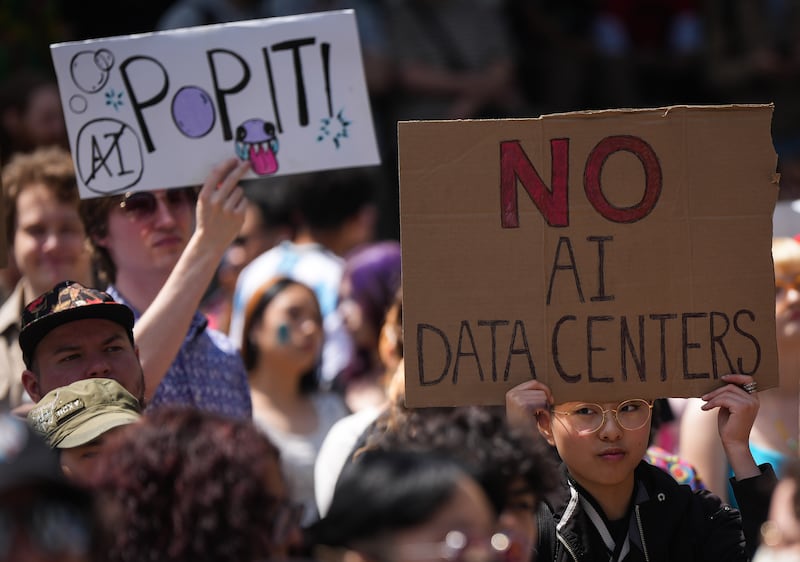
People hold signs during a rally before participating in a march to protest the opening of AI data centres, in Vancouver, on Saturday, June 27, 2026. Telus is moving forward with two new AI data centres in Vancouver and the expansion of an existing facility in Kamloops. THE CANADIAN PRESS/Darryl Dyck
With high electricity usage, there have been concerns that AI data centres could drive up the cost of power for domestic consumers, but also strain the power grid to the point of failure.
Still, experts point out the data centres need to be located in relatively close proximity not only to the infrastructure needed to support them, but to the expertise that is required to build and maintain them. Typically, that means large metropolitan areas.
Industry says there’s a way to balance needs
A major new data centre being constructed by Microsoft in North York highlights some of the challenges and opportunities in meeting the infrastructure demands required to support AI data centres within cities.
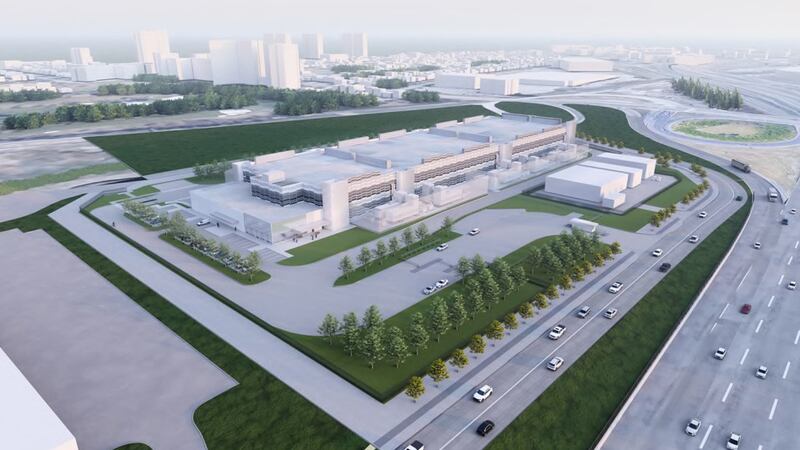
Located at the site of a former Lowe’s store in the area of Islington Avenue and Rexdale Boulevard, the two-storey facility will draw power directly from Hydro One, by tunneling under Hwy. 401 to reach new junction stations designed to draw power directly from overhead transmission wires.
The project, which has undergone multiple revisions with city staff since 2022, is nearing completion.
An artist's rendering of a new Microsoft data centre planned for Toronto is pictured.
In a statement to CP24.com, a Microsoft spokesperson said the company believes communities “should share in the benefits of AI infrastructure, not bear the costs” and pointed out it is paying for the infrastructure upgrades needed to support the new facility.
“We work closely with utilities, system operators, and regulators to plan energy needs well in advance and invest in efficient infrastructure,” the statement read.
“Through our Community-First AI approach, announced in April, we are committed to ensuring our data centres do not increase electricity prices for Canadians by paying the full cost of infrastructure required to support our operations, including substations and other grid assets dedicated to provincial utilities.”
Microsoft also pointed out it designs its data centres with energy and water efficiency in mind, with its facilities relying primarily on outside air for cooling and using water less than five percent of the year. Rainwater harvesting further offsets demand.
“Data centres are critical infrastructure that supports the digital services Canadians rely on every day - from video calls and online banking to AI-powered tools, education, research, and government services,” the company said. “They also create opportunities for broader economic growth by enabling innovation, helping organizations adopt AI, and supporting local jobs and skills development.”
Amazon Web Services (AWS), a major player in cloud computing, including AI services, did not respond to specific questions about industry regulation, but noted it has “established data centre regions” in the Montreal area since 2016 and in the Calgary area since 2023.
The company, which boasts tens of thousands of Canadian customers, pointed to a fact sheet that said it is “proud to be committed to Canada’s Net Zero Challenge as of 2026” and highlighted a number of measures it takes to mitigate the environmental impact of the centres.
“Our sustainability work includes enhancing energy efficiency, transitioning to carbon free energy, reducing embodied carbon, using water responsibly, driving a circular economy, and enabling sustainability for customers,” the company says on a site dedicated to its sustainability efforts.
“At AWS, we focus on efficiency across all aspects of our infrastructure. We use industry standard metrics to measure efficiency and seek the optimal balance of energy and water use.”
According to the company, AWS uses no water to cool its Montreal data centres 95 per cent of the year and 99 per cent of the year in Calgary, using free-air cooling instead.
Environmental impact
There’s also the question of where the electricity is coming from.
Eric Miller is director of the Ecological Footprint Initiative at York University, – a multidisciplinary group of scholars, students and organizations working to advance understanding of the world’s ecological footprint and biocapacity. He says that where a data centre is situated can make a huge difference.
When the Ecological Footprint Initiative looked at where their data was stored within Amazon Web Service’s (AWS) network of data facilities, he says, they found it was primarily located at a facility in the U.S. that relied on fossil fuel-heavy electricity.
“It so happens that AWS has a data centre off the south shore of Montreal, which is Hydro Quebec-fed,” Miller says. “We crunched the numbers and found out we could, by shifting our data use to that centre, reduce our greenhouse gas emissions by 87 per cent.”
Luckily AWS allows customers to select the facility where they would like their data primarily to be hosted and the Ecological Footprint Initiative made the switch.
The anecdote highlights some of the environmental concerns around data centres, but also demonstrates that decisions around data centres offer opportunities to make better choices while still acknowledging the need for what they provide.
“It’s kind of like voting with your dollars a little bit,” Miller says.
Provincial guidelines unclear
Local officials have said it would help to have provincial guidance as they seek to set local rules for AI data centres, but requirements at the provincial level remain unclear.
The Ontario government has said it plans to make the province “a world-leading AI jurisdiction,” noting in the latest budget that Ontario was already home to about 100 AI data centres as of 2025.
The budget also said the government plans to “ensure the province has the digital and grid-ready energy infrastructure required for next-generation innovation” as part of a comprehensive AI strategy expected to be unveiled this summer.
Legislation passed last year, the Protect Ontario by Securing Affordable Energy for Generations Act, allows the province to set out certain criteria that data centres must meet before connecting or reconnecting to the electricity grid.
“This ensures Canadian data stay in Canada, protected from misuse,” the government said in the budget.
However the legislation does not stipulate exactly what criteria the data centres must meet.
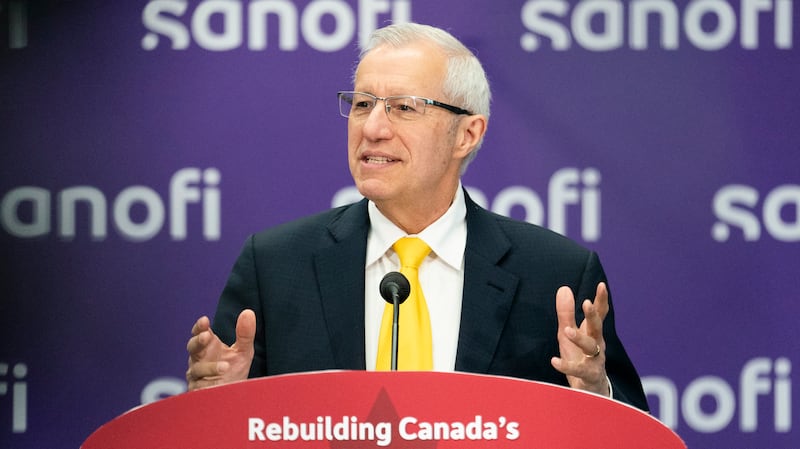
Ontario Minister of Economic Development, Job Creation and Trade Vic Fedeli delivers remarks during a press conference in the facilities of vaccine producer Sanofi, in Toronto on Thursday, May 30, 2024. THE CANADIAN PRESS/Arlyn McAdorey
Ontario’s Ministry of Energy referred questions about AI data centres and their impact on the grid to the office of Minister of Economic Development, Job Creation and Trade Vic Fedeli.
“Our government is ensuring that any investment made in the province delivers lasting prosperity for Ontario’s workers, businesses, and economy. No digital infrastructure project will proceed unless it contributes to the local economy and the company commits to paying the full cost of energy,” Fedeli’s spokesperson, Jennifer Cunliffe, said in an email.
She said legislation passed by the province provides “clear guardrails and gives Ontario the authority to prevent projects from connecting to the grid if they fail to meet these expectations.”
There was no response to a follow-up email asking where those guardrails are detailed.
Staff in Hamilton and Toronto are expected to report back to their respective city councilsnext year with recommendations for specific guidelines around AI data centres.
Pritam Das, associate professor of electrical and computer engineering at Binghamton University, State University of New York, photographed at his laboratory in the Engineering and Science Building.
Credit: Binghamton University, State University of New York
Artificial intelligence is increasingly a part of our everyday lives, and tech companies are building more data centers to accommodate the spike in computer processing.
Meeting the demands from thousands of new machines plugged into the power grid can be tricky, so promoting energy efficiency has become more important than ever.
Through his research at Binghamton University, Associate Professor Pritam Das has developed technology that could help. Now, thanks to a program supported by the National Science Foundation, he’s hoping to get it out to the marketplace.
As AI data centers proliferate and scale, and AI hyperscalers like Amazon Web Services, Microsoft Azure, and Google Cloud push for increased performance, challenges have emerged in powering critical AI graphics processing units (GPUs). Moore’s law — which for many years promised that the number of transistors on a microchip would double every two years — has reached its limit. Also, physical CMOS (complementary metal-oxide-semiconductor) transistors — which are the building blocks for modern electronics — measuring smaller than 4 to 7 nanometers are not currently viable.
As a result, GPU and AI processor designers aim for higher computing ability for all usable area, but managing heat and power becomes paramount. Modern chips are said to be power-limited, not area-limited, and designers are aggressively working to push transistor power to 1 volt and even as low as 0.5 volt.
“Because we cannot make the transistor any smaller, we need to reduce the voltage that these chips handle or operate from,” Das said. “Traditionally, it has been 5 volts or 3.3 volts, and now chipmakers are looking below 1 volt. As the voltage is reduced, it allows electronics packaging in a more dense way.”
However, Ohm’s law — the fundamental principle outlined by physicist Georg Ohm in the early 19th century — dictates that lowering the voltage requires more current for the same amount of computing power, and AI’s ever-increasing computing demands only make those equations more complex.
There are plans to increase the voltage on the DC distribution bus from 12 to 48 volts, which leads to 16 times less ohmic power loss and significantly reduces a data center’s thermal stress and energy consumption.
These two changes require a fundamental technology shift for point-of-load converters (POLc), which are the small DC-DC converters that sit closest to the ultra-low voltage GPUs and power them from the 48-volt DC current.
Traditional point-of-load converters for GPUs rely on multiple stages of DC-DC power conversion, reducing their efficiencies to 80%. That means for every 100 watts delivered, about 20 watts is lost as heat.
“These point-of-load converters are placed very close together, and those processors produce a lot of heat while they are computing,” he said. “You don't want to add to that thermal problem with less efficiency from the power conversion, because wherever efficiency drops, it also becomes heat, and that heat needs to be managed properly by a thermal cooling system.”
Das’ solution is a new kind of point-of-load converter to better step down the power in a single stage. A laboratory prototype achieved 10-12% higher efficiency for all load conditions and doubled the slew rate, which measures how fast the power conversion happens.
“You need to deliver that current at a very fast pace, just like our brain needs a lot of brain food when it is working,” he said. “AI needs that food very quickly as it is computing.”
NSF’s ART grant supports programs like EXCEED to help institutions of higher education in building capacity, infrastructure, and training to accelerate research translation, strengthen technology transfer, and create sustained economic and societal impacts across the U.S.
“It is incredible to be able to support technologies like Professor Das’ POLc patents through EXCEED, so these projects can more quickly address real-world problems,” said Kathryn Cherny, senior program manager for the University’s Office of Entrepreneurship and Innovation Partnerships. “These problems are not theoretical, and neither are the impacts of Binghamton innovation.”

No comments:
Post a Comment