One critic noted that Sahrawis “are beaten, arbitrarily arrested, and have their equipment confiscated for trying to make their own films of life under occupation.”
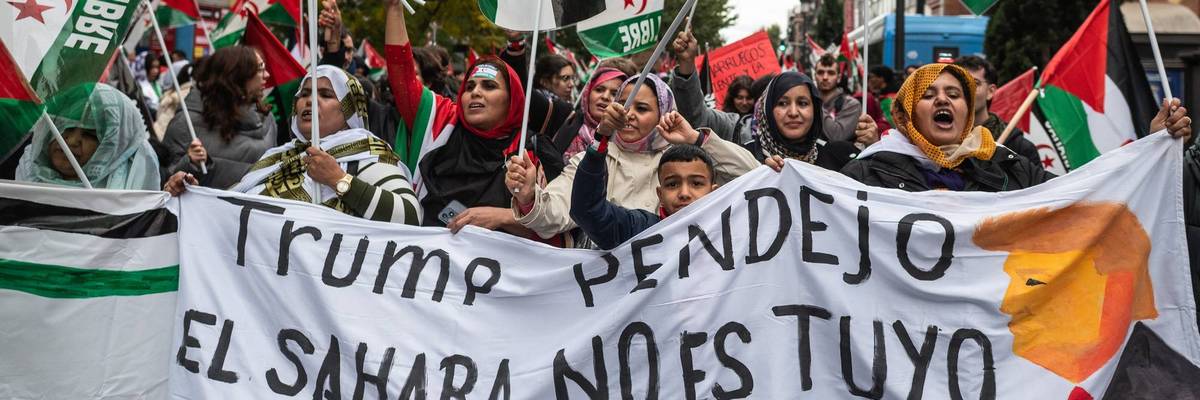
People carry a banner reading, “Trump, You Asshole, the Sahara Isn’t Yours” during a November 15, 2025 demonstration in Madrid against Morocco’s illegal occupation of Western Sahara and Western complicity.
(Photo by Marcos del Mazo/LightRocket via Getty Images)
Brett Wilkins
Jul 15, 2026
COMMON DREAMS
Sahrawi activists and filmmakers are leading renewed calls to boycott the big-screen adaptation of Homer’s ancient Greek epic The Odyssey over filmmaker Christopher Nolan’s decision to shoot the film in the Western Sahara, whose people have suffered Moroccan occupation for over half a century.
“It is deeply disturbing that while Sahrawi journalists are imprisoned for exposing abuses, an international film production can use our homeland as a cinematic backdrop without addressing the reality of the occupation,” Sahrawi journalist and filmmaker Mamine Hachimi told Middle East Eye (MEE) in an interview published on Wednesday.
Hachimi, who co-directed the short documentary Three Stolen Cameras about the oppression of people who document human rights crimes committed by Moroccan occupiers, told MEE’s Alex MacDonald that calls to boycott The Odyssey—which was filmed in the Western Saharan city of Dakhla and opens on Friday—“is not a campaign against cinema or artistic freedom, it is a call for ethical responsibility.”
“Two of my colleagues, Abdallah Lhafaouni, who is serving a life sentence, and Bachir Khadda, who is serving a 20-year sentence, are political prisoners simply because they documented human rights violations in occupied Western Sahara,” Hachimi said.
Another Sahrawi filmmaker, Mohamedsalem Werad, told MEE that “choosing to film in occupied Western Sahara was not a politically neutral production decision—it meant operating with the permission of the occupying power in a territory where the Sahrawi people have long been denied the opportunity to exercise their right to self-determination.”
“A boycott sends a clear message that filmmakers cannot expect audiences to overlook decisions that risk legitimizing an occupation,” he added.
Sarah Yerkes, a senior fellow in the Middle East Program at the Carnegie Endowment for International Peace, wrote last week that The Odyssey “has a colonialism problem.”
“For Morocco, the territories that make up Western Sahara are referred to as the ‘southern provinces’ and are an indisputable part of the kingdom,” Yerkes noted. “But... Dakhla is part of what is considered the occupied and non-self-governing Western Sahara under existing international law.”
“The Sahrawi people, who are indigenous to the region and currently have no meaningful self-determination, have not consented to the film’s production—and the Moroccan government is reaping the rewards at their expense,” she added.
The renewed calls to boycott The Odyssey follow last year’s appeal, led by the Western Sahara International Film Festival and signed by hundreds of artists, journalists, activists, and other human rights defenders, urging Nolan, Universal Pictures, and producers of the film “to break their silence and cease to be accomplices to Morocco’s 50-year illegal occupation.”
The government of the Sahrawi Arab Democratic Republic, which claims sovereignty over Western Sahara but is not recognized by the United Nations, has also condemned what it called “an attempt to film a cinematic work in occupied Dakhla, considering it a violation of international legitimacy and the ethics of cultural and artistic work.”
Morocco has occupied Western Sahara since 1975, when Spanish forces withdrew from their former colony in the dying days of longtime dictator Francisco Franco’s regime. Moroccan warplanes bombed Sahrawis, many of whom fled into neighboring Algeria as the government under King Hassan II orchestrated a “Green March” of hundreds of thousands of Moroccan civilians into the phosphate- and fishery-rich territory.
Western Sahara is today known among locals and human rights advocates as “Africa’s last colony.” Moroccan forces have brutally oppressed the Sahrawi people under their rule, severely restricting freedom of expression, movement, association, and the press, and utilizing arbitrary arrest and torture as tools of repression, according to human rights groups.
Moroccan occupation forces also built a 1,700-mile mostly sand wall to keep Algerian-backed Sahrawi militants led by the Polisario Front out of the territory, while denying people inside their occupied homeland a United Nations-backed referendum they’ve been awaiting for decades.
During his first term, US President Donald Trump recognized Moroccan sovereignty over Western Sahara, essentially in exchange for Morocco’s decision to normalize relations with Israel under the Abraham Accords.
Social media decries colonial plunder after Zendaya wears ancient Iranian earrings to promote The Odyssey
The earrings were made from 3,000-year-old medallions.

Images Staff
15 Jul, 2026
DAWN
The Odyssey is an ancient text, believed to have been first composed around 2,800 years ago, but do you know what’s even older than that? The earrings American actor Zendaya wore to promote the movie at a photo-call in London on July 5.
The pieces were made from a pair of gold medallions discovered in Iran in 1947, which are estimated to be 3,000 years old. They were part of the Ziwiye hoard, a large collection of jewellery, ceramics and other artefacts, parts of which are housed in major museums across the globe.
As with anything over a century old from the region, quite a few questions arose.
Days after the pictures were first shared, people wanted to know how the pieces had made it to a private collection in London. Were they taken out of Iran in a less-than-proper way? Did the people whose culture they represented agree with how they were being used?
And perhaps most importantly, wasn’t it a bit on the nose for Zendaya to be using Iranian cultural heritage to promote an American film about a Greek legend at a time when the US and Iran were on opposite ends of the battlefield?
Some users on X said Zendaya was a repeat offender when it came to insensitivity in fashion after her outfit for another event promoting the film — a white gown from Italian fashion house Schiaparelli — was flown to London via private jet right after it had been shown on the runway at Paris Fashion Week.
Unfortunately, Zendaya is not the first celebrity to appropriate jewellery that mysteriously wound up in Western hands. In January, Margot Robbie promoted her film Wuthering Heights in Los Angeles while wearing the Taj Mahal diamond around her neck.
The diamond had little to do with the film, or its 18th-century setting, but it had everything to do with Mughal emperor Shah Jahan, who had it made for his wife Nur Jahan.
That’s not even the worst case, which might be Cartier’s lending decisions surrounding the Patiala necklace, originally belonging to Maharaja Bhupinder Singh.
As per a report from India Today, the French jewellery house let Emma Chamberlain wear a part of the ornate necklace to the 2022 Met Gala, but refused a request from Diljit Dosanjh to wear it in 2026.
It’s bad enough that they didn’t let an Indian celebrity wear an Indian necklace, but it gets even worse when you realise Dosanjh’s Met Gala look was inspired by the Maharaja who owned it.
The earrings were made from 3,000-year-old medallions.

Images Staff
15 Jul, 2026
DAWN
The Odyssey is an ancient text, believed to have been first composed around 2,800 years ago, but do you know what’s even older than that? The earrings American actor Zendaya wore to promote the movie at a photo-call in London on July 5.
The pieces were made from a pair of gold medallions discovered in Iran in 1947, which are estimated to be 3,000 years old. They were part of the Ziwiye hoard, a large collection of jewellery, ceramics and other artefacts, parts of which are housed in major museums across the globe.
As with anything over a century old from the region, quite a few questions arose.
Days after the pictures were first shared, people wanted to know how the pieces had made it to a private collection in London. Were they taken out of Iran in a less-than-proper way? Did the people whose culture they represented agree with how they were being used?
And perhaps most importantly, wasn’t it a bit on the nose for Zendaya to be using Iranian cultural heritage to promote an American film about a Greek legend at a time when the US and Iran were on opposite ends of the battlefield?
Some users on X said Zendaya was a repeat offender when it came to insensitivity in fashion after her outfit for another event promoting the film — a white gown from Italian fashion house Schiaparelli — was flown to London via private jet right after it had been shown on the runway at Paris Fashion Week.
Unfortunately, Zendaya is not the first celebrity to appropriate jewellery that mysteriously wound up in Western hands. In January, Margot Robbie promoted her film Wuthering Heights in Los Angeles while wearing the Taj Mahal diamond around her neck.
The diamond had little to do with the film, or its 18th-century setting, but it had everything to do with Mughal emperor Shah Jahan, who had it made for his wife Nur Jahan.
That’s not even the worst case, which might be Cartier’s lending decisions surrounding the Patiala necklace, originally belonging to Maharaja Bhupinder Singh.
As per a report from India Today, the French jewellery house let Emma Chamberlain wear a part of the ornate necklace to the 2022 Met Gala, but refused a request from Diljit Dosanjh to wear it in 2026.
It’s bad enough that they didn’t let an Indian celebrity wear an Indian necklace, but it gets even worse when you realise Dosanjh’s Met Gala look was inspired by the Maharaja who owned it.
Zendaya wearing stolen ancient artifacts from a country and region that's being bombed, where women and girls are being murdered and disabled by the gov't and military of her country, at a film premiere is vile and tasteless.
Zendaya, Law, and the thief who made these are gross.

No comments:
Post a Comment