Extreme Heat Takes Farming to the Brink
July 10, 2026
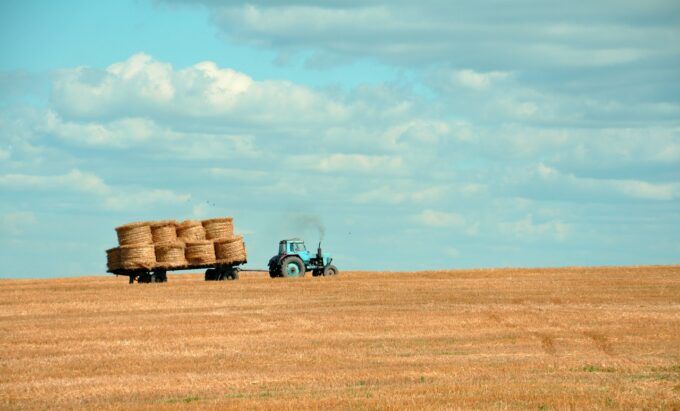
Image by Gozha Net.
Ever since the landmark Paris ’15 UN climate agreement wherein 195 nations agreed to cut fossil fuel CO2 emissions via NDCs 30% to 60% by 2030, the opposite has happened.
It’s now ten (10) years since Paris ’15, and according to the International Energy Agency (IEA), atmospheric carbon dioxide (CO2) levels have reached an all-time high, peaking at an average of 432.3 ppm in May 2026. This is the opposite of what the parties agreed to do and based upon current and proposed cuts, Paris ’15 is dead. The nations of the world have failed.
Their failure is now showing up in climate change, meaning: There can be no excuses for extreme heat. They inadvertently asked for it, and they got it. But it’s problematic for farmers. They cannot pick up stakes and move when heat bakes the land.
As a result of the collective failure of 195 nations, fossil fuel CO2 blankets the atmosphere more so than anytime in human history, and it turns up the heat that’s the primary force of a lurking danger: UN agencies have warned that “extreme heat is pushing global food and farming systems to the brink,” UN News d/d April 22, 2026 and WMO warning.
Apparently, global warming has entered “the red zone,” signifying dangerous thresholds where climate instability accelerates, leading to extreme weather and severe disruptions to ecosystems.
Extreme Heat as a Risk Multiplier
Across farming systems, the impact is already visible. For most major crops, yields begin to decline with temperatures above 30°C (86°F). This leads to weakened plant structures and reduced productivity. Livestock experience stress at even lower temperatures, especially pigs and poultry. They cannot cool themselves efficiently, resulting in reduced growth and risks of organ failure.
All food sources are negatively impacted. Regarding ocean life, rising temperatures lower oxygen levels putting marine life under strain, e. g., The Australian Marine Conservation Society d/d January 29, 2025: Marine Heatwave Kills 30,000 Fish on WA Coast, Highlighting Impacts of Climate Change. Reports indicated ocean waters 3°-5°C above normal,
Overall, the global ocean complex has recently experienced never-seen-before massive marine heatwaves lasting 500 days. Some scientists have expressed alarm, saying the situation is “scary.” See – Massive Ocean Regime Shift, Alarming.
Additionally, the above-mentioned UN report claims extreme heat in parts of South Asia, sub-Saharan Africa, and Latin America ramps up the number of “too hot to work days” going up to 250 days per year, over time. Can AI handle planting and harvesting of crops?
France “the EU Breadbasket” Slammed
According to Le Monde d/d July 3, 2026: “Early heatwaves are devastating French agriculture and leaving farmers helpless.” French farmers fear double-digit production losses and fear “the worst is yet to come.” According to Agriculture Minister Annie Genevard, agriculture is in a “crisis mode.” Even tree leaves are “burned”, crop growth that survives is “stunted “and poultry farms “decimated.”
Bloomberg News, July 2, 2026:
+A heat wave in western Europe may have damaged almost a third of French corn, according to preliminary estimates from the country’s Agriculture Ministry.
+The extreme weather also scorched about half of carrot production, 60% of hops and a large swath of orchards, and killed hundreds of thousands of poultry.
+Corn output was already expected to fall after growers reduced plantings due to higher fertilizer and fuel costs resulting from the Iran war.
French crop research institute ARVALIS says potato growth is optimal at around 18°C, slows at higher temperatures, and can stop at around 28°C to 30°C.. France recently endured a record-shattering national heatwave that pushed temperatures into the 40°C (104°F) range and well above 28°C for a consecutive 14-day period from June 17 to June 30.
Extreme Heat Hits Global Farming
“From India’s grain-producing northwestern plains to Australia’s eastern wheat belt, and from Thailand’s rice fields to Indonesia’s vast palm oil plantations, hot weather and below-normal rains are hurting crops and forcing farmers to reduce planting.” (Hot Weather Hurts Asian Crops as Powerful El Nino Takes Shape, Reuters, June 3, 2026)
“El Nino-driven dryness is a double blow for farmers already grappling with fertilizer and diesel shortages caused by the Iran war,” Ibid.
“About 50% of ice-free land mass is used for feeding humans, basically for agriculture. But deteriorating environment conditions such as more droughts, more floods, more wildfires have very significant implications on how we feed ourselves in the future. Climate change is affecting agriculture in ways no longer in line with practices of the past. So, past performance is no longer a good predictor of future production. This is a big deal.” (Source: Climate Extremes: Agriculture, Oos Pictures, June 2026)
Moreover, “globally, crops lose about 40% to diseases and pest every year. About 15 years ago that number was 25%. We’re not doing better, we’re doing worse and the reason is climate change…” Ibid, Shely Aronov, Co-founder Innerplant, San Francisco.
“We are now at an inflection point where we are no longer able to adapt to climate change in ways generations before were able to do it,” Ibid, Berninger, Bayer Global.
Climate Change has been sending signals of danger for some time. It doesn’t happen all at once, but by the time it does, it’s too late. Grist publication recently itemized early warning signals: The World is Getting too hot to Feed Itself d/d April 27, 2026.
“The authors cite how, in Chile, warming seas in 2016 prompted massive algae blooms that killed off an estimated 100,000 metric tons of farmed salmon and trout, creating the largest aquaculture mortality event in history. In the U.S.’s Pacific Northwest, when one of the strongest heat waves ever recorded struck in 2021, entire raspberry and blackberry harvests were lost, Christmas tree farms saw 70 percent timber volume declines, and the intersection of extreme heat, vegetative drying, and wildfires led to an increase of between 21 and 24 percent of forest area burned in North America that year. After a record heatwave hit India in 2022, wheat in over a third of Indian states fell anywhere between 9 and 34 percent, dairy animals afflicted with heat stress produced up to 15 percent less milk, and some cabbage and cauliflower yields were halved. And last spring in Kyrgyzstan’s Fergana mountain range, a region known for its year-round snow, spring temperatures rose 50 degrees Fahrenheit higher than the seasonal average — a bout of weather so unusual that it contributed to a locust outbreak and dramatic declines in cereal harvests.” (Grist)
The Food/Fuel/Human Paradox
Burning fossil fuels powers the food-producing revolution that powers human population overshoot altogether powering a massive heat-generation complex. Ipso facto, human civilization is a heat machine without a turn-off switch.
According to Earth Overshoot Day: “Fossil fuels are everywhere, and they are one of the main reasons that humanity is in ecological overshoot. In industrial agriculture, crops are dependent on large amounts of nitrogen fertilizers, petroleum-based agricultural chemicals, pumps that run irrigation, diesel for machinery, and oil for food distribution across the world. The green revolution focused on creating exponentially higher crop yields with decreased dependency on human labor, but it also boosted our food system’s dependence on fossil fuels.” This inescapable paradox has created the biggest heat machine in human history.
“Food is now more dependent than ever on finite resources and inexpensive fossil fuel energy. It is no wonder that, in many cases, our food is embedded with more “fossil fuel calories” than nutritional calories. For example, in Slovenia it takes 7 calorie-equivalents of fossil fuel to provide every 1 calorie of meat consumed. The number of calories of fossil fuel required varies by food group and among countries,” Ibid. In general, a seven-to-one calorie ratio needed to feed billions is not sustainable on an overheated planet. Something has to give to live.
The World Economic Forum (WEF), which is the hotbed of “Stakeholder Capitalism,” on the heels of Paris ’15, claimed that “most of the world’s countries could run on 100% renewable energy.” This did not sink in with WEF elites, aka: “Extreme Heatheads.”
The Renewables/Fossil Fuel Interchange
“Across all the energy the world uses, not just electricity but transport, heat, and industry too fossil fuels still supply about 80%. And that share has barely moved in 60 years.” (Forbes, aka: “the Capitalist Tool,” June 7, 2026)
You can cover the planet with renewables until you’re blue in the face and it won’t make a damn bit of difference to extreme heat if burning fossil fuels that emit CO2 remains at high levels, like ~80%. Heat thrives on CO2.
The outlook for Extreme Heat has never been so strong.
This Deadly Heat Wave Has a Culprit

Photo by Akanda Kilicarslan
Temperatures have soared globally this summer. And far from simply being uncomfortable, it’s killing people.
This past July 4th was one of the hottest in U.S. history. While Americans gathered to celebrate the country’s 250th birthday, dozens died from extreme heat — and the toll may still rise. In Europe, which has seen its own devastating heat wave, some 3,700 people have died. And the heat has become so extreme in Pakistan that people’s teeth are literally dissolving in their mouths.
This is only the beginning of extreme heat this summer — and if we don’t stop the climate crisis, for the rest of time. Scientists are warning that this marks “uncharted territory” in rising temperatures.
The good news? We know the solution. To build a better world, with cheaper and cleaner energy, we have to phase out fossil fuels and transition to green energy. This process is easier and cheaper than ever. Some 90 percent of renewable energy is now cheaper than fossil fuels, and renewables don’t heat our planet the way that fossil fuels do.
The bad news? Fossil fuel companies, and the politicians who support them, are trying to block this transition. Companies like Exxon have known for over 50 years that fossil fuels cause climate change — and that rising temperatures would cost lives. But they’ve tried to bury this information, stall the transition, and deceive the public that fossil fuels aren’t responsible.
I’ve seen this play out firsthand.
When I was 17, I spent a sunny week in Dubai at the 28th United Nations annual climate conference (COP28). I was so excited to attend the conference. I met other activists passionate about renewable energy and taking down the fossil fuel industry. I even attended lobbying meetings with the lead U.S. negotiators, Trigg Talley and Sue Biniaz.
Everything in Dubai felt larger than life — from the Burj Khalifa to the massive dome in the middle of the conference center. But over the week, the conference began to feel more and more dystopian. The fossil fuel industry had sent 2,456 lobbyists to that COP — and despite the loud cries of activists and scientists, their voices drowned ours out.
At the end of the conference, we had a small win — fossil fuels were mentioned in a COP text for the first time ever. But the language was so weak that the statement felt almost meaningless. The text did nothing to change the trajectory of the climate crisis.
The fossil fuel industry has propagated lies about climate change for years. They’ve tried to convince us that climate change is our fault instead of theirs, with campaigns around “carbon footprints” — a concept created by BP — and recycling, which was popularized by the plastics industry but has never managed to efficiently recycle plastics themselves.
They have also spent hundreds of millions of dollars on influencing climate decision making spaces — from United Nations conferences to Washington, D.C. Big Oil spent $445 million during the 2024 elections — and in return has gotten $40 billion in fossil fuel subsidies from the Trump administration.
The time has come for us to rise up against this deceptive and powerful industry, to finally kick them out of spaces with influence. It is high time for us to stop being manipulated by fossil fuel companies that are only out to make a profit and harm us.
As temperatures rise, we are now in a battle of people vs. fossil fuels. We must win — it’s a matter of life and death.
No comments:
Post a Comment