
published by the Independent Institute
By Craig Eyermann
By Craig Eyermann
Key Takeaways
US Public Debt is on an Unsustainable Path — Debt held by the public is projected to grow much faster than the economy, reaching dangerous levels as a percentage of GDP through 2056.
Spending, Not Revenue, is the Core Problem — Persistent primary deficits are driven by rising costs in Social Security, Medicare, and other health programs due to an aging population and higher per-beneficiary expenses.
Interest Payments are Exploding — Net interest on the debt is the fastest-growing part of federal spending and is projected to reach nearly 10% of GDP by 2056 — more than triple current levels — risking a debt default if unchecked.
They say, “A picture is worth a thousand words.”
Here then is a picture that tells a long, depressing story. It is the first figure that appears in the General Accounting Office’s June 2026 Annual Report to the U.S. Congress on the Nation’s Fiscal Health, entitled “Debt Held by the Public Is Projected to Grow Faster Than the Economy”. All it does is show how the publicly held portion of the U.S. government’s total public debt outstanding has changed and is projected to change as a percent of the nation’s Gross Domestic Product (GDP) over the years from 1900 through 2056.
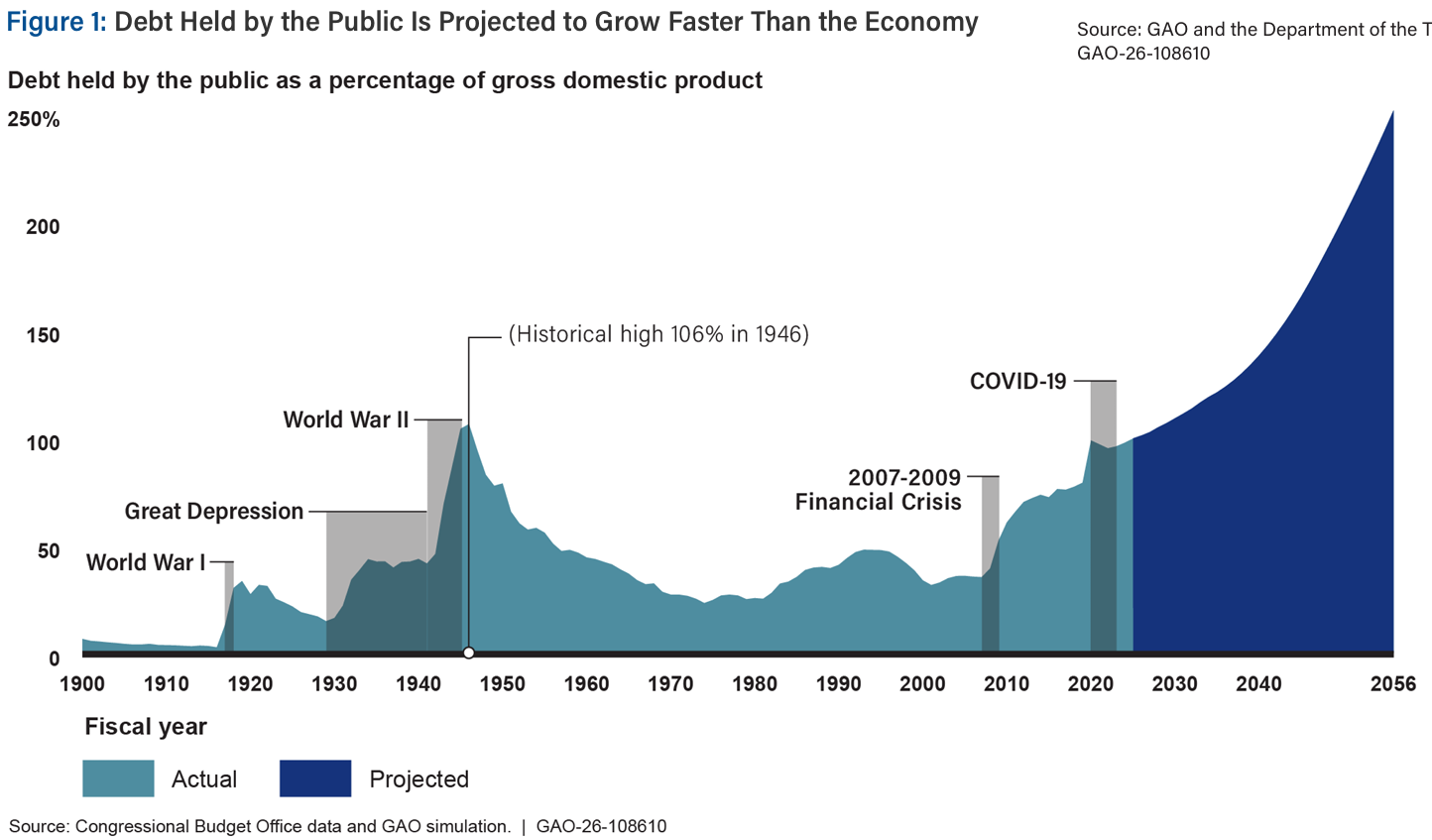
The GAO’s report explains why this problem exists and why it will continue to get worse without serious fiscal reforms:
For over two decades, the government has consistently run primary deficits (i.e., excluding interest payments), as revenue averaged 16.7 percent of GDP annually compared to annual average program spending of 20.7 percent of GDP. The primary deficit of $805 billion for fiscal year 2025 represented 2.7 percent of GDP.
Under current policies, revenue is projected to increase (as a percentage of GDP) but not enough to keep pace with spending increases, resulting in increasingly large primary deficits.
The GAO’s report features another figure that clearly illustrates the cause of the problem. Here it is:
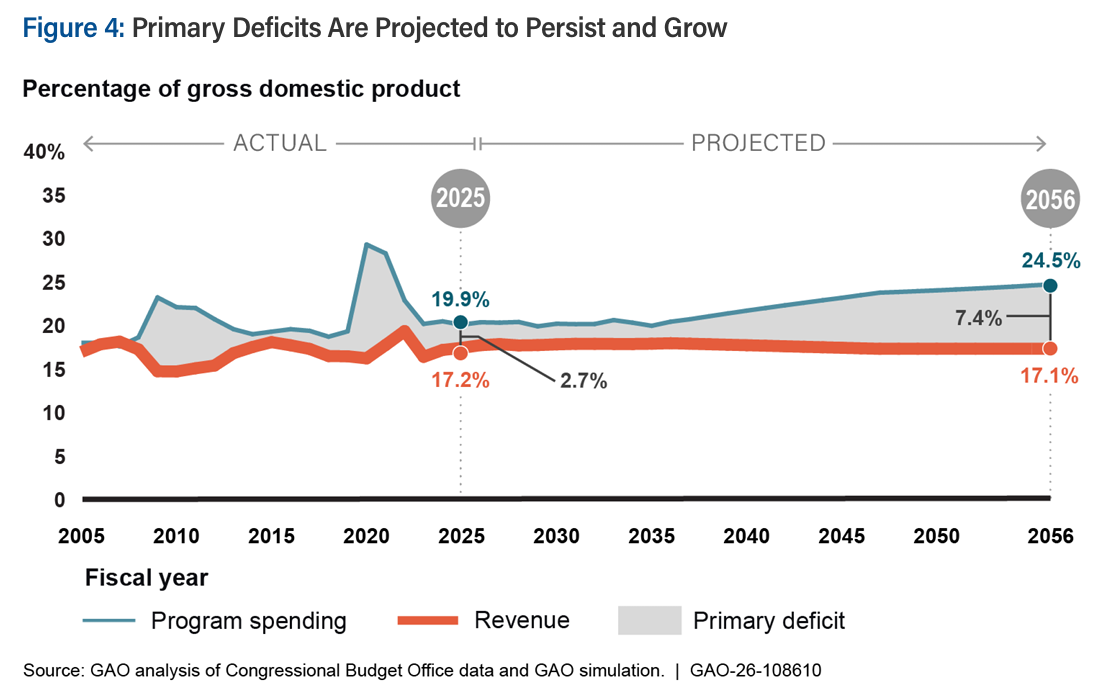
Notice how steady the line representing the U.S. government’s projected revenues as a percent of GDP is, while the line representing spending curves upward. That’s a clear sign the true threat to the nation’s fiscal health is excessive spending under the government’s fiscal policies.
The GAO identifies the programs that are responsible for the growth of the government’s projected excessive spending:
Projected growth in program spending is largely driven by Social Security, Medicare, and other federal health care programs. The American population is aging, which increases the number of Social Security and Medicare beneficiaries relative to the overall population. In addition, Medicare and other federal health care programs face increasing health care costs per beneficiary. Federal health care spending consists of Medicare, Medicaid, the Children’s Health Insurance Program, and subsidies for insurance purchased through the health insurance exchanges.
The GAO also confirms that paying interest on the national debt has become the fastest-growing component of the federal government’s spending:
Interest costs have increased rapidly since 2021 becausedebt has accumulated quickly as large annual deficits have required more borrowing, and
higher interest rates have increased the cost of borrowing.
Under current policy, we project that spending on net interest will grow quickly, reaching almost 10 percent of GDP in 2056—more than three times current levels.
Paying interest on the national debt is the only truly mandatory portion of the government’s spending. If the government fails to pay that interest, it will default on the national debt. A default would ensure enormous and negative consequences.
That’s quite a scary story to tell with a picture!
This article was published by the Independent Institute
About Craig Eyermann
Craig Eyermann is a Research Fellow at the Independent Institute. He is also the creator ofMyGovCost.org: Government Cost Calculator. He received his M.S. in mechanical engineering from New Mexico State University and M.B.A. from the University of Phoenix, having received a B.S. in both mechanical and aerospace engineering from the Missouri University of Science and Technology.
View all posts by Craig Eyermann →
About Craig Eyermann
Craig Eyermann is a Research Fellow at the Independent Institute. He is also the creator ofMyGovCost.org: Government Cost Calculator. He received his M.S. in mechanical engineering from New Mexico State University and M.B.A. from the University of Phoenix, having received a B.S. in both mechanical and aerospace engineering from the Missouri University of Science and Technology.
View all posts by Craig Eyermann →
No comments:
Post a Comment