Forcing Refugees To Return to Syria is a Bad Idea
Saturday 11 July 2026, by Joseph Daher
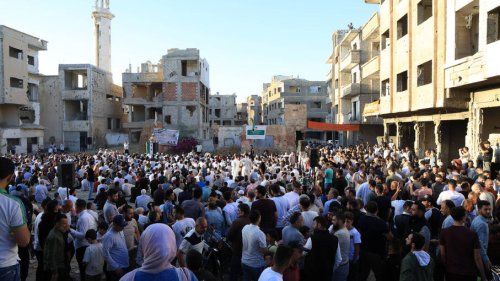
During the first official visit of Syrian Interim President Ahmed al-Sharaa to Germany at the end of March 2026 German Chancellor Friedrich Merz declared that “about 80% of the Syrians currently living in Germany should return to their homeland” over the next three years – which would be more than 720,000 people. [1]
After his statement was criticised, Merz clarified that he was not expressing a refugee policy but merely repeating the opinion of interim President al-Sharaa and those, "who wish to remain in Germany and are well integrated will be able to remain in Germany." Al-Sharaa rejected Merz’ claim, characterizing it as “somewhat exaggerated”.He insisted that returns would depend on economic reconstruction and improved living conditions. Meanwhile, German Foreign Minister Johann Wadephul endorsed Merz‘ statement, while pointing out that "what the Chancellor says is, of course, the goal of the federal government" — and was not motivated by the interim President of Syria.
Regardless of the “clarifications” of the German chancellor, and the practical impossibility such a plan faces, these declarations reflect a wider political trend in Europe calling for the return and deportation of Syrians. The European Parliament’s support of the Return Regulation, at the end of March 2026, expanding “the EU’s punitive and restrictive detention and deportation plans”, demonstrates this continuously hostile dynamic regarding migrants and the collaboration of conservative and the far right. This contributes to the ongoing and expanding racist and islamophobic atmosphere in Europe. But the plans of mass returns must not only be rejected for the racism that underpins it. These attempts are directed against the interests of Syrian working classes, be it in Germany or in Syria.
Is Syria Ready to Receive 1.6 Million Returnees
A large majority of Syrians in Germany, and Europe do not want to return to Syria under current conditions of wartime destruction, political instability, economic crisis and ongoing human rights violations. At the same time, the labor market remains disrupted, and unemployment is high, particularly among the youth. While there are no clear rates for the size of unemployment in Syria, due to the absence of periodic and regular labor force surveys, estimates for 2025 range from 14% to 60% youth unemployment. In addition, 83% of the Syrian labor market is reportedly informal, which does not guarantee access to social security and legal protection, leaving millions of workers vulnerable to exploitation or sudden income loss.
The returns of Syrians have also further strained the labor market, which does not have the capacity to absorb them. Most of the Syrians who came back to Syria since the fall of the Assad regime in December 2024, an estimated 1.6 million, had taken refuge in neighboring countries, especially Turkey, Lebanon and Jordan. In addition, an estimated 1.9 million Internally Displaced People (IDP) returned to their areas of origin, while approximately 5.54 million IDP remained displaced nationwide.
According to the UNHCR “these movements continued to place pressure on already overstretched services and infrastructure, particularly in areas hosting displaced populations and high numbers of returnees”. According to the UN, only 57% of public hospitals are fully functional, and only around a third of the primary health care centers are operational, while more than a third of the schools are damaged or destroyed. Similarly the International Organization for Migration in May 2025 underlined that the “lack of economic opportunities and essential services pose the greatest challenge for Syrians returning to their communities”.
Syria’s needs are acute: the cost of reconstruction is estimated to range between $140 billion and $345 billion, according to the World Bank, which is equivalent to 7 to 17.5 times the current estimated GDP in Syria. More than half of Syrians remain displaced, either internally or abroad. Nine out of ten live below the poverty line, nearly 17 million people require urgent assistance to survive; and more than nine million face acute food insecurity.
Although the Syrian ruling authorities raised public-sector salaries and pensions by 200% in July 2025 and by 50% in March 2026, most of the population, whether employed in the public or the private sector, still cannot cover their monthly expenses with their salaries. While the minimum wage was increased to around $114 a month, this is far from enough to sustain an average person’s livelihood, with the minimum cost of living for a family of five in Damascus exceeding this fourfold and the average cost of living being almost ten times higher at the beginning of the year 2026. Under these conditions, mass return of Syrian refugees would increase the pressure on the labor market, which is already characterized by low salaries and and a very low level of social protection. In addition, it would cut the flow of remittances to the country.
How Syrian Diaspora Remittances Keep Families Alive
Large segments of society rely on money transfer from relatives abroad amounting to around $4 billion annually, according to estimates from earlier this year, with Europe and Gulf countries as the main sources since 2011. Germany constitutes the main source for remittances from Europe, between 300 and 400 million of Euro on a yearly basis. This is connected to the progressive and ongoing integration of Syrians in the German labor market.
The role of remittances in Syria evolved in the past decade from a supplemental resource into a primary structural requirement for household survival. These flows played an increasingly critical role in sustaining livelihoods, often becoming the main source of income for many households as their purchasing powers were continuously reduced as a result of the depreciation of the national currency and rising inflation. In certain cases and more particularly after the fall of the Assad’s regime, remittances have been used by families to rebuild their households, and collective initiatives in some areas have emerged benefitting from diaspora remittances to rehabilitate specific infrastructures or buildings. These examples remain quite rare however.
Real Estate Projects During Syria’s Housing Crisis
The country continues to suffer a deep and combined housing and infrastructure shortfall. According to the 2025 Humanitarian Needs and Response Plan (HNRP), “one-third of the country’s housing stock has been damaged or destroyed, while critical infrastructure, including roads, water networks, electricity, and sanitation systems, remains largely non-functional”. In this context and in the absence of any reconstruction plan, several local communities have protested against real estate projects seeking profit rather than housing for people in need. In Homs, residents of the Qarabis neighbourhood pressured the Kuwait-based al-Omran Real Estate Development Company to part of its “Boulevard of Victory” plan, which would have threatened their properties and displaced them from their homes. Similarly, Damascus residents successfully opposed a project that sought to transform Al-Jahiz Park – one of Damascus’s last remaining public green spaces – into a commercial space with cafés and parking facilities. In the beginning of May 2026, a demonstration was organized in Damascus by residents of the Mezzeh, Kfar Souseh, and Basateen al-Razi neighborhoods affected by Decree 66, which was enacted in 2012 and allows the “redesigning of unauthorized or illegal housing areas” and their replacement with “modern” real estate projects with quality services.
Large segments of the population suffering from worsening living conditions and low purchasing power face very high rents and expensive property prices. Instead of building housing schemes and infrastructures for the broader population, these real estate projects serve an elite class able to afford new and expensive housing projects and accumulate capital. Alongside these dynamics, these housing policies reflect a larger political economic strategy, responding to a crisis-ridden economy with austerity measures.
Austerity in Post-Assad Syria: Who Pays the Price?
Household stability has become increasingly contingent on remittances rather than local economic dynamics, particularly as the former Assad’s regime engaged in austerity measures and cut back on social support to the population. The share of spending on public subsidies and other support programmes diminished significantly in the state’s budget after 2011, representing 15.5% in 2010 compared to just 5.6% in 2024. In addition, continuously rising inflation resulted in diminishing purchasing power for large sectors of the population.
The new Syrian ruling authorities’ economic policies have not challenged this reality, quite the opposite. Following the declared reduction of state spending, the Syrian ruling authorities quickly announced plans to dismiss up to one third of the state workforce, targeting employees allegedly receiving salaries without fulfilling their duties. Dismissals have continued across multiple ministries in 2026. Damascus’ austerity measures have had a significant impact on the population’s purchasing power. The price of subsidized bread was raised in December 2024 from 400 Syrian Pounds (SYP) (for 1,500 grams) to SYP 4,000 (for 1,200 grams and then 1,050 grams since May 2026), representing an increase of around 1365% and exacerbating food insecurity among the most vulnerable. At the same time, the government suspended subsidies on fuel and oil derivatives, increasing production costs across the agricultural and manufacturing sectors. In October 2025, the Syrian government announced a significant increase in electricity prices. In January 2026, tariffs increased from an average of $0.85-$4 to bills ranging from $50 and $169. Some families even saw their bills reach between $423 and $508. This has also severely affected key productive economic sectors, particularly manufacturing and agriculture.
The political-economic orientation of the new ruling authorities has entrenched the economic dynamics present in the former regime. Syria is facing structural economic challenges, including the instability of the Syrian pound, a weakened financial system, the destruction infrastructure, low purchasing power, high cost of production, a dearth of skilled workers, and more. Yet, the new government is pushing a commercial model focused on short-term profit and primarily on the service sector to the detriment of Syria’s productive sectors, which is not conducive to developmental dynamics. Meanwhile, no protection against foreign competitive products has been provided to national production, particularly manufacturing industry and agriculture. Accelerated trade liberalization is threatening production even more. In late January 2025, Damascus reduced customs duties on over 260 Turkish products. At the end of 2025, Syria’s trade deficit with Turkey reached an all-time high of $3.26 billion in 2025. This represents an 86.5% rise in comparison to 2024, when the deficit stood at $1.74 billion.
Workers’ Unrest and Protests Across Syria in 2026
Increasing frustration among workers in the public, private and informal sectors with the government’s economic policies has led to popular protests and strikes, particularly since the beginning of the year. In the Idlib and Aleppo countryside governorates, teachers engaged in a large-scale strike in late January 2026 demanding permanent employment, the swift reinstatement of those dismissed, and salary increases that commensurate with the soaring cost of living. More than 1,700 schools closed in these areas for the “Strike for Dignity,” in response to the authorities’ failure to honor commitments regarding salary increases and improved working conditions. Other sectors have also mobilized protests – including transport workers, industrial workers, students, lawyers and bakery owners – demonstrating deepening grievances across the country over the continued erosion of purchasing power and the deterioration of public services. But the protests were also directed against corruption, nepotism, and a lack of transparency and participation in decision making processes.
Multiple protests on various socio-economic issues are ongoing throughout the country. New demonstrations erupted in mid-May, initially in Raqqa, Deir Ez-Zor, and Daraa and then spread to further regions, after the Syrian Ministry of Economy and Industry had fixed a price of wheat widely considered too low. This sparked widespread frustration among wide sectors of farmers and peasants, as the cost of production exceeds this price.
The Case for Legal Settlement Over Mass Deportation
Not only are the conditions for a safe and dignified return to Syria not given. Without economic recovery and the reconstruction of critical state infrastructure a mass return of refugees to Syria would only worsen socio-economic conditions within the country and threaten large sectors of society dependent on remittances to survive. While this transfer of money by the Syrian diaspora remains essential for consumption of basic goods and services, they can’t sustain any recovery of the productive sectors of the economy. Remittances fuel consumption rather than productive investment within the national economy. In other words, they are a tool for survival, but they are no substitute for sustainable economic development.
Instead of threats to return Syrians to Syria, Germany and the EU should consolidate the legal settlement of Syrian refugees. This would enable them to stabilize their living conditions and move freely between their host country and Syria. Thereby, they could play a more active role in Syria’s reconstruction, and participate in its economic, social and political life. Rather than unfeasible announcements of mass returns, German and European officials should seek to encourage an inclusive reconstruction process and a wider democratic participation within Syria. Otherwise, the current challenges may result in deepened authoritarian dynamics and entrenched forms of exclusion, both political and economic. This would rather create new incentives for Syrians to seek better opportunities and living conditions abroad.
Source: Rosa Luxemburg Stiftung.
Footnotes
[1] Photo: Reconstruction costs in Syria will be high: Muslims gather this May for Eid al-Adha prayers in a public square heavily damaged by war in Damascus IMAGO / StringersHub.
No comments:
Post a Comment