The Investigation Into the Minab Elementary School Bombing Is Done. Where Is It?
The Trump administration is stonewalling the public about the US’s deadliest strike on civilians in decades.
By Etan Mabourakh ,
July 10, 2026
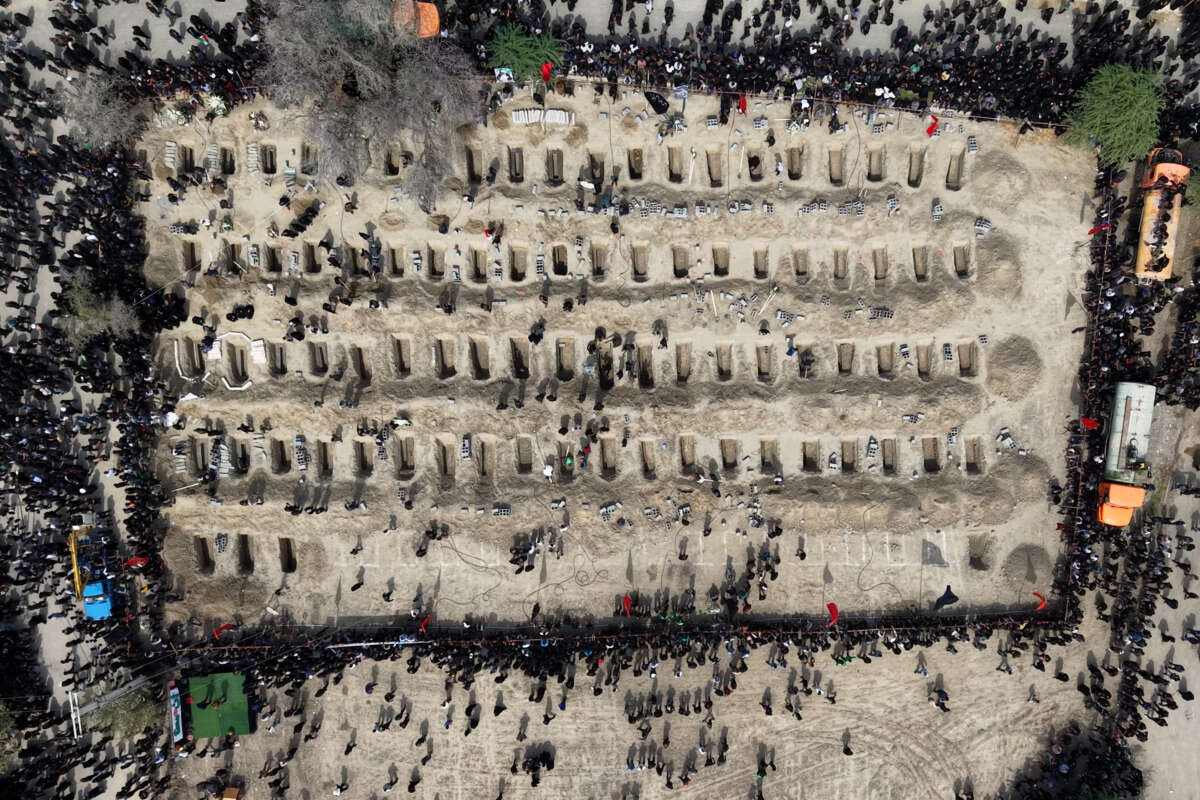
Bodies of children are carried to their graves during a funeral held on March 3, 2026, in Minab, Iran, for students killed in the U.S.-Israeli strike on an elementary school in Minab on February 28, 2026.Iranian press handout / Getty Images
New details are emerging about the U.S. attack on the Minab school that killed 168 people — and yet the Trump administration continues to stonewall and is refusing to release findings, even as CNN reports that U.S. military officials knew within days what happened.
Here’s what we know: On the morning of February 28, 2026, the first day of “Operation Epic Fury,” the United States bombed the Shajareh Tayyebeh girls’ elementary school in Minab, a small city in southern Iran. At least 168 people were killed — the majority of them girls between the ages of 7 and 12. More than 100 children and staff were wounded. By any measure, it was one of the deadliest single strikes on civilians in the history of U.S. military operations in recent decades.
But more than four months later, the U.S. government continues to stonewall the public over who is responsible for this horrific crime, and if anyone will be held accountable.
CNN just reported that U.S. commanders bypassed warnings about outdated targeting data ahead of the strike. Satellite imagery analyzed by NPR showed that the school, while adjacent to an Iranian naval base, had been walled off from that facility and operating as a functioning school since at least 2016. A New York Times analysis concluded that U.S. forces most likely struck the school amid attacks on that naval base. And critically, Reuters reported that U.S. military investigators themselves believed U.S. forces were likely responsible.
CNN just reported that U.S. commanders bypassed warnings about outdated targeting data ahead of the strike.
Neither the United States nor the Israeli government has taken public responsibility. Secretary of Defense Pete Hegseth, when asked about the strike on March 4, said only: “All I know, all I can say, is that we’re investigating that.” He offered no commitment to transparency or accountability, and no timeline for the investigation. He also said that Operation Epic Fury would have “no stupid rules of engagement” and described U.S. military operations as delivering “death and destruction from the sky all day long.” President Donald Trump, when asked directly about the strike, said he doesn’t think it was the United States and that he doesn’t know if we are “ever going to solve that problem.”
New details are emerging about the U.S. attack on the Minab school that killed 168 people — and yet the Trump administration continues to stonewall and is refusing to release findings, even as CNN reports that U.S. military officials knew within days what happened.
Here’s what we know: On the morning of February 28, 2026, the first day of “Operation Epic Fury,” the United States bombed the Shajareh Tayyebeh girls’ elementary school in Minab, a small city in southern Iran. At least 168 people were killed — the majority of them girls between the ages of 7 and 12. More than 100 children and staff were wounded. By any measure, it was one of the deadliest single strikes on civilians in the history of U.S. military operations in recent decades.
But more than four months later, the U.S. government continues to stonewall the public over who is responsible for this horrific crime, and if anyone will be held accountable.
CNN just reported that U.S. commanders bypassed warnings about outdated targeting data ahead of the strike. Satellite imagery analyzed by NPR showed that the school, while adjacent to an Iranian naval base, had been walled off from that facility and operating as a functioning school since at least 2016. A New York Times analysis concluded that U.S. forces most likely struck the school amid attacks on that naval base. And critically, Reuters reported that U.S. military investigators themselves believed U.S. forces were likely responsible.
CNN just reported that U.S. commanders bypassed warnings about outdated targeting data ahead of the strike.
Neither the United States nor the Israeli government has taken public responsibility. Secretary of Defense Pete Hegseth, when asked about the strike on March 4, said only: “All I know, all I can say, is that we’re investigating that.” He offered no commitment to transparency or accountability, and no timeline for the investigation. He also said that Operation Epic Fury would have “no stupid rules of engagement” and described U.S. military operations as delivering “death and destruction from the sky all day long.” President Donald Trump, when asked directly about the strike, said he doesn’t think it was the United States and that he doesn’t know if we are “ever going to solve that problem.”
On Mother’s Day, I Will Mourn Alongside the Grieving Parents of Minab
The first Mother’s Day proclamation was a call to disarm. It’s more crucial than ever to honor the day’s antiwar roots. By Negin Owliaei , Truthout May 10, 2026
Some in Congress Have Demanded Answers
In the weeks that followed the Minab bombing, some members of Congress moved swiftly to demand accountability. On March 11, Sen. Chris Van Hollen (D-Maryland) led a letter signed by more than 40 senators to Secretary Hegseth, demanding a full investigation into the Minab strike and pressing the administration on its compliance with the law of armed conflict. The letter raised pointed questions: Did U.S. forces conduct the strikes? What was the intended target? Were AI tools used in targeting? Was a “no-strike list” established before operations began? The senators requested answers from Hegseth by March 18, 2026.
The American people are owed the truth. So are the families in Minab.
The following day, Rep. Sara Jacobs (D-California) led a letter signed by more than 150 House lawmakers raising alarm over the broader civilian toll in Iran — over 1,000 Iranians killed by early March. The letter called out the administration’s systematic dismantling of the institutions built to prevent exactly this kind of harm: budget cuts at CENTCOM, the firing of senior military lawyers responsible for compliance with the laws of war, and the gutting of the Civilian Protection Center of Excellence. Jacobs publicly demanded accountability during a congressional hearing as well. None of these letters received the substantive responses they demanded.
This week, on July 5, a group of senators and House members — including Elizabeth Warren, Mazie Hirono, Tammy Duckworth, Patty Murray, Kirsten Gillibrand, Andy Kim, Mark Kelly, Jason Crow, and Sara Jacobs — pressed Secretary Hegseth on the Inspector General’s findings in a May report raising new concerns about failure to uphold civilian harm mitigation responsibilities. The lawmakers argue that Hegseth is putting service members and Department of Defense missions “at risk by gutting civilian harm mitigation and response (CHMR) efforts and that the DoD no longer has the ‘personnel and capabilities’ required to comply with the law and its congressionally-mandated CHMR responsibilities.”
In the weeks that followed the Minab bombing, some members of Congress moved swiftly to demand accountability. On March 11, Sen. Chris Van Hollen (D-Maryland) led a letter signed by more than 40 senators to Secretary Hegseth, demanding a full investigation into the Minab strike and pressing the administration on its compliance with the law of armed conflict. The letter raised pointed questions: Did U.S. forces conduct the strikes? What was the intended target? Were AI tools used in targeting? Was a “no-strike list” established before operations began? The senators requested answers from Hegseth by March 18, 2026.
The American people are owed the truth. So are the families in Minab.
The following day, Rep. Sara Jacobs (D-California) led a letter signed by more than 150 House lawmakers raising alarm over the broader civilian toll in Iran — over 1,000 Iranians killed by early March. The letter called out the administration’s systematic dismantling of the institutions built to prevent exactly this kind of harm: budget cuts at CENTCOM, the firing of senior military lawyers responsible for compliance with the laws of war, and the gutting of the Civilian Protection Center of Excellence. Jacobs publicly demanded accountability during a congressional hearing as well. None of these letters received the substantive responses they demanded.
This week, on July 5, a group of senators and House members — including Elizabeth Warren, Mazie Hirono, Tammy Duckworth, Patty Murray, Kirsten Gillibrand, Andy Kim, Mark Kelly, Jason Crow, and Sara Jacobs — pressed Secretary Hegseth on the Inspector General’s findings in a May report raising new concerns about failure to uphold civilian harm mitigation responsibilities. The lawmakers argue that Hegseth is putting service members and Department of Defense missions “at risk by gutting civilian harm mitigation and response (CHMR) efforts and that the DoD no longer has the ‘personnel and capabilities’ required to comply with the law and its congressionally-mandated CHMR responsibilities.”
The Investigation Is Finished. Where Is It?
By May, there was reason to believe the military’s internal review was nearing completion. CENTCOM Commander Admiral Brad Cooper told reporters that the probe into the Minab school strike was near its conclusion. And yet no findings have been released publicly. Some reports indicate the investigation has been submitted but has remained stalled under review from CENTCOM, raising concerns that it’s being stonewalled for political purposes. The investigation appears complete — and buried.
Congress could use the National Defense Authorization Act to require the declassified release of the investigation’s findings.
Meanwhile, the above-mentioned May 13, 2026 report from the Pentagon’s own Inspector General found that the Department of Defense had systematically failed to implement its Civilian Harm Mitigation and Response Action Plan (CHMR-AP). All eleven objectives of the plan — once making progress — were reclassified as “at risk.” The IG found that the legally-mandated Civilian Protection Center of Excellence lacked key staff and leadership. Officials from the Joint Staff told the IG that gutting these programs “harms readiness” and increases the risk of “civilian casualties, damaged coalitions and alliances, loss of legitimacy, increased local resistance.”
Accountability Will Require Transparency
This is not a complicated question of law or politics. The investigation is done. People in the U.S. have a right to know how this happened, why it happened and how we can prevent it from ever happening again. The children killed at that school deserve far more than silence.
There are clear vehicles through which lawmakers can — and should — act. Congress could use the National Defense Authorization Act to require the declassified release of the investigation’s findings. Lawmakers can attach explicit reporting requirements to defense legislation, forcing public disclosure. And members of Congress, as they have already begun to do, can continue raising these questions in hearings and in letters until this administration can no longer ignore them.
What is not acceptable is the current state of affairs: an investigation reportedly completed, a president who says he doesn’t think it was us, a defense secretary who has openly dismissed the rules designed to prevent war crimes, and 168 people — most of them schoolgirls — whose deaths have received no official accounting.
The American people are owed the truth. So are the families in Minab.
This article is licensed under Creative Commons (CC BY-NC-ND 4.0), and you are free to share and republish under the terms of the license.

Etan Mabourakh
Etan Mabourakh is the national organizing manager at the National Iranian American Council, where he organizes grassroots volunteers through a nationwide chapter network and coalitions across the United States. A Jewish Iranian American based in New York, Etan has consulted on campaigns at every level of government, speaks frequently on U.S.–Iran policy, as well as civil rights and antiwar advocacy.
No comments:
Post a Comment