_0.jpeg)
Thousands of Albanians marched through central Tirana for a 41st consecutive evening on July 10, demanding the resignation of Prime Minister Edi Rama and calling for the removal of the country's entire political establishment, in a protest movement that has grown far beyond its environmental origins.
Gathering shortly after 7pm in the city’s central Skanderbeg Square, demonstrators carrying Albanian flags and banners marched to the prime minister's office, where speeches, music, drumming, whistles and chants continued for more than two hours before protesters walked through the capital's streets.
The protesters repeated demands they have made throughout the past six weeks, including the resignation of Rama's government, the formation of a technical administration and the replacement of what they call the country's old political class.
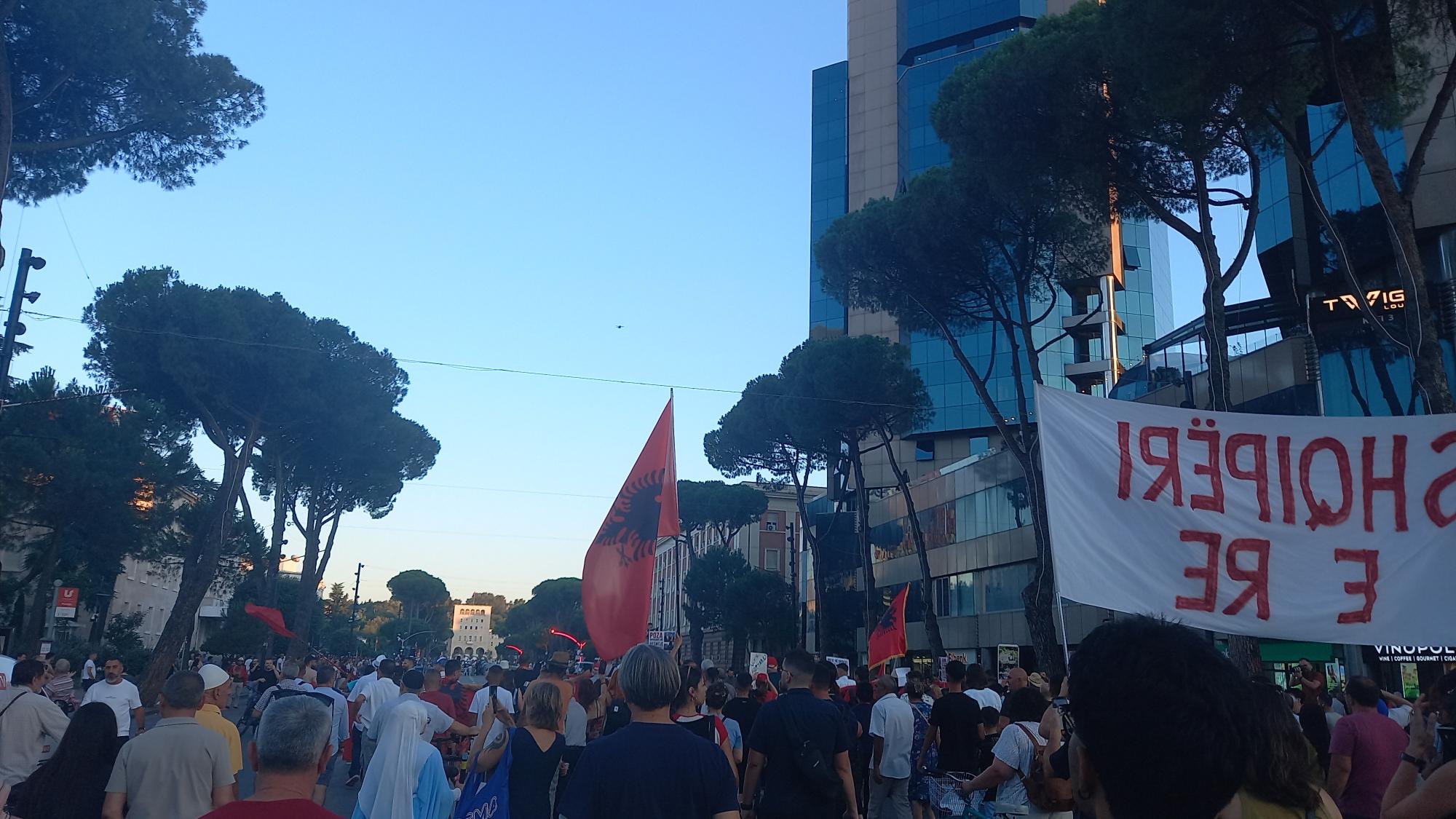
Among the loudest chants were calls of “Revolution” and “Rama in prison, [opposition leader Sali] Berisha in prison", reflecting frustration not only with the government but also with Albania's traditional opposition parties.
Many of the protesters gather night after night, while others come as often as they can, with larger numbers turning out at weekends.
“I’m here because our prime minister has sold the country," one woman told IntelliNews as protesters gathered on Skenderbeg Square.
A member of Albania’s diaspora said she had returned from Florence with her daughter to take part in the protests.
“This is the first step, and the most important thing is that it is in the right direction,” she said.
"I think things will change for our daughters, if not for us," she added.
Several protesters stressed that the demonstrations are peaceful, blaming a handful of violent incidents on paid provocateurs. They also highlighted the coming together of Christians and Muslims, old and young. Close to where demonstrators gathered, sheets of paper and crayons had been laid out for children to draw.
Clashes in Zvërnec
The protests, which organisers have dubbed the "Flamingo Revolution", began on May 30 near the village of Zvërnec after environmental activists tried to halt construction linked to a luxury tourism development near the Vjosa-Narta wetlands, one of the Mediterranean's most important protected coastal ecosystems and a habitat for hundreds of bird species including flamingos. The development has been linked to US President Donald Trump's son-in-law Jared Kushner through his investment firm Affinity Partners.
Since the initial clashes between protesters and private security guards in Zvërnec, demonstrations have spread to Tirana and other cities including Vlora, Durres and Korca, while members of Albania's large diaspora have organised solidarity protests abroad.
What began as opposition to a single development project has evolved into a broader movement against corruption, environmental degradation, economic inequality and weak governance.
Arben Kola, a tour guide and environmental activist who has campaigned on conservation and anti-corruption issues for more than a decade, said the movement had rapidly expanded beyond its original cause.
"First of all, it started because of the flamingos, the lagoon, Zvërnec and Sazan Island," he told IntelliNews.
"But after a few days it was clear that people on the street were not just there for the lagoon and the flamingos. They were against corruption.
"So the revolution of the flamingos has become a revolution of eagles," he added. "The flamingos teach us how to fly together, but the eagles teach us how to protect Albania because they fly very high above the sky."
Kola argued that the protests had already achieved significant results by drawing international attention to the situation in Albania.
"On the international stage this has become big news," he said. More important than international recognition, however, had been the psychological impact inside Albania. "What we have achieved is that a lot of people have killed the fear. The fear was inherited from communism and then reinstalled by what I call the neo-communist oligarchy state or narco-state. At least everybody is not scared any more."
He pointed to the presence of women and children as evidence that demonstrators were determined to maintain peaceful tactics. "You can see kids and women here," he said. "Even though there were groups, sometimes financed to cause trouble or create clashes with the police or the government, we have managed to keep it peaceful because this is the only way we can succeed."
European scrutiny
The protests have coincided with growing scrutiny from European politicians. Environmental organisations and members of the European Parliament argued during a webinar on July 6 that the project inside the Vjosa-Narta Protected Landscape could establish a precedent for large-scale construction in Albania's protected coastal areas following legislative changes adopted by the parliament.
The dispute has become increasingly significant for Albania's European Union membership ambitions because environmental protection forms part of Chapter 27 of the accession negotiations covering climate and environmental standards.
Public anger intensified on July 10 following the government's decision to allocate around €4mn in support for a Kanye West concert planned in Tirana. Critics argue the money should instead be spent on public services and other pressing needs in one of Europe's poorer countries, while the government says the event will promote tourism, attract international attention and strengthen Albania's events industry.
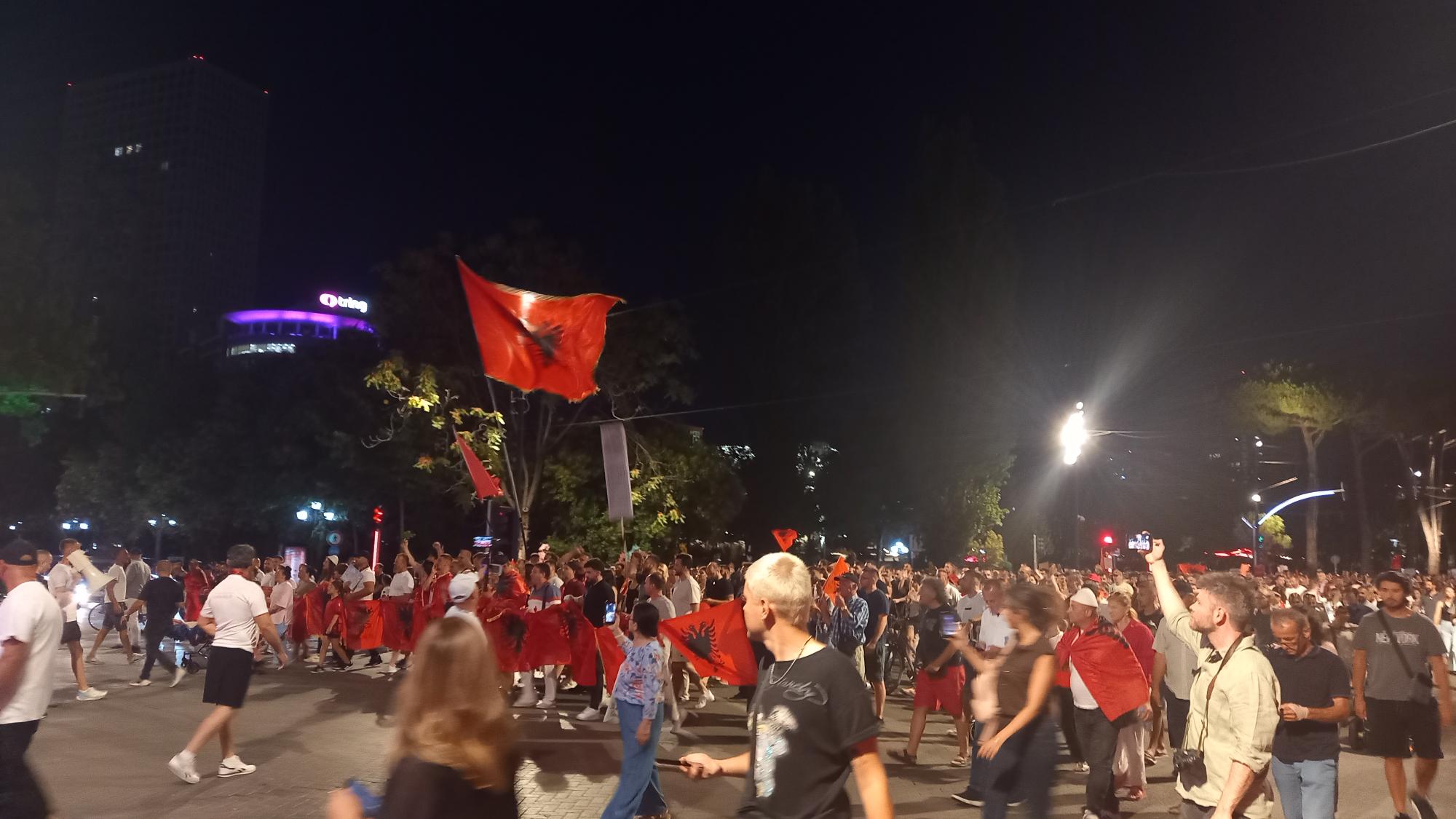

Every evening, protesters gather outside Albanian Prime Minister Edi Rama's office carrying banners, chanting slogans and demanding his resignation. But among the placards denouncing corruption, living standards and a controversial luxury tourism development, one image has come to define the movement: the flamingo.
The pink migratory birds, which flock each year to the protected Narta Lagoon near the southern city of Vlora, have become a symbol of resistance against plans for a luxury resort backed by a group of international investors that includes Jared Kushner, the son-in-law of US President Donald Trump.
Initially, demonstrators focused on fears that the development could damage one of Albania's most important wetland ecosystems. As the nightly protests have continued, however, the agenda has broadened to include corruption, education and the cost of living. Protesters call each night for Rama to step down.
In a country where birds occupy a prominent place in folklore, national identity and political rhetoric, the flamingo has joined a long list of feathered metaphors deployed in public life.
Albania's national symbol is the double-headed eagle, which dominates the country's red flag and gives the country its Albanian name, Shqipëria, or ‘Land of the Eagles’. Albanians often refer to themselves as Shqiptarë, commonly interpreted as "sons of the eagle", reflecting the bird's association with courage, freedom and national unity.
The golden eagle, once widespread across Albania's mountains, also remains a national icon even as conservationists warn that habitat loss, poisoning and illegal hunting have caused its numbers to decline sharply.
Other birds carry darker meanings. In Albanian folklore, crows and ravens are associated with ill fortune, death and malicious gossip, while the call of an owl is traditionally regarded as an omen of misfortune.
Politicians have long exploited those cultural associations. Rama has repeatedly described opponents of his government as "crows and ravens", suggesting they spread pessimism and disorder.
Defending the Zvërnec tourism project at the end of June, he contrasted protesters with supporters of his government.
"Flamingos and crows and ravens are separated by the same divide that separates peace from violence. The former want a better, fairer and cleaner Albania, while the latter want an Albania of hooliganism, violence and filth," he wrote on Facebook.
He added: "The flamingos will get what they seek, while losers of this protest will receive what crows and ravens deserve."
The imagery resurfaced this week as Rama defended €4bn of government support for a Kanye West concert, arguing it would generate tourism revenue and international publicity.
"Now the crows and ravens of the social channels are full of glasses making perverse accounts of unscrupulous manipulators," he wrote, accusing critics of spreading misinformation about public spending.
He went further, accusing unnamed opponents of attempting to "stop and take Albania back" through "violence of arbitrariness, insults, accusations and threats.”
On July 8, the head of the ruling Socialist Party’s parliamentary group, Taulant Balla, posted a picture on Facebook of two protesters who accosted him on a visit to Strasbourg, with the caption “here are two crows”.
Birds have featured in Albanian political battles before. Ahead of the 2025 parliamentary election, Rama repeatedly mocked opposition Democratic Party leader Sali Berisha by portraying him as a "swamp owl" in a series of social media videos.
Berisha responded by appearing at a press conference carrying a plush white owl. "You cannot insult me by calling me an owl," he declared. "The owl has been the symbol of wisdom, knowledge, and decision for millennia."
Rama responded within hours, saying: ”What did you say today? 'I am an owl'? It's a good start that you admitted it.”
The exchange amused many Albanians but also prompted criticism that political debate had descended into theatrical exchanges while more pressing economic and social issues remained unresolved.
The flamingo protests have taken the symbolism in a different direction. Rather than being imposed by politicians (though Rama’s Facebook page now has a flamingo header), the bird was adopted organically by demonstrators seeking to protect the Narta Lagoon, whose wetlands host thousands of migratory birds every year and are recognised as one of Albania's most important habitats.
In a country where birds have long carried meanings extending far beyond the natural world, the latest political contest has once again taken flight.
Cocaine-cash investigation entangles Ivanka Trump's Albanian resort spot: reports
July 11, 2026

Ivanka Trump attends the annual Allen and Co. Sun Valley Media and Technology Conference at the Sun Valley Resort in Sun Valley, Idaho, U.S., July 8, 2026. REUTERS/Brendan McDermid
A Miami businessman wanted in Albania for alleged drug money laundering is suspected of faking deeds to the land where Ivanka Trump and Jared Kushner hope to build a multi-billion-dollar resort, new reports show.
Albania's anticorruption prosecution service is investigating whether Artur Shehu transferred land to Albania Land Development, a Kushner-linked company, with forged deeds and falsified titles, according to reporting by Al Jazeera and Reuters.
"Prosecutors allege Shehu and his associates funnelled proceeds from cocaine trafficking into Albanian property, using falsified titles to disguise the money’s origin, and have since frozen roughly 110 million euros ($126m) tied to the sale in a notary’s account," Al Jazeera reported.
Shehu’s lawyer Kujtim Cakrani denied the allegations to Reuters.
“Nothing that has been alleged regarding Mr Artur Shehu’s character is true,” he told Reuters. "Mr Shehu is aware of the allegations made by the Albanian prosecution. These allegations do not concern him because he maintains that the truth is entirely different from what the prosecution claims."
A U.S. Justice Department spokesperson declined Reuter's request for comment.
Ivanka and Kushner's announcement that they plan to build a $1.6 billion luxury resort on Sazan Island, a protected nature preserve on Albania's largest island, already sparked mass protests. However, it hasn't stopped the couple from moving forward with the deal and snapping up coastal land.
Shehu sold a strip of pristine Albanian coastline to Kushner's company in April, according to reporting by Reuters.
"Reasonable suspicions are formed, based on evidence, that the above-mentioned assets were acquired through the use of forged documents," according to case files reviewed by Reuters.
Reuters also reported that an Albanian organized crime-fighting agency issued a warrant seeking Shehu's arrest for laundering money for South American cocaine traffickers shipping drugs into European ports.
"Shehu's lawyer Cakrani, confirming that Shehu was a target, said he was unconcerned about the arrest warrant," Reuters reported, "as it was 'widely believed' that Albanian prosecutors operated under the influence of politicians and business figures."
No comments:
Post a Comment