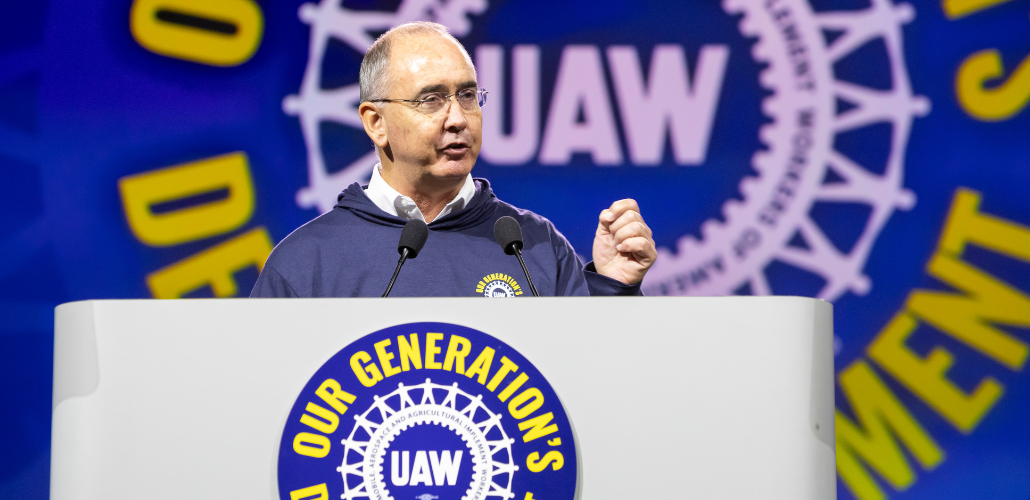
The federal monitor charged with rooting out “fraud, corruption, illegal behavior, dishonesty, and unethical practices” in the Auto Workers union issued a report today accusing UAW President Shawn Fain of “retaliation” against Vice President Rich Boyer. Earlier reports by Monitor Neil Barofsky had made similar claims regarding Secretary-Treasurer Margaret Mock.
The Monitor said he had not decided on remedies for the conduct he described, “pending further consultation with the parties to the Consent Decree.” It was a 2021 Consent Decree, quoted above, between the Justice Department and the union that put Barofsky, who had no prior experience with unions, in his job.
PRE-ELECTION SURPRISE
The move comes as Fain begins his campaign among members for re-election as president. Boyer is the best known of his opponents for the job. Ballots are to be mailed in August.
Fain says, in effect, that Barofsky is the one guilty of “retaliation.” His animus toward Fain dates to late 2023, when the new UAW International Executive Board was debating a call for a ceasefire in Gaza. Barofsky phoned Fain to ask him to block the move. Although he admitted that the union’s stance on international affairs was not in his jurisdiction as a monitor, he continued to try to influence Fain and the Board not to oppose Israel’s actions, even saying Fain’s position appeared “anti-Semitic.”
Ever since, Barofsky has issued a series of reports critical of Fain. His office has spent countless hours interviewing UAW staffers and officers, digging into internal decision-making.
In today’s report, for example, he notes that Fain was critical of Boyer, who oversees the union’s Stellantis Department, for holding a meeting of Stellantis local officers in Puerto Rico, though no Stellantis members work on the island. (Holding meetings in warm-weather resorts was common practice in the UAW before Fain took office.) But the Monitor defended the Puerto Rico junket, saying it was “the result of a good-faith reliance on UAW guidance and a failure of the Compliance Department to conduct timely training on the new policy. Boyer was therefore not derelict in his duty by having the conference in Puerto Rico.”
Last week the UAW’s quadrennial convention overwhelmingly adopted measures, proposed by Fain’s team, designed to continue the union’s more militant direction. Delegates also voted to divest the union of all Israel bonds.
BACKGROUND
Barofsky was appointed in 2021 as the result of a Justice Department investigation into corruption at the highest levels of the union, including embezzlement, self-dealing, and collusion with employers. Twelve union leaders (and one widow) and one Stellantis (then called Fiat-Chrysler) executive were convicted and most went to jail. One top official had his mortgage paid off by the company; another was charged with taking $1.99 million in kickbacks from vendors for UAW swag, among many examples.The idea, according to Stellantis execs, was to keep union bargainers “fat, dumb, and happy.”
Members then voted, in a union-wide referendum, that they wanted the right to elect top officers themselves, rather than delegating that power to the union’s convention.
In subsequent elections and run-offs that stretched over months in 2022-23, Fain’s slate—which at that time included Boyer and Mock—went on to win a majority on the union’s executive board, on a platform of “No Concessions, No Corruption, No Tiers.”
Fain immediately began prepping members for a contract campaign and strike against the Big 3 automakers. Their Stand-Up Strike won contracts equal in value to four times the money won in the previous four contracts.
But while the union was making history in the outside world, dissent was rife at union headquarters.
Fain said that Mock was managing the union’s finances in a way that undermined the union’s new approach. She refused to sign off on expenditures other officers saw as necessary, such as buying new picket signs for the Stand-Up Strike or billboards for the union drive at Volkswagen. Boyer, meanwhile, was accused of failing to enforce the contract at Stellantis, including the reopening of the Belvidere plant, and of agreeing to a new attendance program that members hated.
At Fain’s urging, the IEB voted to relieve Mock and Boyer of some of their responsibilities.
Barofsky called the board’s actions “retaliation.” The two were returned to all their posts earlier this year.
OUT SWINGING
Earlier, Fain had attempted to de-escalate his relationship with Barofsky and complied with his orders to reinstate Mock and Boyer. But today he issued a statement: “Now, more than two years after becoming aware of Vice President Boyer’s allegations, Mr. Barofsky has chosen to release a politically charged and false report about me. The most reasonable conclusion is that he is playing political games and abusing his power.”

Fain’s reelection slate, United UAW, is standing behind him unanimously.
Cathy Highet, a union democracy lawyer, said, “It is utterly inappropriate for a court-appointed monitor to try to influence a union’s position on foreign policy.
“Court-appointed monitors only have the authority given to them by the court, and it’s important they limit themselves to that role rather than trying to run the union…
“The Monitor has the authority to bring ‘charges’ against officers. Then the officers have a right to a trial by someone else, with a just-cause standard. In other words, the Monitor is a prosecutor, not a judge.”
Nick Livick, a General Motors worker in Kansas City and chair of the reform network UAW Member Action, said, “The Monitor told Fain to support Israel. Fain told him to kick rocks. It’s clear this has all been personal since then…
“We pay this corporate lawyer a lot of money to undermine our union. I’m glad Shawn is fighting back!”

Solidarity Strikes and Taft-Hartley’s Long Shadow
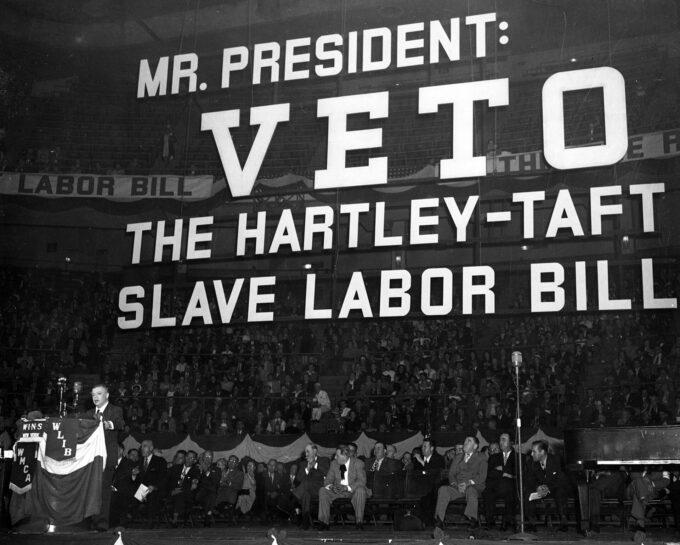
David Dubinsky of the International Ladies Garment Workers Union speaks against the Taft–Hartley Act, May 4, 1947. The Kheel Center for Labor-Management Documentation and Archive, Cornell University. CC BY 2.0
This week marks the anniversary of the enactment of one of the most consequential pieces of labor legislation in US history. The Labor Management Relations Act, better known as the Taft-Hartley Act, was passed over President Truman’s veto on June 23, 1947, and substantially narrowed the forms of collective action protected under federal labor law. The Taft-Hartley Act provided employers with a myriad of new legal weapons while suppressing some of organized labor’s most powerful tactics, dramatically reshaping the US labor landscape. Most of the provisions in the Taft-Hartley Act remain in effect nearly eight decades later.
For most private-sector workers, one of the costliest parts of the Taft-Hartley Act is its prohibition on secondary or “solidarity” actions. In a secondary action, workers at one company strike, picket, or boycott to support workers at another. Secondary actions enable workers across a supply chain to join forces and exert pressure, giving employees across different shops more leverage together than they would have individually. The Taft-Hartley Act, however, largely confined legal protections for strikes and picketing to actions directed at the “primary employer” involved in the labor dispute. Twelve years later, Congress would add Section 8(e), the “hot cargo” provision, which blocked unions from negotiating contractual solidarity with their employers. In practice, this meant unions could no longer blunt the Taft-Hartley restrictions through contract language requiring their employer to avoid doing business with a company involved in a labor dispute.
The Taft-Hartley Act’s restrictions on secondary actions represented a major change to the New Deal-era National Labor Relations Act (NLRA), which contained no such ban. The restrictions on solidarity strikes carry particular weight. The ability to withhold labor is the backbone of worker organizing; without it, workers have little leverage when negotiating with their employers. Solidarity strikes expand that leverage by making it harder for an employer to isolate a single bargaining unit, reroute work, or otherwise keep production moving despite a strike. Strike action of all kinds is associated with growth in union membership.
Workers in countries where solidarity actions are permitted have used them to great effect. In Finland, for example, striking postal workers found reinforcement from rail and aviation workers, among others. Solidarity actions disrupted rail, aviation, ferry, bus, and port operations, culminating in a successful agreement that preserved workers’ pay and conditions in their next contract.
While not the only factor, restrictions on solidarity actions almost certainly contributed to the weakening of organized labor in the US. Solidarity actions reinforce the idea of a labor movement that encompasses the entire working class, rather than siloing workers by employer or industry. The Taft-Hartley Act’s rules against solidarity actions weakened workers’ negotiating power. They also helped chip away at the burgeoning class consciousness that had powered many of the pre-1947 solidarity actions the Act was intended to curb.
Solidarity strikes would be especially useful now, given the Trump administration’s attacks on federal workers. The administration has attempted to remove collective bargaining rights for thousands of federal workers, a move which is still being fought in the courts. More recently, President Trump issued an executive order removing civil service protections for many federal workers, effectively converting about 8,000 employees to “at-will” status. Given that federal workers make up an outsized share of the labor movement, this would have been an opportune moment for private-sector unions to engage in solidarity actions to protect the movement as a whole.
As one of the most effective mechanisms for workers to build power, unions are essential to that agenda. Unions are broadly popular in the US, and strong majorities agree that declines in unionization hurt both the country and working people. The US labor movement, however, is hamstrung by a system that is rigged against workers from the start. The Taft-Hartley Act helped rig that system and continues to reinforce it decades later. Its prohibitions against solidarity strikes were a political response to a labor movement that had demonstrated the capacity to disrupt entire industries. That is the kind of labor movement that the US needs today.
This first appeared on CEPR.
Teamsters: The Ghost of Jackie Presser
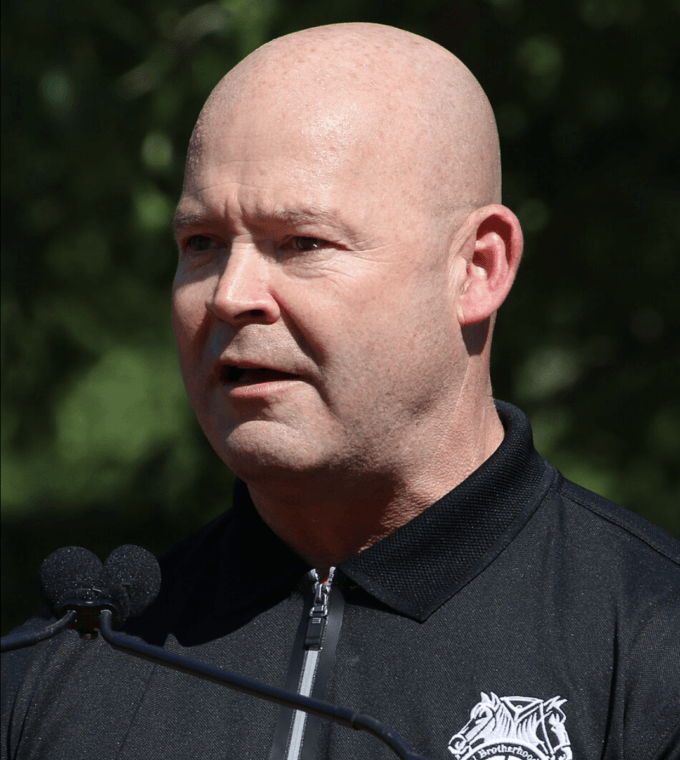
Teamsters President Sean O’Brien. Photo: Ted Merriman. CC BY-SA 4.0
The big news coming out of the Teamsters’ recent convention in Las Vegas is that for the first time in 35 years, there will be no rank-and-file democratic elections for the top officers of the union. The Fearless slate, led by Richard Hooker, failed to get the 5% of the delegates necessary to make it onto the ballot. The Incumbent Sean O’Brien and Fred Zuckerman, “Teamsters United Slate” were elected to office by delegates to the convention.
Popularly known as the “OZ” slate, they secured 96% of the vote. They are the first leaders of Teamsters to be elected without a popular mandate since the 1989 voluntary consent decree between the union and the federal government. The court order mandated changes in the union’s highly undemocratic constitution to provide for one-member-one-vote for convention delegates and International officers. The last Teamster leader elected by convention delegates was Jackie Presser in 1986. He was notoriously corrupt, mobbed-up, and an FBI informant and led the union until his death in 1988. It looks like Teamsters have come full circle.
The Teamsters’ General President Sean O’Brien cast the OZ slate’s reelection as a victory for the union’s rank and file. “This victory belongs to rank-and-file Teamsters. When we were sworn into office four years ago, our leadership team committed to building a bigger, faster, stronger union, and that’s exactly what we’ve done,” O’Brien declared in an official union statement. Yet, convention delegates are disproportionately union officers, staff, and close allies—with bloated and multi-salaries—where rank-and-file workers are few and far between.
Bloviating claims such as, “The Teamsters is now the most aggressive, effective, and respected labor union on Earth,” according to O’Brien, are in sharp contrast to a union deep in crisis. It must be a great relief for O’Brien and Zuckerman to avoid campaigning, especially at UPS, which has been ravaged by tens of thousands of layoffs and building closures across the country. Adding insult to injury, the Teamsters’ approved buyout program for UPS drivers has been implemented so incompetently that has infuriated many more people than those who took it in order to get out of the hell-hole of UPS.
Congressman Ro Khanna (D-CA), inadvertently captured the new reality of the Teamster “democracy,” according to the New York Times:
He received a standing ovation in Las Vegas and opened with a joke about Mr. O’Brien’s resounding victory. “Ninety percent! Those are Putin numbers!” There was some halting laughter. In fact, Mr. O’Brien secured 96 percent of the vote.
The most important reason that the Fearless slate wasn’t able to reach the 5% of the delegates necessary was due to the Teamsters for a Democratic Union’s (TDU) dirty alliance with the O’Brien leadership. The Teamsters is the most pro-Trump of all of the major unions. TDU, since its founding in 1978 heroically supported long-shot candidates in the bleakest of times. This is especially true in the two decades following the federal government’s purge of Ron Carey, the first rank-and-file, democratically elected leader of the Teamsters. Carey led the Great UPS Strike of 1997.
TDU, for example, supported Tom Leedham’s three reform campaigns against the old-guard candidate James Hoffa Jr., the son of the infamous and long-dead leader of the Teamsters. It supported Sandy Pope’s 2011 campaign, the first woman to run for the top spot in the union. She ran as a single candidate for General President in a three-way race. In 2016, TDU supported Fred Zuckerman and Tim Sylvester and the first “Teamsters United” slate; it nearly defeated the incumbent Hoffa. In the 2021 elections, it flipped the other way and made a deal with some of the worst elements of the old guard that split from Hoffa and endorsed a slate led by Sean O’Brien.
O’Brien’s long record of threatening members and the racism and misogyny of his home Local 25, based in Boston, were well documented. TDU claims they have a “coalition” with O’Brien, but the effect has been that there is no independent organization of rank-and-file Teamsters to oppose the union’s alliance with the fascist-aligned Trump administration, along with long list of other vital issues. There was no open discussion or debate of this detrimental alliance between TDU, O’Brien, and Trump at the recent Labor Notes conference, which doesn’t reflect well on the state of the left and the trade unions.
The Fearless slate campaign always faced long odds in its challenge to O’Brien. The death of Fearless slate member, New York Teamster Chris Silvera, the former head of the Teamsters National Black Caucus (TNBC), on his way to the convention, threw a shadow over the convention for his slate. Promises made to the Fearless slate that local union delegates would vote for them didn’t materialize, whether by subtle or not-so-subtle methods. But, TDU’s unrelenting hostility to Fearless played an important role, acting as O’Brien’s whip on any dissent in the union membership.
I spoke to Richard Hooker, the Secretary-Treasurer of Teamsters Local 623 based in Philadelphia, who challenged O’Brien for the top spot in the union, a week after the close of the convention. Richard is the first African-American candidate for the top spot in the Teamsters. He faced the jeers and boos of hostile convention delegates while accepting his nomination. I asked him how he was doing. “Boos don’t bother me. You have to go through it. It doesn’t bother me at all.” Richard told me that the convention had “too many officers.” I asked him what the consequences of such an overwhelming victory for the incumbents. “Unfortunately, our members are going to face the hard truth with this administration.”
Other Teamster convention business included providing speaking opportunities to far-right and pro-Israel politicians. In sharp contrast to the UAW convention that voted to divest the union of Israeli Bonds, the Teamsters had two prominent supporters of the State of Israel speak at their convention: Senators Josh Hawley (R-MO) and Cory Booker (D-NJ). Hawley is also a prominent far-right politician. Sean O’Brien also announced that the union had reached a deal with the Trump administration to end the government oversight of the union, one of the last methods for rooting out corruption, despite its notorious role in ousting Carey from the union, who was later found not guilty in federal court.
Meanwhile, the disgraced former Secretary of Labor Lori Chavez-DeRemer attended the convention and appears to have become part of O’Brien’s entourage. Finally, and most bizarrely, the Teamsters passed a resolution recognizing February 14 as “James R. Hoffa Day” as a paid holiday, the man most responsible for bringing the Mafia into the highest levels of the union, further consolidating the cult-like internal life of the union.
The Long Counterrevolution
Back in 1996, Steve Greenhouse, the New York Times labor reporter, wrote an article called “Teamster Counterrevolution: Why It Nearly Won Election.” Ron Carey won the 1996 election with a majority of the vote against a well-funded campaign led by James P. Hoffa, Jr. Greenhouse saw a lot of the appeal of Hoffa, Jr. in his famous name, a nostalgia for the mythical Teamsters union. He also ran a sophisticated campaign that played on the shortcomings of Carey’s few years in office. Despite the horrid reputation of many of Hoffa’s key supporters, he didn’t promise a restoration of the old order; he promised to “Restore the Power.”
Ken Paff, the director of TDU in 1996 and still a leading figure today, told Greenhouse: ‘’Why is it that in countries that are new to democracy, dictators always try to make a comeback? The people in the counterrevolution don’t like someone trying to take away their power. They control armies; they control people and pensions. They mustered a lot of power and resources to defeat Carey.” The two decades of Hoffa Jr. chipped away at many of the reforms that Carey implemented, but he couldn’t do away with all of them. The Counterrevolution took a lot longer to triumph, but this time around, it was with the vital support of the ex-reformers of TDU.
A full restoration, hopefully, is still not in the cards. While another rank-and-file election is not possible for another five years—and any efforts to abolish them is in all likelihood to fail—but, making it more difficult to run for office is not out of the question. It will certainly be more difficult to challenge the leadership over the next few years. The Teamsters are looking more like the old Teamsters. Jackie Presser would be pleased.
No comments:
Post a Comment