Turkey steps up arrests ahead of NATO summit
Journalists, academics and members of left-wing groups have reportedly been detained during police raids in several Turkish provinces. Turkey's capital Ankara is set to host a major NATO summit this week.

Turkish police have arrested several journalists, rights activists, academics and members of leftist groups, according to media and unions in Turkey on Sunday.
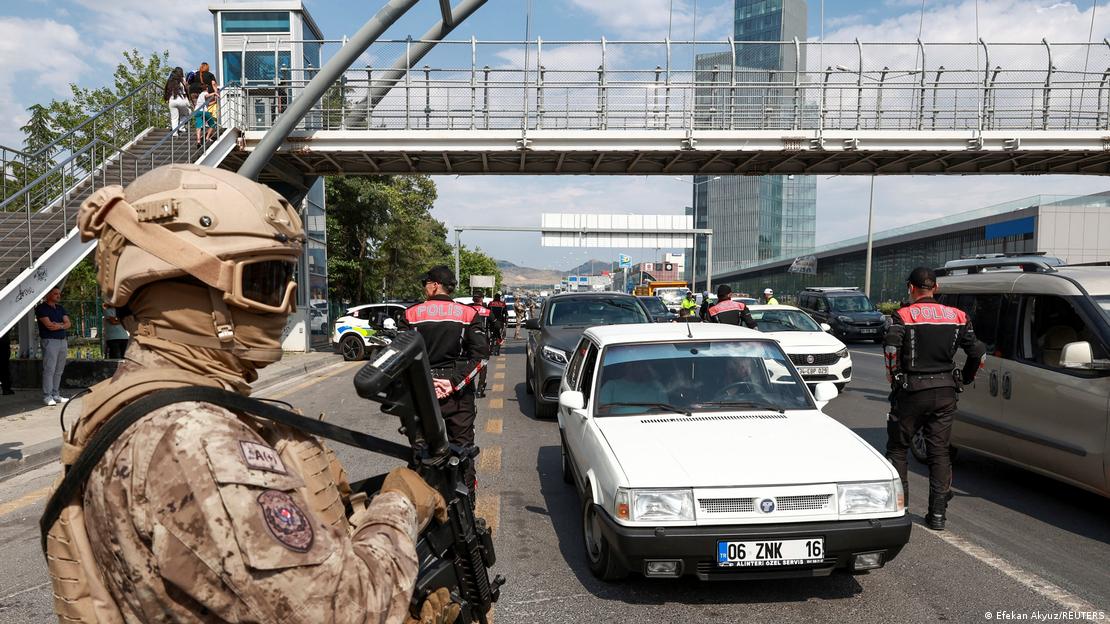
The raids across several provinces come as the Turkish government, led by President Recep Tayyip Erdogan, steps up security operations in the run-up to a NATO summit taking place in Ankara on Tuesday and Wednesday.
Turkish authorities have imposed a strict ban on public gatherings in Ankara ahead of the summit.
Despite that ban, left-wing protesters demonstrated against NATO in Ankara on Sunday.
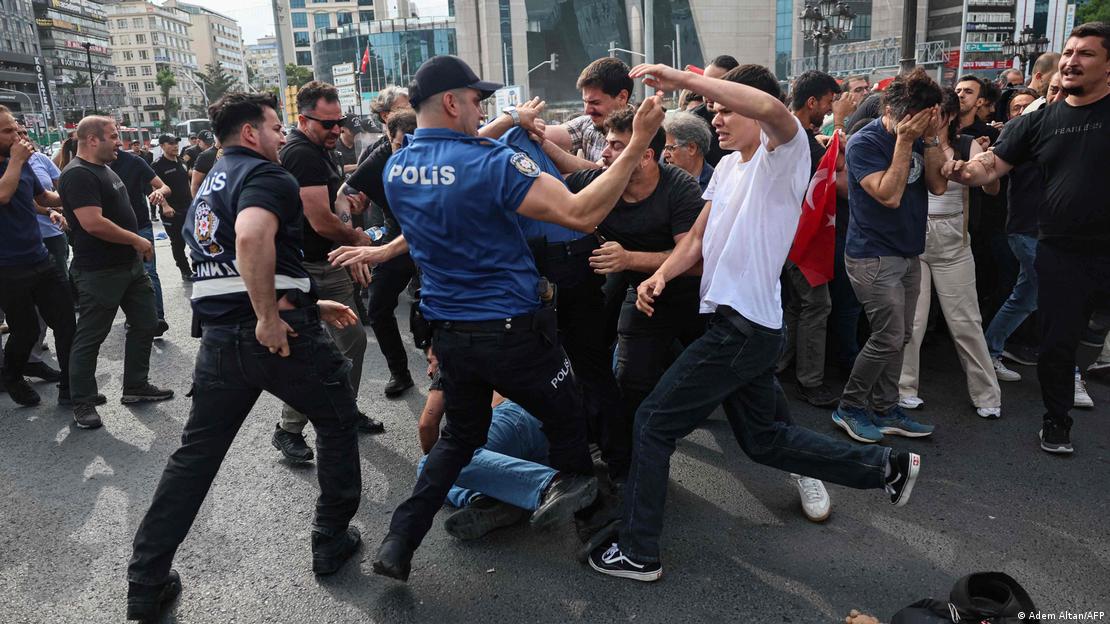
What do we know about the police raids in Turkey?
Opposition broadcaster Halk TV and the Cumhuriyet newspaper reported that police operations in Ankara, Istanbul and other provinces had targeted dozens of left-wing and socialist political parties, labor unions and civil society groups.
The chairwoman of the Istanbul chapter of the Association of Contemporary Lawyers (CHD) was arrested and her apartment was searched, the organization said, adding that several of her clients were also arrested.
The editor-in-chief of the T24 online newspaper, Buse Sotuglu, and Ceren Erdogdu, a reporter for Oda TV, were both arrested at their homes, their respective employers said.
No reasons for their detentions were given, but lawyer Erman Ozturk said he presumed the arrests were related to the upcoming NATO summit.
Ozturk told the AFP news agency that the police raids were seemingly trying to "intimidate democrats, leftists, and the press."
State news agency Anadolu said police had arrested 39 suspects in raids across the country which targeted the youth wing of the banned leftist organization THKP/C-DEV YOL.
Police also detained 28 suspects in the western Kocaeli province who have alleged ties to the "Islamic State" and left-wing militant groups, according to Anadolu, with police seizing ammunition and banned digital materials.
Groups denounce police crackdown
While authorities say the raids are part of counterterrorism investigations, government critics say the police crackdown is designed to prevent protests and silence dissent ahead of the summit in Ankara this week. More than 30 leaders of NATO member states, including US President Donald Trump and German Chancellor Friedrich Merz, are set to attend.
Turkey's representative for Reporters Without Borders (RSF), Erol Onderoglu, condemned the "blind, arbitrary, and haphazard operations" which endangered "the reputation and safety of journalists."
The Turkish Journalists' Association (TGC) also denounced the arrests, saying it was "unacceptable for journalists to be placed under pressure and attempted to be silenced through the threat of detention."
The TGC demanded the release of all those detained, warning that the raids were a violation of press freedoms and just the latest attempt to silence opposition dissent ahead of the NATO summit in Ankara.
Over 200 people, including lawyers, academics, civil society representatives and students, were arrested in late June, human rights activists say, as part of the crackdown by Turkish authorities in the run-up to the NATO meeting.
Edited by: Wesley Dockery

Karl Sexton Writer and editor focused on international current affairs

The ongoing legal campaign against Ekrem Imamoglu, the jailed mayor of Istanbul and presumptive opposition presidential candidate, reached an unprecedented logistical and judicial peak on July 6. In a single day, the most prominent political rival to President Recep Tayyip Erdogan was scheduled to defend himself across three separate criminal proceedings.
The extraordinary scheduling posed a spotlight on the mounting legal pressure, which is seen as an overt attempt to permanently disqualify Imamoglu from public life ahead of the upcoming elections. The mayor has more than a dozen ongoing trials.
Corruption, espionage, forgery
The Republican People’s Party (CHP) figure, who has been held in pre-trial arrest since March 2025, faced an array of charges spanning from administrative malpractice to national security threats. The three distinct cases heard on July 6 included the main Istanbul Metropolitan Municipality (IBB) case along with the political espionage and diploma forgery cases.
The main IBB case is a massive, 414-defendant trial concerning allegations of corruption, graft and embezzlement during Imamoglu’s tenure at the IBB. The hearings are being conducted at the infamous Silivri prison complex, where Imamoglu is also held.
In the espionage case, Imamoglu is being prosecuted alongside journalist Merdan Yanardag, his political adviser Necati Ozkan and businessman Huseyin Gun. The case was based on Gun’s alleged statement during his questioning by prosecutors.
At the first hearing, Gun declined that he was a spy and he had conducted espionage activities with the three other defendants. Nevertheless, the trial continues. Imamoglu has a court ruling for being jailed pending trial from the IBB case while the other three defendants are kept in prison for the espionage case in question.
The diploma forgery case is another trial regarding allegations of "forgery of official documents" following the abrupt annulment of Imamoglu’s undergraduate business degree by Istanbul University in March 2025. A university diploma is a credential legally required to run for the Turkish presidency.
"A lawlessness triathlon"
The logistical bottleneck of managing three trials simultaneously follows a period of escalating friction between the defense and the state judiciary. Just days prior, on July 2, courtroom proceedings descended into chaos when Imamoglu and his legal team fiercely protested a newly imposed judicial deadline aiming to wrap up the first stage of the main trial by July 9.
Defense lawyers argued that compressing the timeline made a robust defense impossible for a case encompassing over 400 co-defendants. The ensuing argument led to the presiding judge ordering gendarmerie officers to forcibly remove Imamoglu, his counsel and observing opposition MPs from the courtroom.
On July 6, Imamoglu attended the espionage hearing at 10:30 and he left after 15 minutes to attend the diploma hearing.
During his statement at the diploma hearing, he described the day as “a lawlessness triathlon”.
Turkey jails comedian who called Erdogan “dictator” pending trial
HUMOUR IS SUBVERSIVE
GEORGE ORWELL

A criminal court (sulh ceza) at the Caglayan courthouse in the European side of Istanbul on July 3 jailed popular stand-up comedian Deniz Goktas pending trial, according to local media reports.
As reported by IntelliNews on June 26, Goktas described Turkey’s president, Recep Tayyip Erdogan, as having transitioned from a "shy dictator" to one who is "at peace with himself" during his performance.
It is no joke
Following the hearing, Goktas was transferred to the Karatepe prison in the Corlu town of Tekirdag province, the western neighbour of Istanbul. It is a high-security prison, known as “well-type” since prisoners are kept alone in five square-metre cells and they have no access to direct sunlight.
The prisons in question were designed for those who were convicted for being a member of a terrorist organisation. Some special prisoners are also kept in these facilities for the sake of educating them.
On July 5, Gurkan Turkoglu, a prisoner who spent 266 days on hunger strike to demand to be transferred to a non-well-type prison, died.
The court ruling follows the widespread social media success of Goktas’ latest stand-up special, Ölü Deniz (Dead Sea). The performance, which has so far garnered more than 11mn views after being uploaded on YouTube on June 24, features a biting, satirical critique of Turkey’s current political landscape and societal pressures.
Well-planned political act
Legal proceedings were initiated after segments of the show were circulated on social media, prompting calls for censorship by the government’s media and trolls. As reported by IntelliNews on June 28, portions of the special posted on X (formerly Twitter) had been blocked from access in Turkey by a court order under the pretext of "national security".
On June 29, the Istanbul chief public prosecutor’s office announced that it had launched a prosecution against Goktas. In response, Goktas wrote on X that he was abroad for a vacation and he would be back. It was obvious that he would be jailed.
On July 2, Turkish police forces detained Goktas at Istanbul Airport during a passport control check upon his return to Turkey from a trip abroad.
The Goktas incident is not a mistake by the comedian or a slip of the tongue. It is rather a very well-planned and well-executed political act to remind people of the situation in Turkey. He was very well aware that he would end up in jail when he uploaded his video on YouTube.
Erdogan’s opinion on dictator discussion
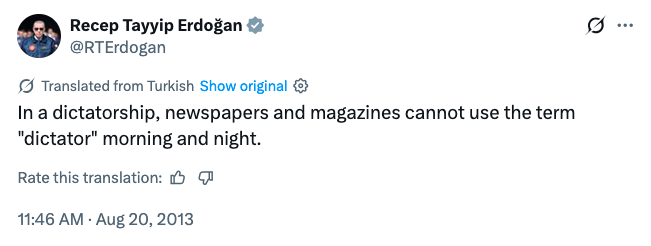
Tweet: President Recep Tayyip Erdogan (@RTErdogan) wrote in August 2013 during the widespread Gezi protests in Turkey: “Where there is a dictatorship, newspapers and magazines can not use the term dictator day and night.”
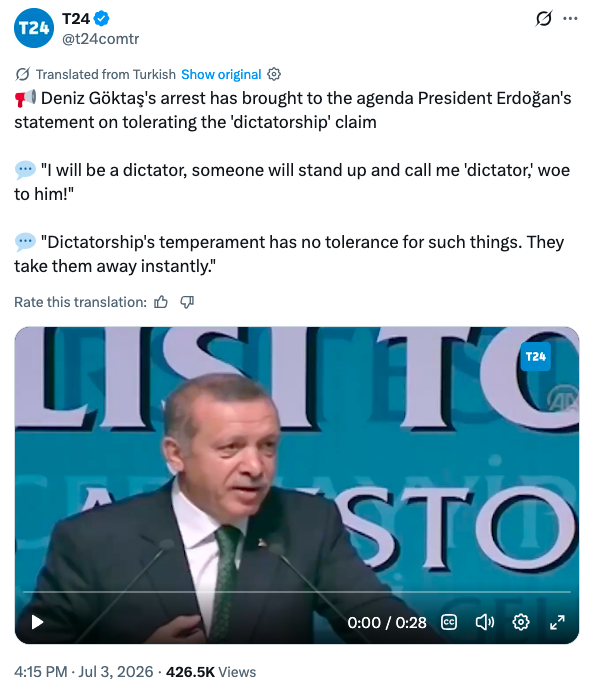
Screenshot: Back in 2013, Erdogan talking on a separate occasion on the dictator matter: “If I were a dictator and someone stood up and called me a 'dictator,' woe betide them! The nature of dictatorship does not tolerate such things. They would be taken away in an instant.”
The dictator discussion in Turkey is not new. It dates back to the countrywide Gezi protests that were held against Erdogan across the summer of 2013. Goktas is also pointing at a transition in the matter.
Back then, Erdogan’s argument was that no one would be allowed to call him a dictator if he was a dictator. His tweets and videos on the matter have been re-circulated with the Goktas incident.
Backed by the West, and the East
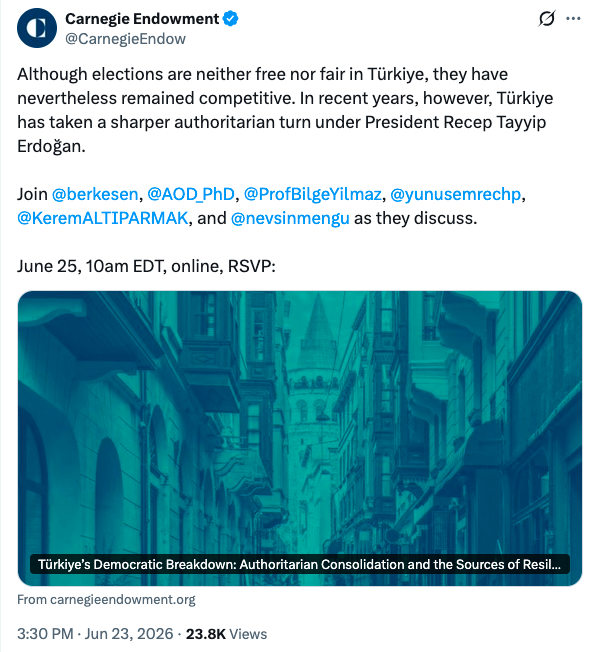
Tweet: Not free, not fair but competitive. The destiny of any attempt to legitimize Turkey’s government unfortunately is to fall into a fallacy. Where competitiveness is concerned, two of Erdogan’s rivals in presidential elections, namely Selahattin Demirtas and Ekrem Imamoglu, are currently in jail.
In recent weeks, access to the social media accounts of numerous LGBT+ organisations and activists has been blocked while more than 200 people have been detained ahead of next week's Nato leaders' summit in the capital Ankara, the BBC noted on July 3 while reporting the Goktas incident.
During July 7-8, all of the heads of state of Nato members will be in Ankara.
The Erdogan government is also backed by non-Nato actors in the league of states such as Russia, China and Iran.
Thanks to the global consensus in question on the continuation of the Erdogan government in Turkey, the lack of legitimacy at home makes no sense.
No comments:
Post a Comment