Steve Benen
Mon, August 17, 2026

President Donald Trump and North Korean leader Kim Jong-un stand on North Korean soil in the Demilitarized Zone on June 30, 2019, in Panmunjom, Korea.
Throughout Donald Trump's first term, the president went to bizarre lengths to cozy up to North Korea, a longtime enemy of the United States, while alienating South Korea, a longtime U.S. ally. In 2019, the Republican took steps to cancel U.S. military exercises near the peninsula while echoing Pyongyang's rhetoric, criticizing the exercises as "very provocative" and "inappropriate."
After losing his 2020 re-election bid and preparing for a White House comeback, Trump's belligerence toward Seoul by some measures managed to get worse. The Republican referred to South Korea as "an enemy" of the U.S. on matters of trade — despite the fact that his own administration struck a trade deal with South Korea — adding that he believed "it's time we stop" helping our Korean allies.
The antagonistic attitude hasn't improved. On Sunday afternoon, for reasons unknown, the American president published an odd message to his social media platform, which read in part:
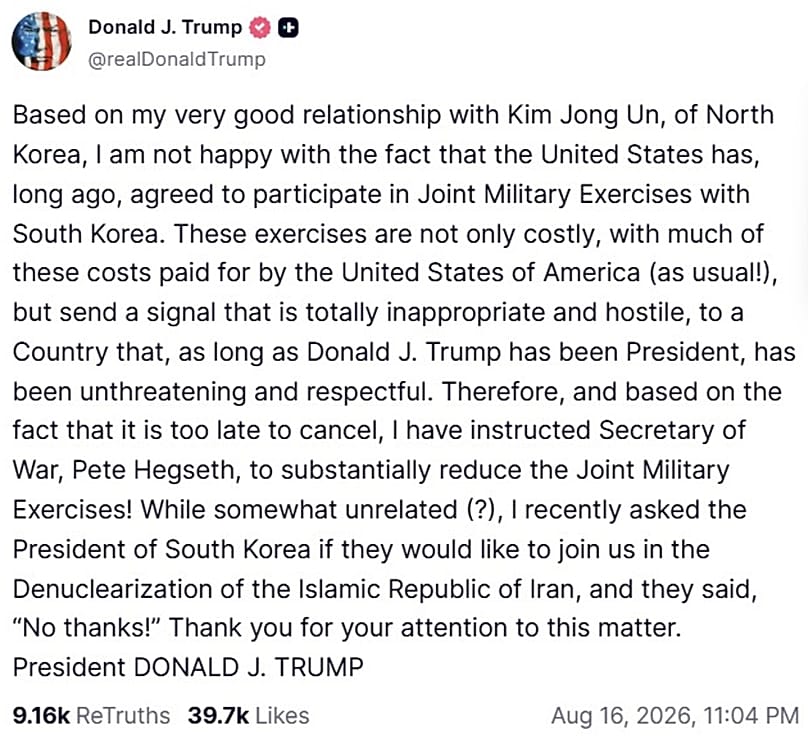
Based on my very good relationship with Kim Jong Un, of North Korea, I am not happy with the fact that the United States has, long ago, agreed to participate in Joint Military Exercises with South Korea. These exercises are not only costly, with much of these costs paid for by the United States of America (as usual!), but send a signal that is totally inappropriate and hostile, to a Country that, as long as Donald J. Trump has been President, has been unthreatening and respectful. Therefore, and based on the fact that it is too late to cancel, I have instructed Secretary of War, Pete Hegseth, to substantially reduce the Joint Military Exercises!
Trump went on to complain about South Korea not participating in his war with Iran (he labeled it "the Denuclearization of the Islamic Republic of Iran"), which ostensibly shouldn't even be necessary, given how often he's declared victory in that conflict.
A day later, at an unrelated event in the Oval Office, Trump kept this going, telling reporters on Monday afternoon that he'd spoken to the North Korean dictator over the last 24 hours, before again complaining about our South Korean allies.
As part of the exchange, the Republican said he wants South Korea to pay $10 billion to cover the cost of the military exercises. (Trump made similar comments in 2019. Vipin Narang, an associate professor at MIT who follows the Korean peninsula, said at the time, "Nothing says 'I love you' like a shakedown.")
With recent history in mind, it's important to emphasize that we do not yet know for certain whether the president's rhetoric reflects reality. Trump said he'd directed the Pentagon to "substantially reduce" the U.S. role in the military exercises, but he claims all sorts of things, many of which prove baseless. Indeed, the long-planned exercises began Monday as scheduled, and it remains unclear whether and how much the Republican's post will affect the plans for the rest of the scheduled operations.
But if the online statement reflects reality in any meaningful way, it's another regressive step for a White House that's gone to breathtaking lengths to alienate U.S. allies. As The Atlantic's Tom Nichols summarized, "Scaling back the exercise is, of course, an insane decision, which does nothing but hurt an ally, and tempt an adversary to think — correctly — that American leadership is feckless. … The Chinese and the Russians and the North Koreans are certain to draw the appropriate lessons from this deranged policy. They have been shown, yet again, that when Trump fails, he hurts those he feels safe hurting."
Democratic Sen. Jack Reed of Rhode Island, the ranking member on the Senate Armed Services Committee, went further, accusing the president of "appeasement."
Reed's written statement added, "This is another inane, haphazard decision by President Trump and his chaotic administration. America's alliances are built on trust and strength. When President Trump cuts military exercises to flatter a dictator or punishes South Korea for declining to join a war he started, all of our allies — and adversaries — think that America's commitments are negotiable. Kim Jong Un has won a propaganda victory and South Korea, one of our strongest allies, has been punished for no reason beyond Trump's ego.
"China and Russia are watching how easily this president abandons America's allies, and they will remember it the next time they test us."
During his presidency, Joe Biden made major strides in strengthening ties between the U.S. and our South Korean allies. Trump is needlessly going out of his way to undo that progress in ways that can only benefit our enemies.
This article was originally published on ms.now
South Korea and Japan stress 'critical' US alliance as Trump slashes military drills
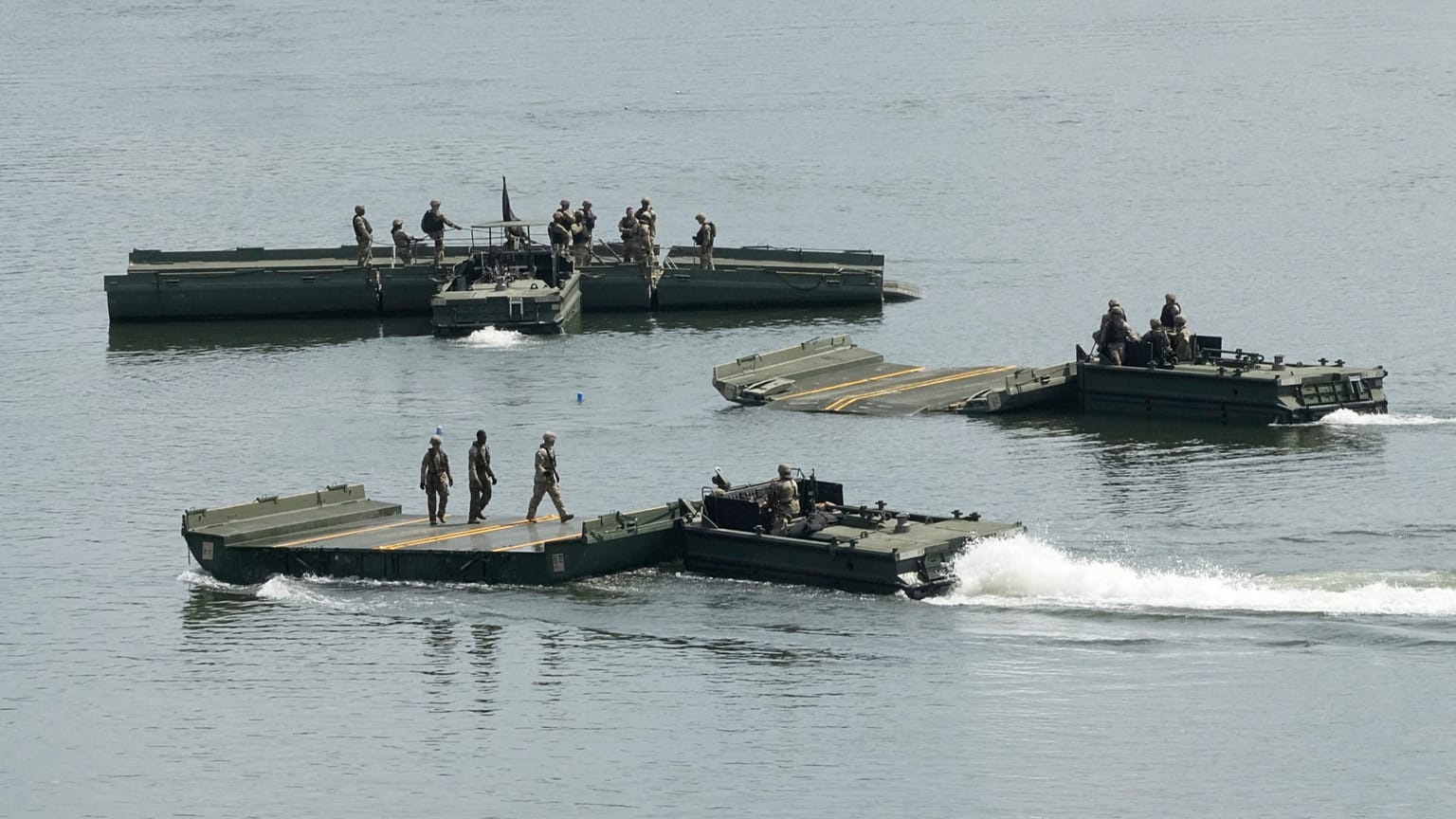
Trump made the surprise announcement about the troop drawdown in a social media post just before US and South Korean soldiers began Monday's annual Ulchi Freedom Shield exercises.
South Korea’s president said on Tuesday that a solid alliance with the United States underpins national security, after US President Donald Trump’s abrupt order to “substantially reduce” joint military exercises left many South Koreans baffled and concerned.
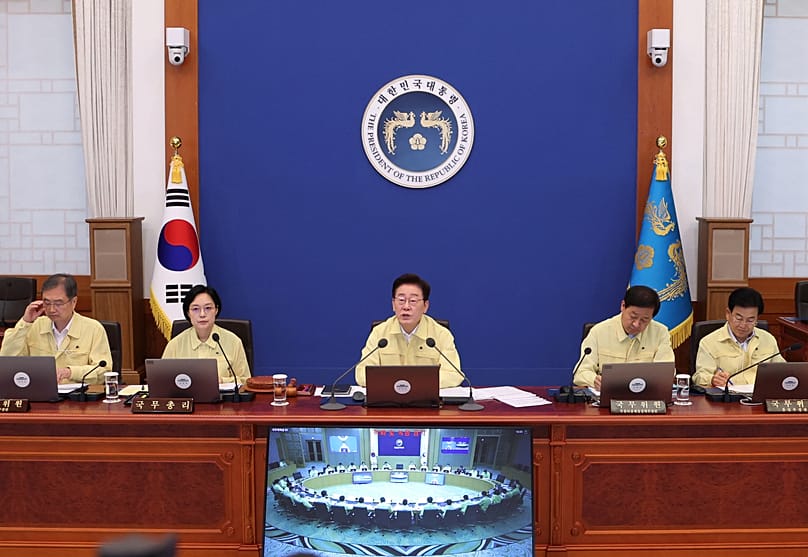
In a regular Cabinet meeting, South Korean President Lee Jae Myung stressed the importance of a firm military alliance with the US, saying that “national security will be further strengthened when the alliance is solid.”
“When we build up our strengths, our value and importance as an ally will further grow,” said Lee, a liberal who has called for a stronger, self-reliant defence posture.
It was unclear which parts of the 11-day South Korea-US exercises were being downsized.
The South Korean and US militaries earlier said their drills this year would be similar in scale to previous years and incorporate lessons from recent conflicts such as North Korea’s battlefield experiences on the Russia-Ukraine front. They also said the drills are defensive in nature.
North Korea's Foreign Ministry accused South Korea and the US of plotting more provocative drills this year and vowed to respond with “a new level of a deterrent.”
Support from Tokyo
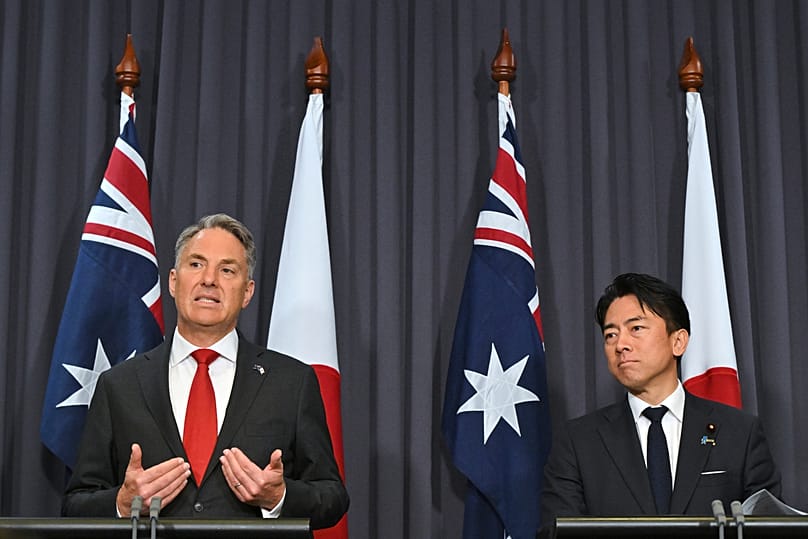
Lee’s comments were echoed by Japan’s defence minister who, on a visit to Australia on Tuesday, supported security cooperation with key defence backer Washington and neighbour Seoul.
"As Japan faces the most severe and complicated security environment in the post-war era, the cooperation among Japan, the United States and South Korea is critical to the peace and stability of the region," Shinjiro Koizumi told journalists.
Trump made the surprise announcement about the troop drawdown in a social media post just before US and South Korean soldiers began Monday's annual Ulchi Freedom Shield exercises, which are largely designed to sharpen readiness against North Korean threats.
Trump cited what he said was a good relationship with North Korean leader Kim Jong Un and South Korea's refusal to join the US war against Iran.
Trump’s move was apparently taken without consultations with South Korea and meant to reach out to Kim, deepening concerns about the reliability of the US-South Korean alliance forged in the turmoil of the Korean War.
A weakening of the US defence commitment could shake South Korea’s national security as it has no nuclear weapons and is under the US “nuclear umbrella” protection, which guarantees a devastating American response in the event of an attack on its ally by nuclear-armed North Korea.
The United States stations about 28,500 troops in South Korea to bolster the country's defences, a legacy of the 1950-53 Korean War that ended with an armistice rather than a peace treaty.
Confidence in the US has already eroded among many South Koreans because of Trump's tariff war and last year's immigration raid in the US state of Georgia that led to the detention of hundreds of South Korean workers.
Trump's announcement “reveals the stark reality of a faltering Korea-US alliance, fuelling public anxiety,” South Korea's Hankook Ilbo newspaper said in an editorial on Tuesday.
“It's absurd that the US appears to treat North Korea more respectfully than its ally South Korea.”
Prospects unclear for reengagement between Trump and Kim
Trump on Monday insisted he was making the situation "much safer" through his ties with the North's Kim Jong-un, whom he met three times in his first term but has yet to encounter since his return to the White House.
He also said his ties with Kim have reduced tensions.
"Kim Jong-un has always treated me with great respect," Trump said. "I understand him. He understands me."
Kim has shunned any talks with the US and South Korea since his earlier high-profile diplomacy with Trump fell apart in 2019.
Experts say Kim likely won’t embrace Trump’s overtures and return to talks anytime soon unless he is promised bigger US concessions.
Kim has boosted his military and diplomatic credentials in recent years by enlarging his nuclear arsenal and aligning with Russia over its war against Ukraine.
Lee’s presidential office on Monday expressed hopes that a “friendly relationship” between Trump and Kim would lead to “meaningful dialogue” between their countries to promote peace on the Korean Peninsula.
That invited a backlash from conservatives, who criticised Lee’s government for allegedly prioritising resumption of Kim-Trump diplomacy over security concerns.
“South Korea’s security bulwark is being shaken to its very foundations,” Park Chung-kwon, a spokesperson for the main conservative opposition People Power Party, said in a statement.
Doubts about US alliance grow in South Korea
In his social media post, Trump said the military exercises with South Korea are not only costly but “send a signal that is totally inappropriate and hostile” to North Korea, which he said “has been unthreatening and respectful” during his time in the White House.
Trump said he asked Lee if South Korea would join the US in the “denuclearisation” of Iran, “and they said, ‘No thanks!’”
Lee's office said South Korea and the US are closely discussing practical and military contributions that South Korea can make to help restore freedom of navigation in the Strait of Hormuz.
“Trump thinks of an alliance as an investment that should pay regular dividends, or a rainy-day fund he can withdraw from when another project isn’t going well,” said Leif-Eric Easley, a professor at Ewha University in Seoul.
“South Korean leaders understand that relations with the Trump administration will be a constant renegotiation linking economic and security issues. Seoul is thus cautiously responding to recent developments within that framework,” Easley said.
No comments:
Post a Comment