Trump’s Newest Unconstitutional, Dangerous Birthright Ban Must Be Stopped
People’s constitutional rights are once again being threatened by a xenophobic administration with no regard for the Constitution or the rule of law.
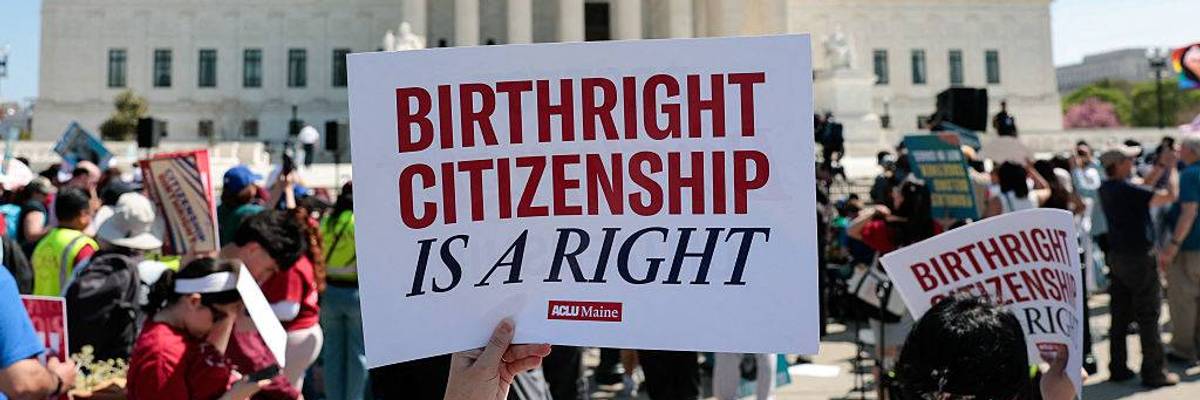
Demonstrators rally in support of birthright citizenship outside the US Supreme Court in Washington, DC on April 1, 2026.
(Photo by Kent Nishimura / AFP via Getty Images)
Jordan Liz
Aug 11, 2026
Protect Birthright Citizenship
Given the Supreme Court’s decision in Trump v. Barbara, these orders should be ruled unconstitutional. Regardless of whether the parents engaged in fraud or were members of a real (or fictional) terrorist organization, their US-born child would still be a citizen under the 14th Amendment. No child is responsible for the circumstances of their birth—even if their parents are guilty of a crime, they are innocent.
So, what then is the point? Perhaps the Trump administration believes that by framing their birthright ban in terms of terrorism and fraud that the Supreme Court might see things differently.
Perhaps it believes that returning to the birthright issue will help Republicans in the midterms. While Trump is broadly unpopular, 8 in 10 Republicans continue to support his immigration policies. An April 2026 poll by Reuters found that 62% of Republicans support ending birthright citizenship.
Once again, we are put in a position where we must trust the Supreme Court to do the right thing. And once again we are forced to reckon with the fact that we cannot take for granted that it will.
Perhaps the point is to stoke more fear within immigrant communities in hopes that more people will self-deport.
Perhaps the cruelty is the point.
Whatever the reason, the reality is that birthright citizenship is once again under fire. People’s constitutional rights are once again being threatened by a xenophobic administration with no regard for the Constitution or the rule of law. Once again, we are put in a position where we must trust the Supreme Court to do the right thing. And once again we are forced to reckon with the fact that we cannot take for granted that it will.
For the sake of ourselves, future generations, and the country, we cannot allow this to become the new normal. We must continue to protest the Trump administration’s abuses, support the journalists documenting its atrocities, and demand that Congress take actions to rein in its corruption.
Our work is licensed under Creative Commons (CC BY-NC-ND 3.0). Feel free to republish and share widely.
Jordan Liz
Jordan Liz is an Associate Professor of Philosophy at San José State University. He specializes in issues of race, immigration and the politics of belonging.
Full Bio >
People’s constitutional rights are once again being threatened by a xenophobic administration with no regard for the Constitution or the rule of law.
Demonstrators rally in support of birthright citizenship outside the US Supreme Court in Washington, DC on April 1, 2026.
(Photo by Kent Nishimura / AFP via Getty Images)
Jordan Liz
Aug 11, 2026
Common Dreams
On August 6, five weeks after the Supreme Court rejected his first birthright ban, President Donald Trump signed two executive orders aimed at restricting birthright citizenship and ending “birth tourism.”
Birthright Ban 2.0
The first denies automatic citizenship to babies born in the US to two noncitizen parents if at least one of them is: an “alien enemy,” a member of a “Foreign Terrorist Organization” (FTO), a government employee, or has “engaged in fraudulent activity to obtain citizenship.” While the scope of this is technically narrower than his first birthright ban, it is ultimately vague enough that the Trump administration could effectively weaponize it against anyone.
Consider this: On his first day back in office, Trump signed an executive order designating Tren de Aragua (TdA) and La Mara Salvatrucha (MS-13) as FTOs. In March, Trump issued a proclamation declaring that all Venezuelan noncitizens 14 years or older who are members of TdA “are liable to be apprehended, restrained, secured, and removed as Alien Enemies.” The very same day, the administration announced the deportation of nearly 300 Venezuelan nationals it accused of being members of TdA.
Among these deportees were those whose only crime was having a tattoo that immigration officials had designated as a sign of gang affiliation. Such tattoos included: “stars on shoulder,” “crowns,” “firearms and grenades,” “trains and dice,” “roses and predatory felines,” gas masks, clocks, and even the iconic silhouette of Michael Jordan dunking—the Jumpman. Notably, unlike other gangs, TdA does not require its members to obtain any tattoos. The Trump administration simply used this as a pretext to deport innocent people to El Salvador’s notorious mega-prison, the Terrorism Confinement Center (CECOT).
No child is responsible for the circumstances of their birth—even if their parents are guilty of a crime, they are innocent.
Under this latest executive order, the US-born children of those accused of being a member of a FTO—no matter how baseless the allegation—would have their citizenship status jeopardized and more than likely denied. In doing so, it would pave the way for more family deportations. Notably, the Trump administration has already deported several US-born children along with their parents.
Moreover, while TdA and MS-13 are real organizations, the Trump administration has already designated at least one fictional group as a FTO: the Cartel de los Soles. In 2025, the State Department alleged that this organization was “headed by [Venezuelan President] Nicolás Maduro and other high-ranking individuals of the illegitimate Maduro regime.” This was a strategic lie. Like antifa, Cartel de los Soles is not a formal organization with a clearly defined leadership structure. Rather, experts describe it as a loose network of individuals broadly involved in the drug trade.
Nevertheless, that designation gave the Trump administration the pretext to invade Venezuela, kidnap Maduro, and put him on trial for his alleged narco-crimes. After his capture, the Department of Justice (DOJ) revised its indictment of Maduro and abandoned its claim that Cartel de los Soles is an actual organization. Whereas the old indictment made 32 mentions of the fictional cartel, the new one refers to it twice. It claims that Maduro, like former Venezuelan President Hugo Chávez, participated in, perpetuated, and protected this “patronage system.”
While the DOJ altered its indictment of Maduro, Cartel de los Soles is still formally classified as a FTO by the State Department.
Herein lies the real danger: The Trump administration lies and lies often. For an administration this corrupt and xenophobic, this new birthright ban offers it the ability to accuse any noncitizen, under whatever false pretenses, of being a member of a real or fictional organization to target their children. And, make no mistake, if the Supreme Court allows them, the Trump administration certainly will.
Ending Birth Tourism
The other executive order aims at ending birth tourism, or the practice of traveling to another country to give birth, thereby allowing the child to automatically acquire citizenship. While Trump insists that there are “hundreds of thousands” of such births each year, the Migration Policy Institute notes that the most expansive estimate puts the figure at 22,000 to 26,000 babies born annually in the US due to birth tourism—or less than 1% of all births in the country.
That number, however, is disputed. In 2024, the Centers for Disease Control and Prevention (CDC) reported that 9,576 babies were born in the US to mothers who list their official address as outside the US. A 2026 study by researchers at Pennsylvania State University found that birth tourism accounted for less than 0.3% of all US births in any given year between 2014 and 2024.
This executive order authorizes the Secretary of State and Secretary of Homeland Security “to issue or adopt rules, policies, operational guidance, or other guidance” designed to stop foreign nationals from entering the country via a temporary visa if they have the goal of giving birth on American soil.
Notably, while the executive order decries the purported dangers of birth tourism, it is vague with respect to how the State Department or DHS would actually go about identifying these people.
Since the first executive order explicitly targets the children of noncitizens who “engage in a commercial transaction to ensure that the person’s mother is present in the United States, or a territory of the United States, to give birth,” these departments would be empowered to deport law-abiding visa holders and deny their children citizenship based solely on their own discretion—no matter how disingenuous.
In short, together, these two executive orders would allow the Trump administration to further accelerate its mass deportation agenda while denying citizenship to whoever they want.
On August 6, five weeks after the Supreme Court rejected his first birthright ban, President Donald Trump signed two executive orders aimed at restricting birthright citizenship and ending “birth tourism.”
Birthright Ban 2.0
The first denies automatic citizenship to babies born in the US to two noncitizen parents if at least one of them is: an “alien enemy,” a member of a “Foreign Terrorist Organization” (FTO), a government employee, or has “engaged in fraudulent activity to obtain citizenship.” While the scope of this is technically narrower than his first birthright ban, it is ultimately vague enough that the Trump administration could effectively weaponize it against anyone.
Consider this: On his first day back in office, Trump signed an executive order designating Tren de Aragua (TdA) and La Mara Salvatrucha (MS-13) as FTOs. In March, Trump issued a proclamation declaring that all Venezuelan noncitizens 14 years or older who are members of TdA “are liable to be apprehended, restrained, secured, and removed as Alien Enemies.” The very same day, the administration announced the deportation of nearly 300 Venezuelan nationals it accused of being members of TdA.
Among these deportees were those whose only crime was having a tattoo that immigration officials had designated as a sign of gang affiliation. Such tattoos included: “stars on shoulder,” “crowns,” “firearms and grenades,” “trains and dice,” “roses and predatory felines,” gas masks, clocks, and even the iconic silhouette of Michael Jordan dunking—the Jumpman. Notably, unlike other gangs, TdA does not require its members to obtain any tattoos. The Trump administration simply used this as a pretext to deport innocent people to El Salvador’s notorious mega-prison, the Terrorism Confinement Center (CECOT).
No child is responsible for the circumstances of their birth—even if their parents are guilty of a crime, they are innocent.
Under this latest executive order, the US-born children of those accused of being a member of a FTO—no matter how baseless the allegation—would have their citizenship status jeopardized and more than likely denied. In doing so, it would pave the way for more family deportations. Notably, the Trump administration has already deported several US-born children along with their parents.
Moreover, while TdA and MS-13 are real organizations, the Trump administration has already designated at least one fictional group as a FTO: the Cartel de los Soles. In 2025, the State Department alleged that this organization was “headed by [Venezuelan President] Nicolás Maduro and other high-ranking individuals of the illegitimate Maduro regime.” This was a strategic lie. Like antifa, Cartel de los Soles is not a formal organization with a clearly defined leadership structure. Rather, experts describe it as a loose network of individuals broadly involved in the drug trade.
Nevertheless, that designation gave the Trump administration the pretext to invade Venezuela, kidnap Maduro, and put him on trial for his alleged narco-crimes. After his capture, the Department of Justice (DOJ) revised its indictment of Maduro and abandoned its claim that Cartel de los Soles is an actual organization. Whereas the old indictment made 32 mentions of the fictional cartel, the new one refers to it twice. It claims that Maduro, like former Venezuelan President Hugo Chávez, participated in, perpetuated, and protected this “patronage system.”
While the DOJ altered its indictment of Maduro, Cartel de los Soles is still formally classified as a FTO by the State Department.
Herein lies the real danger: The Trump administration lies and lies often. For an administration this corrupt and xenophobic, this new birthright ban offers it the ability to accuse any noncitizen, under whatever false pretenses, of being a member of a real or fictional organization to target their children. And, make no mistake, if the Supreme Court allows them, the Trump administration certainly will.
Ending Birth Tourism
The other executive order aims at ending birth tourism, or the practice of traveling to another country to give birth, thereby allowing the child to automatically acquire citizenship. While Trump insists that there are “hundreds of thousands” of such births each year, the Migration Policy Institute notes that the most expansive estimate puts the figure at 22,000 to 26,000 babies born annually in the US due to birth tourism—or less than 1% of all births in the country.
That number, however, is disputed. In 2024, the Centers for Disease Control and Prevention (CDC) reported that 9,576 babies were born in the US to mothers who list their official address as outside the US. A 2026 study by researchers at Pennsylvania State University found that birth tourism accounted for less than 0.3% of all US births in any given year between 2014 and 2024.
This executive order authorizes the Secretary of State and Secretary of Homeland Security “to issue or adopt rules, policies, operational guidance, or other guidance” designed to stop foreign nationals from entering the country via a temporary visa if they have the goal of giving birth on American soil.
Notably, while the executive order decries the purported dangers of birth tourism, it is vague with respect to how the State Department or DHS would actually go about identifying these people.
Since the first executive order explicitly targets the children of noncitizens who “engage in a commercial transaction to ensure that the person’s mother is present in the United States, or a territory of the United States, to give birth,” these departments would be empowered to deport law-abiding visa holders and deny their children citizenship based solely on their own discretion—no matter how disingenuous.
In short, together, these two executive orders would allow the Trump administration to further accelerate its mass deportation agenda while denying citizenship to whoever they want.
Protect Birthright Citizenship
Given the Supreme Court’s decision in Trump v. Barbara, these orders should be ruled unconstitutional. Regardless of whether the parents engaged in fraud or were members of a real (or fictional) terrorist organization, their US-born child would still be a citizen under the 14th Amendment. No child is responsible for the circumstances of their birth—even if their parents are guilty of a crime, they are innocent.
So, what then is the point? Perhaps the Trump administration believes that by framing their birthright ban in terms of terrorism and fraud that the Supreme Court might see things differently.
Perhaps it believes that returning to the birthright issue will help Republicans in the midterms. While Trump is broadly unpopular, 8 in 10 Republicans continue to support his immigration policies. An April 2026 poll by Reuters found that 62% of Republicans support ending birthright citizenship.
Once again, we are put in a position where we must trust the Supreme Court to do the right thing. And once again we are forced to reckon with the fact that we cannot take for granted that it will.
Perhaps the point is to stoke more fear within immigrant communities in hopes that more people will self-deport.
Perhaps the cruelty is the point.
Whatever the reason, the reality is that birthright citizenship is once again under fire. People’s constitutional rights are once again being threatened by a xenophobic administration with no regard for the Constitution or the rule of law. Once again, we are put in a position where we must trust the Supreme Court to do the right thing. And once again we are forced to reckon with the fact that we cannot take for granted that it will.
For the sake of ourselves, future generations, and the country, we cannot allow this to become the new normal. We must continue to protest the Trump administration’s abuses, support the journalists documenting its atrocities, and demand that Congress take actions to rein in its corruption.
Our work is licensed under Creative Commons (CC BY-NC-ND 3.0). Feel free to republish and share widely.
Jordan Liz
Jordan Liz is an Associate Professor of Philosophy at San José State University. He specializes in issues of race, immigration and the politics of belonging.
Full Bio >
Myah Ward
Updated Sat, August 8, 2026
POLITICO

WASHINGTON, DC - AUGUST 06: U.S. President Donald Trump (C) speaks as White House Deputy Chief of Staff and Homeland Security Advisor Stephen Miller (L) and U.S. Commerce Secretary Howard Lutnick look on during an event in the Oval Office of the White House on August 06, 2026 in Washington, DC. President Trump is expected to sign two executive orders on bringing computer chip manufacturing to the U.S. and denying birthright citizenship to children of foreign diplomats. (Photo by Alex Wong/Getty Images)
Just weeks after the Supreme Court rejected President Donald Trump's sweeping bid to end birthright citizenship, his conservative allies were bucking one another up and insisting that the loss in court was fuel for the movement.
The court's ruling — narrower than many expected — and the ensuing media coverage brought a fringe legal interpretation of the 14th Amendment further into the mainstream. And now its proponents are certain that it is seeded in the conservative consciousness.
"There's going to be a lot of focus on this issue, both in legal academia from some, but not exclusively, conservative law professors," Iowa Solicitor General Eric Wessan, told POLITICO. "There's now a lot of interest in this area, and when you get the truth-seeking function of academia set on an interesting question, you're naturally going to elicit a lot of responses, and that's going to keep the issue fresh."
Wessan was one of several conservative lawyers, former Trump aides and immigration hawks who mingled over pastries and coffee in late July at the conservative gathering place Bellator Hall near Capitol Hill, where they discussed the future of the movement. Well understood is that it's a fight that may outlast some of those in the room, a decades-long battle akin to the effort to end a constitutional right to an abortion or overturn the doctrine of Chevron deference, which held that courts should defer to an agency's stance when interpreting an ambiguous statute.
"They turned birthright citizenship into the next Roe v. Wade, that we're going to have to spend the next 50 years overturning," Mike Davis, the founder of Article III Project, a Trump-aligned legal organization, said at the event. "They have destroyed our most crucial sovereign power as we the people, which is our sovereignty, controlling who comes and goes and who becomes one of us."
The discussions outside the administration have run parallel to talks inside the White House, where aides over the last several weeks have debated policy options, with a particular focus on targeting women who travel to the United States for the primary purpose of giving birth so their child can obtain U.S. citizenship.
The Trump administration missed the deadline to ask Supreme Court for a rehearing on its June ruling, but the president, flanked by White House deputy chief of staff Stephen Miller on Thursday, unveiled two new executive orders narrowing birthright citizenship and cracking down on "birth tourism" schemes, the White House's latest bid to work around the ruling.
Though far from the complete change Trump wanted, the orders work to narrow who qualifies. The first order targeted children born of foreign diplomatic staff working in the U.S., those born of "alien enemies" of the United States, including foreign terrorist organizations, and children born of women who enter the United States with the sole purpose of giving birth so their child gains citizenship.
"We're taking this action to ensure that large numbers of people that wrongly would be getting birthright citizenship will no longer be eligible for those benefits," Miller told reporters on Thursday.
For more than a century, the legal consensus has been that, with a few notable exceptions, anyone born in the United States was a citizen — a right guaranteed by the 14th Amendment. Trump tried to change that with a broad executive order on his first day back in office. In Trump v. Barbara, five justices — Chief Justice John Roberts, Justice Amy Coney Barrett and three liberal justices — agreed the 14th Amendment guarantees birthright citizenship. Justice Brett Kavanaugh said the executive order was in violation of a federal statute but that Congress could end birthright citizenship.
Kate Shaw, a professor of law at the University of Pennsylvania Carey School of Law, who has written on the Supreme Court and reproductive rights, said there's "every reason to think that the fight for the future of birthright citizenship will resemble recent fights over federal constitutional protections for abortion."
"The question isn't whether conservatives will mobilize against birthright citizenship and Barbara, but whether progressives will also mobilize to defend the settled understanding of the Constitution's citizenship clause — as they very much need to," she said.
The president's executive orders this week are evidence that Republicans will continue to push the envelope, said New York University law professor Melissa Murray.
"They're going to keep pressing on this, whether it is incrementally or in big bursts," she said. "These are attempting to rewrite the rules of birthright citizenship."
Speakers at the recent convening, hosted by the Conservative Partnership Institute and the Immigration Accountability Project, included Gene Hamilton, president of America First Legal, and previously the president's deputy White House counsel, Roger Severino of the Heritage Foundation and Florida chief deputy attorney general Ryan Newman. John Eastman, who, before he helped Trump devise his bid to overturn the 2020 election, had spent decades pushing the cause, also addressed the room.
The president's allies said they plan to make ending birthright citizenship a recurring topic at conferences and law schools where the next generation of lawyers will be trained. And even as the prospects of legislation remain slim, they are pressing lawmakers to introduce bills ranging from constitutional amendments to narrower measures targeting women who come to the U.S. just to give birth. They also view it as a moment to expand broader immigration enforcement efforts, to ramp up deportations and deter migration to the U.S.
"It was a success that we got as far as we did," said Eastman, who directs the Claremont Institute Center for Constitutional Jurisprudence. "And that conversation is now going on throughout the country, throughout the country by ordinary citizens and lawmakers and legislators and judges alike."
For others, the long game is in the courts. They say birthright citizenship should be a litmus test for all future judicial nominees.
"We need nine [Justice Samuel] Alitos on the Supreme Court," Davis said.
WASHINGTON, DC - AUGUST 06: U.S. President Donald Trump (C) speaks as White House Deputy Chief of Staff and Homeland Security Advisor Stephen Miller (L) and U.S. Commerce Secretary Howard Lutnick look on during an event in the Oval Office of the White House on August 06, 2026 in Washington, DC. President Trump is expected to sign two executive orders on bringing computer chip manufacturing to the U.S. and denying birthright citizenship to children of foreign diplomats. (Photo by Alex Wong/Getty Images)
Just weeks after the Supreme Court rejected President Donald Trump's sweeping bid to end birthright citizenship, his conservative allies were bucking one another up and insisting that the loss in court was fuel for the movement.
The court's ruling — narrower than many expected — and the ensuing media coverage brought a fringe legal interpretation of the 14th Amendment further into the mainstream. And now its proponents are certain that it is seeded in the conservative consciousness.
"There's going to be a lot of focus on this issue, both in legal academia from some, but not exclusively, conservative law professors," Iowa Solicitor General Eric Wessan, told POLITICO. "There's now a lot of interest in this area, and when you get the truth-seeking function of academia set on an interesting question, you're naturally going to elicit a lot of responses, and that's going to keep the issue fresh."
Wessan was one of several conservative lawyers, former Trump aides and immigration hawks who mingled over pastries and coffee in late July at the conservative gathering place Bellator Hall near Capitol Hill, where they discussed the future of the movement. Well understood is that it's a fight that may outlast some of those in the room, a decades-long battle akin to the effort to end a constitutional right to an abortion or overturn the doctrine of Chevron deference, which held that courts should defer to an agency's stance when interpreting an ambiguous statute.
"They turned birthright citizenship into the next Roe v. Wade, that we're going to have to spend the next 50 years overturning," Mike Davis, the founder of Article III Project, a Trump-aligned legal organization, said at the event. "They have destroyed our most crucial sovereign power as we the people, which is our sovereignty, controlling who comes and goes and who becomes one of us."
The discussions outside the administration have run parallel to talks inside the White House, where aides over the last several weeks have debated policy options, with a particular focus on targeting women who travel to the United States for the primary purpose of giving birth so their child can obtain U.S. citizenship.
The Trump administration missed the deadline to ask Supreme Court for a rehearing on its June ruling, but the president, flanked by White House deputy chief of staff Stephen Miller on Thursday, unveiled two new executive orders narrowing birthright citizenship and cracking down on "birth tourism" schemes, the White House's latest bid to work around the ruling.
Though far from the complete change Trump wanted, the orders work to narrow who qualifies. The first order targeted children born of foreign diplomatic staff working in the U.S., those born of "alien enemies" of the United States, including foreign terrorist organizations, and children born of women who enter the United States with the sole purpose of giving birth so their child gains citizenship.
"We're taking this action to ensure that large numbers of people that wrongly would be getting birthright citizenship will no longer be eligible for those benefits," Miller told reporters on Thursday.
For more than a century, the legal consensus has been that, with a few notable exceptions, anyone born in the United States was a citizen — a right guaranteed by the 14th Amendment. Trump tried to change that with a broad executive order on his first day back in office. In Trump v. Barbara, five justices — Chief Justice John Roberts, Justice Amy Coney Barrett and three liberal justices — agreed the 14th Amendment guarantees birthright citizenship. Justice Brett Kavanaugh said the executive order was in violation of a federal statute but that Congress could end birthright citizenship.
Kate Shaw, a professor of law at the University of Pennsylvania Carey School of Law, who has written on the Supreme Court and reproductive rights, said there's "every reason to think that the fight for the future of birthright citizenship will resemble recent fights over federal constitutional protections for abortion."
"The question isn't whether conservatives will mobilize against birthright citizenship and Barbara, but whether progressives will also mobilize to defend the settled understanding of the Constitution's citizenship clause — as they very much need to," she said.
The president's executive orders this week are evidence that Republicans will continue to push the envelope, said New York University law professor Melissa Murray.
"They're going to keep pressing on this, whether it is incrementally or in big bursts," she said. "These are attempting to rewrite the rules of birthright citizenship."
Speakers at the recent convening, hosted by the Conservative Partnership Institute and the Immigration Accountability Project, included Gene Hamilton, president of America First Legal, and previously the president's deputy White House counsel, Roger Severino of the Heritage Foundation and Florida chief deputy attorney general Ryan Newman. John Eastman, who, before he helped Trump devise his bid to overturn the 2020 election, had spent decades pushing the cause, also addressed the room.
The president's allies said they plan to make ending birthright citizenship a recurring topic at conferences and law schools where the next generation of lawyers will be trained. And even as the prospects of legislation remain slim, they are pressing lawmakers to introduce bills ranging from constitutional amendments to narrower measures targeting women who come to the U.S. just to give birth. They also view it as a moment to expand broader immigration enforcement efforts, to ramp up deportations and deter migration to the U.S.
"It was a success that we got as far as we did," said Eastman, who directs the Claremont Institute Center for Constitutional Jurisprudence. "And that conversation is now going on throughout the country, throughout the country by ordinary citizens and lawmakers and legislators and judges alike."
For others, the long game is in the courts. They say birthright citizenship should be a litmus test for all future judicial nominees.
"We need nine [Justice Samuel] Alitos on the Supreme Court," Davis said.


No comments:
Post a Comment