Scientists are preserving vital climate-related information amid the Trump administration’s attacks on climate science.
By Sasha Abramsky ,
August 22, 2026
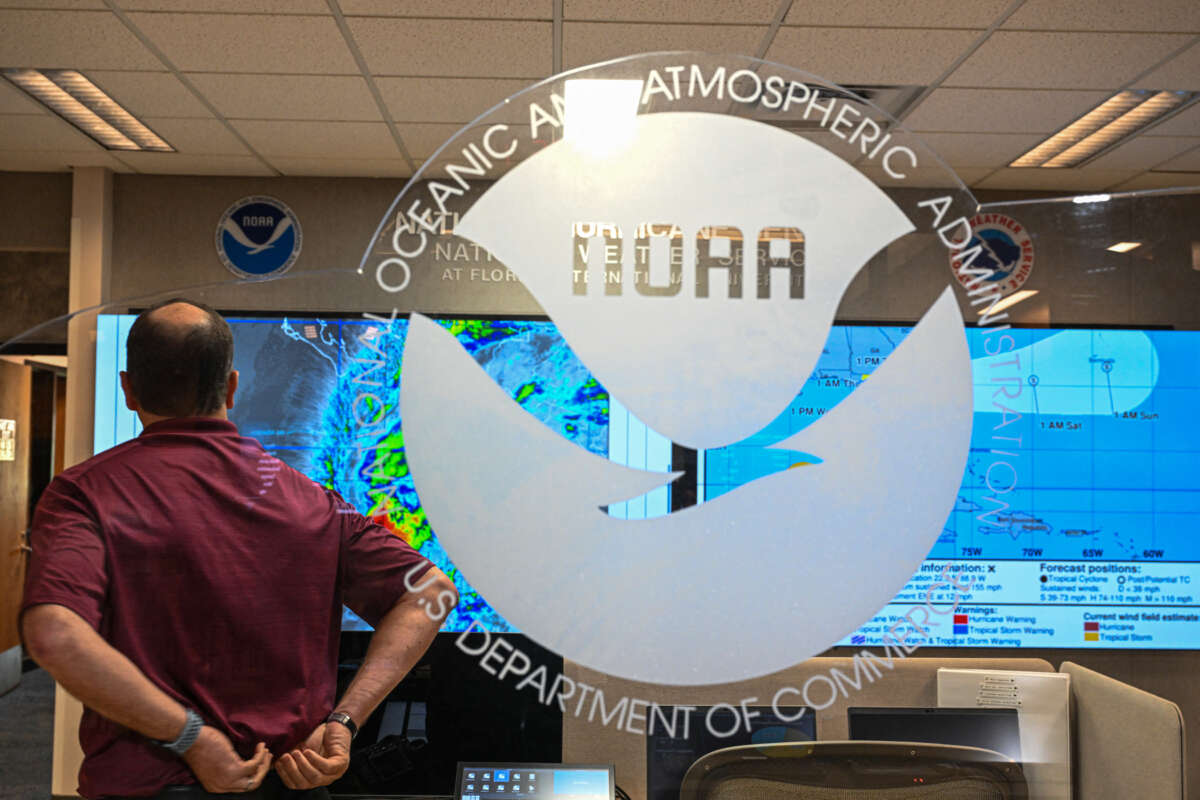
An employee of National Hurricane Center looks at the multiple hurricane models displayed on the monitors at the National Oceanic and Atmospheric Administration's (NOAA) National Hurricane Center in Miami, Florida, on May 30, 2025.CHANDAN KHANNA / AFP via Getty Images
Since June 23, a group of former employees of the communications branch of the National Oceanic and Atmospheric Administration (NOAA) have been busily resurrecting one of the government’s premier educational websites on climate change.
Climate.gov was started in the early 2010s by communicators with NOAA, and for more than a decade it consistently produced high-quality graphics and other charts documenting rising global temperatures, changing rain patterns, drought conditions, El Niño impacts, and other climate-related data. If you were a layperson and wanted to understand the parameters of human-induced global warming, the website rapidly became a go-to spot. By the 2020s, it was logging more than 1 million visitors per month, according to Rebecca Lindsey, a West Virginia-based communications specialist with an undergraduate degree in biochemistry and a master’s degree in journalism who used to work as the site’s lead writer and editor.
In February 2025, as the so-called “Department of Government Efficiency” (DOGE) purges accelerated, most of the staff and contractors attached to the website, Lindsey included, were fired — part of a NOAA culling that saw the agency’s workforce cut by roughly 600 in the first couple months of the new administration. By May of last year, the website had been officially taken down. Try to access it today and you get redirected to a NOAA site with this Orwellian message:
In compliance with Executive Order 14303 (‘Restoring Gold Standard Science’), the White House Office of Science and Technology Policy’s June 23, 2025 Memorandum (‘Agency Guidance for Implementing Gold Standard Science in the Conduct & Management of Scientific Activities’), 15 USC § 2904 (“National Climate Program’), 15 USC § 2934 (‘National Global Change Research Plan’), and 33 USC § 893a (‘NOAA Ocean and Atmospheric Science Education Programs’), you have been redirected to NOAA.gov. Future research products previously housed under Climate.gov will be available at NOAA.gov/climate and its affiliate websites.
Calling it “gold standard science” is, of course, something of a stretch; peruse this site and you’ll find no mention of human-induced global warming, no mention of CO2 emissions exacerbating climate change, no mention even that global warming is accelerating.

Disease Researchers Blame DOGE Cuts for Spiraling Cyclospora Outbreak
Public health agencies are struggling to mount an effective response with less resources and fewer staff. By Sasha Abramsky , Truthout July 29, 2026
Lindsey and her colleagues have, however, refused to go quietly into the night. They believe their educational mission was too important for them to simply fold in the face of Donald Trump and Elon Musk’s hostility. “We worked very hard for 15 years to build Climate.gov, and had a relationship with our readers,” Lindsey explained to Truthout. “And we wanted that to continue. We decided too much had been invested and too much was at stake to let it go without a fight.”
A year after Climate.gov’s demise, Lindsey and several of her erstwhile colleagues resurrected the vast majority of its materials. Left out of the mix were only a few data sets, the information from which they are still trying to access, that were removed early in the DOGE purges because they ostensibly violated anti-DEI mandates or because they referred to the Gulf of Mexico despite Trump’s executive order renaming it the Gulf of America. The new, privately run site is Climate.us and it contains a wealth of sophisticated data sets and graphics on the world’s climate. Each week, new parts of the site come online— including, most recently, a blog titled the El Niño Southern Oscillation (ENSO), recreated just in time to help website visitors grapple with the likely consequences of what is shaping up to be the most powerful El Niño in decades.
Their work has proven to be an inspiration for ex-government employees in a number of other different agencies and branches of government. Former Environmental Protection Agency (EPA) communicators are, Lindsey says, now looking to resurrect climate-related EPA pages that have been taken down; a group called the Public Environmental Data Partners is attempting to rescue specialist environmental monitoring tools — it has some information online, but not yet a fully interactive website. Another group, the Environmental Data and Governance Initiative is working to save specialized environmental justice screening tools. As the Trump administration deliberately shreds decades of climate-related research, ex-government employees are attempting to ride to the rescue by creating a sort of shadow information-dispersal system. The American Geophysical Union, which most U.S. Earth scientists are members of, has been instrumental in putting the Intergovernmental Panel on Climate Change back on track after the Trump administration pulled support for its annual reports.
Lindsey says that the Climate.us site now is seeing close to a million visitors a month, putting it up there with where the NOAA-run site was before its demise. Teachers use it frequently, she says, as do an array of others simply trying to get an accurate read on what is happening to the climate.
As with the old government-run website, Climate.us has a network of scientific advisers around the country willing to lend their expertise to the project and to make sure that what the communications people write up is scientifically accurate. The network is made up of people such as Rick Thoman, a long-time National Weather Service employee in Alaska, who left the government in 2018 and moved over to the University of Alaska Fairbanks, where he is now a climate specialist with the Alaska Center for Climate Assessment and Preparedness.
Thoman used to work as an editor with the Arctic Report Card — another vital international project that the Trump administration has, scientists involved in it tell me, recently decided to withdraw from — and had provided Lindsey’s Climate.gov team with detailed scientific input on Alaska-related phenomena. “When, in February 2025, disaster occurred and Climate.gov goes away, and out of the ashes rises Climate.us, for me it was natural; I was happy to continue in the role in this new form,” Thoman told Truthout. “Because they are so skilled at turning complex environmental information into accessible graphics, the work they do is really important in conveying to non-specialists the changes that are happening.”
An Earth scientist who used to work for NASA (and who asked to remain anonymous) told Truthout that he was now volunteering to be an external reviewer of Climate.us content “because they’re continuing an essential curated and recognized database of how the climate is changing — and where it’s likely to go in the future.” The scientist expressed dismay at the Trump administration’s shuttering of critical climate change work that would be “useful to the U.S. military, to the states,” and that ought to serve as background material upon which Congress based informed legislative decision-making around environmental policies. Now, he said, “not only are [members of the Trump administration] not making good decisions, but they don’t want good information to be readily available.”
For Lindsey, the preservation of this vital climate-related information in an era of administration-enforced environmental ignorance has become a mission. “Climate information shouldn’t be available to the public just on a political basis or a whim,” she said. Instead, there ought to be a way to “promote public climate literacy and to equip people to turn knowledge into meaningful conversations and climate-conscious actions.”
Since June 23, a group of former employees of the communications branch of the National Oceanic and Atmospheric Administration (NOAA) have been busily resurrecting one of the government’s premier educational websites on climate change.
Climate.gov was started in the early 2010s by communicators with NOAA, and for more than a decade it consistently produced high-quality graphics and other charts documenting rising global temperatures, changing rain patterns, drought conditions, El Niño impacts, and other climate-related data. If you were a layperson and wanted to understand the parameters of human-induced global warming, the website rapidly became a go-to spot. By the 2020s, it was logging more than 1 million visitors per month, according to Rebecca Lindsey, a West Virginia-based communications specialist with an undergraduate degree in biochemistry and a master’s degree in journalism who used to work as the site’s lead writer and editor.
In February 2025, as the so-called “Department of Government Efficiency” (DOGE) purges accelerated, most of the staff and contractors attached to the website, Lindsey included, were fired — part of a NOAA culling that saw the agency’s workforce cut by roughly 600 in the first couple months of the new administration. By May of last year, the website had been officially taken down. Try to access it today and you get redirected to a NOAA site with this Orwellian message:
In compliance with Executive Order 14303 (‘Restoring Gold Standard Science’), the White House Office of Science and Technology Policy’s June 23, 2025 Memorandum (‘Agency Guidance for Implementing Gold Standard Science in the Conduct & Management of Scientific Activities’), 15 USC § 2904 (“National Climate Program’), 15 USC § 2934 (‘National Global Change Research Plan’), and 33 USC § 893a (‘NOAA Ocean and Atmospheric Science Education Programs’), you have been redirected to NOAA.gov. Future research products previously housed under Climate.gov will be available at NOAA.gov/climate and its affiliate websites.
Calling it “gold standard science” is, of course, something of a stretch; peruse this site and you’ll find no mention of human-induced global warming, no mention of CO2 emissions exacerbating climate change, no mention even that global warming is accelerating.
Disease Researchers Blame DOGE Cuts for Spiraling Cyclospora Outbreak
Public health agencies are struggling to mount an effective response with less resources and fewer staff. By Sasha Abramsky , Truthout July 29, 2026
Lindsey and her colleagues have, however, refused to go quietly into the night. They believe their educational mission was too important for them to simply fold in the face of Donald Trump and Elon Musk’s hostility. “We worked very hard for 15 years to build Climate.gov, and had a relationship with our readers,” Lindsey explained to Truthout. “And we wanted that to continue. We decided too much had been invested and too much was at stake to let it go without a fight.”
A year after Climate.gov’s demise, Lindsey and several of her erstwhile colleagues resurrected the vast majority of its materials. Left out of the mix were only a few data sets, the information from which they are still trying to access, that were removed early in the DOGE purges because they ostensibly violated anti-DEI mandates or because they referred to the Gulf of Mexico despite Trump’s executive order renaming it the Gulf of America. The new, privately run site is Climate.us and it contains a wealth of sophisticated data sets and graphics on the world’s climate. Each week, new parts of the site come online— including, most recently, a blog titled the El Niño Southern Oscillation (ENSO), recreated just in time to help website visitors grapple with the likely consequences of what is shaping up to be the most powerful El Niño in decades.
Their work has proven to be an inspiration for ex-government employees in a number of other different agencies and branches of government. Former Environmental Protection Agency (EPA) communicators are, Lindsey says, now looking to resurrect climate-related EPA pages that have been taken down; a group called the Public Environmental Data Partners is attempting to rescue specialist environmental monitoring tools — it has some information online, but not yet a fully interactive website. Another group, the Environmental Data and Governance Initiative is working to save specialized environmental justice screening tools. As the Trump administration deliberately shreds decades of climate-related research, ex-government employees are attempting to ride to the rescue by creating a sort of shadow information-dispersal system. The American Geophysical Union, which most U.S. Earth scientists are members of, has been instrumental in putting the Intergovernmental Panel on Climate Change back on track after the Trump administration pulled support for its annual reports.
Lindsey says that the Climate.us site now is seeing close to a million visitors a month, putting it up there with where the NOAA-run site was before its demise. Teachers use it frequently, she says, as do an array of others simply trying to get an accurate read on what is happening to the climate.
As with the old government-run website, Climate.us has a network of scientific advisers around the country willing to lend their expertise to the project and to make sure that what the communications people write up is scientifically accurate. The network is made up of people such as Rick Thoman, a long-time National Weather Service employee in Alaska, who left the government in 2018 and moved over to the University of Alaska Fairbanks, where he is now a climate specialist with the Alaska Center for Climate Assessment and Preparedness.
Thoman used to work as an editor with the Arctic Report Card — another vital international project that the Trump administration has, scientists involved in it tell me, recently decided to withdraw from — and had provided Lindsey’s Climate.gov team with detailed scientific input on Alaska-related phenomena. “When, in February 2025, disaster occurred and Climate.gov goes away, and out of the ashes rises Climate.us, for me it was natural; I was happy to continue in the role in this new form,” Thoman told Truthout. “Because they are so skilled at turning complex environmental information into accessible graphics, the work they do is really important in conveying to non-specialists the changes that are happening.”
An Earth scientist who used to work for NASA (and who asked to remain anonymous) told Truthout that he was now volunteering to be an external reviewer of Climate.us content “because they’re continuing an essential curated and recognized database of how the climate is changing — and where it’s likely to go in the future.” The scientist expressed dismay at the Trump administration’s shuttering of critical climate change work that would be “useful to the U.S. military, to the states,” and that ought to serve as background material upon which Congress based informed legislative decision-making around environmental policies. Now, he said, “not only are [members of the Trump administration] not making good decisions, but they don’t want good information to be readily available.”
For Lindsey, the preservation of this vital climate-related information in an era of administration-enforced environmental ignorance has become a mission. “Climate information shouldn’t be available to the public just on a political basis or a whim,” she said. Instead, there ought to be a way to “promote public climate literacy and to equip people to turn knowledge into meaningful conversations and climate-conscious actions.”
No comments:
Post a Comment