It’s possible that I shall make an ass of myself. But in that case one can always get out of it with a little dialectic. I have, of course, so worded my proposition as to be right either way (K.Marx, Letter to F.Engels on the Indian Mutiny)
Wednesday, August 05, 2026
Human activity more than doubles fire occurrence in the arctic
Credit: Nils Rietze, University of Zurich; ArcGIS Pro
The occurrence of fires in the Arctic is linked not only to warming temperatures and increasingly dry conditions, but also human activity in the region. An international research team led by the University of Zurich found that fires occurred 2.5 times more often in lit areas associated with human activity than in climatically similar unlit areas. Effective fire prevention and response can help reduce risks whose impacts extend far beyond the Arctic.
Fires in the Arctic are not solely a regional issue, as shown by the hazy skies in Switzerland last summer despite otherwise sunny weather. Smoke from major fires in northern Canada crossed the Atlantic and reached Europe. Until now, large-scale studies of Arctic tundra fires have focused primarily on rising temperatures and drought as the main drivers. The role of human activity has received much less attention, even as industrial development, settlements, roads, and other infrastructure expand rapidly in parts of the Arctic, particularly in connection with extractive industries such as oil and gas production and mining.
Comparing artificial light at night and fire occurrence
An international team of researchers led by the University of Zurich (UZH) has investigated for the first time at the pan-Arctic scale whether human activity is linked to fire occurrence between 2001 and 2013. Study leader Gabriela Schaepman-Strub from the Department of Evolutionary Biology and Environmental Sciences at UZH collaborated with colleagues from NASA’s Goddard Space Flight Center, USA, and the University of Münster, Germany. Since direct and consistent data on human activities across the entire Arctic are difficult to obtain, the researchers used artificial light at night as a satellite-based indicator of human presence, including settlements and industrial activities.
"Our results show that in the Arctic, fires occurred 2.5 times more often in areas illuminated by artificial nighttime light than in climatically similar unlit areas. We also found that fire occurrence was higher closer to lit areas, suggesting a strong spatial association between light-emitting human activity and Arctic fire occurrence," says Cengiz Akandil, a postdoctoral researcher at UZH and first author of the study. He notes that this does not mean that human activity is the only driver of fires in the Arctic, as changing temperature, moisture, and drought conditions remain major factors. The findings nevertheless show that human activity also plays an important role.
According to Miguel Román, Deputy Director for Atmospheres and Data Systems at NASA Goddard and co-author of the study, earth observations are most powerful when they help scientists understand how environmental conditions and human activity interact. "This study underscores the importance of interdisciplinary Earth system science that includes human systems as part of the interconnected whole, rather than treating them as separate from the environment,” says Román.
Different strategies for fire prevention and response
The researchers also found large regional differences in fire occurrence near lit areas. This suggests that fire management, prevention measures, and firefighting capacities may help explain regional differences in fire occurrence associated with human activity. "Better fire prevention and management around settlements, industrial sites, roads, and other lit areas could therefore help reduce ignition risks and limit fire damage," says Akandil.
The study findings are highly relevant to Arctic communities. Fires can threaten homes, infrastructure, transport routes, public health, and livelihoods, as well as culturally important landscapes and valuable ecosystems that support local ways of life and Arctic biodiversity. They can accelerate permafrost thaw and shift tundra ecosystems into new, more fire-prone states. "Reducing human-related ignition risks is therefore important not only for protecting infrastructure, but also for strengthening the resilience and safety of Arctic communities," emphasizes senior author Gabriela Schaepman-Strub.
Impact extends far beyond the Arctic
Because Arctic fires release carbon and can accelerate permafrost degradation, they contribute to feedbacks that affect the global climate. The impact extends far beyond the Arctic. Managing fire risk associated with human activity in the Arctic is therefore a local and a global issue, as Schaepman-Strub concludes: "As Arctic development continues and climatological conditions become more fire-prone, integrating fire prevention into land-use planning, industrial operations, and community protection strategies will become increasingly important."
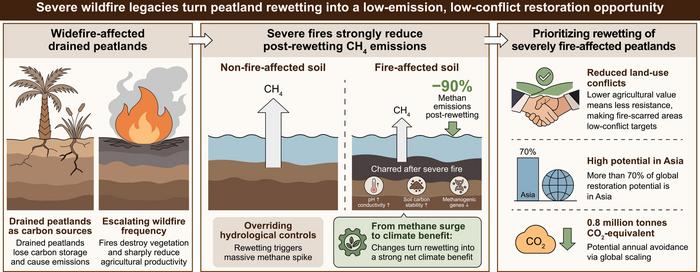
Severe wildfire legacies turn peatland rewetting into a low-emission, low-conflict restoration opportunity. This graphical abstract illustrates the core findings of the study. Decades of drainage have turned peatlands into carbon sources and increased wildfire risks. Severe fires, unlike mild or no fires, fundamentally alter peat chemistry and suppress methane production after rewetting—reducing post‑rewetting CH₄ emissions by 91% compared with unburned sites. These fire‑affected areas also carry lower agricultural value, easing land‑use conflicts and making them pragmatic targets for restoration. Globally, prioritizing such sites could avoid 0.1–0.8 million tonnes CO₂‑equivalent annually, with more than 70% of the potential concentrated in Asia.
Peatlands store roughly one-quarter of global soil carbon, yet decades of drainage for agriculture have turned many into major carbon sources. Rewetting these lands restores their carbon-storing function but often triggers a surge in methane—a greenhouse gas far more potent than carbon dioxide. Now, researchers have found that severely burned peatlands, when rewetted, emit dramatically less methane than unburned or mildly burned ones, suggesting that areas already degraded by wildfire could become prime candidates for accelerated restoration.
Drained peatlands are increasingly vulnerable to wildfires as climate change intensifies droughts and lowers water tables. At the same time, rewetting—while effective at suppressing carbon dioxide release—frequently stimulates methane production, creating a climate trade-off that can delay net benefits for years or even decades. Farmers also resist rewetting on productive agricultural land, as it typically means lost income. Based on these challenges, there is an urgent need to understand how wildfire history influences greenhouse gas emissions from peatlands after rewetting—and whether fire-affected areas could offer a more feasible pathway for large-scale restoration.
A team from Aarhus University in Denmark reports (DOI: 10.1016/j.ese.2026.100735) these findings in Environmental Science and Ecotechnology, published on July 29, 2026. The researchers conducted a 90-day laboratory incubation experiment comparing drained peat soils with rewetted soils that were either unaffected by fire, mildly burned, or severely burned. They measured carbon dioxide and methane emissions, analyzed soil chemistry, and profiled microbial communities to uncover the mechanisms driving post-fire gas dynamics.
The results revealed a striking divergence. Rewetting unburned peat triggered a roughly 40-fold increase in methane emissions compared with drained soils—a well-known consequence of waterlogged, oxygen-free conditions that favor methane-producing microbes. Mildly burned soils produced even more methane, with emissions surging six times higher than unburned rewetted soils. But severely burned soils told a different story: their methane emissions remained low, statistically indistinguishable from drained controls—a 91% reduction compared with unburned rewetted soils.
What explains this stark difference? Severe fires fundamentally altered the peat itself. Fourier-transform infrared spectroscopy revealed that severely burned soils contained higher proportions of recalcitrant carbon compounds such as phenols and aromatics—forms that microbes struggle to break down. In contrast, mild fires did not substantially change carbon chemistry but may have released previously protected labile carbon by breaking down soil aggregates. The researchers also found that severe fires increased soil pH and electrical conductivity, both of which were negatively correlated with methane emissions. At the microbial level, the abundance of mcrA—a key gene for methane production—plummeted in severely burned soils, while methanogen communities flourished in mildly burned ones. "Severe fires essentially override the usual methane response you’d expect from rewetting,” the authors said. “The heat transforms the peat into a less digestible form, and the microbial communities that produce methane simply don’t recover quickly. This means that areas we might have written off as degraded could actually offer a climate advantage if we prioritize them for restoration."
Globally, the team estimates that more than 6 million hectares of peatlands burn each year, with 0.5 to 0.9 million hectares of that being degraded peatlands suitable for rewetting. Prioritizing these fire-affected areas could deliver methane mitigation of 0.1 to 0.8 million tonnes of carbon dioxide equivalent annually under a 100-year global warming potential framework. The numbers are modest relative to global emissions, but the real value lies in feasibility. Burned peatlands have already lost much of their agricultural value, reducing the land-use conflicts that have historically stalled restoration on productive farmland. "Wildfire does the hard work of making rewetting socially acceptable," the authors noted. "The land is less profitable for farming, so the opposition is lower. And biogeochemically, severe fires prime the soil to emit less methane after rewetting. It's a rare alignment of ecological and socioeconomic incentives."
This work was supported by the European Union’s Horizon Europe programme (WET HORIZONS, grant agreement No. 101056848) and the China Scholarship Council (No. CXXM20220022).
Environmental Science and Ecotechnology (ISSN 2666-4984) is an international, peer-reviewed, and open-access journal published by Elsevier. The journal publishes significant views and research across the full spectrum of ecology and environmental sciences, such as climate change, sustainability, biodiversity conservation, environment & health, green catalysis/processing for pollution control, and AI-driven environmental engineering. The latest impact factor of ESE is 14.3, according to the Journal Citation ReportsTM 2024.
No comments:
Post a Comment