India Takes Center Stage In Russia’s Energy Trade – OpEd
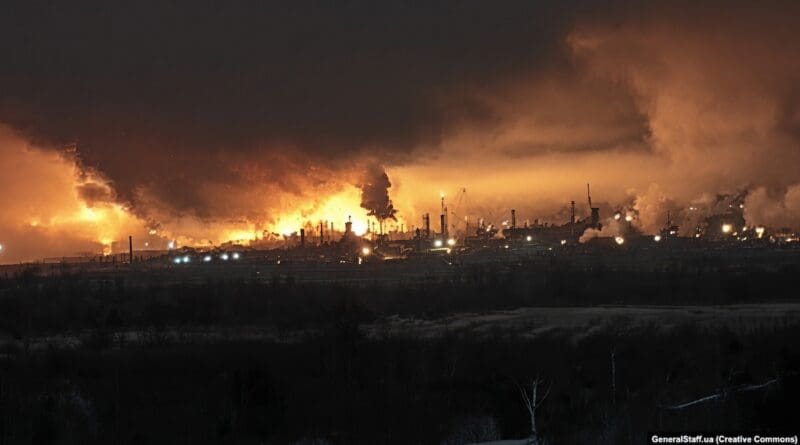
An oil refinery in Kstovo, in Russia's Nizhny Novgorod region, is seen burning after a Ukrainian strike. Photo Credit: Generalstaff.ua, RFE/RL
Key Takeaways:
- After Europe cut Russian oil, India became Moscow’s second-largest crude buyer (about 1.8–2.8 million barrels a day recently), versus only ~84,000 bpd before 2022.
- Ukrainian strikes on Russian refineries have pushed Moscow to import Indian gasoline (over a million barrels in June–July cited), turning a one-way crude flow into a two-way energy trade that can trim India’s deficit.
- New Delhi is also buying more U.S. LPG/LNG after Hormuz disruption and expanding renewables, which the author says gives it more room to deal with both Russia and Washington.
Ukrainian drone attacks on Russian oil refineries have created significant problems for the country’s energy sector. As Russia looks to keep its energy trade running, India has become a partner with both the demand and the industrial capacity to help absorb the shock.
Before the Kremlin launched its invasion of Ukraine in 2022, Europe was the main destination for Russian energy exports. In 2021, Russia accounted for 25.8 percent of the European Union’s oil imports, making it the bloc’s largest oil supplier. On average, it exported to the 27-nation bloc 4.7 million barrels of crude oil per day that year. For comparison, in 2021, India imported about only 84,000 barrels of crude oil per day from Russia, accounting for just two percent of its total crude oil imports.
However, Moscow’s actions in Ukraine have forced the EU to begin the process of “energy decoupling” from Russia. As a result, European countries have substantially reduced their dependence on Russian fossil fuels, while Moscow has found new markets for its energy exports. The East, rather than the West, is now Russia’s major export destination. In this shift, India has become an important partner in Russia’s energy trade.
While in the past, the Indian market was on the periphery of Russia’s energy policy, it has now become a major part of Russia’s energy relationship with Asia. The world’s most populated country is now the second-largest buyer of Russian oil globally. Statistics show that in 2024 and 2025 India imported $56.87 billion of crude oil from Russia, with daily volumes averaging between 1.8 million and 2.1 million barrels.
In July, despite Ukrainian attacks on Russian oil refineries, India’s crude oil imports from Russia rose to 2.8 million barrels per day. In August, according to reports, India bought almost two million barrels per day of crude oil from Russia, more than three times the amount it imported from its second-largest supplier, the United Arab Emirates.
On August 25, following Indian External Affairs Minister S. Jaishankar’s visit to Moscow, New Delhi received assurances that Russia will continue to “uninterruptedly supply energy to India.” At first glance, such dynamics might not appear especially favorable for New Delhi, given India’s significant trade deficit with Russia. Although trade between two countries has grown significantly – nearly quadrupling in five years, from around $13 billion in 2021–22 to almost $60 billion in 2025–26 – the imbalance has widened considerably as well.
The situation, however, seems to be becoming more balanced. Recent Ukrainian attacks on Russian oil refineries have forced Moscow – one of the biggest crude producers and refiners globally – to begin importing gasoline and petrol from New Delhi. Ukraine’s actions might have affected Russia’s ability to produce fuel, but the country can still export crude. It now ships oil to India and, unable to refine it at home, imports refined petroleum products from the world’s fifth-largest economy.
India’s large refining industry is estimated to have supplied more than one million barrels of petrol to Russia in June and July. Despite the fact that crude oil constitutes a dominant share of imports from Russia, the trade is no longer one-way. By exporting fuel to the Russian Federation, New Delhi can now both deepen the two-way nature of the energy relationship and, at least to some extent, reduce its trade deficit with Moscow. At the same time, by diversifying its energy imports, which seems to be one of the country’s top priorities, India is also making sure that its energy security does not depend too heavily on any single supplier.
While continuing to rely on Russian oil, India has sharply increased purchases of liquefied petroleum gas (LPG) and liquefied natural gas (LNG) from the United States, especially as imports from Gulf suppliers have fallen sharply following the effective closure of the Strait of Hormuz. Such a strategy allows New Delhi to maintain its partnership with Moscow while deepening its energy ties with Washington and other suppliers, especially if the Trump administration attempts to force India to halt or at least reduce its imports of Russian oil.
At the same time, India continues to make remarkable progress in renewable energy production, which could help the country gradually reduce its reliance on imports of both Russian oil and American LNG and LPG. Reports suggests that India now ranks third globally in renewable energy installed capacity, highlighting the nation’s growing ability to meet more of its energy needs at home.
For New Delhi, this could be more than a short-term shift in energy trade, as it could also strengthen India’s position in dealing with both Russia and the United States. The more options India has, the easier it is for the country to pursue its own interests without being forced to choose sides. This gives Indian authorities more room to negotiate, both economically and politically.
Finally, for New Delhi, Russia’s energy disruptions could reinforce a relationship that has become an important part of India’s broader energy strategy. What started as a disruption to Russia’s energy sector could end up helping India strengthen its position in the global energy market by showing the value of its role as a major buyer, refiner and energy partner.
No comments:
Post a Comment