More Israelis are leaving as war, economy and political divisions reshape the country

JERUSALEM (RNS) — When Michal Cohen asked her husband to search for a job outside Israel last year, she said she imagined a life without the constant fear of the next missile attack or phone call ordering her husband back to military reserve duty.
While the couple had always dreamed of spending an extended period abroad to expose their children to other cultures and religious pluralism within the Jewish community, the Oct. 7, 2023, Hamas massacre and ensuing war gave their plans a new urgency.
“I was having panic attacks,” Cohen, 33, said from the American Midwest, where her family moved earlier this month. “I couldn’t continue living with the thought that my husband, who served more than 400 days of reserve duty, would be called up again, and not to know where or for how long.”
Experiencing missile attacks while alone with her three small children reinforced her feelings of helplessness. As air raid sirens blared during one Iranian attack, Cohen found herself outside with her baby daughter as people around them rushed to the closest shelter.
“I was sitting with my 6-month-old on the grass, and she started shaking,” Cohen, who lived in Jerusalem, recalled. “I thought, if my baby is getting the vibe, imagine how my 4- and 6-year-olds are being affected. I couldn’t take it anymore.”
The Cohens are among the growing number of Israelis who have left Israel — at least temporarily — since 2023, a trend that reveals the trauma of ongoing war, the high cost of living and dissatisfaction many have with the government of Prime Minister Benjamin Netanyahu.

Israeli air defense system fires to intercept missiles during an Iranian attack over Tel Aviv, Israel, Thursday, June 19, 2025. (AP Photo/Leo Correa, File)
Nearly 270,000 Israeli citizens left Israel for at least three consecutive months from 2023 to 2025 — a 47% increase over the 183,219 Israelis who left during an equivalent three-year period from 2013 to 2015, according to a recent Tel Aviv University study. The country is home to about 10 million.
Researchers estimate that more than half of the 90,922 who left in 2025 stayed abroad for at least a year, according to the Central Bureau of Statistics. And about 82,400 people immigrated to Israel between 2023 and 2025.
“In 2025, we continue to see very troubling numbers of Israelis leaving the country for a significant period of time, adding to the 2023-2024 wave of emigration,” said Itai Ater, one of the study’s researchers. “Taken by themselves, these figures do not yet pose a risk to Israel’s resilience. However, looking ahead, and unless there is a change, there is growing concern that rising emigration from Israel might jeopardize the country’s future security and economy.”
To researchers, the demographics of those leaving adds to the national concern. A 2025 study by the Israel Democracy Institute found about a third of Arabs and a quarter of Jews were considering leaving either temporarily or permanently; those with high incomes and “high-mobility occupations” in sectors like medicine, science and tech were more likely to consider emigrating. Israelis with more than one citizenship or who have friends or relatives abroad were also more likely to want to move.
For Jews, the younger and less religious a person was, the more likely they were to consider leaving (39% of secular versus just 3% of Haredi or ultra-Orthodox Jews), according to the IDI study. And more than 40% of those on the political left and 35% in the center said they were considering leaving, compared to 19% on the right.
For those on the left considering leaving Israel, most cited politics, government, judicial overhaul and lack of a good future for children as reasons. Right-leaning Israelis were more likely to cite high cost of living, as well as a lack of a good future for children.
Yossi Klein Halevi, a senior fellow at the Shalom Hartman Institute, a Jerusalem research and educational center, said emigration has always been part of Israel’s history, pointing to people leaving over the decades for economic, professional, family and other reasons. But what is different now, he said, is that some Israelis are leaving because they have lost faith in the country’s direction.
“We’ve never seen that before,” Halevi said. “They are leaving because they are in despair. They are disillusioned.”
He pointed to a combination of a political struggle over democracy, the trauma of the Oct. 7 attack and the prolonged military burden placed on reservists and their families while tens of thousands of draft-age ultra-Orthodox men refuse to serve in the Israel Defense Forces on the advice of their rabbis.
The dispute over Haredi military service is one of Israel’s most contentious domestic issues, especially since the start of the Gaza war, which has expanded to several fronts. For decades, ultra-Orthodox men studying in yeshivas benefited from a system that effectively exempted them from mandatory military service. But in 2024, Israel’s Supreme Court ruled the exemption was illegal and ordered the government to begin drafting Haredi men.

Israeli police officers disperse ultra-Orthodox Jewish men blocking a highway during a protest against army recruitment in Bnei Brak, Israel, March 2, 2025. (AP Photo/Ohad Zwigenberg)
Netanyahu’s government has long relied on ultra-Orthodox Jews to stay in power and has not ordered the arrest of draft dodgers.
“When Israelis feel a sense of solidarity, it tends to balance sacrifices,” Halevi said. “But this government has committed itself to ensuring that 15% of the population is exempt from military service at a time of unprecedented burden on the rest of us. No Western country demands as much sacrifice of its citizens. It’s not surprising that some are responding by leaving the country.”
The issue has taken on particular weight among families whose members have spent hundreds of days in reserve duty since Oct. 7. Prior to the war, most IDF veterans served about 30 days a year in the IDF reserves. But in 2024, reservists served an average of 94 days, a number that dropped to 78 days in 2025, according to the IDF. Many have served far longer.
For Marion Krivine, 54, who immigrated to Israel from France three decades ago, the breakdown of that sense of shared responsibility was one of the reasons she eventually decided to leave. She moved to Cabo Verde last year after two of her children had already left Israel, and she expected the third to leave after completing military service.
Krivine said attempts by Netanyahu’s government to grant more power to lawmakers by weakening the judicial system was one factor, but not the only one. She described a broader feeling that the Israeli government supports and funds Orthodox Jewish institutions at the expense of non-Orthodox and secular Jews.
“It’s becoming impossible not to be religious in Israel,” she said. “There is no room for secular people.”
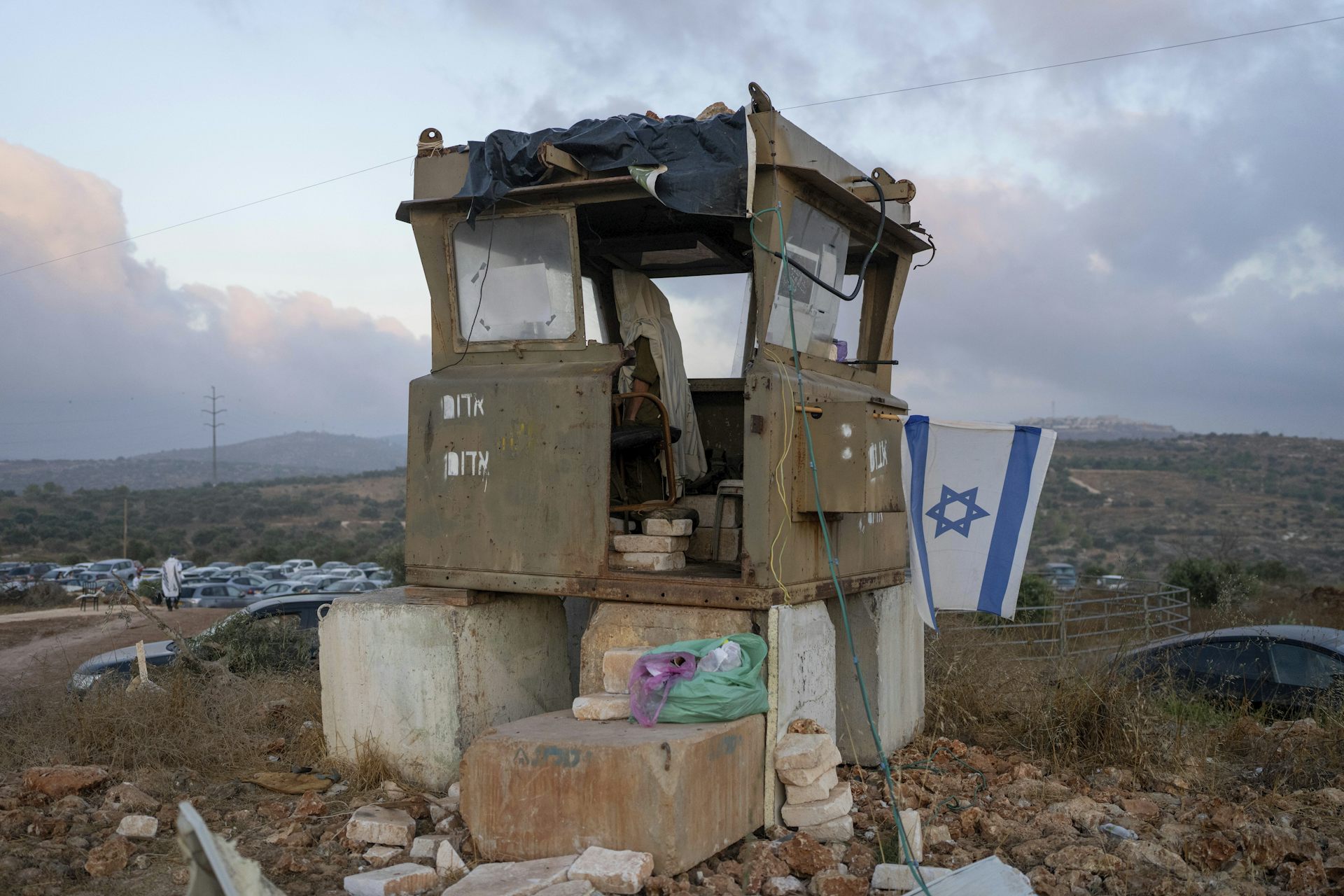
An Israeli soldier prays in the Evyatar outpost in the Israeli-occupied West Bank on July 7, 2024. (AP Photo/Ohad Zwigenberg)
Krivine, who lived in southern Israel, said she’s especially upset that the government prioritizes West Bank settlements over the needs of the residents in the periphery of the country.
“When you live in the Negev, it’s very obvious that the bulk of the national budget goes to Yehuda and Shomron,” she said, using the biblical Hebrew term for the West Bank. “I was the cow being milked, while we get nothing.” Meanwhile, she said the Haredi community, where families have 6.5 children on average, “is getting bigger and bigger.”
Since only 3,000 to 4,000 of the eligible 70,000 Haredi soldiers serve in the IDF, others must serve for longer. Research cited in a recent Taub Center analysis found that prolonged reserve duty negatively affected wages, careers, businesses, education and family life. Many reservists studying for a degree may lose a semester or more, while employed reservists often fall behind professionally. Self-employed reservists often struggle to keep their businesses going.
For J, a Christian Arab citizen of Israel, IDF service is not a factor in his family’s deliberations over whether to move abroad in the near future. Like most other Arabs in Israel, he is exempt from military duty.
“We’re trying to hang on, but it’s nearly impossible to make a living here,” said J, 46, who requested that his full name not be published because he does not want to worry his parents. “Our family business is heavily dependent on pilgrims, and tourism has been decimated, first by COVID and then the war.”
The decision-making is causing his family a lot of sleepless nights, he said. “Our family has lived in the Holy Land for 2,000 years. We don’t want to abandon our community, but times are tough.”
Though relieved to be in the U.S., Cohen still worries about her family and friends and the welfare of the soldiers her husband commanded. His job is expected to last three years. But after Oct. 7, Cohen said, she has learned plans can change quickly.
“For now, it’s a temporary relocation,” she said.
No comments:
Post a Comment