Opinion
New book ‘A Nation Wrestles With God’ traces religious dialogue through our history
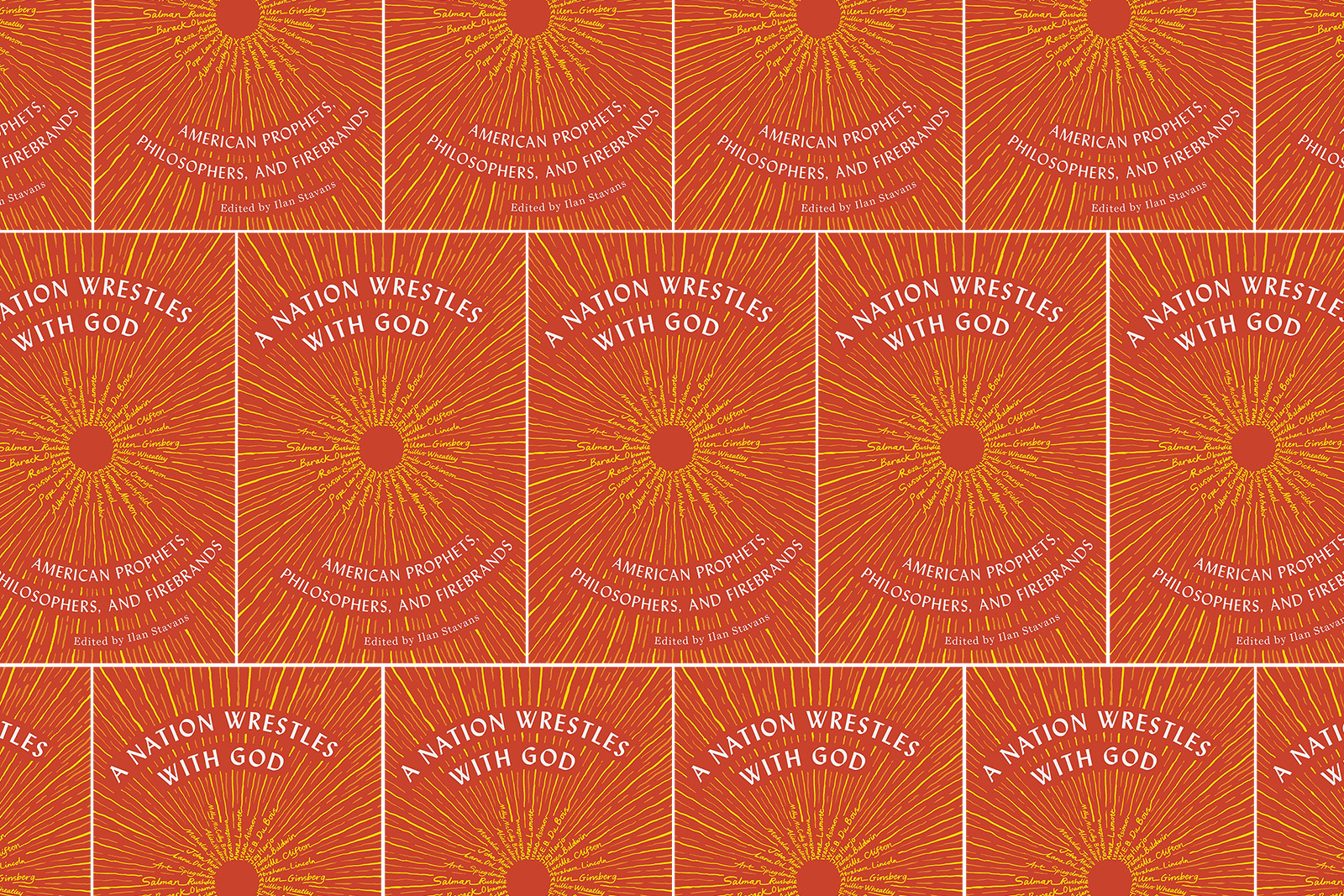
(RNS) — The following is an excerpt from the book ‘A Nation Wrestles with God: American Prophets, Philosophers, and Firebrands’, a 528-page anthology edited by Ilan Stavans and published by Restless Books on June 30, 2026. The collection of essays spans over 400 years of American spiritual thought — from pre-colonial texts to the present day, from Anne Bradstreet and Joseph Smith to James Baldwin, Christopher Hitchens and more — about the country’s unique relationship to religion. The text below is adapted from its introduction.
***
“I was a-trembling, because I’d got to decide, forever, betwixt
two things, and I knowed it. I studied a minute, sort of holding
my breath, and then says to myself:
‘All right, then, I’ll go to hell.’”
- Mark Twain,
“Adventures of Huckleberry Finn” (1884)
Huck Finn, the rambunctious, free-spirited, 13- or 14-year-old boy sailing down the Mississippi River in the pre-Civil War South, son of a drunkard, with a rough upbringing and without a formal education, is arguably the most famous fictional character in the United States.
“All modern American literature comes from one book,” Ernest Hemingway said — Mark Twain’s novel “Huckleberry Finn.”
As the epigraph above attests, Huck’s journey is not only geographical but moral: Faced with what the slave-owning society he lives in sees as right, he doesn’t hesitate in choosing wrong, which in his eyes, of course, is right. Huck isn’t religious, not in the traditional sense. And he doesn’t believe in God, or at least he doesn’t talk about it. Still, he has been exposed to Christianity through figures like his caregiver, Miss Watson, and he finds its teachings contradictory and ineffective in his own life. While he doesn’t embrace organized religion, his odyssey leads him to question societal norms. This allows him to develop his own moral compass to the point of rejecting the idea of hell to help his friend Jim, a runaway slave.
Huck is proof that even atheists wrestle with God, indirectly or otherwise. And if not God, at least with an ethical — or, rather, unethical — universe. That wrestling — with the divine, with morality — might well be America’s most sustained pastime. It was present before the republic came into being, remains vigorous to this day and is unlikely to diminish as time continues its inexorable march. Since 1956, “In God We Trust” has been the nation’s official motto, when Congress formally adopted it (as a replacement of “e pluribus unum”). It is still printed on our currency, having first appeared on U.S. coins during the Civil War. Since 1954, when President Dwight Eisenhower signed it into law, the phrase “under God” has been an integral part of the U.S. Pledge of Allegiance. And although the “invocatio dei” isn’t written into the nation’s Constitution (God, Jesus Christ and Christianity aren’t mentioned in it), it does contain — twice — the word “religion”: in Article 6, which exempts government officeholders from a religious test, and in the First Amendment (“Congress shall make no law respecting an establishment of religion, or prohibiting the free exercise thereof”).
Obviously, if God is on our money and in our pledge, then God is in our hearts. Indeed, in the long and torturous history of the making of nations, there has never been a shortage of using God as a motivator. The need to justify foundational strokes — why a nation is created, its mission, what distinguishes it from others, its connection to the land and its neighbors — by invoking supernatural intervention is essential. The United States, while persuading itself, even deluding itself, as exceptional, is no exception.
Any dialogue with the divine, at its core, unfolds in a variety of ways: as an antagonism between credo and “episteme,” between the Bible and Aristotle, between creationism and evolution. Yet, at its most basic, religion is about language: the use of words to alleviate, or else exacerbate, the anxiety of loneliness, to map out a path through the chaos that is the universe. The Bible, the Quran, and other religious books are nothing if not a collection of words and sentences built in response to our wonder.
Semantically, the word God comes from Old English, which itself stems from the Proto-Germanic “guđán.” It might be traced to the Proto-Indo-European “ghu-tó-m,” likely meaning “that which is invoked” or “that which is poured out.” Merriam-Webster defines God as “the supreme or ultimate reality.” It states that in the Abrahamic religions (Judaism, Christianity and Islam), God is understood to be “the being perfect in power, wisdom, and goodness who is worshipped as creator and ruler of the universe.” The act of conceiving that so-called perfect being isn’t the only challenge; sustaining a relationship with God is a more challenging quest. “To wrestle” means to engage in deep thought, consideration or debate. In other words, to wrestle with God involves two or more participants; it is never one-sided.
Our relationship with God has its ups and downs, its moments of light and darkness, its closeness and distancing, its rewards and disappointments. But it hasn’t always been understood in those terms. In ancient times and up to the Middle Ages, observance was seen as mostly passive from the human perspective: One accepted the will of God, or there would be consequences. This changed from the Renaissance onward into a more balanced equation: As theologian Abraham Joshua Heschel put it, communing with God entails humans searching for God and, in equal measure, God searching for a human counterpart. Thus, the title of this anthology begets its own double: Just as America wrestles with God, God wrestles with America.
(Ilan Stavans is the publisher of Restless Books and the Lewis-Sebring Professor of Humanities and Latin American and Latino Culture at Amherst College in Amherst, Massachusetts. He is the recipient of numerous honors, including a Guggenheim Fellowship, Chile’s Presidential Medal, the International Latino Book Award and the Jewish Book Award. The views expressed in this commentary do not necessarily reflect those of Religion News Service.)
No comments:
Post a Comment