
‘One Big Military Theft’: Trump Announces Deal for US Control of Venezuelan Oil Fields
“This is proof Trump put our service members at risk to get Venezuelan oil for his billionaire buddies,” one Democratic senator said. “Putting our soldiers’ lives on the line for private profit is a gross dereliction of his constitutional duty.”
“This is proof Trump put our service members at risk to get Venezuelan oil for his billionaire buddies,” one Democratic senator said. “Putting our soldiers’ lives on the line for private profit is a gross dereliction of his constitutional duty.”
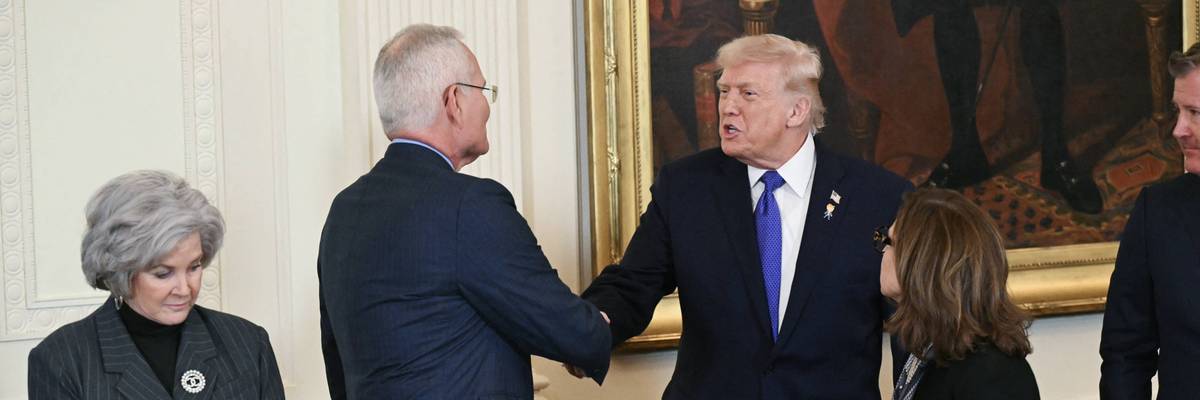
US President Donald Trump shakes hands with ExxonMobil CEO Darren Woods, during a meeting with US oil companies executives in the East Room of the White House in Washington, DC on January 9, 2026.
(Photo by Saul Loeb / AFP via Getty Images)
Olivia Rosane
Aug 29, 2026
COMMON DREAMS
President Donald Trump announced on Truth Social on Friday that his government had “secured majority US control” of Venezuelan oil reserves containing 65 billion barrels of oil.
The announcement followed on reporting from Axios that a deal was in the works, prompting criticisms that such a move would be “colonial” and calls for Congress to reject any such proposal.
“Let’s be clear: This isn’t a win,” Sen. Chris Van Hollen (D-Md.) wrote on social media in response to the announcement. “This is proof Trump put our service members at risk to get Venezuelan oil for his billionaire buddies. Putting our soldiers’ lives on the line for private profit is a gross dereliction of his constitutional duty.”
When US forces invaded Caracas and kidnapped Venezuelan President Nicolás Maduro and his wife First Combatant Cilia Fores on January 3, Trump’s own words following the invasion confirmed suspicions that he acted largely to gain access to the country’s oil.
“These are some of the largest crimes of our lifetimes.”
“We’re going to get the oil flowing the way it should be,” he said in a press conference following the attack.
Friday’s deal, which seems like an attempt to make good on that promise, was also announced by Secretary of State Marco Rubio and acting Venezuelan President Delcy Rodriguez, who provided more details.
According to Venezuelanalysis:
Rodríguez stated that the deal will involve private corporations developing 17 “strategic fields” with 65 billion barrels of proven reserves. She echoed Rubio’s $100 billion investment claim and pledged that the projects would yield $209 billion in tax revenues. According to the acting president, the announced agreement “ushers in a new era of growth and prosperity.”
However, economist Francisco Rodríguez, a senior research fellow at the Center for Economic and Policy Research, argued that the agreement was actually a bad deal for Venezuelans.
“President: According to your figures, this agreement will generate tax revenues of just $3.22 per barrel of Venezuelan oil. This represents 4.7% of the current price, and less than half of the royalty rate contemplated in concessions granted by Juan Vicente Gómez,” he wrote on social media, addressing the current Venezuelan leader and referring to a Venezuelan dictator from the early 20th century.
Joseph Bouchard, a journalist and researcher who focuses on Latin America, agreed with Rodriguez’s criticism of the deal, writing on social media that “Trump [was] ‘generously’ buying billions of barrels of Venezuelan oil at less than 5% its market price. He’s stealing their oil for his own family and cronies’ profit. Guessing this may be used as a chip to manipulate the midterms. These are some of the largest crimes of our lifetimes.”
Francisco Rodriguez had earlier pointed out that the deal violated the Venezuelan Constitution, which holds that all minerals and hydrocarbons are “inalienable public domain,” according to Venezuelanalysis. For the deal to go through, therefore, Venezula would have to alter its Constitution.
Former head of Human Rights Watch Kenneth Roth noted on social media that “senior Venezuelan officials, all fearing arrest, are hardly in a position to negotiate vigorously, making the whole thing seems like one big military theft.”
Trump is under pressure to lower gas prices that have spiked due to the fallout of his war on Iran, which entered its sixth month on Friday, and promised in his announcement, “This Historic Transaction MORE THAN DOUBLES American Oil Reserves, greatly increases our Oil Supply, and will substantially lower Gas Prices for all Americans, long into the future.”
However, The Associated Press pointed out: “A significant drop in US gas prices tied to the agreement should not be expected immediately. Experts have repeatedly warned that a substantial boost in Venezuelan oil production will not happen quickly as repairing and expanding infrastructure takes years and requires billions of dollars.”
Exploiting Venezuela’s oil reserves would also exacerbate the climate crisis, which just this summer intensified a deadly heatwave in Europe and is supercharging an El Niño that could contribute to a significant increase in food prices in 2026 and 2027.
Dark secret comes out on Trump’s big Venezuela oil deal: report
Alexander Willis
August 29, 2026
Alexander Willis
August 29, 2026
RAW STORY
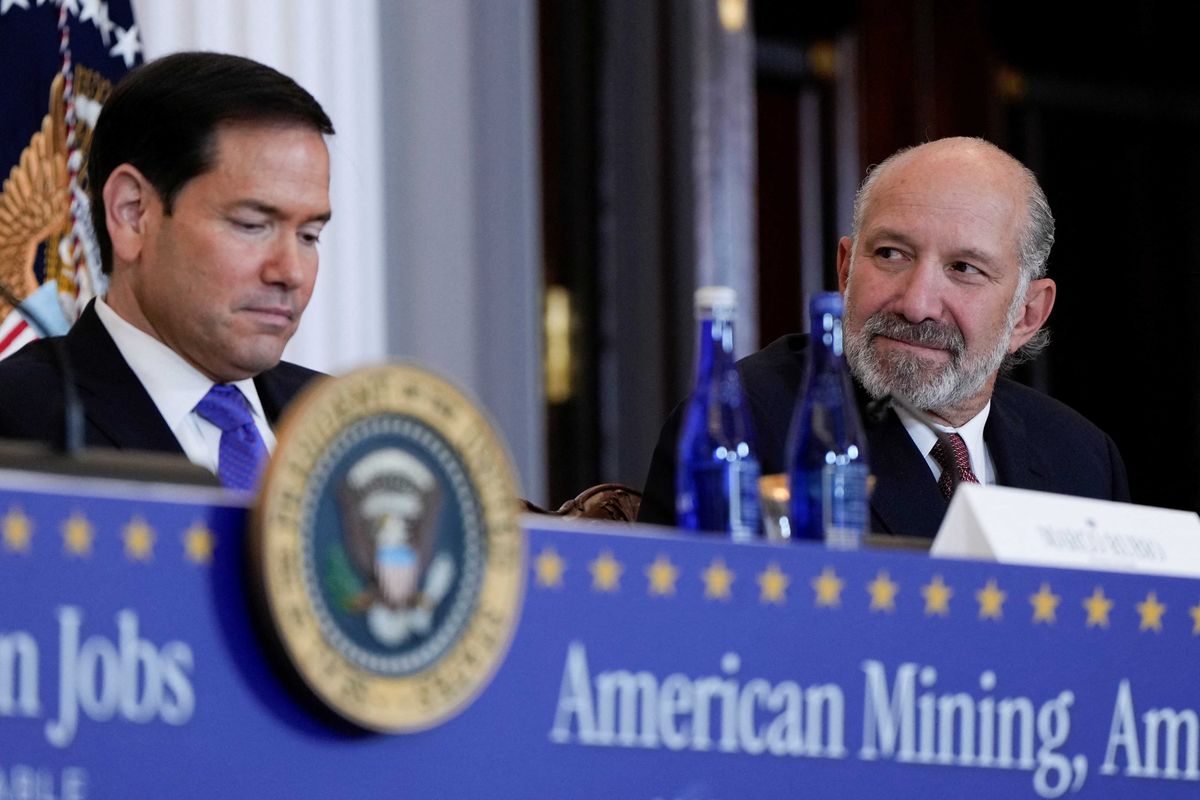
U.S. Secretary of State Marco Rubio and Secretary of Commerce Howard Lutnick attend an American Mining Industry Roundtable at the U.S. Department of State in Washington, D.C., U.S., August 7, 2026. REUTERS/Elizabeth Frantz
Buried within President Donald Trump’s unprecedented oil deal with Venezuela is a provision designed to exert a level of control over the South American company for 100 years, the Wall Street Journal exclusively reported Saturday night.
Announced on Friday, the deal will see the United States be granted rights to Venezuela’s untapped oil fields for a century. Furthermore, the U.S. government would take a direct stake in Venezuela's oil reserves, the single-largest proven oil reserves on earth.
According to “people involved in negotiating the agreement” who spoke with the Journal on the condition of anonymity, the U.S. government “plans to take a 35% passive stake” in North American Blue Energy Partners, a private oil-and-gas company led by controversial Venezuelan businessman Alejandro Betancourt. The company’s structure was also set up in such a way as to tie the hands of future Venezuelan governments.
“The private company structure was deliberately intended to bind future Venezuelan governments to the agreement and make it difficult to unwind, one of the people involved said,” the Journal’s report reads. “They consider it unlikely that a new government would expropriate a private company, the people said.”
Trump has faced bi-partisan scrutiny over the deal since announcing it on Friday, including from one of the chief supporters of his operation to kidnap Venezuelan President Nicolás Maduro, Rep. Maria Elvira Salazar (R-FL), who slammed the deal in a social media post before quickly deleting it.
Venezuelans have been critical of the deal as well.
“It’s an operation that’s absolutely unconstitutional because it’s an illegitimate government,” said Diego Arria, a former Venezuelan cabinet minister, speaking with the Journal. “They are seizing [the oil] — there’s no other word for it.”
U.S. Secretary of State Marco Rubio and Secretary of Commerce Howard Lutnick attend an American Mining Industry Roundtable at the U.S. Department of State in Washington, D.C., U.S., August 7, 2026. REUTERS/Elizabeth Frantz
Buried within President Donald Trump’s unprecedented oil deal with Venezuela is a provision designed to exert a level of control over the South American company for 100 years, the Wall Street Journal exclusively reported Saturday night.
Announced on Friday, the deal will see the United States be granted rights to Venezuela’s untapped oil fields for a century. Furthermore, the U.S. government would take a direct stake in Venezuela's oil reserves, the single-largest proven oil reserves on earth.
According to “people involved in negotiating the agreement” who spoke with the Journal on the condition of anonymity, the U.S. government “plans to take a 35% passive stake” in North American Blue Energy Partners, a private oil-and-gas company led by controversial Venezuelan businessman Alejandro Betancourt. The company’s structure was also set up in such a way as to tie the hands of future Venezuelan governments.
“The private company structure was deliberately intended to bind future Venezuelan governments to the agreement and make it difficult to unwind, one of the people involved said,” the Journal’s report reads. “They consider it unlikely that a new government would expropriate a private company, the people said.”
Trump has faced bi-partisan scrutiny over the deal since announcing it on Friday, including from one of the chief supporters of his operation to kidnap Venezuelan President Nicolás Maduro, Rep. Maria Elvira Salazar (R-FL), who slammed the deal in a social media post before quickly deleting it.
Venezuelans have been critical of the deal as well.
“It’s an operation that’s absolutely unconstitutional because it’s an illegitimate government,” said Diego Arria, a former Venezuelan cabinet minister, speaking with the Journal. “They are seizing [the oil] — there’s no other word for it.”
No comments:
Post a Comment