Overflowing Bins in Bethlehem Tell a Bigger Story
They are telling the story of a city under pressure, a story of institutions struggling to maintain essential services, a story of workers trying to do their jobs under increasingly difficult circumstances.
They are telling the story of a city under pressure, a story of institutions struggling to maintain essential services, a story of workers trying to do their jobs under increasingly difficult circumstances.
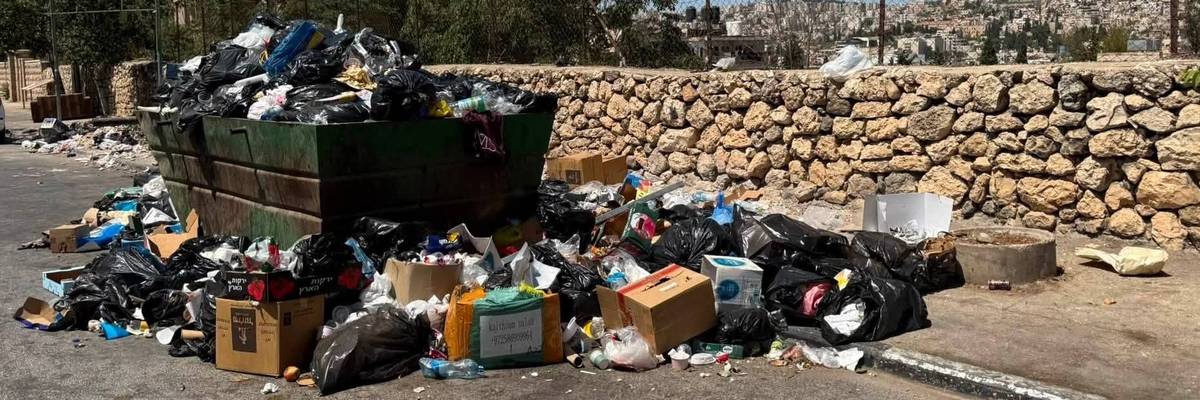
A waste collection point overflows in Bethlehem.
(Photo by Mahmoud Ibrahim)
Mahmoud Ibrahim
Aug 23, 2026
Common Dreams
The world knows Bethlehem as the city of the Nativity. It is a city of churches, olive groves, ancient stone streets, and a history that attracts pilgrims and visitors from across the globe. For many, Bethlehem symbolizes peace, hope, and human resilience.
Yet in recent weeks, another image has emerged. Overflowing garbage containers. Piles of waste left uncollected for days. Unpleasant odors drifting through neighborhoods. Stray dogs searching through torn plastic bags. Flies, rodents, and growing public concern about health and sanitation.
For residents, these scenes are disturbing. For visitors, they are difficult to reconcile with the image of one of the world’s most recognized and beloved cities. But the garbage accumulating in Bethlehem’s streets is not the real story. It is merely the most visible symptom of a much larger crisis. The question is not why a container is overflowing. The question is what happened to the system behind it.
At first glance, it may seem like a simple municipal problem. A shortage of fuel. A broken truck. Workers on strike. Delayed collection rounds. The reality is far more complicated.
The environment does not understand politics. It understands only what we do—or fail to do—to protect it.
Waste management depends on an entire chain of institutions, workers, vehicles, roads, fuel supplies, disposal facilities, municipal revenues, and public cooperation. When enough pressure is placed on that chain, it begins to break. And in Bethlehem, pressure has been building for years.
The city has suffered repeated economic shocks. The tourism sector, once a major source of income, was devastated by the Covid-19 pandemic. Before it could fully recover, the war and the broader economic crisis brought new hardships. Businesses struggled. Workers lost jobs. Household incomes declined. Many families found themselves prioritizing food, rent, and basic necessities over municipal fees.
As revenues declined, local institutions found it increasingly difficult to sustain essential services. At the same time, operational costs continued to rise. Fuel became more expensive and, at times, harder to secure. Vehicles required maintenance. Equipment aged. Service providers struggled to balance growing needs with shrinking resources.
The crisis does not stop there.
Road closures, military gates, and movement restrictions have increasingly complicated daily life throughout Bethlehem Governorate. What should be a routine collection route can suddenly become longer, slower, or more expensive. A delayed truck today may become an overflowing container tomorrow.
Even the final destination of the waste is not immune from these pressures.
The Al-Minya landfill, which serves communities in southern parts of the West Bank, represents a critical component of the region’s waste management system. Any disruption affecting access, transportation, security, or operations along this chain eventually reaches the streets of Bethlehem and surrounding communities.
The result is a problem that residents experience every day. A container left uncollected. A street corner filled with waste. A smell that lingers in the summer heat. A growing sense that something is no longer working as it should.
When waste accumulates, the consequences extend beyond appearance.
Overflowing garbage attracts stray dogs, insects, rodents, and other disease vectors. It increases environmental risks and can create fire hazards during hot weather. It affects public health, community well-being, and the quality of life in neighborhoods already facing multiple challenges.
This is why waste management should never be viewed as a secondary service. It is not simply about removing garbage from the street. It is about protecting public health. It is about preserving human dignity. It is about maintaining the environmental quality of cities and communities. It is also about protecting the people who perform this difficult work.
One night, at around 2:00 am in the morning, I drove into Bethlehem to take my wife to catch an early bus to Allenby Bridge Boarder with Jordan. While most of the city slept, sanitation workers were already on the streets. Wearing reflective orange uniforms, they swept roads, emptied containers, and loaded waste onto trucks. Few residents would ever see them. By sunrise, most traces of their work would have disappeared.
Their presence reminded me that waste management is not an abstract system. It depends on real people working under difficult conditions, often exposed to hazards that most citizens never think about.
But workers alone cannot solve this crisis, neither can municipalities, nor can citizens. Responsibility is shared.
Citizens must reduce the waste they generate, support cleaner public spaces, and contribute to the sustainability of essential services whenever possible.
Municipalities and service providers need stronger planning, better resource management, and long-term financial stability.
National institutions must support local governments struggling under extraordinary economic and political pressures.
And international partners should recognize that environmental services are not luxuries. They are fundamental to public health, social stability, and human dignity.
There is another reason this issue deserves greater attention. Pollution does not recognize borders. Smoke from burning waste does not stop at a checkpoint. Contaminated water does not respect political divisions. Air pollution travels wherever the wind takes it.
The environment does not understand politics. It understands only what we do—or fail to do—to protect it. That is why environmental protection requires cooperation, shared responsibility, and long-term vision.
Bethlehem does not simply need more garbage trucks or more containers. It needs investment in sustainable solutions. It needs stronger institutions. It needs public awareness. It needs serious efforts to reduce waste generation, expand reuse and recycling, and create economic opportunities through a circular economy approach.
Most importantly, it needs recognition that environmental challenges are not isolated technical problems. They are deeply connected to economic conditions, governance, public services, and the daily lives of ordinary people.
The overflowing containers seen today across Bethlehem are telling a much bigger story. They are telling the story of a city under pressure, a story of institutions struggling to maintain essential services, a story of workers trying to do their jobs under increasingly difficult circumstances, a story of economic hardship, environmental vulnerability, and a community searching for sustainable solutions.
And perhaps they are also reminding us of something simple: Garbage does not appear overnight. Neither do environmental crises. Both are the result of problems left unresolved for too long.
If Bethlehem is to remain the beautiful city that the world knows and cherishes, addressing those problems can no longer wait.
Our work is licensed under Creative Commons (CC BY-NC-ND 3.0). Feel free to republish and share widely.
Mahmoud Ibrahim
Mahmoud Ibrahim is a Palestinian humanitarian and environmental professional based in the Bethlehem area of the occupied West Bank, Palestine.
Full Bio >
The world knows Bethlehem as the city of the Nativity. It is a city of churches, olive groves, ancient stone streets, and a history that attracts pilgrims and visitors from across the globe. For many, Bethlehem symbolizes peace, hope, and human resilience.
Yet in recent weeks, another image has emerged. Overflowing garbage containers. Piles of waste left uncollected for days. Unpleasant odors drifting through neighborhoods. Stray dogs searching through torn plastic bags. Flies, rodents, and growing public concern about health and sanitation.
For residents, these scenes are disturbing. For visitors, they are difficult to reconcile with the image of one of the world’s most recognized and beloved cities. But the garbage accumulating in Bethlehem’s streets is not the real story. It is merely the most visible symptom of a much larger crisis. The question is not why a container is overflowing. The question is what happened to the system behind it.
At first glance, it may seem like a simple municipal problem. A shortage of fuel. A broken truck. Workers on strike. Delayed collection rounds. The reality is far more complicated.
The environment does not understand politics. It understands only what we do—or fail to do—to protect it.
Waste management depends on an entire chain of institutions, workers, vehicles, roads, fuel supplies, disposal facilities, municipal revenues, and public cooperation. When enough pressure is placed on that chain, it begins to break. And in Bethlehem, pressure has been building for years.
The city has suffered repeated economic shocks. The tourism sector, once a major source of income, was devastated by the Covid-19 pandemic. Before it could fully recover, the war and the broader economic crisis brought new hardships. Businesses struggled. Workers lost jobs. Household incomes declined. Many families found themselves prioritizing food, rent, and basic necessities over municipal fees.
As revenues declined, local institutions found it increasingly difficult to sustain essential services. At the same time, operational costs continued to rise. Fuel became more expensive and, at times, harder to secure. Vehicles required maintenance. Equipment aged. Service providers struggled to balance growing needs with shrinking resources.
The crisis does not stop there.
Road closures, military gates, and movement restrictions have increasingly complicated daily life throughout Bethlehem Governorate. What should be a routine collection route can suddenly become longer, slower, or more expensive. A delayed truck today may become an overflowing container tomorrow.
Even the final destination of the waste is not immune from these pressures.
The Al-Minya landfill, which serves communities in southern parts of the West Bank, represents a critical component of the region’s waste management system. Any disruption affecting access, transportation, security, or operations along this chain eventually reaches the streets of Bethlehem and surrounding communities.
The result is a problem that residents experience every day. A container left uncollected. A street corner filled with waste. A smell that lingers in the summer heat. A growing sense that something is no longer working as it should.
When waste accumulates, the consequences extend beyond appearance.
Overflowing garbage attracts stray dogs, insects, rodents, and other disease vectors. It increases environmental risks and can create fire hazards during hot weather. It affects public health, community well-being, and the quality of life in neighborhoods already facing multiple challenges.
This is why waste management should never be viewed as a secondary service. It is not simply about removing garbage from the street. It is about protecting public health. It is about preserving human dignity. It is about maintaining the environmental quality of cities and communities. It is also about protecting the people who perform this difficult work.
One night, at around 2:00 am in the morning, I drove into Bethlehem to take my wife to catch an early bus to Allenby Bridge Boarder with Jordan. While most of the city slept, sanitation workers were already on the streets. Wearing reflective orange uniforms, they swept roads, emptied containers, and loaded waste onto trucks. Few residents would ever see them. By sunrise, most traces of their work would have disappeared.
Their presence reminded me that waste management is not an abstract system. It depends on real people working under difficult conditions, often exposed to hazards that most citizens never think about.
But workers alone cannot solve this crisis, neither can municipalities, nor can citizens. Responsibility is shared.
Citizens must reduce the waste they generate, support cleaner public spaces, and contribute to the sustainability of essential services whenever possible.
Municipalities and service providers need stronger planning, better resource management, and long-term financial stability.
National institutions must support local governments struggling under extraordinary economic and political pressures.
And international partners should recognize that environmental services are not luxuries. They are fundamental to public health, social stability, and human dignity.
There is another reason this issue deserves greater attention. Pollution does not recognize borders. Smoke from burning waste does not stop at a checkpoint. Contaminated water does not respect political divisions. Air pollution travels wherever the wind takes it.
The environment does not understand politics. It understands only what we do—or fail to do—to protect it. That is why environmental protection requires cooperation, shared responsibility, and long-term vision.
Bethlehem does not simply need more garbage trucks or more containers. It needs investment in sustainable solutions. It needs stronger institutions. It needs public awareness. It needs serious efforts to reduce waste generation, expand reuse and recycling, and create economic opportunities through a circular economy approach.
Most importantly, it needs recognition that environmental challenges are not isolated technical problems. They are deeply connected to economic conditions, governance, public services, and the daily lives of ordinary people.
The overflowing containers seen today across Bethlehem are telling a much bigger story. They are telling the story of a city under pressure, a story of institutions struggling to maintain essential services, a story of workers trying to do their jobs under increasingly difficult circumstances, a story of economic hardship, environmental vulnerability, and a community searching for sustainable solutions.
And perhaps they are also reminding us of something simple: Garbage does not appear overnight. Neither do environmental crises. Both are the result of problems left unresolved for too long.
If Bethlehem is to remain the beautiful city that the world knows and cherishes, addressing those problems can no longer wait.
Our work is licensed under Creative Commons (CC BY-NC-ND 3.0). Feel free to republish and share widely.
Mahmoud Ibrahim
Mahmoud Ibrahim is a Palestinian humanitarian and environmental professional based in the Bethlehem area of the occupied West Bank, Palestine.
Full Bio >
The abuses by the Israeli government and military are “a stain on the conscience of humanity, requiring the UK and France to act.”
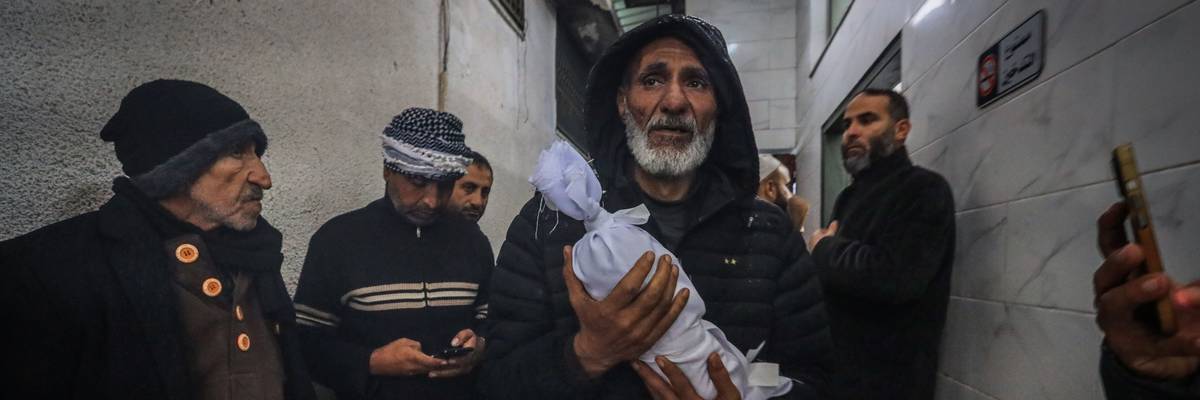
Palestinians mourn for a three-month-old baby named Tim El Khavaja, who lived in a tent in the Shati Camp lost his life due to cold weather conditions in northern Gaza Strip, Gaza on December 12, 2025. The body of the baby was brought to Al-Shifa Hospital in Gaza City for funeral arrangements.
(Photo by Hamza Z. H. Qraiqea/Anadolu via Getty Images)
Jon Queally
Aug 23, 2026
COMMON DREAMS
While critics of the French and British governments say they are doing too little to confront the crimes and human rights violations of Israel against the Palestinian people, about 100 former diplomats of the two nations penned an open letter published over the weekend agreeing that much stronger actions must be taken to end the atrocities taking place in both the Gaza Strip and Occupied West Bank.
Published in Le Monde on Saturday, the joint op-ed by the former UK and French ambassadors and foreign diplomats argues that because their two nations “played a decisive role in the shaping of the Middle East,” it is incumbent upon them to “make common cause over the region’s fundamental faultline: equal rights for Israelis and Palestinians”—a dynamic grossly lacking as Palestinians are starved and bombed in Gaza, with their rights endlessly under assault in the West Bank.
According to the letter:
In Gaza, two million Palestinians are kettled into 30% of their devastated land, hungry, lacking medicine and housing. Over 1,200 Palestinians have been killed since the so-called “ceasefire” of October 2025. In East Jerusalem and the rest of the West Bank, Palestinian house demolitions and rampant settler violence—with the connivance of the Israeli army and police—amount to ethnic cleansing. Palestine is being erased before our eyes.
This policy of occupation and destruction extends to Lebanon—where many villages have been razed—and Syria. It is a stain on the conscience of humanity, requiring the UK and France to act.
While human rights groups have steadfastly demanded accountability for Israel—including tougher sanctions, suspension of trade agreements, a halt to weapons transfers, and enforcement of rulings by the International Court of Justice (ICJ) and proceedings at the International Criminal Court—for its ongoing criminal behavior against the Palestinians, European governments, the United States, and other western allies have resisted such calls.
While noting that much can be done to help Palestine become “a fully functioning democratic nation,” the letter from the former diplomats makes a call for seven specific action designed to end Israeli impunity and bring the government back into compliance with international law. The policy recommendations directed at the UK and French governments are:Uphold the decisions of the International Court of Justice and the International Criminal Court;
Suspend the EU-Israel Association Agreement and the UK-Israel Trade and Partnership Agreement for breach of human rights provisions;
Suspend arms transfers to and from Israel and all bilateral military cooperation;
Insist on unrestricted aid access to Gaza, led by UNRWA, other UN agencies and international NGOs, with consequences for non-compliance; access too for journalists, diplomats and parliamentarians;
Ban all trade with settlements, including goods, investment, insurance and other financial services;
Warn potential bidders for the red-line “E1” area [east of Jerusalem, in the occupied territories] or other settlement financing/construction that their interests in and with our countries will suffer;
Make it an offense for our citizens to buy property on stolen Palestinian land and remove charitable status from “charities” funding settlements.
Nicholas Hopton, a former UK ambassador to Iran, Qatar and Yemen and one of the signatories of the letter, said that the language they used was not invented by the diplomats themselves.
“The words are not our own,” Hopton explained to Al Jazeera. “They are taken from the international legal bodies, the UN, those who have been observing from a neutral position and with expertise.”
What’s key to understand, said Peter Millett, a former British ambassador to Libya who also signed the letter, is that what the signatories are asking for “is action, not words.”
Foreign ministers of the France and Britia “over the last few months and years have issued statements of criticism, of condemnation and so forth,” Millett told Al-Jazeera, “but as the letter makes clear, this is the time now where we need to see action on trade, action on settlements, more support for aid to go into Gaza, and the ending of the arms trade.”
At the heart of the letter is the idea that world leaders, whether in Europe or elsewhere, must now act aggressively to bring the suffering of the Palestinians to an end and bring Israel’s violations and abuses to a halt.
"These proposals reflect our shared values—international law and equal rights—which are in our interest," the letter concludes. "Where there is no law, none of us is safe."
Aug 23, 2026
COMMON DREAMS
While critics of the French and British governments say they are doing too little to confront the crimes and human rights violations of Israel against the Palestinian people, about 100 former diplomats of the two nations penned an open letter published over the weekend agreeing that much stronger actions must be taken to end the atrocities taking place in both the Gaza Strip and Occupied West Bank.
Published in Le Monde on Saturday, the joint op-ed by the former UK and French ambassadors and foreign diplomats argues that because their two nations “played a decisive role in the shaping of the Middle East,” it is incumbent upon them to “make common cause over the region’s fundamental faultline: equal rights for Israelis and Palestinians”—a dynamic grossly lacking as Palestinians are starved and bombed in Gaza, with their rights endlessly under assault in the West Bank.
According to the letter:
In Gaza, two million Palestinians are kettled into 30% of their devastated land, hungry, lacking medicine and housing. Over 1,200 Palestinians have been killed since the so-called “ceasefire” of October 2025. In East Jerusalem and the rest of the West Bank, Palestinian house demolitions and rampant settler violence—with the connivance of the Israeli army and police—amount to ethnic cleansing. Palestine is being erased before our eyes.
This policy of occupation and destruction extends to Lebanon—where many villages have been razed—and Syria. It is a stain on the conscience of humanity, requiring the UK and France to act.
While human rights groups have steadfastly demanded accountability for Israel—including tougher sanctions, suspension of trade agreements, a halt to weapons transfers, and enforcement of rulings by the International Court of Justice (ICJ) and proceedings at the International Criminal Court—for its ongoing criminal behavior against the Palestinians, European governments, the United States, and other western allies have resisted such calls.
While noting that much can be done to help Palestine become “a fully functioning democratic nation,” the letter from the former diplomats makes a call for seven specific action designed to end Israeli impunity and bring the government back into compliance with international law. The policy recommendations directed at the UK and French governments are:Uphold the decisions of the International Court of Justice and the International Criminal Court;
Suspend the EU-Israel Association Agreement and the UK-Israel Trade and Partnership Agreement for breach of human rights provisions;
Suspend arms transfers to and from Israel and all bilateral military cooperation;
Insist on unrestricted aid access to Gaza, led by UNRWA, other UN agencies and international NGOs, with consequences for non-compliance; access too for journalists, diplomats and parliamentarians;
Ban all trade with settlements, including goods, investment, insurance and other financial services;
Warn potential bidders for the red-line “E1” area [east of Jerusalem, in the occupied territories] or other settlement financing/construction that their interests in and with our countries will suffer;
Make it an offense for our citizens to buy property on stolen Palestinian land and remove charitable status from “charities” funding settlements.
Nicholas Hopton, a former UK ambassador to Iran, Qatar and Yemen and one of the signatories of the letter, said that the language they used was not invented by the diplomats themselves.
“The words are not our own,” Hopton explained to Al Jazeera. “They are taken from the international legal bodies, the UN, those who have been observing from a neutral position and with expertise.”
What’s key to understand, said Peter Millett, a former British ambassador to Libya who also signed the letter, is that what the signatories are asking for “is action, not words.”
Foreign ministers of the France and Britia “over the last few months and years have issued statements of criticism, of condemnation and so forth,” Millett told Al-Jazeera, “but as the letter makes clear, this is the time now where we need to see action on trade, action on settlements, more support for aid to go into Gaza, and the ending of the arms trade.”
At the heart of the letter is the idea that world leaders, whether in Europe or elsewhere, must now act aggressively to bring the suffering of the Palestinians to an end and bring Israel’s violations and abuses to a halt.
"These proposals reflect our shared values—international law and equal rights—which are in our interest," the letter concludes. "Where there is no law, none of us is safe."
No comments:
Post a Comment