The Museum of the Bible is offering a Christian nationalist vision of America’s past
(RNS) — The Museum of the Bible seeks to unite people of faith from various life experiences and convince them that modern political efforts to ‘reestablish’ a Christian America are rooted in America's founding.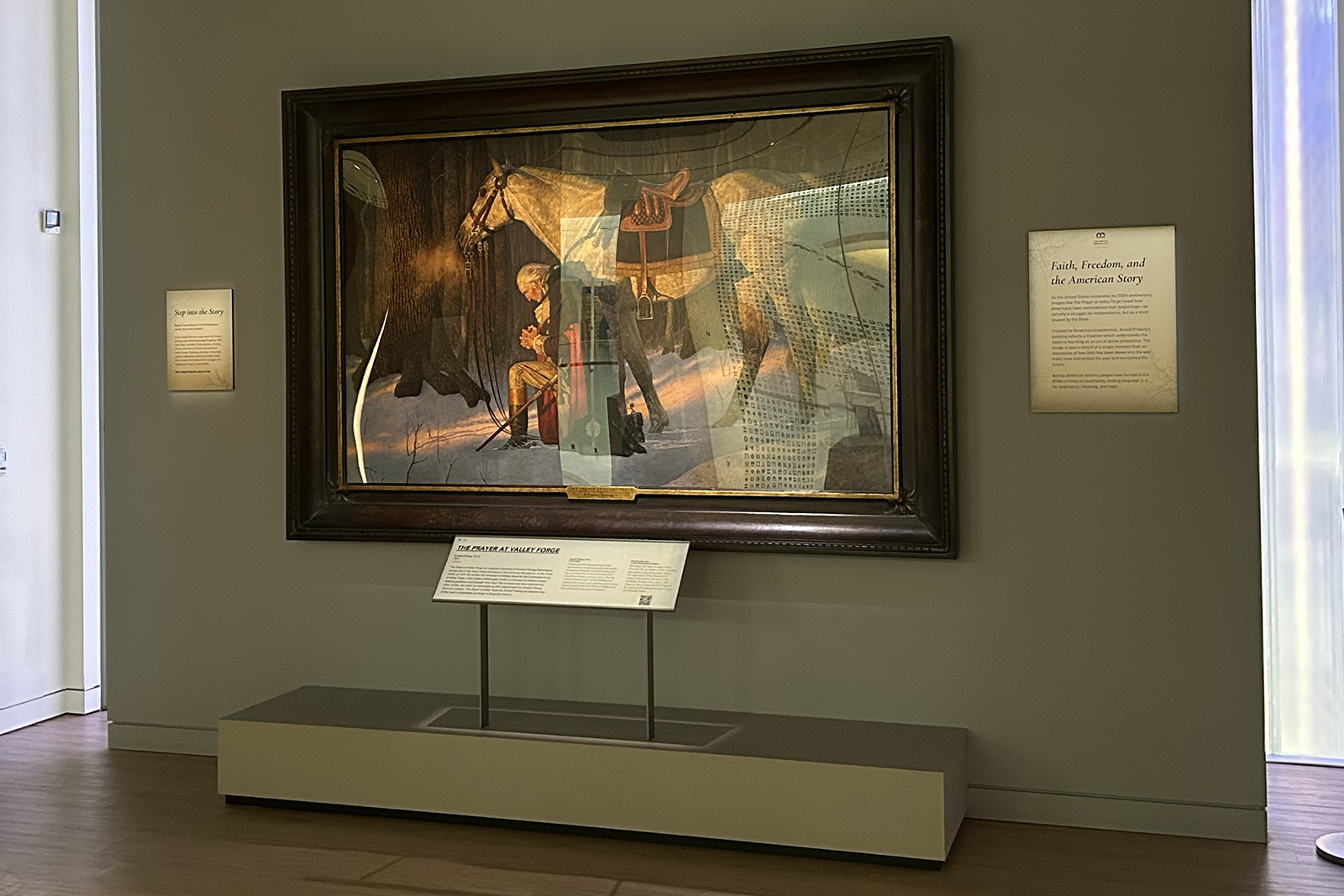 “The Prayer at Valley Forge” (1975) by Arnold Friberg on display at the Museum of the Bible in July 2026. (Photo by Emma Cieslik)
(RNS) — Much attention has been paid to the Trump administration’s ongoing attacks on the Smithsonian museums and on American history generally, attacks that have included, but are not limited to, the removal of signs about slavery, the reinstallation of the statue of a Confederate general in Washington and, most recently this summer, a new executive order mandating that the Smithsonian install signs outside of museum buildings “warning visitors about the ideological capture at the National Museum of American History.”
What is less well known is that alongside their claims that the Smithsonian’s Museum of American History promotes “extreme political activism,” Trump and his allies are simultaneously using the nearby “Museum of the Bible” located just yards from the Smithsonian museums on the National Mall to legitimize an alternate Christian nationalist history of America.
Just under a year ago, Trump spoke at the Museum of the Bible, praising its founders, Steve and Jackie Green, for creating a “museum to honor the most widely read book in history.” Trump even went on to say that “the Museum of the Bible had more come here than anywhere else.” Although his syntax is confusing, what Trump appears to be claiming is that the Museum of the Bible attracts more visitors than the neighboring Smithsonian and other DC-based museums, a claim that is false.
This summer, as people flocked to the capital to celebrate America’s 250th anniversary, the Museum of the Bible offered visitors a simultaneous and coordinated “museum experience” designed to pair with and augment Rededicate 250 and The Great American State Fair. The Museum of the Bible’s deliberate attempt to both capitalize on the 250th anniversary and offer its own alternative history is clear from the website’s landing page, which reads: “Award-winning and endlessly surprising, Museum of the Bible sits just three blocks from the US Capitol and offers something for everyone: rare artifacts spanning 4,000 years, immersive experiences that bring the biblical narrative to life, and conversations that will change how you see American history.”
On July 3, the Museum of the Bible debuted its new exhibit, “Sacred Liberty,” which “highlight(s) individuals whose lives were impacted by the Bible throughout American history—both historically influential figures and everyday Americans,” and “showcase(s) the ways these individuals used the Bible, (drawing out) themes related to the Bible in foundational and influential American documents.”
Prior to opening this exhibit, (which is free to the public compared to the regular $35 fee for adults), the Museum of the Bible also unveiled an updated version of its flagship exhibition, “The Impact of the Bible,” now retitled “The Bible in America,” along with a brand-new exhibit, entitled “The Bible in Times of War.” Taken together, these exhibits provide an important window into the pseudo-historic world, which Christian nationalists would ideally like to implement in lieu of the complex version of American history preserved and presented by the Smithsonian.
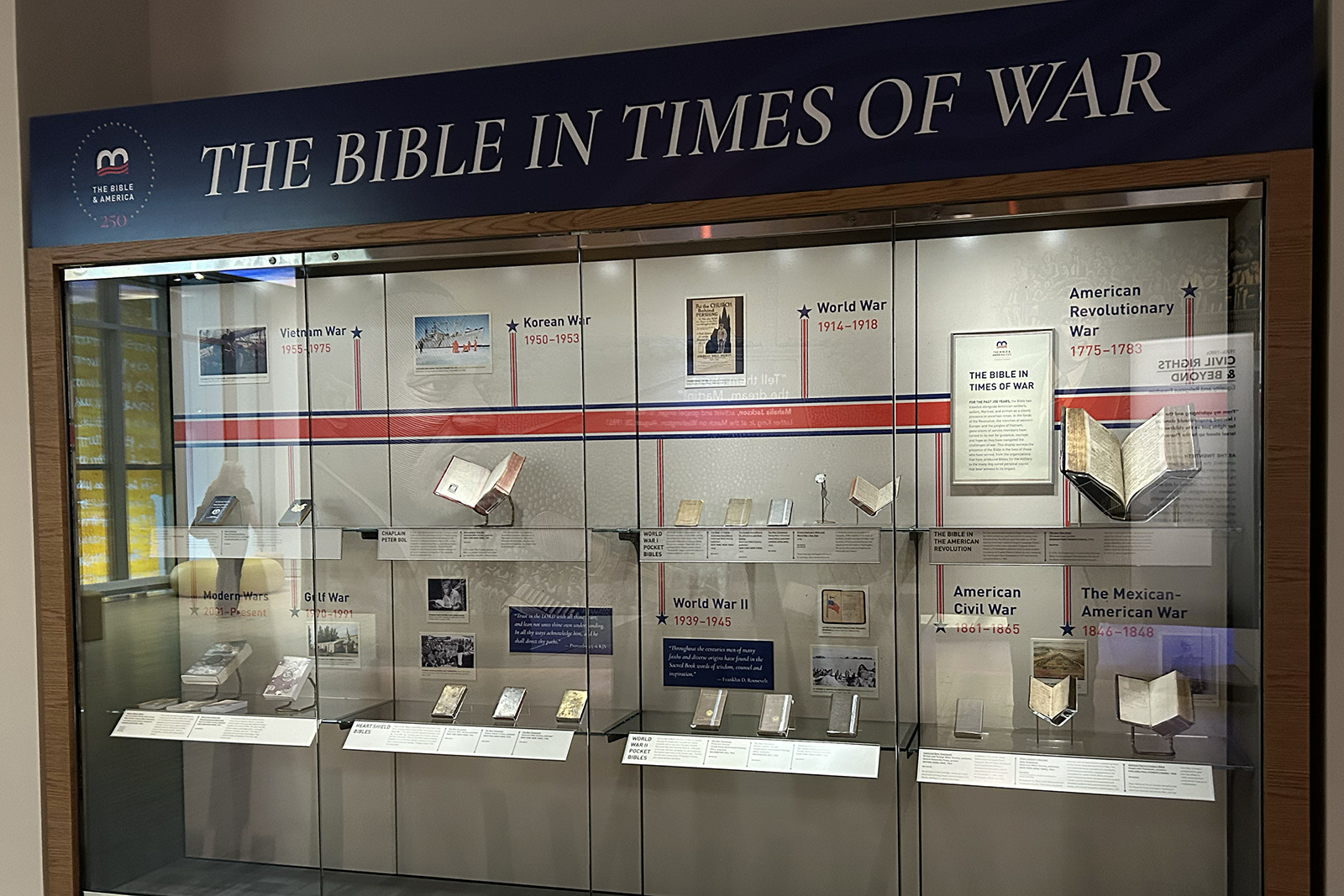
“The Bible in Times of War” exhibit at the Museum of the Bible in July 2026. (Photo by Emma Cieslik)
In these exhibits, the Museum of the Bible purports that not only was America founded as a Christian nation, but that the idea of a democratic republic was somehow foretold in the Bible itself. A label exploring “Monarchy and the Bible” states that “the Bible’s notion of kingship under a higher law represents an early chapter in the history of limited government and constitutional thought.” This claim would seem to be an attempt to de-emphasize American democracy in favor of the notion of a strong executive leader whose role is to consolidate religio-political power.
In another exhibit on the Declaration of Independence, a label describes the Bible as the “spiritual framework” of the burgeoning republic. This overarching claim becomes especially glaring with the display of Arnold Friberg’s “The Prayer at Valley Forge” (1975) at the start of the exhibit. Today, historians recognize that the story of George Washington kneeling in the snow was merely legend, yet the Museum of the Bible situates it next to a label that reads, “Friberg’s painting reflects a tradition which understands the nation’s founding as an act of divine providence.”
The label, titled “Faith, Freedom, and the American Story,” frames the Museum of the Bible’s renovation as a critical historical exercise: “As the United States celebrates its 250th anniversary, images like The Prayer at Valley Forge reveal how Americans have remembered their beginnings — not only a struggle for independence, but as a story shaped by the Bible.”
Another label goes so far as to explain how the Bible informed the constitutional delegates’ creation of founding documents, reading:
“The Declaration’s signers were steeped in the Bible. They heard it preached in church and they read it at home. Its teachings permeated their lives. As young men they also studied Enlightenment philosophy and were inspired by its ideals. The Declaration of Independence is a product of these influences. It marks the birth of American liberty and expresses the foundational belief that our rights come not from the state but from our ‘Creator.’”
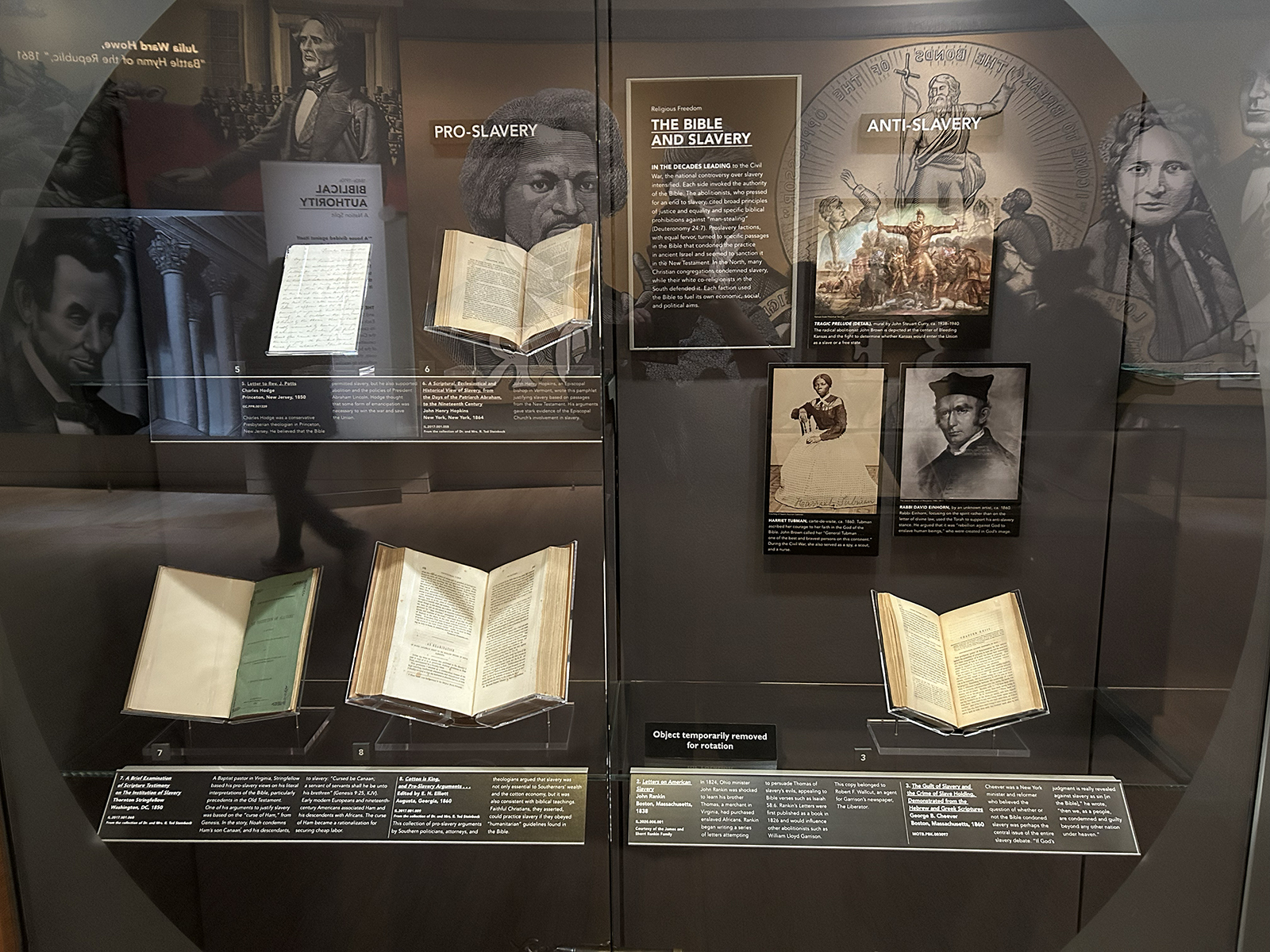
An exhibit about the Bible and slavery at the Museum of the Bible in July 2026. (Photo by Emma Cieslik)
The paternalistic idea that marginalized groups found justification for their rights in the Bible’s influence and presence in America’s founding documents repeats throughout the exhibition, with one panel explaining that, “though the Founders’ view of rights fully applied only to white male property holders, it opened a path for other groups who would fight for their own rights in future generations.” In sections exploring the arguments for and against abolition, women’s suffrage and civil rights, the museum reframes all liberation movements as developments out of a biblical form of Protestant Christianity. While Christianity was a significant influence in the lives of many American leaders, reframing American history as inherently tied to the Bible is both inaccurate and misleading.
What is happening here is more than an issue of competing historical emphases or differences in interpretation. The Museum of the Bible, with the support of the Trump administration and its allies, is appropriating the familiar material aspects of museums (signage, interactive displays, artifacts) along with the very term “museum” in order to present a predetermined and Christianized version of American identity.
The Museum of the Bible has an a priori set of conclusions (“From America’s earliest days, no text has left a deeper mark on the nation’s ideals, laws and culture than the Bible”), which means there is really no opportunity for the kind of critical engagement or narrative questioning that authentic history entails. This approach is not so different from what the Creation Museum in Kentucky has been doing for decades — that is, taking what looks superficially like a museum and using it not to invite questions and engagement but to funnel visitors into predetermined conclusions about both the nation and the world.
Of course, museums have never been neutral spaces. Historically, they have been used by colonial and fascist leaders to define national identity, promote racial superiority and marginalize some groups while centering others. In recent years, many museums, such as the Museum of Us, the Peabody Museum of Archaeology, as well as the Smithsonian’s many museums, have begun reframing and addressing these wrongs and facing them headlong. This process involves repatriating objects that were stolen or obtained under duress and also challenging the segregation, exoticization and racist display of Black and Brown peoples and their bodies in museum galleries. The Museum of the Bible is at the heart of this work, given that it has been involved in the looting and illegal smuggling of objects out of Iraq (which it is now returning).
But beyond repatriating objects back to descendant communities, museums are just beginning to confront the ways in which its curatorial work and collecting also fed into Christian nationalist frameworks. In exhibits that fetishized people of color, museums also exoticized non-Christian religious beliefs, using objects (many of which were collected by white people on evangelization missions) to argue that these spiritual systems were “primitive” compared to European (and American) Christianity. The Museum of the Bible builds on the second part of this framework, arguing that an ideal America was envisioned by and built on the foundations of white Protestant Christianity.
In fact, later museums created by and under fascist governments also built on this model of cultural and religious classification and moralistic ordering. For example, museums during the fascist era in Italy were markedly simpler and showier, Beatrice Falcucci noted in her 2020 article, and these spaces, such as the Museo Archeologico, opened in June 1930, served as vital “construction sites” for the nation, tethering together Italian colonies and the homeland through displays that encouraged and exalted the outcome of empire. As Falcucci explained, one “interpretative key for navigating the museum was the harmony between colonised and colonizers.” Religion was also part of this. “The theme of the exhibition layout was the recurrence of the past within the present,” Falcucci continued. “There was also an attempt to emphasize the importance of Christian influences: so much so that there was a plan to house a Christian Museum in the adjacent former mosque.”
The Museum of the Bible does something strikingly similar in that it seeks to unite people of faith from various life experiences and convince them that modern political efforts to “reestablish” a Christian America are rooted in the very history of how America came to be. When neighboring museums like the Smithsonian present a more complicated picture of how Christianity not only emboldened but enabled colonial violence, segregation, slavery and discrimination, or one that challenges the idea that the Founding Fathers were all unequivocally Christian, the Museum of the Bible offers an easier, unified alternative, one where patriotism is likened to an unwavering belief in America’s white Protestant Christian origins.
When the administration officially praises the Museum of the Bible while the museum aligns its own marketing with the 250th celebrations (giving it the impression that it is officially approved or connected to the government), it creates yet another institution functioning to promote the well-being of, and faith in, a Christian nationalist state.
(Karen E. Park is an acquisitions editor at Broadleaf Books and a writer and historian of American Christianity whose work focuses on religion, politics and public life. She publishes the newsletter Ex Voto . Emma Cieslik is a queer, disabled religious scholar and museum worker based in Washington, D.C. The views expressed in this commentary do not necessarily reflect those of Religion News Service.)
Spiritual Politics
Oklahoma primary runoff answered a question about anti-Christian nationalism(RNS) — The answer shouldn't please church-state separationists.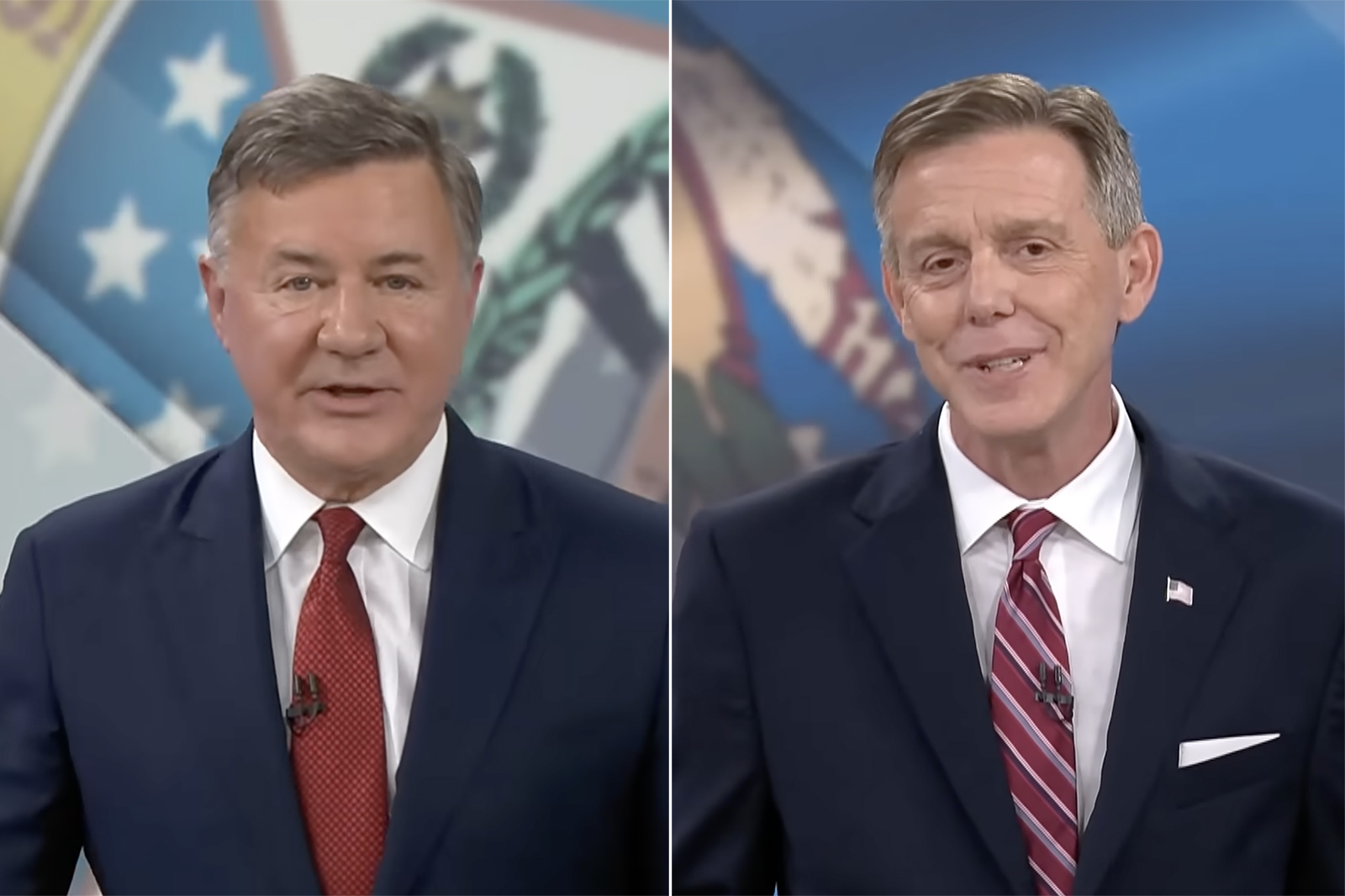
Oklahoma Attorney General Gentner Drummond, left, and former State Senator Mike Mazzei during an Oklahoma Republican gubernatorial primary runoff debate on August 3, 2026. (Video screen grabs)
Mark Silk
August 26, 2026 RNS
(RNS) — On Tuesday, Oklahoma Attorney General Gentner Drummond lost the state’s GOP gubernatorial primary to Trump-endorsed former state Senator and Budget Secretary Mike Mazzei by half a percentage point. For supporters of church-state separation, this is bad news.
Here’s why.
In the early 2020s, Oklahoma’s most prominent Christian nationalist was Ryan Walters, who served as Oklahoma’s appointed secretary of education from 2020 to 2023 and its elected superintendent of public instruction from 2023 to 2025. Walters’ most notable legacy as a public official was a mandate that required all of the state’s public schools to teach the Bible in grades five through 12.
To facilitate this, he undertook to purchase 55,000 copies of the King James Version of the Bible, one for each public-school classroom. He also issued an order to integrate the Bible and character education into elementary-level social studies curriculum and solicited bids for instructional materials to that end. After the 2024 election, he sent public school administrators an email requiring them to show students a video of a new Office of Religious Liberty and Patriotism, in which he prayed for President-elect Trump and declared that religious liberty had been attacked and patriotism mocked “by woke teachers unions.”
In response, a spokesman for Attorney General Drummond told CBS News, “Not only is this edict unenforceable, it is contrary to parents’ rights, local control and individual free-exercise rights.” The state Supreme Court, for its part, ordered Walters to halt his effort to purchase the Bibles, pending resolution of a lawsuit opposing the Bible education mandate. In a separate case, the court blocked implementation of the Bible-based social studies curriculum.
To understand the attorney general’s statement and the court’s actions, a little state constitutional history is in order.
When Oklahoma became a state in 1907, its constitution banned public material support for religion in no uncertain terms; to wit: “No public money or property shall ever be appropriated, applied, donated, or used, directly or indirectly, for the use, benefit, or support of any sect, church, denomination, or system of religion, or for the use, benefit, or support of any priest, preacher, minister, or other religious teacher or dignitary, or sectarian institution as such.” That sentence remains in the state constitution to this day, as Article II, Section 5.
Not that the GOP-dominated Legislature in Oklahoma City hasn’t tried to kill it off. That happened in 2016, after the state Supreme Court ruled that a law installing a Ten Commandments display at the state Capitol (Mazzei voting in the affirmative) violated Article II, Section 5. The solons of Oklahoma City (including Mazzei) struck back by voting to institute a public referendum to get rid of Article II, Section 5. By a margin of 57% to 43%, Oklahomans voted no.
Then, in 2023, the Oklahoma charter school board approved a contract with the Catholic Archdiocese of Oklahoma City and the Diocese of Tulsa to establish St. Isidore’s virtual charter school, which was intended to participate in “the evangelizing mission of the church.” Drummond filed an action to invalidate the contract, and in due course, the Oklahoma Supreme Court did just that, in a decision narrowly upheld by the U.S. Supreme Court.
In its decision, the Oklahoma court rejected the claim that Article II, Section 5 is a Blaine amendment, so-called after a failed U.S. constitutional amendment that resulted in some states banning public funding of parochial schools because of anti-Catholic prejudice. To the contrary, wrote the court, “Enforcing the St. Isidore Contract would create a slippery slope and what the framers warned against — the destruction of Oklahomans’ freedom to practice religion without fear of government intervention.”
“I think its genesis is in Christian nationalism,” Drummond told Politico’s Weekly Education newsletter. “There are believers that are confusing true religion — and religious liberty, and faith in God — with political power. And this Christian nationalism is the movement that is giving oxygen to this attempt to eviscerate the Establishment Clause.”
In October of 2025, Drummond, a decorated Air Force combat pilot and a rancher from an old Oklahoma family, announced his candidacy for the governorship. In due course Mazzei did as well, and the two finished one and two respectively in the GOP primary, resulting in Tuesday’s runoff.
In their televised debate earlier this month, they were asked whether they “support using taxpayer dollars to fund religious education.” “This is one of the big differences between Drummond and myself,” Mazzei said, going on to pretend that the Charter board’s appeal to the U.S. Supreme Court was somehow a lawsuit by Drummond against the federal government.
“Drummond sued against the Trump administration to shut down an Oklahoma religious charter school,” Mazzei said. “He does like being the darling of the liberal teachers unions.”
In his response, Drummond was political enough to insert some Islamophobia, alluding to the UAE’s investment in a controversial $4 billion aluminum smelter — backed by both Trump and Mazzei — as well as implying that Mazzei’s support for religious charter schools in general would mean permitting Muslim ones:
I took an oath in January of 2023 to uphold the federal constitution and the Oklahoma constitution, and the Oklahoma constitution leaves no ambiguity: we shall not fund any religious school. Now Mr. Mazzei is supporting the Muslim monarchy, (and) we can anticipate will also support Sharia schools. I stood between that and the freedom to worship god when you wish with whom you wish and how you wish.
To which Mazzei replied, “Part of the reason President Trump supports me is he knows I will ban Sharia law in the state of Oklahoma and designate the Muslim Brotherhood and the Council of American Islamic Relations as foreign terrorist organizations.”
When Drummond announced for the governorship, it remained to be seen whether an outspoken critic of Christian nationalism could win a Republican primary in so red a state as Oklahoma. The answer on Tuesday was, not quite.


(RNS) — Much attention has been paid to the Trump administration’s ongoing attacks on the Smithsonian museums and on American history generally, attacks that have included, but are not limited to, the removal of signs about slavery, the reinstallation of the statue of a Confederate general in Washington and, most recently this summer, a new executive order mandating that the Smithsonian install signs outside of museum buildings “warning visitors about the ideological capture at the National Museum of American History.”
What is less well known is that alongside their claims that the Smithsonian’s Museum of American History promotes “extreme political activism,” Trump and his allies are simultaneously using the nearby “Museum of the Bible” located just yards from the Smithsonian museums on the National Mall to legitimize an alternate Christian nationalist history of America.
Just under a year ago, Trump spoke at the Museum of the Bible, praising its founders, Steve and Jackie Green, for creating a “museum to honor the most widely read book in history.” Trump even went on to say that “the Museum of the Bible had more come here than anywhere else.” Although his syntax is confusing, what Trump appears to be claiming is that the Museum of the Bible attracts more visitors than the neighboring Smithsonian and other DC-based museums, a claim that is false.
This summer, as people flocked to the capital to celebrate America’s 250th anniversary, the Museum of the Bible offered visitors a simultaneous and coordinated “museum experience” designed to pair with and augment Rededicate 250 and The Great American State Fair. The Museum of the Bible’s deliberate attempt to both capitalize on the 250th anniversary and offer its own alternative history is clear from the website’s landing page, which reads: “Award-winning and endlessly surprising, Museum of the Bible sits just three blocks from the US Capitol and offers something for everyone: rare artifacts spanning 4,000 years, immersive experiences that bring the biblical narrative to life, and conversations that will change how you see American history.”
On July 3, the Museum of the Bible debuted its new exhibit, “Sacred Liberty,” which “highlight(s) individuals whose lives were impacted by the Bible throughout American history—both historically influential figures and everyday Americans,” and “showcase(s) the ways these individuals used the Bible, (drawing out) themes related to the Bible in foundational and influential American documents.”
Prior to opening this exhibit, (which is free to the public compared to the regular $35 fee for adults), the Museum of the Bible also unveiled an updated version of its flagship exhibition, “The Impact of the Bible,” now retitled “The Bible in America,” along with a brand-new exhibit, entitled “The Bible in Times of War.” Taken together, these exhibits provide an important window into the pseudo-historic world, which Christian nationalists would ideally like to implement in lieu of the complex version of American history preserved and presented by the Smithsonian.
“The Bible in Times of War” exhibit at the Museum of the Bible in July 2026. (Photo by Emma Cieslik)
In these exhibits, the Museum of the Bible purports that not only was America founded as a Christian nation, but that the idea of a democratic republic was somehow foretold in the Bible itself. A label exploring “Monarchy and the Bible” states that “the Bible’s notion of kingship under a higher law represents an early chapter in the history of limited government and constitutional thought.” This claim would seem to be an attempt to de-emphasize American democracy in favor of the notion of a strong executive leader whose role is to consolidate religio-political power.
In another exhibit on the Declaration of Independence, a label describes the Bible as the “spiritual framework” of the burgeoning republic. This overarching claim becomes especially glaring with the display of Arnold Friberg’s “The Prayer at Valley Forge” (1975) at the start of the exhibit. Today, historians recognize that the story of George Washington kneeling in the snow was merely legend, yet the Museum of the Bible situates it next to a label that reads, “Friberg’s painting reflects a tradition which understands the nation’s founding as an act of divine providence.”
The label, titled “Faith, Freedom, and the American Story,” frames the Museum of the Bible’s renovation as a critical historical exercise: “As the United States celebrates its 250th anniversary, images like The Prayer at Valley Forge reveal how Americans have remembered their beginnings — not only a struggle for independence, but as a story shaped by the Bible.”
Another label goes so far as to explain how the Bible informed the constitutional delegates’ creation of founding documents, reading:
“The Declaration’s signers were steeped in the Bible. They heard it preached in church and they read it at home. Its teachings permeated their lives. As young men they also studied Enlightenment philosophy and were inspired by its ideals. The Declaration of Independence is a product of these influences. It marks the birth of American liberty and expresses the foundational belief that our rights come not from the state but from our ‘Creator.’”
An exhibit about the Bible and slavery at the Museum of the Bible in July 2026. (Photo by Emma Cieslik)
The paternalistic idea that marginalized groups found justification for their rights in the Bible’s influence and presence in America’s founding documents repeats throughout the exhibition, with one panel explaining that, “though the Founders’ view of rights fully applied only to white male property holders, it opened a path for other groups who would fight for their own rights in future generations.” In sections exploring the arguments for and against abolition, women’s suffrage and civil rights, the museum reframes all liberation movements as developments out of a biblical form of Protestant Christianity. While Christianity was a significant influence in the lives of many American leaders, reframing American history as inherently tied to the Bible is both inaccurate and misleading.
What is happening here is more than an issue of competing historical emphases or differences in interpretation. The Museum of the Bible, with the support of the Trump administration and its allies, is appropriating the familiar material aspects of museums (signage, interactive displays, artifacts) along with the very term “museum” in order to present a predetermined and Christianized version of American identity.
The Museum of the Bible has an a priori set of conclusions (“From America’s earliest days, no text has left a deeper mark on the nation’s ideals, laws and culture than the Bible”), which means there is really no opportunity for the kind of critical engagement or narrative questioning that authentic history entails. This approach is not so different from what the Creation Museum in Kentucky has been doing for decades — that is, taking what looks superficially like a museum and using it not to invite questions and engagement but to funnel visitors into predetermined conclusions about both the nation and the world.
Of course, museums have never been neutral spaces. Historically, they have been used by colonial and fascist leaders to define national identity, promote racial superiority and marginalize some groups while centering others. In recent years, many museums, such as the Museum of Us, the Peabody Museum of Archaeology, as well as the Smithsonian’s many museums, have begun reframing and addressing these wrongs and facing them headlong. This process involves repatriating objects that were stolen or obtained under duress and also challenging the segregation, exoticization and racist display of Black and Brown peoples and their bodies in museum galleries. The Museum of the Bible is at the heart of this work, given that it has been involved in the looting and illegal smuggling of objects out of Iraq (which it is now returning).
But beyond repatriating objects back to descendant communities, museums are just beginning to confront the ways in which its curatorial work and collecting also fed into Christian nationalist frameworks. In exhibits that fetishized people of color, museums also exoticized non-Christian religious beliefs, using objects (many of which were collected by white people on evangelization missions) to argue that these spiritual systems were “primitive” compared to European (and American) Christianity. The Museum of the Bible builds on the second part of this framework, arguing that an ideal America was envisioned by and built on the foundations of white Protestant Christianity.
In fact, later museums created by and under fascist governments also built on this model of cultural and religious classification and moralistic ordering. For example, museums during the fascist era in Italy were markedly simpler and showier, Beatrice Falcucci noted in her 2020 article, and these spaces, such as the Museo Archeologico, opened in June 1930, served as vital “construction sites” for the nation, tethering together Italian colonies and the homeland through displays that encouraged and exalted the outcome of empire. As Falcucci explained, one “interpretative key for navigating the museum was the harmony between colonised and colonizers.” Religion was also part of this. “The theme of the exhibition layout was the recurrence of the past within the present,” Falcucci continued. “There was also an attempt to emphasize the importance of Christian influences: so much so that there was a plan to house a Christian Museum in the adjacent former mosque.”
The Museum of the Bible does something strikingly similar in that it seeks to unite people of faith from various life experiences and convince them that modern political efforts to “reestablish” a Christian America are rooted in the very history of how America came to be. When neighboring museums like the Smithsonian present a more complicated picture of how Christianity not only emboldened but enabled colonial violence, segregation, slavery and discrimination, or one that challenges the idea that the Founding Fathers were all unequivocally Christian, the Museum of the Bible offers an easier, unified alternative, one where patriotism is likened to an unwavering belief in America’s white Protestant Christian origins.
When the administration officially praises the Museum of the Bible while the museum aligns its own marketing with the 250th celebrations (giving it the impression that it is officially approved or connected to the government), it creates yet another institution functioning to promote the well-being of, and faith in, a Christian nationalist state.
(Karen E. Park is an acquisitions editor at Broadleaf Books and a writer and historian of American Christianity whose work focuses on religion, politics and public life. She publishes the newsletter Ex Voto . Emma Cieslik is a queer, disabled religious scholar and museum worker based in Washington, D.C. The views expressed in this commentary do not necessarily reflect those of Religion News Service.)
Spiritual Politics
Oklahoma Attorney General Gentner Drummond, left, and former State Senator Mike Mazzei during an Oklahoma Republican gubernatorial primary runoff debate on August 3, 2026. (Video screen grabs)
August 26, 2026
(RNS) — On Tuesday, Oklahoma Attorney General Gentner Drummond lost the state’s GOP gubernatorial primary to Trump-endorsed former state Senator and Budget Secretary Mike Mazzei by half a percentage point. For supporters of church-state separation, this is bad news.
Here’s why.
In the early 2020s, Oklahoma’s most prominent Christian nationalist was Ryan Walters, who served as Oklahoma’s appointed secretary of education from 2020 to 2023 and its elected superintendent of public instruction from 2023 to 2025. Walters’ most notable legacy as a public official was a mandate that required all of the state’s public schools to teach the Bible in grades five through 12.
To facilitate this, he undertook to purchase 55,000 copies of the King James Version of the Bible, one for each public-school classroom. He also issued an order to integrate the Bible and character education into elementary-level social studies curriculum and solicited bids for instructional materials to that end. After the 2024 election, he sent public school administrators an email requiring them to show students a video of a new Office of Religious Liberty and Patriotism, in which he prayed for President-elect Trump and declared that religious liberty had been attacked and patriotism mocked “by woke teachers unions.”
In response, a spokesman for Attorney General Drummond told CBS News, “Not only is this edict unenforceable, it is contrary to parents’ rights, local control and individual free-exercise rights.” The state Supreme Court, for its part, ordered Walters to halt his effort to purchase the Bibles, pending resolution of a lawsuit opposing the Bible education mandate. In a separate case, the court blocked implementation of the Bible-based social studies curriculum.
To understand the attorney general’s statement and the court’s actions, a little state constitutional history is in order.
When Oklahoma became a state in 1907, its constitution banned public material support for religion in no uncertain terms; to wit: “No public money or property shall ever be appropriated, applied, donated, or used, directly or indirectly, for the use, benefit, or support of any sect, church, denomination, or system of religion, or for the use, benefit, or support of any priest, preacher, minister, or other religious teacher or dignitary, or sectarian institution as such.” That sentence remains in the state constitution to this day, as Article II, Section 5.
Not that the GOP-dominated Legislature in Oklahoma City hasn’t tried to kill it off. That happened in 2016, after the state Supreme Court ruled that a law installing a Ten Commandments display at the state Capitol (Mazzei voting in the affirmative) violated Article II, Section 5. The solons of Oklahoma City (including Mazzei) struck back by voting to institute a public referendum to get rid of Article II, Section 5. By a margin of 57% to 43%, Oklahomans voted no.
Then, in 2023, the Oklahoma charter school board approved a contract with the Catholic Archdiocese of Oklahoma City and the Diocese of Tulsa to establish St. Isidore’s virtual charter school, which was intended to participate in “the evangelizing mission of the church.” Drummond filed an action to invalidate the contract, and in due course, the Oklahoma Supreme Court did just that, in a decision narrowly upheld by the U.S. Supreme Court.
In its decision, the Oklahoma court rejected the claim that Article II, Section 5 is a Blaine amendment, so-called after a failed U.S. constitutional amendment that resulted in some states banning public funding of parochial schools because of anti-Catholic prejudice. To the contrary, wrote the court, “Enforcing the St. Isidore Contract would create a slippery slope and what the framers warned against — the destruction of Oklahomans’ freedom to practice religion without fear of government intervention.”
“I think its genesis is in Christian nationalism,” Drummond told Politico’s Weekly Education newsletter. “There are believers that are confusing true religion — and religious liberty, and faith in God — with political power. And this Christian nationalism is the movement that is giving oxygen to this attempt to eviscerate the Establishment Clause.”
In October of 2025, Drummond, a decorated Air Force combat pilot and a rancher from an old Oklahoma family, announced his candidacy for the governorship. In due course Mazzei did as well, and the two finished one and two respectively in the GOP primary, resulting in Tuesday’s runoff.
In their televised debate earlier this month, they were asked whether they “support using taxpayer dollars to fund religious education.” “This is one of the big differences between Drummond and myself,” Mazzei said, going on to pretend that the Charter board’s appeal to the U.S. Supreme Court was somehow a lawsuit by Drummond against the federal government.
“Drummond sued against the Trump administration to shut down an Oklahoma religious charter school,” Mazzei said. “He does like being the darling of the liberal teachers unions.”
In his response, Drummond was political enough to insert some Islamophobia, alluding to the UAE’s investment in a controversial $4 billion aluminum smelter — backed by both Trump and Mazzei — as well as implying that Mazzei’s support for religious charter schools in general would mean permitting Muslim ones:
I took an oath in January of 2023 to uphold the federal constitution and the Oklahoma constitution, and the Oklahoma constitution leaves no ambiguity: we shall not fund any religious school. Now Mr. Mazzei is supporting the Muslim monarchy, (and) we can anticipate will also support Sharia schools. I stood between that and the freedom to worship god when you wish with whom you wish and how you wish.
To which Mazzei replied, “Part of the reason President Trump supports me is he knows I will ban Sharia law in the state of Oklahoma and designate the Muslim Brotherhood and the Council of American Islamic Relations as foreign terrorist organizations.”
When Drummond announced for the governorship, it remained to be seen whether an outspoken critic of Christian nationalism could win a Republican primary in so red a state as Oklahoma. The answer on Tuesday was, not quite.


No comments:
Post a Comment