Matthew Chapman
August 25, 2026
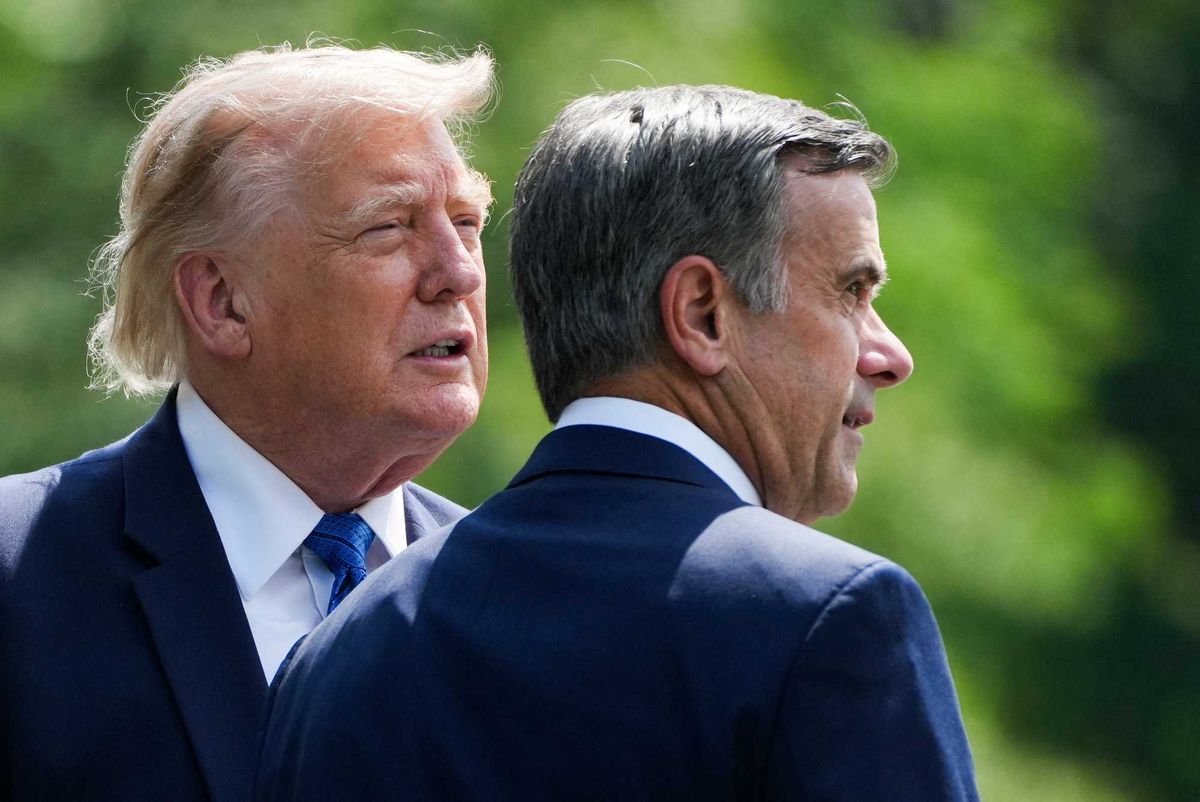
U.S. President Donald Trump and John Ratcliffe, Director of the Central Intelligence Agency (CIA), speak as they depart after a Cabinet meeting at Camp David in Thurmont, Maryland, U.S., July 31, 2026. REUTERS/Nathan Howard/Pool
CIA Director John Ratcliffe reportedly slipped into Moscow on a secret trip Tuesday, marking the highest-level visit by a Trump administration official to Russia since January — even as the Kremlin insists no such meeting is happening at all.
CBS News and Axios both reported Ratcliffe's presence in the Russian capital, citing sources familiar with the situation, though neither outlet identified who he was meeting or what was discussed. Meanwhile, according to Al Jazeera, flight-tracking data showed a U.S. military C-17 departing Riga, Latvia early Tuesday morning and landing in Moscow roughly 74 minutes later, before departing again later in the day.
Kremlin spokesman Dmitry Peskov flatly denied anything was underway, saying, "No, there are no such plans." When pressed specifically about reports of the U.S. military plane landing in Moscow, Peskov claimed he had "no such information."
But Axios reported that Washington gave Ukraine advance notice of the senior delegation's trip and asked Kyiv to hold off on strikes until the group left Russian territory.
The visit comes as U.S.-brokered talks to end Russia's invasion of Ukraine remain stalled, though Moscow did free a former U.S. Marine detained since 2022 earlier this month, reportedly over health concerns.
Ratcliffe has quietly played a central role in several high-profile prisoner swaps between Washington and Moscow since President Trump returned to office in January 2025, including the release of dual national Ksenia Karelina last year. If confirmed, his reported Moscow trip would be the first by a sitting CIA director since William Burns traveled there in 2021.
The CIA declined to comment on the reports
 / bne IntelliNews
CIA director John Ratcliffe made an unannounced visit to Moscow on August 25 spending seven hours in Moscow in talks with the Kremlin before flying out again the same day, sparking a torrent of speculation on the subject matter of the meeting.
The US admitted that it had asked Ukraine to hold off on attacking the Russian capital for three days ahead of the meeting so that his plane could land – a requestion Kyiv reported adhered to.
A US Air Force C-17 Globemaster that had left Joint Base Andrews and stopped at Riga on August 23 touched down at Vnukovo airport at about 10:00 local time and was gone by half past five. In between, video circulated on Telegram of a motorcade carrying US diplomatic plates moving along Novy Arbat towards the Kremlin. Little else is known about who Ratcliffe met and what was said, but this is not the first time a CIA chief has flown into Moscow in the midst of a military crisis and had top level talks in search of either a deal, or to deliver a stern warning.
Ratcliffe was confirmed to be aboard the C-17, Axios and CBS News reported, citing people familiar with the trip. It is his first known visit to Russia as director and the first by a senior American official since special envoys Steve Witkoff and Jared Kushner met Vladimir Putin in January as part of the Ukraine ceasefire talks.
Neither government announced the trip ahead of time and neither has explained it. Kremlin spokesman Dmitry Peskov told journalists he had no information about the aircraft and that no meetings with the US administration were planned that week. He later told the Washington Post the trip was for "contacts between security services” and declined to say more.
Three days of quiet over Moscow
Washington asked Kyiv last week to hold off striking Moscow, St Petersburg and Russia's northern regions between Monday and Wednesday, because of the “visit of a senior American official.” Radcliff was not mentioned by name and Bankova, Ukraine’s presidential administration, says it is still waiting for a debrief from the White House.
"They don't believe in the strength of Putin's air defences," a source told the Kyiv Independent. The pause ran from August 24 to 26 and Kyiv agreed to it.
Ukrainian drones have been reaching Moscow this summer, which is why the request was necessary and why granting it was a concession.
Why he went
No insider account of the purpose emerged before August 25 evening and the press is awash with speculation the next day as to the purpose and content of the meeting. Four theories are in circulation:
A prisoner release or exchange. While the official's identity was still unknown, socialite newscaster Ksenia Sobchak wrote, without citing a source, that the aircraft had come for Charles Zimmerman, a former US sailor sentenced to five years in a penal colony in 2026 for smuggling a rifle he failed to declare at Sochi. Sobchak, citing a source, says Zimmerman petitioned for a pardon over the summer, and the outlet Important Stories noted that Putin signed two classified decrees on August 25 - standard practice for pardons tied to swaps. Ratcliffe personally negotiated the April 2025 release of Ksenia Karelina. Against this theory is that no US official travelled to Moscow to help negotiate a historic prisoner swap completed last August for US journalists Evan Gershkovich or jailed basketball player Brittney Griner, and Zimmerman is a far more obscure prisoner;
A warning delivered to the Kremlin. Russian media pushed this all day, citing the Wall Street Journal. The paper claimed that the US knows that Russia is preparing to test Nato defences with an attack on a Nato member and sent Radcliff to warn the Kremlin off. The Wall Street Journal that the two sides may have discussed a truce over Iran and also drew a parallel with CIA director William Burns, who was in Moscow shortly before the outbreak of the Ukraine war in 2021 carrying a warning from Joe Biden in 2021; and the paper's own earlier reporting that US intelligence fears Russia may test Nato with a limited operation against a member state. It also claims that Moscow has rehearsed mobilisation procedures in Kaliningrad;
Iran deal. Trump has discussed the war with Putin repeatedly, Washington has just announced economic “D-DAY” sanctions designed to strangle the Iranian economy, and Moscow is one of Tehran's principal military and political partners, if not a large trading one;
A fresh round of Ukraine talks. The least likely of the four. Witkoff and Kushner were meant to go to Kyiv and did not, a TASS source said on Monday the trip had been postponed, Putin had restated on Sunday in the starkest terms that he intends to fight to a victory, and Ratcliffe's reputation as a hawk makes him an odd choice of mediator.
The last time
A CIA director last visited Russia in November 2021, when Burns met Nikolai Patrushev, then secretary of the Security Council, over two days at Biden's request. Russia was massing troops on Ukraine's border for the first time and Burns had come to say Washington knew what was being planned and was preparing a response.
Putin was in Sochi. Burns was received at the Kremlin and allowed to speak to him by phone. Putin did not deny the plans; he set out Russia's grievances against the West and Ukraine instead. Burns left convinced the preparations were real. The invasion came three months later, after an eight-point list of demands from the Russian foreign ministry - no Nato for Ukraine among them - was argued over through January and February 2022 and rejected.
Washington's most pro-Ukraine spy chief
Ratcliffe is not Burns. He has none of the career-diplomat's history with Putin, and Burns had spent three years as ambassador in Moscow in the mid-2000s. What he does have is a reputation as one of the more pro-Ukraine figures in Trump's national security team.
Where Pentagon chief Pete Hegseth began sidelining generals who argued for supporting Kyiv, Ratcliffe pressed for resources to be committed to it, the New York Times has reported. When intelligence sharing was suspended in spring 2025 after the Trump-Zelenskiy falling out, Hegseth cut every link and Ratcliffe insisted on keeping CIA contacts with Ukrainian intelligence open. Agency support helped Kyiv organise the first wave of strikes on Russian refineries in the summer of 2025. And in spring 2026, according to a recent account in The Atlantic, it was Ratcliffe who convinced Trump that Ukraine was winning and therefore worth backing.
The trip that didn't happen
Witkoff and Kushner agreed at the July 28 Oval Office meeting between Trump and Volodymyr Zelenskiy to make their first visit to Kyiv, intended to restart the diplomacy. Ukraine correspondent Christopher Miller reported the agreement for the Financial Times on July 29; Zelenskiy said he expected the envoys within a fortnight and RFE/RL put it in the second half of August. They have yet to announce a date.
The pair have been to Russia repeatedly and Vedomosti reported in early July that a return was imminent. On August 14 Sergei Lavrov said publicly that Putin "is ready to receive them once again - the question is what they will come with", a line deputy foreign minister Sergei Ryabkov repeated a week later. By August 20 the Kremlin said it still had no information on any visit.
The Kyiv trip was cancelled on the morning of August 24, Ukraine's 35th Independence Day, the day the envoys should have been there. No serving senior US official attended the commemorations; only former vice-president Mike Pence. Britain's new prime minister Andy Burnham, Emmanuel Macron and a $9.2bn Norwegian aid pledge filled the space instead making the landing of Radcliff’s C-17 at Vnukovo the following morning poignant.
Backchannels open
The visit is the visible part of backchannel talks between Russia and the US that are ongoing all year. Ratcliffe has kept regular contact with his Russian counterpart, SVR chief Sergei Naryshkin, since taking office in January 2025; the two agreed to "regular contact" between their agencies to "contribute to international stability and security, as well as reduce confrontation in relations between Moscow and Washington", TASS reported at the time. Before that, the last recorded contact between the two services' chiefs was Naryshkin's meeting with Burns in Ankara in November 2022.
Earlier this year private conversations between top Russian officials and the US envoys were leaked in November, showing Witkoff and Kushner talking to Yuri Ushakov, Putin's foreign policy adviser, and Kirill Dmitriev, who runs the sovereign wealth fund, about the terms of a peace plan. The Kremlin was widely read as having leaked them itself to drag attention back to the original 27-point peace plan (27PPP) agreed at a Moscow meeting on December 3.
A prisoner released, a statement refused
Those backchannel talks bore fruit only a fortnight ago and suggest that relations between the White House and the Kremlin remain cordial. Robert Gilman, a 32-year-old former US Marine, was released on August 11-12 after four and a half years in Russian custody. He was arrested in Voronezh in January 2022 for kicking a police officer while drunk on a Moscow-Abkhazia train and given four and a half years; later convictions for assaults on prison staff and an investigator pushed the term to 10. His family and human rights groups say those charges were fabricated.
By late June he had been moved from a prison hospital in Voronezh to a civilian psychiatric ward in what was described as a dissociative stupor, unable to move or speak, tube-fed and unresponsive, with his lawyers alleging torture and forced injections. Washington asked for his release in early August and Putin pardoned him. Trump said Russia had freed him "solely on humanitarian grounds" and demanded nothing in return; the State Department confirmed there was no swap and no US concessions. Gilman was one of at least 10 Americans held in Russia.
Read less charitably, an unprompted gift casts Putin as a pragmatist and banks a favour to be called in on Ukraine later.
US President Donald Trump’s attitude to Russia remains confused. While he has threatened new harsh sanctions that would target Moscow, on August 24, the US abstanded in a UN vote to condemn Russia’s invasion of Ukraine on the occasion of Ukraine’s Independence Day. Fifty countries signed a statement at the UN calling for a full, immediate and unconditional ceasefire, but the United States again declined to sign.
"We strongly urge Russia to respond to the calls for a full, immediate and unconditional ceasefire and resume talks on a comprehensive, just and lasting peace in Ukraine," Danish foreign minister Lars Lokke Rasmussen said, reading it out. The next morning the CIA's director was in Moscow.
No comments:
Post a Comment