Alexander Willis
August 29, 2026
RAW STORY
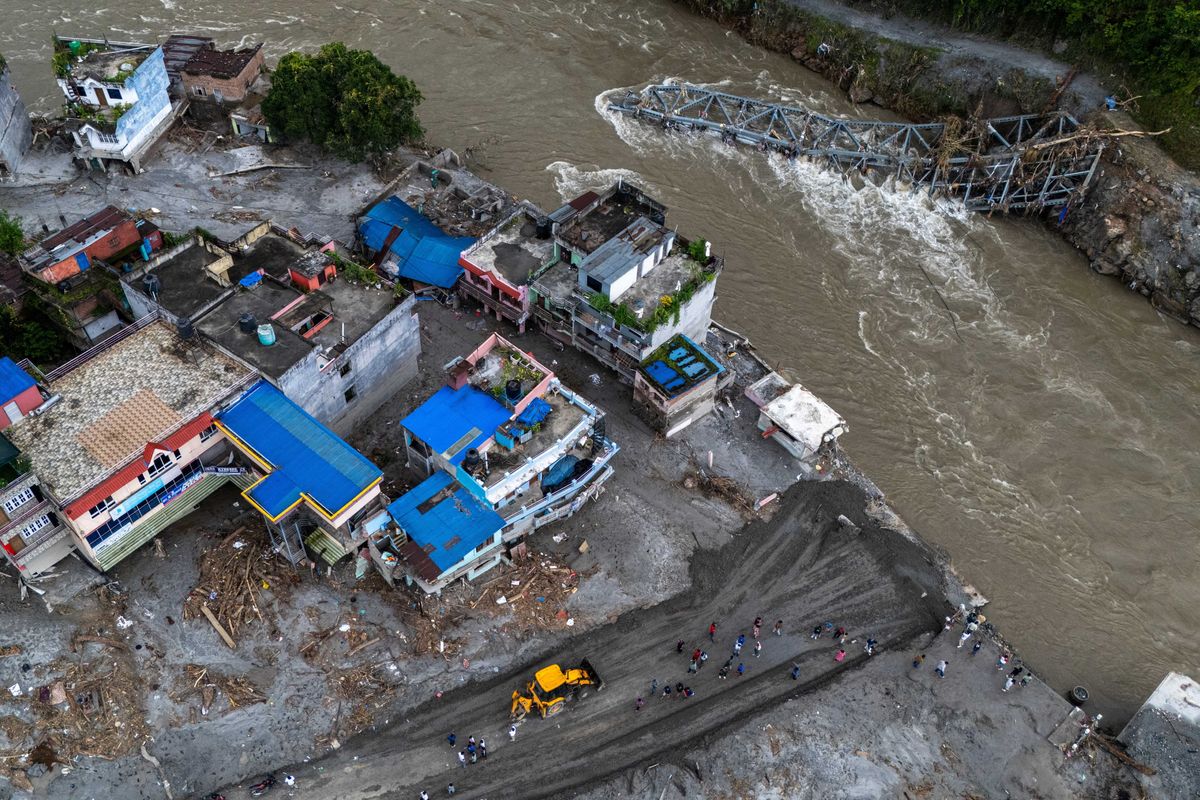
A drone view of houses covered in mud and the broken bridge after deadly flash floods and mudslide, at Devighat, Nuwakot district, Nepal, August 29, 2026. REUTERS/Athit Perawongmetha
The devastating flash floods in Nepal this week that killed at least 670 people and left around 3,000 missing — including 90 Americans — might have claimed fewer lives if not for the actions of the Trump administration, former USAID disaster-response chief Jeremy Konyndyk suggested on Saturday.
A series of catastrophic flash floods hit Nepal near its border with China on Wednesday causing unprecedented destruction. The event is believed to have been caused by a glacier collapse in the Himalayas.
Konyndyk, who led USAID’s response to the COVID-19 pandemic under the Biden administration, raised an unsettling question as to whether the Trump administration and its Department of Government Efficiency, or DOGE, may have crippled locals’ ability to adequately prepare for such a disaster.
“DOGE famously used keyword searches for terms like ‘climate’ to terminate federal grants,” Konyndyk wrote, referring to the DOGE-led blitz to gut funding for USAID, the U.S. Agency for International Development.
“Among the victims: a collab between USAID and NASA for flood prediction, early warning, disaster readiness, glacier inventories, and mapping dangerous glacial lakes… in Nepal.”
Spearheaded by Tesla CEO Elon Musk, DOGE oversaw around $60 billion in cuts to U.S. foreign aid under the Trump administration, leaving “few surviving” USAID projects in its wake. Among the USAID programs Konyndyk said was affected was SERVIR, a program that produced detailed and advanced flood forecasting with “days lead time” that “allows people to plan and prepare for [floods].” The program also specifically monitored the “potentially dangerous glacial lakes of Nepal.”
A notice from NASA supports Konyndyk’s assertion that SERVIR was impacted by DOGE cuts.
“Earlier this month USAID notified SERVIR partners that they have terminated all agreements and contracts with NASA and the SERVIR network,” the notice, published in late March of 2025, reads. “Without the partnership with USAID, NASA cannot continue the SERVIR program.”
What to know about the Mount Kailash pilgrimage site after floods in Nepal and Tibet
BEIJING (AP) — Mount Kailash holds sacred significance for Hinduism, Buddhism, Jainism and the Tibetan Bon tradition. Each associates the mountain with different beliefs and sacred histories.
Maria Teresa Hernandez
August 28, 2026
BEIJING (AP) — Devotees on a pilgrimage to Mount Kailash — a sacred site in the Himalayas — were among the many people missing after the massive floods along the border between Nepal and China.
Here’s what to know about the mountain and its centuries-old role as a pilgrimage site.
Mount Kailash is sacred for several religious traditions
Mount Kailash is a Himalayan peak in southwestern Tibet, near China’s borders with Nepal and India. It rises more than 6,400 meters (21,000 feet) above sea level and lies close to Lake Manasarovar. Both have long been part of Sanskrit religious and literary traditions.
Mount Kailash holds sacred significance for Hinduism, Buddhism, Jainism and the Tibetan Bon tradition. Each associates the mountain with different beliefs and sacred histories.
According to the International Centre for Integrated Mountain Development, the mountain is considered the home of Shiva, the Hindu god of destruction, and Parvati, a Hindu goddess associated with marriage, fertility and motherhood.
Followers of the Tibetan Bon tradition regard it as a seat of spiritual power and associate the region with Tonpa Shenrab, the tradition’s founder.
Geographer Emily Yeh, a professor at the University of Colorado Boulder, who has conducted research in Tibet, wrote in 2017 that Kailash is associated with the mythical Mount Meru, considered the center of the world in Hindu and Buddhist cosmology.
The surrounding landscape also figures in local legends and Himalayan traditions. “Shared Sacred Landscapes,” a book published by ICIMOD in 2017, gathers some of them.
One story tells of Guru Nanak, the founder of Sikhism, who visits villagers longing to make the pilgrimage to Mount Kailash. Nanak teaches them that the true pilgrimage is a spiritual journey within themselves.
Pilgrims travel to the mountain for purification
India’s government operates an official Kailash Manasarovar pilgrimage from June through August or September each year, with routes through the states of Uttarakhand and Sikkim. Private operators also organize pilgrimages through Nepal.
Pilgrims traditionally walk around Mount Kailash rather than climb it, completing a roughly 33-mile (53-kilometer) circuit around the mountain.
The journey around the peak is believed to cleanse pilgrims of their sins and can take about three days to complete. Hindus and Buddhists traditionally circle the mountain clockwise, while followers of Bon travel counterclockwise.
At nearby Lake Manasarovar, some Hindu pilgrims bathe in its waters as a ritual of spiritual purification.
Yeh wrote that Tibetan pilgrims stop at monasteries and other sacred sites along the route, touching prayer beads or their foreheads to features believed to bear sacred imprints. Other rituals are meant to test a pilgrim’s merit, sin or fortune.
Pilgrims are among the missing after floods
The death toll for the disaster continues to grow, and hundreds more are missing in Nepal and China.
The missing include at least 178 people from India, most of whom were believed to be on the pilgrimage. The missing also includes people from U.S., Australia, Britain and Canada.
Indian spiritual guru Jaggi Vasudev, also known as Sadhguru, said in a post on X that 77 people returning from the mountain with groups organized by his Isha Foundation were at an immigration center in Gyirong, Tibet, when the floods struck.
___
Associated Press religion coverage receives support through the AP’s collaboration with The Conversation US, with funding from Lilly Endowment Inc. The AP is solely responsible for this content.
August 28, 2026
BEIJING (AP) — Devotees on a pilgrimage to Mount Kailash — a sacred site in the Himalayas — were among the many people missing after the massive floods along the border between Nepal and China.
Here’s what to know about the mountain and its centuries-old role as a pilgrimage site.
Mount Kailash is sacred for several religious traditions
Mount Kailash is a Himalayan peak in southwestern Tibet, near China’s borders with Nepal and India. It rises more than 6,400 meters (21,000 feet) above sea level and lies close to Lake Manasarovar. Both have long been part of Sanskrit religious and literary traditions.
Mount Kailash holds sacred significance for Hinduism, Buddhism, Jainism and the Tibetan Bon tradition. Each associates the mountain with different beliefs and sacred histories.
According to the International Centre for Integrated Mountain Development, the mountain is considered the home of Shiva, the Hindu god of destruction, and Parvati, a Hindu goddess associated with marriage, fertility and motherhood.
Followers of the Tibetan Bon tradition regard it as a seat of spiritual power and associate the region with Tonpa Shenrab, the tradition’s founder.
Geographer Emily Yeh, a professor at the University of Colorado Boulder, who has conducted research in Tibet, wrote in 2017 that Kailash is associated with the mythical Mount Meru, considered the center of the world in Hindu and Buddhist cosmology.
The surrounding landscape also figures in local legends and Himalayan traditions. “Shared Sacred Landscapes,” a book published by ICIMOD in 2017, gathers some of them.
One story tells of Guru Nanak, the founder of Sikhism, who visits villagers longing to make the pilgrimage to Mount Kailash. Nanak teaches them that the true pilgrimage is a spiritual journey within themselves.
Pilgrims travel to the mountain for purification
India’s government operates an official Kailash Manasarovar pilgrimage from June through August or September each year, with routes through the states of Uttarakhand and Sikkim. Private operators also organize pilgrimages through Nepal.
Pilgrims traditionally walk around Mount Kailash rather than climb it, completing a roughly 33-mile (53-kilometer) circuit around the mountain.
The journey around the peak is believed to cleanse pilgrims of their sins and can take about three days to complete. Hindus and Buddhists traditionally circle the mountain clockwise, while followers of Bon travel counterclockwise.
At nearby Lake Manasarovar, some Hindu pilgrims bathe in its waters as a ritual of spiritual purification.
Yeh wrote that Tibetan pilgrims stop at monasteries and other sacred sites along the route, touching prayer beads or their foreheads to features believed to bear sacred imprints. Other rituals are meant to test a pilgrim’s merit, sin or fortune.
Pilgrims are among the missing after floods
The death toll for the disaster continues to grow, and hundreds more are missing in Nepal and China.
The missing include at least 178 people from India, most of whom were believed to be on the pilgrimage. The missing also includes people from U.S., Australia, Britain and Canada.
Indian spiritual guru Jaggi Vasudev, also known as Sadhguru, said in a post on X that 77 people returning from the mountain with groups organized by his Isha Foundation were at an immigration center in Gyirong, Tibet, when the floods struck.
___
Associated Press religion coverage receives support through the AP’s collaboration with The Conversation US, with funding from Lilly Endowment Inc. The AP is solely responsible for this content.
No comments:
Post a Comment