Port of NY and NJ Memorializes 9/11 With the Permanence of Sunlight

The Port Authority of New York and New Jersey has taken a new step to build remembrance of the 9/11 attack into its infrastructure, creating a permanent reminder for all generations. Inscribed into the floor of the Oculus - the transportation hub designed as a memorial for 9/11 - are the azimuth and altitude of the sun at 1028 hours on September 11, 2001, the moment that the North Tower collapsed.
The inscription and accompanying inlays amplify and explain the Oculus' defining feature. When architect Daniel Libeskind was commissioned to design the monolithic main hall of the building, he oriented its entire shape and orientation so that a "wedge of light" sweeps the hall with sunlight from 0846 to 1028 hours each day.
The newly-installed floor inlay includes a line subtly inscribed in the marble across the west and east ends of the space. The line follows the path of the sun throughout the time of the attack on that fateful morning. It is inscribed with the words "Azimuth 128.45 to North - Altitude 41.33 to the Sun - At 10:28 AM on September 11, 2001.”
"Permanently weaving that wedge of light into the literal foundation of the Oculus is a fitting tribute to the memory of those first moments of the attacks and to the master design vision that our redeveloped campus is built around," said Port Authority Chairman Kevin O’Toole. "Future generations will be able to follow the path of the wedge of light across the campus using these markings to connect with how the events of that day and those terrible moments in time are with us still, woven into the campus itself."
The use of the sun's position as a marker of time and space will be intimately familiar to mariners as the underlying principle of the noon sight. It is also part of a long architectural lineage of using the sun to mark important moments in time: Stonehenge is the best-known example of a monumental sundial, built to indicate the seasons, but there are many more. At the Selinente ruins in Sicily, the Temple of Apollo - the Greek god of the sun - is aligned with the sun's position at the spring solstice. Similar sites from entirely different cultures exist in present-day Egypt, Malta and Jordan, and have outlasted the civilizations that built them. By structuring a monument-scale 9/11 memorial to mark a moment with ageless sunlight, the design sits within a practice measured in millenia.
Remembering 9/11: Lt. Michael Day and the Lower Manhattan Boatlift
On September 11, 2001, Lieutenant Michael Day was working at Coast Guard Activities New York preparing to leave for a meeting at Tower One of the World Trade Center when the command center alert came in. A plane had hit one of the World Trade Center towers. Then another hit.
“We were unable to get any reports from lower Manhattan since all the communications systems failed. It was chaotic. People from multiple agencies were responding to the scene without any unity of purpose,” he said. “There wasn’t a pre-planned response; there was no CONOP for how to respond to two planes crashing into the Towers.”
Not having a specific response plan for this situation, Day grabbed the closest thing he could think of to help – the OPSAIL 2000 plan.
“I knew it had a lot of ambulance staging areas. We had a lot of evacuation points identified. Although it wasn’t necessarily a full-scale evacuation plan, it had information,” he said.
As Day rushed out the door to head to the waterfront, Andrew McGovern, pilot of the 100-foot pilot boat NEW YORK, showed up for the meeting. They grabbed a bunch of extra lifejackets, the OPSAIL plan, a Coast Guard Ensign and headed for the pilot boat.
“I remember listening to the radio because by this time we were underway on the boat and it was just… chaos. Every channel you clicked to people were screaming, ‘Help, people are here… I’ve got someone hurt here’,” he said.
With a front row seat to the collapsing buildings, frightened people and distressing devastation, Day only momentarily worried about his own safety. With thousands of citizens needing help, he didn’t have time to stop and think about what was happening.
Despite poor radio communication and unreliable cellular reception, Day began dispatching Coast Guardsmen with handheld radios to the piers to help coordinate a more organized evacuation effort. Meanwhile, he hoisted the Coast Guard Ensign on the pilot boat and began broadcasting to all available boats willing to help with the evacuation to assemble off the tip of Governors Island and await further assignment.
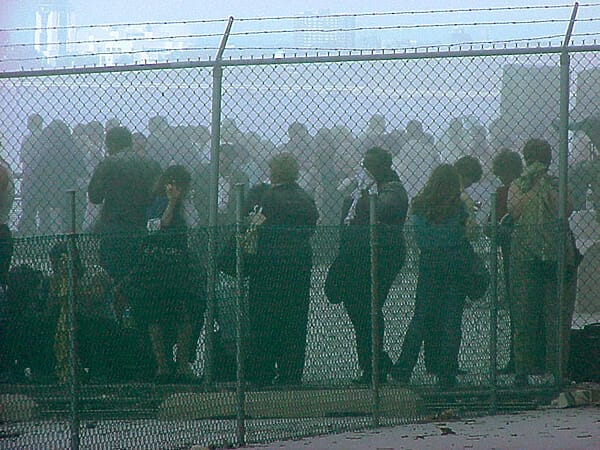
New Yorkers rushed to the Lower Manhattan water front to try to escape the collapse of the World Trade Center towers September 11. They were later evacuated by ferries and tugboats from all over New York harbor. (USCG photo by Chief Brandon Brewer)
The process of transporting the crowds of people from Manhattan to safety, one boat load at a time, continued into the evening. With the pilot boat docked in lower Manhattan, still flying the Coast Guard Ensign, first responders began asking them for help.
Establishing communications with the New Jersey Office of Emergency Management, he was able to start getting some supplies brought over to the pier… first water, then ice and meals. Soon, more specific items like tools, equipment and fuel began to arrive.
“We were quickly overrun with relief supplies,” he said. “It was just such a ‘can do’ effort. Everyone wanted to help.”
In what he called, “hands-on VTS,” Day and a Chief Boatswain’s Mate managed the hundreds of vessels bringing supplies to the pier.
“We set up three different staging areas because the supplies were coming in so fast and furious that we were running out of room, and we couldn’t distribute them fast enough,” he added.
The pure scope of the event and lack of communication with his superiors meant making decisions wasn’t always easy for Day, nor were his actions always by the book, but he looks at the response as great example of initiative and teamwork. Getting more than one hundred boats and dozens of response crews to work together cohesively is not an easy task. But for Day, it just sort of happened under what he describes as a “common purpose.”
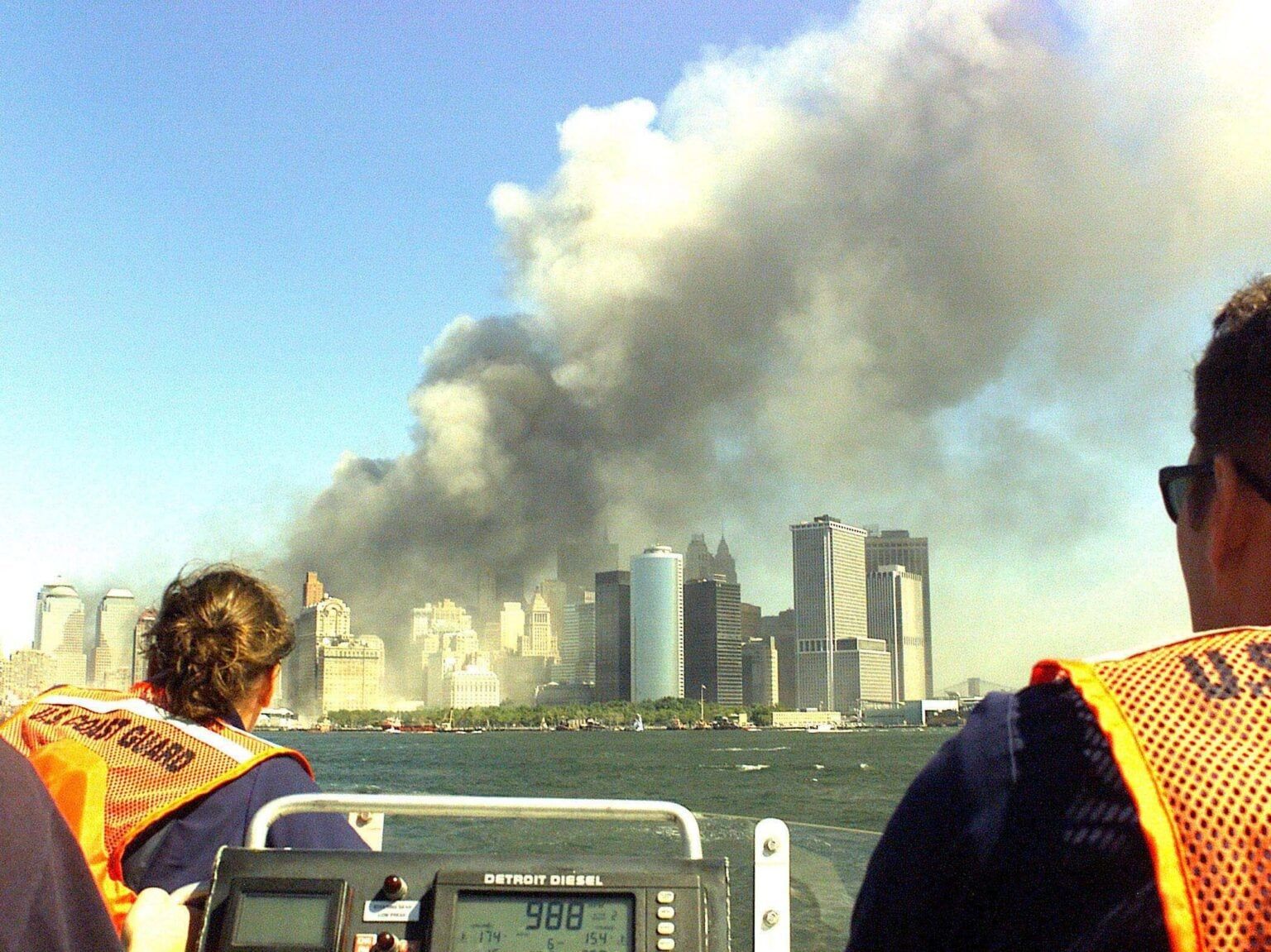 A Coast Guard rescue team from Sandy Hook, NJ, races to the scene of the World Trade Center terrorist attack. (USCG photo by PA2 Tom Sperduto)
Day also learned valuable leadership lessons.
“One is the value of partnering and partnerships, and building your bridges before you need them,” he said. “Two, making your people feel empowered. I really felt when I worked for Admiral Bennis that I was totally empowered to do the right thing. And three, to have faith in your people and the power of the concept of unity of purpose.”
After four days of responding with only about three hours of sleep total, Day finally had some time to reflect on what had happened.
“And it’s when I had quiet time, you know, a little bit alone to myself that it really, really struck home,” he said. “I think being in the Coast Guard we kind of shut things off at times of stress; it’s like a defense mechanism.”
This article originally appeared in Coast Guard Compass and may be found in archived form here. TME reprints it each year on Sept. 11 in honor of the heroes of the Lower Manhattan Boatlift and the victims of the attacks.
The opinions expressed herein are the author's and not necessarily those of The Maritime Executive.
25 Years Later, Mariners Remember the Tragedy and Heroism of 9/11

25 years after 9/11, the nation has not forgotten the shock and tragedy of the attacks on the Twin Towers and the Pentagon - nor the heroism of the response that followed. In Manhattan, 2,700 people were killed that day, and countless more suffered lasting injuries from exposure to toxic smoke and dust. But in one of American maritime's finest moments, hundreds of good Samaritan vessels and their crews rushed into harm's way to evacuate survivors from the waterfront and carry them to safety, at considerable personal risk.
After the towers began to collapse, the city moved to evacuate everyone located south of Canal Street - more than a million people. For those north of the disaster zone, evacuation on foot was possible, either north into Midtown (as instructed by then-Mayor Rudolph Giuliani) or over the bridges into Brooklyn.
But hundreds of thousands were left on the south side of the site, and when the towers collapsed, they were hemmed in by thick dust and smoke. There were no ordinary ways out. The subways were shut down, and the Brooklyn Battery Tunnel and the tunnels over to the New Jersey side were closed for safety reasons. That left only the option of a boat and ferry evacuation to move throngs of people away from the danger of falling debris, toxic smoke and the possibility of any further attacks in Lower Manhattan.
Acting under the direction of then-Lt. Mike Day, a handful of on-scene U.S. Coast Guard personnel coordinated an all-hands, all-vessels boatlift to get the survivors off the waterfront. About 160,000 people got away from the danger zone aboard NY Waterway ferries, according to the Port Authority of New York and New Jersey. Another 250-300,000 people boarded harbor cruise boats, tugs, and anything else that could be mobilized to the scene. Coast Guard officers helped organize the boarding area and direct traffic, while civilian mariners worked fast to pull people to safety. In the rush to escape, some of the survivors jumped into the water and had to be pulled aboard.
Tug crewmember Herbert Jones recalled that day in an interview with local outlet WAVY. He saw the first plane coming down the river before it hit the North Tower, then the second hit the South Tower. His tug moved in to assist the survivors. "There was boats everywhere, it was unbelievable. I learned something about New York that day. They might fight among each other, but when it comes to a day like that they all came together," he said.
The operation continued into the evening, and volunteer boats brought relief supplies over with them on the return trip. “We set up three different staging areas because the supplies were coming in so fast and furious that we were running out of room, and we couldn’t distribute them fast enough,” Adm. Day recalled in an earlier interview.
The heroic event was memorialized in a powerful short film, Boatlift, based on interviews with mariners who had joined the effort. Drawing on records, news footage, photos and survivors' recollections, an independent production team assembled a 12-minute documentary of the events of that day (with narration by Tom Hanks). Released in ____, it remains a powerful tribute and a clear portrayal of the largest marine evacuation in history.
This year, to mark the 25th anniversary, the family-oriented Great American Pure Flix - a Christian digital content channel - has released a dramatic re-envisioning of that day's heroic rescue operation. The newly-released "Boatlift 9/11" places a mother-daughter tugboat crew at the center of the action, with a twist, bringing a less-known maritime story back to the attention of the broader public.
No comments:
Post a Comment