Cruise Ship Mein Schiff 7 Completes Methanol Bunkering Demonstration

A demonstration bunkering and trial of methanol was completed with the cruise ship Mein Schiff 7, which was also the first cruise ship to be built methanol-ready. According to TUI Cruises and the companies supplying and bunkering the methanol, it was a critical test to demonstrate that the systems exist to use the emerging fuel for the cruise sector.
Mein Schiff 7 (115,000 gross tons) was delivered in 2024 with designs to be the first cruise ship to be methanol-ready. The cruise line said at the time it was waiting for additional parts but anticipated it could proceed with tests by 2026. While it is using low-sulfur diesel for propulsion, it was now able to proceed with the demonstration bunkering.
The cruise ship was supplied with 25 cubic meters of methanol from renewable feedstocks. MB Energy provided the fuel, which was loaded from a truck operated by Johs. Martens. TUI Cruises reports the fuel will be used primarily for boil operations onboard.
“The operation shows that lower carbon fuels like methanol from renewable feedstocks can already be integrated into cruise operations in a safe and reliable way,” says Jonathan Perkins, CEO of MB Energy.
By safely and reliably supplying methanol to the large cruise ship with around 2,900 passengers on board, and while multiple simultaneous operations were happening at the pier, MB Energy and TUI Cruises said they have jointly demonstrated system readiness for this mode of delivery. This proof of concept, they said, provides valuable operational experience for the future.
MB Energy highlights that it is working to support the maritime sector’s transition to more sustainable operations. The company says it is currently developing its storage infrastructure in Hamburg-Blumensand to be “methanol-ready,” enabling the supply of larger volumes of lower carbon ammonia and methanol to maritime customers in the future. Hamburg and Kiel will serve as the company’s primary operational hubs in northern Germany, with the flexibility and ambition to also supply other European ports.
Jörg Umann, Director Strategic Planning, Treasury, IR and Fuel at TUI Cruises noted, “For TUI Cruises, this project provided valuable operational experience with the supply and handling of certified renewable methanol under real operating conditions. While the methanol from renewable feedstocks supplied during this operation is used for boiler operations rather than propulsion, projects like this help us better understand how alternative fuels can contribute to reducing emissions as part of a broader carbon reduction strategy.”

Mein Schiff Relax bunkers with bio-LNG (TUI Cruises)
It is also part of TUI Cruises’ broader effort to expand its sustainable operations and reduce emissions. The company built two LNG-fueled cruise ships in its new InTUItion-class (Mein Schiff Relax and Mein Schiff Flow, each 157,651 gross tons). They can use LNG or marine gas oil for propulsion, or they can also use renewable LNG (bio-LNG or e-LNG) without technical modifications.
The company ran tests twice bunkering Mein Schiff Relax with bio-LNG in 2025. This year it is using the renewable fuel for its entire summer season in Northern Europe. Her sister ship Mein Schiff Flow also began regularly bunkering with bio-LNG this year in Barcelona. It will continue to use the renewable fuel through its winter season during cruises from Hamburg.
TUI was the first of several cruise lines to begin exploring methanol. Disney Cruise Line also prepared its new ship Disney Adventure to sail on methanol but, saying that green methanol was not expected to be readily available in its Singapore homeport, the ship would operate on a mix of sustainable and low-emission fuels, such as Hydrotreated Vegetable Oil (HVO). Celebrity Cruises built a ship in France for which Wartsila converted the engine to be tri-fuel, including the ability to handle methanol. Norwegian Cruise Line, working with Fincantieri, also announced that the fifth and sixth ships of its Prima class would be designed for methanol, while the cruise line was also working with Everllence (MAN) to explore methanol conversions for its existing cruise ships.
SeaDream Announces Plans for New Yacht Cruise Ship in 2029

SeaDream Yacht Club, an operator of two small yacht cruise ships, announced plans to add a third, larger cruise ship to its fleet in 2029. It comes as the market is undergoing rapid growth and with the company’s two ships now 42 years old.
Plans for SeaDream III were unveiled on September 1, with the company reporting it was opening reservations for the July 10, 2029, maiden voyage from Hong Kong. The company announced an elaborate inaugural year that will see the ship sail from the Orient to Southeast Asia, Indonesia, Australia and New Zealand, India, Arabia, the Mediterranean, Northern Europe, and then across the Atlantic in the fall of 2030 to Canada, the United States, and the Caribbean. On January 5, 2031, it is scheduled to sail the line’s first-ever world cruise, 180 days ending in London.
SeaDream tells The Maritime Executive that the vessel is currently in the engineering phase. It will be built by China Merchants Cruise Shipbuilding in coordination with European engineering and technical suppliers. Plans call for the new ship to be 16,500 gross tons versus its current vessels, which are just 4,333 GT.
Many of the details were not revealed for the new ship, but it will have accommodations for 230 passengers versus the current ships, which each carry just 112 passengers. The new ship will be 151 meters (495 feet) in length and have a crew of approximately 200. SeaDream is emphasizing it will “remain rooted in the defining qualities” of its operation, including an intimate yachting style and personalized service.
The line says that open-air living will be at the center of the design of the new ship, with expansive upper decks, a dedicated pool deck, indoor and outdoor dining spaces and three dedicated watersports marinas. It will also feature an expanded spa and fitness and wellness offerings. SeaDream says every space on the new ship has been reconsidered rather than simply being enlarged. It calls the new ship the next evolution of its experience, building on the iconic design of its two current ships.
The company says there will be a greater selection of passenger accommodations. But unlike others in the ultra-luxury category, which are emphasizing all suites with private balconies, 20 of the staterooms on the new ship will not have balconies.
“SeaDream III has been designed not only to travel farther, but to bring guests closer to the places she visits,” said Atle Brynestad, founder and owner of SeaDream Yacht Club. “Her size will allow her to reach distinctive harbors and sail globally while maintaining the highly personalized experience our guests expect. This deployment reflects the spirit of SeaDream: unhurried exploration, exceptional service and access to places best experienced by yacht.”
The two ships, SeaDream I and SeaDream II, were pioneers in the modern ultra-luxury category, introduced in 1984 and 1985 as the SeaGoddess I and SeaGoddess II. A small private company, it, however, faced severe financial challenges with the ships being chartered in 1986 and later sold to Cunard before shipbuilder Wärtsilä could foreclose and sell the ships to Kloster’s Royal Viking Line. The ships were transferred to Seabourn Cruise Line in 1999 after Carnival Corporation acquired the company, and in 2001 were acquired by Brynestad, who had also been the founder of Seabourn in 1987.
The two ships have built a loyal clientele and niche following, building on the yacht-style experience. They were last refurbished in 2023 and 2024.
SeaDream had announced plans in March 2019 to build its first new cruise ship. It entered into an agreement with Damen for a Polar 6 class ship that was to be 155 meters (508 feet) in length. The ship was to have entered service in September 2021, but the order was canceled after just a few months.
Fincantieri Floats First Next-Generation Cruise Ship for NCLH's Oceania
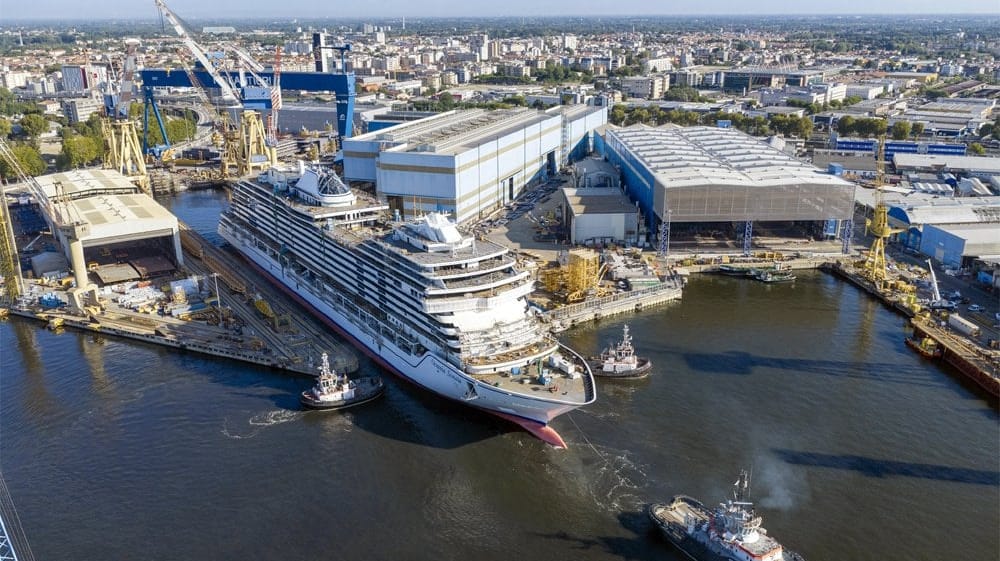
Fincantieri and Oceania Cruises, a brand of Norwegian Cruise Line Holdings, marked the float-out of the first of a new generation of cruise ships as NCLH moves forward with a strategy to align the fleet with the enhanced luxury positioning of the brand. The launch came the same day as the first of the line’s oldest ships prepared to leave the fleet.
The new ship, named Oceania Sonata, was christened and floated out at the Fincantieri shipyard in Marghera, Italy. She was moved from the assembly dry dock to the fitting out berth for completion of her interior spaces. She is scheduled to enter service in 2027.
"The float out of Oceania Sonata is an incredibly exciting moment as we move one step closer to welcoming our first guests aboard next August," said Jason Montague, Chief Luxury Officer of Oceania Cruises. “As the first ship in our new Sonata Class, she represents the beginning of an exciting new chapter for the brand and a defining milestone in the continued evolution of Oceania Cruises."
The line highlights that the ship, at 86,000 gross tons, will be approximately 30 percent larger than the prior class, Allura and Vista (68,000 gross tons), and will increase passenger capacity by just 15 percent from 1,200 to 1,390 passengers with the addition of 90 staterooms. The line says the Sonata class is designed in keeping with the brand positioning to provide more space, elevate accommodations, and enhance the culinary experiences aboard. A third of the accommodations will be suites, including four Owner’s Suites and two new suite categories. Oceania Sonata will feature 13 dining venues.
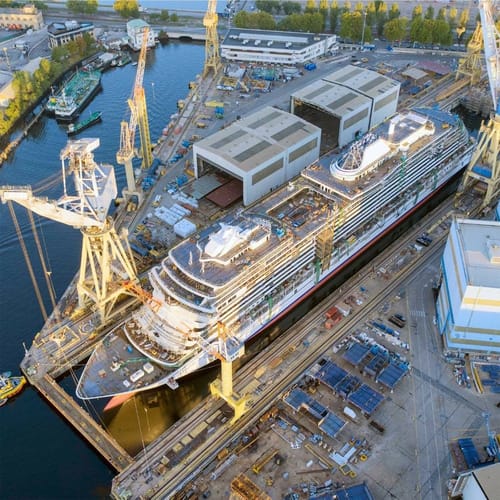
Oceania Sonata is 30 percent larger than the lines' prior cruise ships (Oceania Cruises)
Construction began with the steel cutting in June 2025. NCLH has now expanded the order to a total of five ships, with a sistership, Oceania Arietta, starting construction for delivery in 2029. Three more sisters will deliver in 2032, 2035, and 2037.
The recently appointed CEO of NCLH, John Chidsey, says this is part of a “deliberate portfolio action … that better supports the brand’s positioning and long-term return profile.”
One of the line’s smallest and original ships, Oceania Regatta (30,000 gross tons), completed its final cruise for the line on August 27 in Istanbul. The line ultimately acquired four of the 684-passenger ships, but they have been outclassed by newer and larger ships designed to emphasize greater luxury. Oceania introduced the sisters Riviera and Marina (66,000 gross tons) in 2011 and 2012 and Vista and Allura (68,000 gross tons) in 2023 and 2024, all also built by Fincantieri.
The Oceania Regatta is starting a two-year charter to Australia-based My Cruises, which will operate the cruise ship on 365-day world cruises. The first begins on September 1 from Italy. Under the terms of the charter, it can be extended, or the ship can be sold to a third-party cruise operator.
Two of the other sisters are also slated for changes. Oceania Sirena was sold and will be delivered to its new owners in the spring of 2028. Oceania Nautica will be “reimagined” as Oceania Aurelia in 2027 for the luxury long cruise market. The ship’s accommodations will be reworked with 179 of the ship’s 238 cabins designed as suites. The total number of cabins is being reduced from 340 to 238 as they enlarge rooms to create more suites.
The changes are part of a broader strategy to improve the financial performance of Norwegian Cruise Line Holdings. The corporation is undertaking a fleet modernization across its three brands and reworking operations and costs after an activist shareholder demanded changes.
No comments:
Post a Comment