White House bars CNN from covering upcoming Trump trip
DW with AP
September 25, 2026
CNN said its journalists have been barred from accompanying President Donald Trump on his upcoming trip to Tennessee. The episode marks the Trump administration's latest salvo against the major cable news network.

Trump banned reporters from CNN from White House grounds earlier this week, with main networks having suspended coverage in solidarity as well
Image: Bonnie Cash/UPI Photo/Newscom/picture alliance
American news broadcaster CNN said its journalists were not allowed to board Air Force One for a planned trip with President Donald Trump on Saturday.
CNN was scheduled to travel on Air Force One to Knoxville, Tennessee, where Trump was expected to watch a college football game.
The news organization was to be the representative of the TV press pool for the weekend, meaning that it would cover the president and share video and information with the four other big networks that are part of the press pool.
CNN was replaced by Real America's Voice News, a conservative network, the Associated Press reported.
The episode represents the latest showdown between the Trump administration and media networks that the president believes to be unfavorable in their coverage.
Trump bans CNN, MS NOW, and Politico from White House
Trump earlier this week barred CNN, MS NOW and Politico from the White House after he said the networks report "fiction and lies."
Major TV networks, including DW, then cut off their pooled coverage of the president in solidarity.
A federal judge temporarily struck down the ban in a ruling on Thursday after the outlets filed a lawsuit.
But the order from the judge addressed "hard passes" to the White House grounds and didn't directly address pool duties.
Edited by: Rana Taha

Roshni Majumdar Roshni is a global breaking news writer and digital editor for DW, based in Germany.@RoshniMaj
American news broadcaster CNN said its journalists were not allowed to board Air Force One for a planned trip with President Donald Trump on Saturday.
CNN was scheduled to travel on Air Force One to Knoxville, Tennessee, where Trump was expected to watch a college football game.
The news organization was to be the representative of the TV press pool for the weekend, meaning that it would cover the president and share video and information with the four other big networks that are part of the press pool.
CNN was replaced by Real America's Voice News, a conservative network, the Associated Press reported.
The episode represents the latest showdown between the Trump administration and media networks that the president believes to be unfavorable in their coverage.
Trump bans CNN, MS NOW, and Politico from White House
Trump earlier this week barred CNN, MS NOW and Politico from the White House after he said the networks report "fiction and lies."
Major TV networks, including DW, then cut off their pooled coverage of the president in solidarity.
A federal judge temporarily struck down the ban in a ruling on Thursday after the outlets filed a lawsuit.
But the order from the judge addressed "hard passes" to the White House grounds and didn't directly address pool duties.
Edited by: Rana Taha
Roshni Majumdar Roshni is a global breaking news writer and digital editor for DW, based in Germany.@RoshniMaj
Trump’s Diversionary Assault on the First Amendment
As the many disasters of his presidency pile up, President Donald Trump turned to a familiar foil and a proven strategy: Attack the press to distract public attention from his failures.
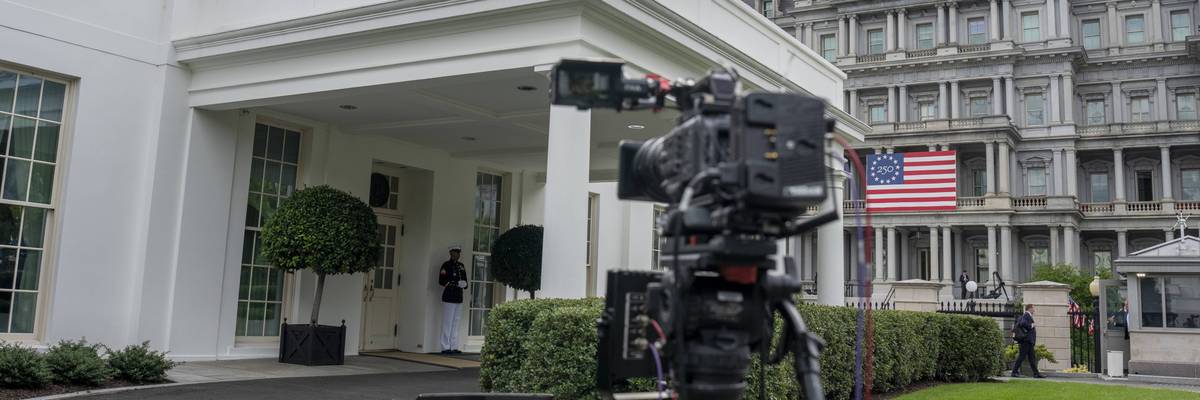
A television camera is pointed at the entrance to the West Wing of the White House on September 18, 2026 in Washington, DC.
(Photo by Daniel Heuer/Getty Images)
Steven Harper
Sep 26, 2026
As the many disasters of his presidency pile up, President Donald Trump turned to a familiar foil and a proven strategy: Attack the press to distract public attention from his failures.
A television camera is pointed at the entrance to the West Wing of the White House on September 18, 2026 in Washington, DC.
(Photo by Daniel Heuer/Getty Images)
Steven Harper
Sep 26, 2026
Common Dreams
President Donald Trump is in trouble and he knows it.He promised “no more foreign wars,” but started a war with Iran that he has lost.
He promised to tame inflation, but tariffs and his war of choice have made it worse.
He promised to deport only the “worst of the worst” illegal immigrants. But Immigration and Customs Enforcement has terrorized American cities as agents sometimes arrested, detained, wounded, or killed US citizens.
He promised to make the United States the most respected country in the world, but he has destroyed America’s reputation and alienated its allies.
He calls himself the best president in history, but his approval rating has dropped to the mid-30s—his lowest ever and approaching President Richard Nixon’s final approval rating of 24% shortly before his resignation in 1974.
He tells his audiences to pretend he’s on the ballot in November, but many Republican congressional candidates are distancing themselves from him.
Sen. John Curtis (R) from ruby-red Utah is not up for reelection, but he has urged an investigation into the Trump family’s financial dealings and the potential for corruption.
Trump promised lower interest rates on home mortgages, but 30-year fixed-rate mortgages now exceed 7%—the highest since May 2024.
He promised gasoline below $2.00 per gallon, but the price has soared to an average of $4.50 per gallon. The price of diesel has increased even more dramatically—to a record-shattering $6.50 per gallon.
The list goes on and on. So Trump turned to a familiar foil and a proven strategy: Attack the press to divert public attention from his failures.
Same Old Playbook
CNN, MSNOW, and Politico won the first round in Trump’s latest attempt to subvert the First Amendment. But Trump’s shiny object consumed the media. His goal now is to extend the controversy.
Act I
While many of his most senior advisers were away at 3:00 pm on Friday, September 18, Trump announced on social media that he was banning CNN, MSNOW, and Politico from the White House. At first nothing happened, but by Saturday morning the press passes for reporters at those organizations no longer allowed them past White House security.
On Monday morning, September 21, the news organizations sued the Trump administration for violating their First Amendment right to a free press and their Fifth Amendment right to due process of law.
On Tuesday, September 22, the White House sent the organizations what it purported were notices of the revocations, giving them until Friday to respond.
Act II
At a court hearing on Wednesday, September 23, Trump’s Department of Justice (DOJ) asserted the laughable argument that the White House letter sent to the news organizations on Tuesday, September 22—days after Trump revoked the press passes—somehow satisfied the Fifth Amendment requirement of due process prior to any revocation.
The DOJ also told the judge that amorphous “national security” concerns justified revoking the passes. But Trump’s own statements of his reasons for the revocation undercut that argument.
Without reaching the First Amendment issues, the court based its constitutional ruling on Trump’s failure to provide due process. Judge Timothy J. Kelly—a Trump appointee—granted a temporary restraining order requiring Trump to restore the revoked press credentials immediately.
Act III
Judge Kelly issued his opinion around 1:00 am on Thursday, September 24. But as the business day began, the affected reporters’ press passes were still disabled, prompting the news organizations to file an emergency motion before Judge Kelly. The Justice Department responded with a declaration stating that press access had been restored at 9:55 am, so the judge cancelled the hearing.
But that evening, reporters for CNN and MSNOW were turned away from the state dinner arrivals at the White House, where Trump was hosting Chinese President Xi Jinping.
Act IV
To satisfy Trump, government attorneys are probably working on a new strategy. Here’s one possible scenario:The White House imposes less drastic restrictions on its disfavored press outlets. Slow walking the reinstatement of press passes and preventing CNN and MSNOW reporters from covering arrivals at the state dinner for President Xi Thursday night could be previews of coming attractions.
The White House gives the news organizations new notices and an opportunity to be heard before suspending their press passes again. The notices would concoct arguments, probably with a focus on Trump’s favorite phrase for justifying his consolidation of power—“national security.”
The White House would then revoke the press passes.
The news organizations would file another lawsuit challenging the revocation.
Trump would lose again, but he would press ahead in the hope that eventually the US Supreme Court would bail him out. If Trump loses in the DC Court of Appeals, the Supreme Court probably would refuse to take the case—leaving his loss in place.
If the Supreme Court accepted the case, I predict it would issue a 7-2 opinion—with Justices Samuel Alito and Clarence Thomas dissenting—confirming that the First Amendment still means what it says.
All of this will take time. And most importantly, it will remain a big news item that diverts at least some attention away from the broader failures of Trump’s presidency.
“The People’s House”
Trump has been eager to tear down the East Wing, reshape the White House grounds, turn the interior into a gilded spectacle, and otherwise impose his dramatic construction ideas at 1600 Pennsylvania Avenue.
Yet shortly after revoking the press credentials of CNN, MSNOW, and Politico, he told reporters: “It’s sick. I mean, there’s something wrong with a country that can allow people to write purposely negative stuff.”
In the next sentence, he revealed himself: “Now, if they want to write them, that’s fine. But I don’t have to let them into my, into the people’s house.”
Trump thinks the White House belongs exclusively to him. But his lease ends in two years, and no security deposit is sufficient to cover the profound damage he is inflicting on the nation.
Meanwhile, it is vital to beat back Trump’s repeated assaults in the Constitution. But it’s also important to remember that among the most important underlying goals of his most outrageous actions is diverting Americans from the mess that he has made of the country.
Our work is licensed under Creative Commons (CC BY-NC-ND 3.0). Feel free to republish and share widely.
Steven Harper
Steven J. Harper is an attorney, adjunct professor at Northwestern University Law School, and author of several books, including Crossing Hoffa -- A Teamster's Story and The Lawyer Bubble -- A Profession in Crisis. He has been a regular columnist for Moyers on Democracy, Dan Rather's News and Guts, and The American Lawyer. Follow him at https://thelawyerbubble.com.
Full Bio >
President Donald Trump is in trouble and he knows it.He promised “no more foreign wars,” but started a war with Iran that he has lost.
He promised to tame inflation, but tariffs and his war of choice have made it worse.
He promised to deport only the “worst of the worst” illegal immigrants. But Immigration and Customs Enforcement has terrorized American cities as agents sometimes arrested, detained, wounded, or killed US citizens.
He promised to make the United States the most respected country in the world, but he has destroyed America’s reputation and alienated its allies.
He calls himself the best president in history, but his approval rating has dropped to the mid-30s—his lowest ever and approaching President Richard Nixon’s final approval rating of 24% shortly before his resignation in 1974.
He tells his audiences to pretend he’s on the ballot in November, but many Republican congressional candidates are distancing themselves from him.
Sen. John Curtis (R) from ruby-red Utah is not up for reelection, but he has urged an investigation into the Trump family’s financial dealings and the potential for corruption.
Trump promised lower interest rates on home mortgages, but 30-year fixed-rate mortgages now exceed 7%—the highest since May 2024.
He promised gasoline below $2.00 per gallon, but the price has soared to an average of $4.50 per gallon. The price of diesel has increased even more dramatically—to a record-shattering $6.50 per gallon.
The list goes on and on. So Trump turned to a familiar foil and a proven strategy: Attack the press to divert public attention from his failures.
Same Old Playbook
CNN, MSNOW, and Politico won the first round in Trump’s latest attempt to subvert the First Amendment. But Trump’s shiny object consumed the media. His goal now is to extend the controversy.
Act I
While many of his most senior advisers were away at 3:00 pm on Friday, September 18, Trump announced on social media that he was banning CNN, MSNOW, and Politico from the White House. At first nothing happened, but by Saturday morning the press passes for reporters at those organizations no longer allowed them past White House security.
On Monday morning, September 21, the news organizations sued the Trump administration for violating their First Amendment right to a free press and their Fifth Amendment right to due process of law.
On Tuesday, September 22, the White House sent the organizations what it purported were notices of the revocations, giving them until Friday to respond.
Act II
At a court hearing on Wednesday, September 23, Trump’s Department of Justice (DOJ) asserted the laughable argument that the White House letter sent to the news organizations on Tuesday, September 22—days after Trump revoked the press passes—somehow satisfied the Fifth Amendment requirement of due process prior to any revocation.
The DOJ also told the judge that amorphous “national security” concerns justified revoking the passes. But Trump’s own statements of his reasons for the revocation undercut that argument.
Without reaching the First Amendment issues, the court based its constitutional ruling on Trump’s failure to provide due process. Judge Timothy J. Kelly—a Trump appointee—granted a temporary restraining order requiring Trump to restore the revoked press credentials immediately.
Act III
Judge Kelly issued his opinion around 1:00 am on Thursday, September 24. But as the business day began, the affected reporters’ press passes were still disabled, prompting the news organizations to file an emergency motion before Judge Kelly. The Justice Department responded with a declaration stating that press access had been restored at 9:55 am, so the judge cancelled the hearing.
But that evening, reporters for CNN and MSNOW were turned away from the state dinner arrivals at the White House, where Trump was hosting Chinese President Xi Jinping.
Act IV
To satisfy Trump, government attorneys are probably working on a new strategy. Here’s one possible scenario:The White House imposes less drastic restrictions on its disfavored press outlets. Slow walking the reinstatement of press passes and preventing CNN and MSNOW reporters from covering arrivals at the state dinner for President Xi Thursday night could be previews of coming attractions.
The White House gives the news organizations new notices and an opportunity to be heard before suspending their press passes again. The notices would concoct arguments, probably with a focus on Trump’s favorite phrase for justifying his consolidation of power—“national security.”
The White House would then revoke the press passes.
The news organizations would file another lawsuit challenging the revocation.
Trump would lose again, but he would press ahead in the hope that eventually the US Supreme Court would bail him out. If Trump loses in the DC Court of Appeals, the Supreme Court probably would refuse to take the case—leaving his loss in place.
If the Supreme Court accepted the case, I predict it would issue a 7-2 opinion—with Justices Samuel Alito and Clarence Thomas dissenting—confirming that the First Amendment still means what it says.
All of this will take time. And most importantly, it will remain a big news item that diverts at least some attention away from the broader failures of Trump’s presidency.
“The People’s House”
Trump has been eager to tear down the East Wing, reshape the White House grounds, turn the interior into a gilded spectacle, and otherwise impose his dramatic construction ideas at 1600 Pennsylvania Avenue.
Yet shortly after revoking the press credentials of CNN, MSNOW, and Politico, he told reporters: “It’s sick. I mean, there’s something wrong with a country that can allow people to write purposely negative stuff.”
In the next sentence, he revealed himself: “Now, if they want to write them, that’s fine. But I don’t have to let them into my, into the people’s house.”
Trump thinks the White House belongs exclusively to him. But his lease ends in two years, and no security deposit is sufficient to cover the profound damage he is inflicting on the nation.
Meanwhile, it is vital to beat back Trump’s repeated assaults in the Constitution. But it’s also important to remember that among the most important underlying goals of his most outrageous actions is diverting Americans from the mess that he has made of the country.
Our work is licensed under Creative Commons (CC BY-NC-ND 3.0). Feel free to republish and share widely.
Steven Harper
Steven J. Harper is an attorney, adjunct professor at Northwestern University Law School, and author of several books, including Crossing Hoffa -- A Teamster's Story and The Lawyer Bubble -- A Profession in Crisis. He has been a regular columnist for Moyers on Democracy, Dan Rather's News and Guts, and The American Lawyer. Follow him at https://thelawyerbubble.com.
Full Bio >
Hollow core of Trump's 'preposterous' press ban exposed by shock leak disclosure: expert
Bennito L. Kelty
September 23, 2026
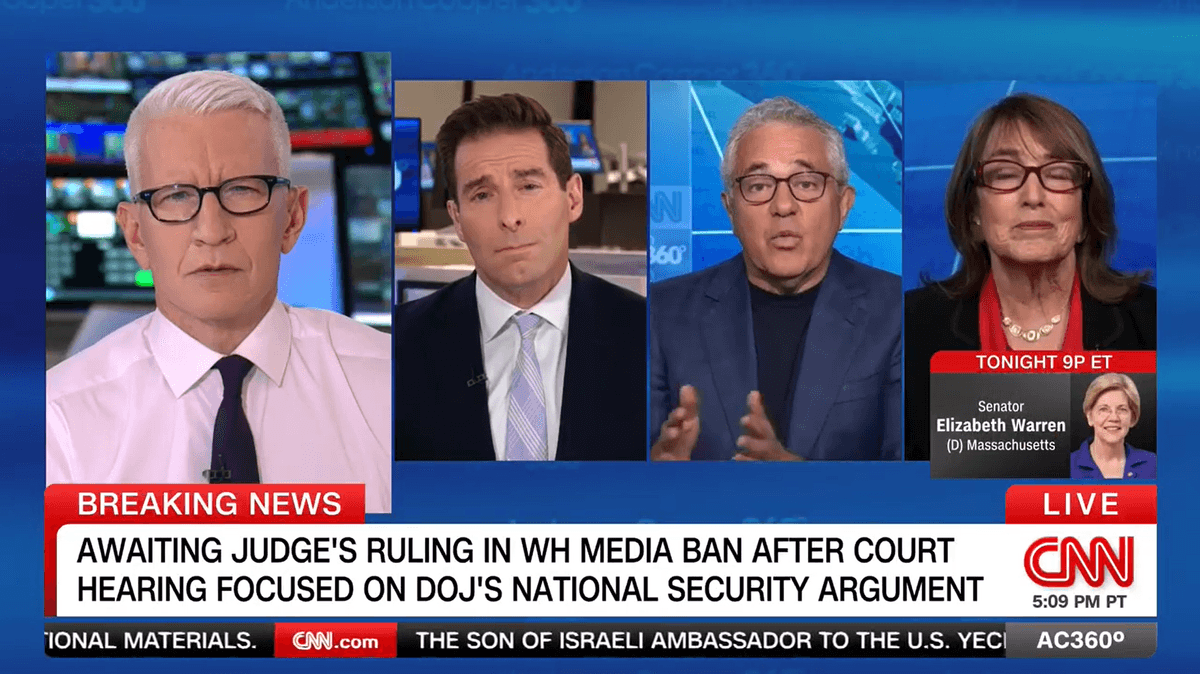
Former federal prosecutor Jeffrey Toobin flagged a reason that the White House's argument for a media ban is 'preposterous.' (CNN/Screenshot)
A CNN analysis keyed in on the latest bombshell revelation about a White House leaker to tear into President Donald Trump's media ban.
On Wednesday, former federal prosecutor and columnist Jeffrey Toobin spoke with CNN anchor Anderson Cooper about the hearing regarding Trump's media ban. U.S. District Judge Timothy Kelly was still expected to rule on a temporary restraining order sought by lawyers for CNN, MS NOW and Politico, who were kicked out of the White House by the ban.
Cooper brought up that the Department of Justice argued to keep the ban in place by citing national security concerns. Toobin said, "It's understandable why the White House is trying this, because the courts are at their most deferential to the executive branch when it comes to national security."
However, Toobin tore into the DOJ's and White House's national security argument and noted how they've undercut it themselves. He mentioned reporting that came out shortly after Wednesday's hearing and while Kelly still hadn't ruled on the case.
In a letter made public through a court filing on Tuesday, the White House justified banning Politico by citing an article with high-level information about the Iran war and characterized it as a leak that endangered national security. However, Status reported on Wednesday that Vice President JD Vance was responsible for leaking the information in question to Politico.
Toobin brought it up as he ripped the DOJ's national security argument, saying, "One of the articles that the White House is complaining about, the source for that was JD Vance, the vice president of the United States."
He continued, "So, they're trying to kick Politico out of the White House for a story where the source was JD Vance. I mean, it just shows how preposterous this argument is."
The Washington Post noted that the White House also called the information that Politico reported "misinformation," even though it came from Vance.
Bennito L. Kelty
September 23, 2026
RAW STORY
Former federal prosecutor Jeffrey Toobin flagged a reason that the White House's argument for a media ban is 'preposterous.' (CNN/Screenshot)
A CNN analysis keyed in on the latest bombshell revelation about a White House leaker to tear into President Donald Trump's media ban.
On Wednesday, former federal prosecutor and columnist Jeffrey Toobin spoke with CNN anchor Anderson Cooper about the hearing regarding Trump's media ban. U.S. District Judge Timothy Kelly was still expected to rule on a temporary restraining order sought by lawyers for CNN, MS NOW and Politico, who were kicked out of the White House by the ban.
Cooper brought up that the Department of Justice argued to keep the ban in place by citing national security concerns. Toobin said, "It's understandable why the White House is trying this, because the courts are at their most deferential to the executive branch when it comes to national security."
However, Toobin tore into the DOJ's and White House's national security argument and noted how they've undercut it themselves. He mentioned reporting that came out shortly after Wednesday's hearing and while Kelly still hadn't ruled on the case.
In a letter made public through a court filing on Tuesday, the White House justified banning Politico by citing an article with high-level information about the Iran war and characterized it as a leak that endangered national security. However, Status reported on Wednesday that Vice President JD Vance was responsible for leaking the information in question to Politico.
Toobin brought it up as he ripped the DOJ's national security argument, saying, "One of the articles that the White House is complaining about, the source for that was JD Vance, the vice president of the United States."
He continued, "So, they're trying to kick Politico out of the White House for a story where the source was JD Vance. I mean, it just shows how preposterous this argument is."
The Washington Post noted that the White House also called the information that Politico reported "misinformation," even though it came from Vance.
Free Press Defenders Demand End of ‘Horrifying’ ICE Detention of Journalist Luis Galeano
“If our government can close off channels of exchange and the free flow of ideas, it is no more than a dictatorship.”
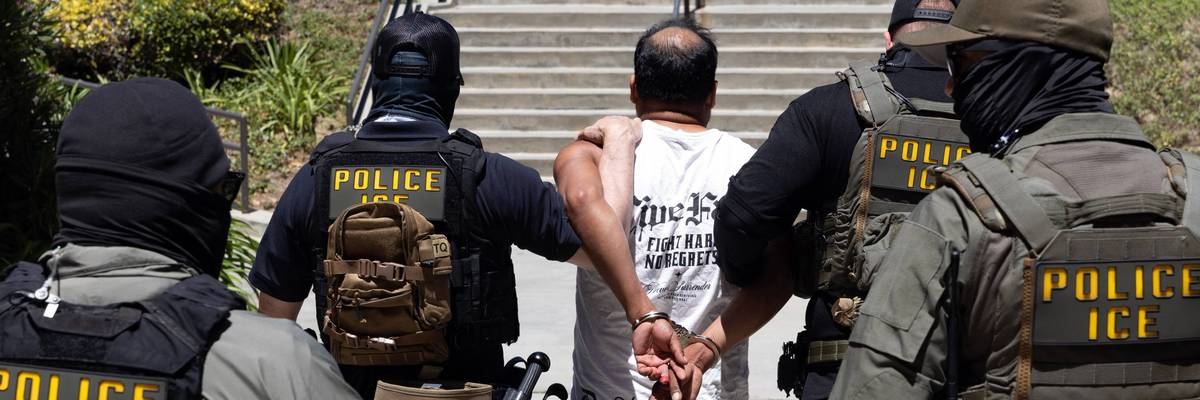
Immigration and Customs Enforcement (ICE) agents walk a detainee out of the Ventura County Government Center in Ventura, California, on July 27, 2026.
(Photo by Blake Fagan/AFP via Getty Images)
Brad Reed
Sep 18, 2026
COMMON DREAMS
A coalition of 15 press freedom advocacy organizations on Friday demanded the release of Nicaraguan journalist Luis Galeano, who was arrested by federal immigration enforcement officials earlier this week.
The groups—which include Free Press, the Committee to Protect Journalists, the Freedom of the Press Foundation, the National Association of Hispanic Journalists, and Reporters Without Borders (RSF)—released a letter decrying Galeano’s detention at the hands of US Immigration and Customs Enforcement (ICE) agents on Monday.
The organizations expressed concern about Galeano being potentially deported back to Nicaragua, where he could face imprisonment for his past work exposing that government’s human rights abuses. According to a Wednesday report in The Guardian, Galeano fled his home country eight years ago shortly after police raided the news outlet where he worked.
The groups also said Galeano’s detention marked “a troubling escalation of attacks on journalists and media workers, particularly immigrant journalists, who consistently provide much-needed journalism and civic information for their communities.”
Galeano was taken into custody despite entering the US legally in 2018 and having a pending asylum case. The Nicaraguan journalist also has a work permit and a Social Security number.
Nora Benavidez, senior counsel at Free Press, called Galeano’s arrest “horrifying,” while noting that the Nicaraguan is “the latest in a long line of journalists who came to the United States to report on issues of the day and instead face deportation.”
“These cases aren’t just about cracking down on immigration,” said Benavidez. “They are about cutting off community access to vital coverage and scaring reporters from holding those in power accountable. If our government can close off channels of exchange and the free flow of ideas, it is no more than a dictatorship.”
Edith Rodríguez Cachera, vice president of RSF Spain, pointed out that Galeano was also a citizen of Spain, and urged the Spanish government to secure his freedom.
“Spain cannot stand by while one of its citizens, a journalist persecuted for doing his job, is detained in the United States and faces the risk of being sent back to a country he fled because of severe repression,” said Rodríguez Cachera, “where his safety could be seriously endangered if he is deported. Spain must use every diplomatic and consular instrument at its disposal to safeguard his security and prevent his return to a country where he will likely be targeted due to his journalistic work.”
Galeano’s wife, Deykell Santamaría, said in an interview with El País published Thursday that she has been able to contact her husband during his detention, but she still fears “for his safety, his freedom, and his integrity if he were to be sent to Nicaragua.”
Javier Melendez, a longtime friend of the detained journalist, was even blunter about what would happen to Galeano were he to be deported, describing it as nothing less than a “death sentence” in an interview with The Guardian.
The El País report noted that US Reps. María Elvira Salazar (R-Fla.) and Mario Díaz-Balart (R-Fla.) have expressed concerns about Galeano’s detention, with Salazar saying that the US government should “always know how to distinguish between a criminal and a political exile.”
“If our government can close off channels of exchange and the free flow of ideas, it is no more than a dictatorship.”
Immigration and Customs Enforcement (ICE) agents walk a detainee out of the Ventura County Government Center in Ventura, California, on July 27, 2026.
(Photo by Blake Fagan/AFP via Getty Images)
Brad Reed
Sep 18, 2026
COMMON DREAMS
A coalition of 15 press freedom advocacy organizations on Friday demanded the release of Nicaraguan journalist Luis Galeano, who was arrested by federal immigration enforcement officials earlier this week.
The groups—which include Free Press, the Committee to Protect Journalists, the Freedom of the Press Foundation, the National Association of Hispanic Journalists, and Reporters Without Borders (RSF)—released a letter decrying Galeano’s detention at the hands of US Immigration and Customs Enforcement (ICE) agents on Monday.
The organizations expressed concern about Galeano being potentially deported back to Nicaragua, where he could face imprisonment for his past work exposing that government’s human rights abuses. According to a Wednesday report in The Guardian, Galeano fled his home country eight years ago shortly after police raided the news outlet where he worked.
The groups also said Galeano’s detention marked “a troubling escalation of attacks on journalists and media workers, particularly immigrant journalists, who consistently provide much-needed journalism and civic information for their communities.”
Galeano was taken into custody despite entering the US legally in 2018 and having a pending asylum case. The Nicaraguan journalist also has a work permit and a Social Security number.
Nora Benavidez, senior counsel at Free Press, called Galeano’s arrest “horrifying,” while noting that the Nicaraguan is “the latest in a long line of journalists who came to the United States to report on issues of the day and instead face deportation.”
“These cases aren’t just about cracking down on immigration,” said Benavidez. “They are about cutting off community access to vital coverage and scaring reporters from holding those in power accountable. If our government can close off channels of exchange and the free flow of ideas, it is no more than a dictatorship.”
Edith Rodríguez Cachera, vice president of RSF Spain, pointed out that Galeano was also a citizen of Spain, and urged the Spanish government to secure his freedom.
“Spain cannot stand by while one of its citizens, a journalist persecuted for doing his job, is detained in the United States and faces the risk of being sent back to a country he fled because of severe repression,” said Rodríguez Cachera, “where his safety could be seriously endangered if he is deported. Spain must use every diplomatic and consular instrument at its disposal to safeguard his security and prevent his return to a country where he will likely be targeted due to his journalistic work.”
Galeano’s wife, Deykell Santamaría, said in an interview with El País published Thursday that she has been able to contact her husband during his detention, but she still fears “for his safety, his freedom, and his integrity if he were to be sent to Nicaragua.”
Javier Melendez, a longtime friend of the detained journalist, was even blunter about what would happen to Galeano were he to be deported, describing it as nothing less than a “death sentence” in an interview with The Guardian.
The El País report noted that US Reps. María Elvira Salazar (R-Fla.) and Mario Díaz-Balart (R-Fla.) have expressed concerns about Galeano’s detention, with Salazar saying that the US government should “always know how to distinguish between a criminal and a political exile.”

No comments:
Post a Comment