EU institution leaders blast Serbia over 'shocking' Ratko Mladić's funeral
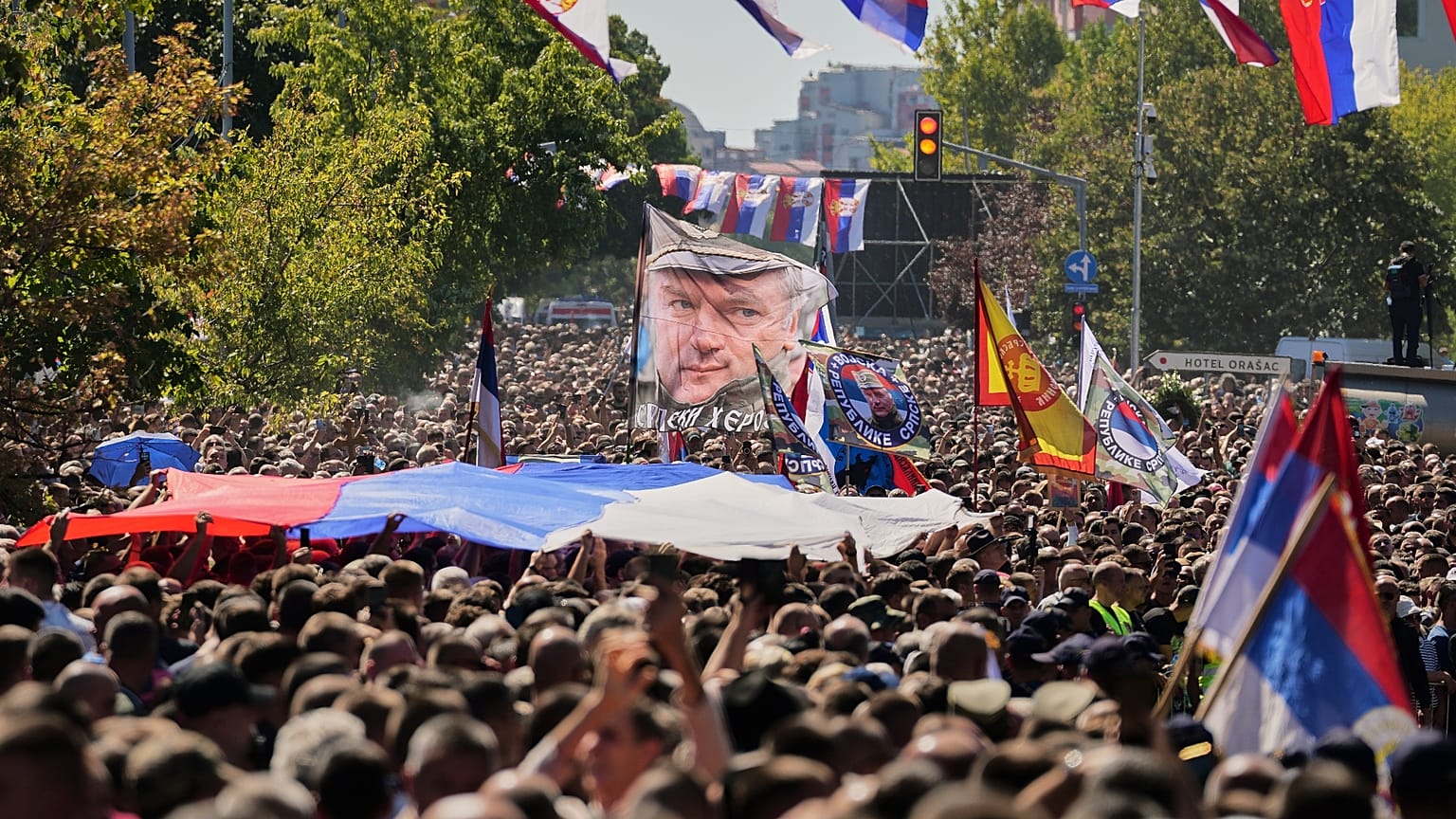
Von der Leyen and Costa called Ratko Mladić's Belgrade funeral 'shocking,' after senior Serbian officials attended with military honours, clouding Serbia's EU bid for the foreseeable future.
The heads of the EU's two main institutions have condemned the presence of senior Serbian officials at the funeral of the convicted war criminal, in a joint statement published simultaneously on X on Tuesday morning.
"The images from Ratko Mladić's funeral yesterday in Belgrade were shocking. Ratko Mladić was a convicted war criminal. He was responsible for genocide, war crimes, and crimes against humanity," European Commission President Ursula von der Leyen and European Council President António Costa wrote on X.
Ratko Mladić, known as the Butcher of Bosnia, died in late August aged 84 in a UN detention facility in The Hague. The Bosnian Serb had served in the Army of Republika Srpska with the rank of colonel-general during the Yugoslav Wars.
Following his death, his body was flown to Belgrade on a state plane, given an honour guard by the Serbian military and various security forces, and commemorated by the public broadcaster and the Serbian Orthodox Church. His coffin was wrapped in a Serbian flag.
On Friday, the glorification of the war criminal attracted the ire of senior EU officials, national ministers and diplomats, while Enlargement Commissioner Marta Kos warned the funeral would be an "important test" for Serbia's accession bid.
"He died while serving a life sentence for the Srebrenica genocide and other crimes. The elements of official support and the presence of some senior Serbian officials at the funeral are deeply regrettable," the post continues.
On Monday, the Commission's chief spokesperson, Paula Pinho, caused a public backlash after telling the daily press conference that "we had heard that there was a funeral foreseen with state honours, and that has not been the case."
"Five ministers from the Serbian Government were seated in the front row at the funeral, a convicted war criminal was given military honours, and his body was flown in on a Serbian Government aircraft," the official X account of the Foreign Ministry of Bosnia and Herzegovina wrote, calling Pinho's statement "a disgrace to the entire European Union."
Von der Leyen and Costa's joint statement appears to cement the EU's institutional condemnation of Mladić's glorification, stressing that Serbia's failure to confront a dark chapter of European history contradicts the values underpinning EU membership. It also marks a sharp escalation from warning to institutional condemnation.
In July, the Commission tried to revive Serbia's accession bid by putting the opening of Cluster 3 back on the table. Eight member states blocked the move, citing rule-of-law concerns and Belgrade's failure to align with EU sanctions against Russia.
"Everyone can see that, following this heinous glorification of Mladić, the opening of Cluster 3 is completely out of the question for now," an EU diplomat told Euronews, speaking on condition of anonymity.
Enlargement Commissioner Marta Kos cancelled her planned visit to Serbia, while a Commission spokesperson denied that von der Leyen had ever had a visit to Serbia planned at all.
Serbian President Aleksandar Vučić called for snap parliamentary elections to take place in late October.

Ratko Mladić. Image: Grok
September 8, 2026
Balkan Insight
By Marina Zec and Katarina Baletic
Key Takeaways:
Mourners treated him as a hero—flags, T-shirts, free buses from Republika Srpska and Montenegro. His son asked the crowd to decide if his father was “a hero or a criminal.” Lawyers disagree on whether a Hague convict should get military honours.
The EU, Bosnia, and Croatia condemned the display as genocide denial that clashes with European values and could hurt Serbia’s (and Montenegro’s) EU path. Mladić was convicted of Srebrenica, the Sarajevo siege, persecution of Bosniaks and Croats, and taking UN hostages.
Large crowds of mourners, including Serbian ministers, gathered in Belgrade on Monday for the funeral of Ratko Mladic, who died in detention while serving a life sentence for genocide, war crimes and crimes against humanity.
Troops lined the road and police saluted the coffin, which was draped with the flags of Serbia and Republika Srpska, as it was transported to Topcider Cemetery from the Church of St. Luke, where the head of the Serbian Orthodox Church, Patriarch Porfirije, led a funeral service.
The Patriarch declared that Mladic’s name will “remain deeply woven into the memory and prayers of the vast majority of our Serbian Orthodox people, who feel and cultivate deep gratitude toward him”.
A Serbian Army honour guard gave a three-volley salute as Mladic’s coffin was lowered into the grave, and mourners shouted “Long live Ratko Mladic” and “Glory to the hero”. He was buried next to his daughter Ana, who committed suicide in 1994.
Serbian Defence Minister Bratislav Gasic, Minister without Portfolio Nenad Popovic and Minister for Labour, Employment, Veterans and Social Affairs Milica Djurdjevic Stamenkovski attended the funeral, as did war veterans in military uniforms.
From Republika Srpska came Milorad Dodik, the head of the ruling coalition in the Serb-dominated entity, and Zeljka Cvijanovic, the Serb member of Bosnia and Herzegovina’s tripartite presidency. The Russian ambassador to Serbia Aleksandar Bocan-Harchenko came to pay condolences to the Mladic family.
But European Union officials, the foreign ministers of neighbouring Croatia and Bosnia, and survivors of wartime crimes committed by Mladic’s forces strongly criticised the commemoration of the genocide convict.
The EU warned that the glorification of war criminals and genocide denial “contradict the most fundamental European values and have no place in the EU or in EU candidate countries”.
T-shirts celebrate Mladic’s wartime actions
From early on Monday, hundreds of mourners streamed towards the Church of St. Luke, some walking several kilometres to pay tribute to the war criminal they consider a Serbian hero, despite his convictions by the Hague Tribunal.
Many carried flags and wore T-shirts depicting Mladic or symbols of Republika Srpska and its army, which he led during the war. One T-shirt slogan read: “Ratko Mladic – Is it a crime to defend the Serbian people?”
“Now even the [football] supporters are together, now we’re all together,” said one man, referring to the fact that both fans of Red Star and Partizan, Belgrade’s main football clubs, had paid tribute to Ratko Mladic during their weekend derby.
A younger Mladic supporter standing next to him was in tears. “He tried to protect us, and now we are here to see him off,” he said.
At noon, the Patriarch Porfirije led the funeral service, saying that Mladic “stood at the head of the army of his people and carried a great responsibility and burden, made a sacrifice, and laid down his life for the freedom, defence and survival of his people”.
Following the service, members of the Serbian Armed Forces carried the coffin from the church to the funeral procession heading towards Topcider Cemetery.
In the procession, Mladic’s son Darko carried a sabre, while other family members carried Mladic’s military decorations and a photograph of him. Mladic’s wife, Bosiljka, walked behind the coffin.
Along the route between the church and the cemetery, water tankers and temporary public toilets had been installed for those attending. The city of Belgrade deployed significant resources, providing the water supplies, electric transport vehicles and city-run security services.
Free transport was offered from Bosnia and most towns in Serbia for anyone who wanted to pay their respects, Reuters news agency and media outlets in Serbia and Montenegro reported. Dozens of buses travelled from Republika Srpska, while organised bus transport was also arranged from Montenegro.
At the ceremony, flags bearing the deceased general’s image were flown and a sound system had been set up so mourners could hear Mladic’s son Darko speak.
Darko Mladic thanked the mourners for what he called a “magnificent farewell.”
“Thank you, my brothers, for coming to decide whether my father is a hero or a criminal,” he said.
Mladic was then buried with a ceremonial volley, an honour traditionally reserved for senior military officials. Mladic held the rank of general in the Yugoslav People’s Army, JNA, during the early 1990s but legal experts in Serbia are divided on whether there is any basis for a funeral with state or army honours, given that he was convicted of genocide
Anger in Bosnia and Croatia
Bosnia and Herzegovina’s Foreign Minister Elmedin Konakovic condemned Monday’s commemoration of Mladic, accusing Serbian President Aleksandar Vucic of “leading Serbia towards complete isolation in the region”.
“We saw a war criminal being given the highest military honours. We saw a large number of Serbian government officials attending the funeral and commemoration,” Konakovic told reporters.
Konakovic said Vucic had been “cowardly” to stay away from the funeral, but claimed that “we all know very well that he is the organiser, implementer and personally the most responsible person”. Vucic avoided the issue of attendance at the funeral by saying he was busy on Monday meeting Uzbekistan’s President Shavkat Mirziyoyev.
Konakovic said draft letters had been prepared for the US, EU and UK, adding that Bosnia will ask the EU “whether it truly respects its own principles”. He added that he will seek to reduce contact with Serbia and withdraw personnel from Bosnia’s embassy in Belgrade. “There will be no more talks on economic cooperation with Serbia while I am here,” he added.
Croatia’s Foreign Minister Gordan Grlic Radman also slammed Monday’s commemorations in Belgrade – and warned that they could affect Serbia’s EU accession process.
“Glorifying this war criminal is truly incompatible with European values,” Grlic Radman declared.
He noted the glorification of Mladic not only in Serbia, but also in Montenegro. “This is above all an insult to the victims, survivors and their families,” he said.
He called for action to be taken over threats to European values in countries that are candidates for EU membership, which include Serbia and Montenegro.
Mladic was found guilty of some of the worst atrocities in Europe since World War II by the International Criminal Tribunal for the Former Yugoslavia in The Hague.
He was convicted of genocide of Bosniaks in Srebrenica in 1995, the persecution and extermination of Bosniaks and Croats across the country, terrorising the population of Sarajevo with a campaign of shelling and sniper attacks, and taking UN peacekeepers hostage.
Azem Kurtic contributed reporting from Bosnia and Vuk Tesija contributed from Croatia.
About Balkan Insight
The Balkan Insight (formerly the Balkin Investigative Reporting Network, BIRN) is a close group of editors and trainers that enables journalists in the region to produce in-depth analytical and investigative journalism on complex political, economic and social themes. BIRN emerged from the Balkan programme of the Institute for War & Peace Reporting, IWPR, in 2005. The original IWPR Balkans team was mandated to localise that programme and make it sustainable, in light of changing realities in the region and the maturity of the IWPR intervention. Since then, its work in publishing, media training and public debate activities has become synonymous with quality, reliability and impartiality. A fully-independent and local network, it is now developing as an efficient and self-sustainable regional institution to enhance the capacity for journalism that pushes for public debate on European-oriented political and economic reform.
View all posts by Balkan Insight →

No comments:
Post a Comment