‘Europe’s climate and security challenges are inseparable,’ Hoekstra tells Euronews
In an exclusive Euronews interview, Hoekstra argues climate resilience, energy security, and geopolitical independence are now inseparable. EU gas storage remains below target as the Strait of Hormuz stays blocked.
Europe must spend more upfront to protect itself from increasingly severe climate disasters, European Union Climate Action Commissioner Wopke Hoekstra told Euronews, arguing that paying for fires, floods and other damage after they strike will ultimately cost far more.
"All evidence shows that making the upfront investments is way cheaper than just being hit by fire, being hit by floods and then paying for the damage. That's just way more costly," Hoekstra told Europe Today, Euronews' flagship morning show.
Describing the summer as “dramatic”, the Dutch Commissioner said the EU was better prepared than last year, with more firefighters, planes and helicopters deployed, but that the scale of destruction had barely improved.
An area twice the size of Luxembourg was lost to fires, while estimates of the economic damage range from €50 billion to €70 billion or more. Spain and France lost thousands of hectares to the blazes, while at least 14 first responders died fighting the fires.
The Commissioner rejected the idea that the EU can attach a single figure to climate resilience. Instead, he called for a more fundamental overhaul of how infrastructure is built, with bridges, for example, rebuilt to withstand the next flood rather than simply replacing what was lost.
Pressed by Euronews for a specific figure, Hoekstra did not commit to one but suggested the bulk of the funding would still come from national budgets.
"The reality is that we need to become much more granular and do a couple of things at the same time. That means we need the same assessment of the type of impact we're going to see for the whole Union," Hoekstra said.
"We need to be crystal clear about who is responsible for what. What is for the local governments, what is for regional governments, what is for national governments and what is for Europe."
But EU governments are under pressure to reduce spending, with tension mounting as talks resume to decide on the EU’s proposed long-term budget for 2027–2034, with Germany, Austria, Denmark, Finland, the Netherlands and Sweden seeking to cut it.
Hoekstra acknowledged the fiscal tight situation but maintained that upfront investment is cheaper than repeatedly paying for climate damage. He also pushed back against attempts to frame climate action and economic competitiveness as competing priorities.
"There is no easy way out and there's no alternative to continuing with our climate ambition," the Commissioner added, after a summer of devastating fires and heatwaves that caused an excess death of at least 30,000 people, according to the European Mortality Monitoring Platform, which tracks data across 23 countries.
Hoekstra's preferred formula combines climate action, competitiveness and European independence. This means continuing the green transition while reducing Europe's dependence on China for clean technologies, Hoekstra noted. He pointed to Finland, Denmark and Sweden as examples where climate policy and competitiveness can reinforce each other.
"It is imperative that we marry-bridge climate action with competitiveness and with independence," stressed Hoekstra.
For the Dutch Commissioner, the direction of the bloc's climate policy is directly linked to Europe's energy vulnerability, particularly amid uncertainty around the Strait of Hormuz, which accounts for 20% of the world's oil and gas transit and affects global energy prices.
He also stressed that, in the long term, a successful climate transition will boost the EU's economic sovereignty.
"In the medium term, by far our best bet is to move to a completely different energy system and that is where the money should be going," Hoekstra said.
The EU cannot rely indefinitely on imported fossil fuels, he warned, citing the around 80% dependence on gas imports and 95% on oil imports as a signal the EU has “a very bad hand”. His proposed escape route includes more nuclear, solar and wind, combined with electrification and more European energy production.
On the immediate gas situation, which is currently at its lowest level (around 62%) since 2011, the Commissioner said EU countries must continue filling storage and prepare for the possibility of low storage combined with a severe winter, which he calls a scenario “no one can afford”.
"Our gas comes primarily from the US and from Norway. That makes it slightly easier, but of course it is a global market, so there is a fight for this gas potentially coming to us as well," Hoekstra said.
EU climate chief warns China dependence will make EU’s green transition more costly
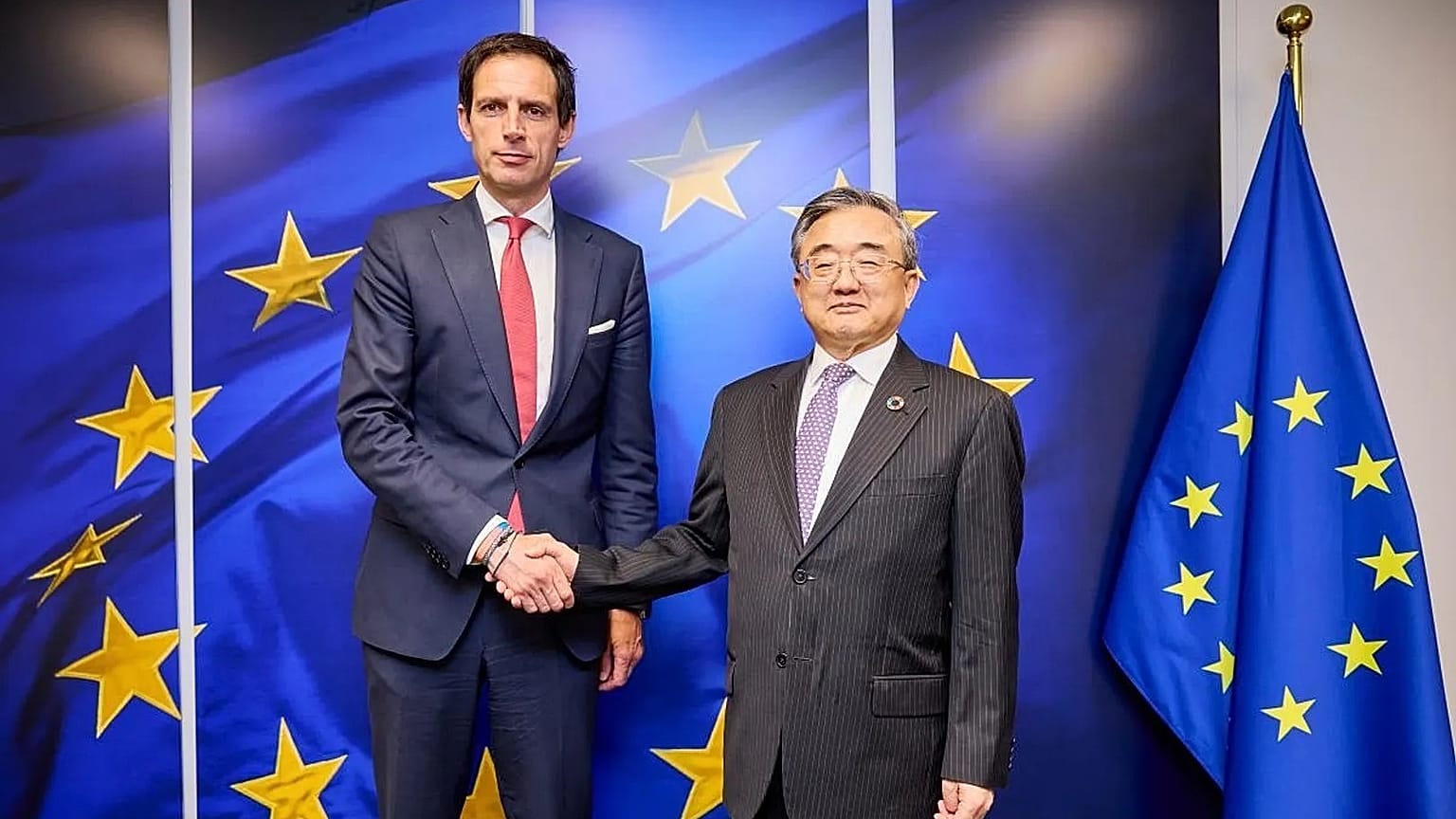
Hoekstra warns China dependence will make the EU’s green transition more costly, saying there is “no alternative” to levelling the playing field.
Europe must accept higher short-term costs to reduce its dependence on China for clean-energy technologies, EU Climate Action Commissioner Wopke Hoekstra has told Euronews, warning that delaying action will make the strategic vulnerability harder and more expensive to unwind.
The EU should have confronted its reliance on China “five to ten years ago”, Hoekstra said, arguing that waiting longer would bring greater disruption and costs.
“But it will be much cheaper and much more to our advantage to do it now than be wishy washy and wait another five to 10 years,” the Dutch Commissioner said.
Europe needs to rapidly deploy solar, wind, batteries and other clean technologies to reach climate neutrality by 2050. But Hoekstra warned that heavy reliance on Chinese manufacturers for electric vehicles, batteries, solar panels and energy storage risks replacing one strategic dependency with another — echoing Europe’s former dependence on Russia for cheap energy.
“This will stay with us for years to come, because the dependencies in many domains have simply become too large,” he said, describing the situation as a “dangerous and uncomfortable” vulnerability for both Europe’s climate ambitions and economic security.
Chinese companies already dominate key parts of Europe’s battery supply chain. They account for more than 80% of the bloc’s residential battery energy storage market and nearly 88% of lithium-ion battery imports, according to Wood Mackenzie.
The EU’s dependence on China for critical materials is also deep-rooted.
The issue has risen up the EU’s political agenda as the rapid expansion of wind and solar power outpaces the development of storage infrastructure. EU energy ministers recently discussed the bloc’s reliance on Chinese-made storage during a meeting under the Cyprus EU Presidency.
The wider trade relationship is also under pressure. The EU’s trade deficit with China reached a record €1 billion a day in 2025, prompting European leaders to call for a rebalancing of what they describe as “unsustainable” economic relations.
“Dialogue with China remains necessary. But it must produce results. And when dialogue is not enough, we must be ready to make full use of our instruments,” Commission President Ursula von der Leyen said on 27 August.
Tensions have intensified as Brussels has taken measures to protect the European market, targeting Chinese companies over issues including illegal products, state subsidies and foreign investment. Beijing has threatened retaliation.
Hoekstra pointed to Europe’s solar industry as a warning of what can happen when domestic production loses out to heavily subsidised Chinese imports.
But the Commissioner went further, raising concerns about alleged Chinese interference and security risks involving critical infrastructure in Europe.
“Kill switches are being included in windmills. Espionage happens at a very high degree on European soil. Intellectual property theft in our most advanced companies happens on a weekly basis and on and on and on — that is something no government and the EU can simply allow,” he said.
The comments come as Brussels seeks tangible progress in its economic relationship with Beijing.
Technical talks between the EU and China are expected to advance in October, with EU Trade Commissioner Maroš Šefčovič expected to travel to China.
For Hoekstra, however, the goal is not to end trade with China but to ensure that Europe is no longer vulnerable to a single external supplier for technologies critical to its energy transition.
The challenge, he said, is to build European capacity now — even if doing so comes with higher costs in the short term.
No comments:
Post a Comment