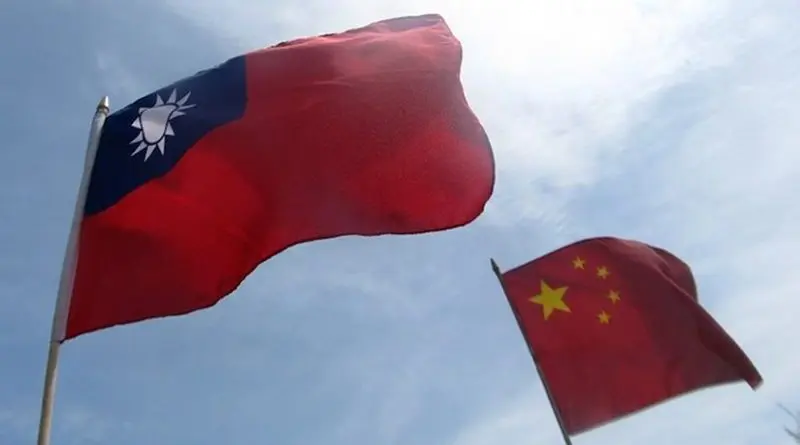
Flags of the Republic of China (Taiwan) and the People's Republic of China. CC BY-SA 4.0
By Dr. Rajaram Panda
Key Takeaways:
Taiwan is recognized by 12 states; four are in the Caribbean (Haiti, St Kitts and Nevis, St Lucia, SVG). China peels allies with aid; Taipei uses aid to hold the rest. Beijing also objected when Palau hosted Taiwan’s foreign minister at the August 2026 Pacific Islands Forum.
After Hurricane Ivan (damage >200% of GDP) Grenada left Taiwan for China in 2005.
After Hurricane Ivan (damage >200% of GDP) Grenada left Taiwan for China in 2005.
Taipei sued in New York over defaulted loans, chased cruise and other revenues, and settled years later by cutting ~$22 million roughly in half. SVG’s Taiwanese debt is cited as $37 million (2022) to $345 million (2026), with New York-law acceleration if it switches; a Taipei trip yielded a $2 million grant. The author treats Grenada as a warning shot to remaining allies.
In the South Pacific, Australia is signing security deals (Vanuatu June 2026; Fiji’s first mutual defence treaty July 2026) while China remains a top trader and infrastructure partner. Island states hedge: Western security, Chinese commerce. The U.S. presence is older (Samoa, WWII bases) but Australia/NZ now carry much of the day-to-day contest Penny Wong called “permanent.”
Taiwan as an island nation and economically vibrant has been facing existential crisis since the days Nationalists fled from the mainland China after losing the civil war and after the Peoples Republic of China’s economic rise and increasing assertiveness over claims of Taiwan as an integral part of the PRC. After the US changed its recognition from Taiwan to China as the official entity, not only Taiwan lost its UN membership but lost its status as a country altogether. Since then China has used economic aid as a bargaining tool to Taiwan’s diplomatic allies and enticed those diplomatic allies to switch allegiance. As a result Taiwan is left with few diplomatic allies, mostly small island nations in the Caribbean region and the islands nations in the South Pacific.
The Caribbean has played a significant role in Taiwan’s foreign relations, as several Caribbean states are among the small number of countries that maintain formal diplomatic recognition of Taiwan rather than the PRC. These relationships have been shaped by international competition for diplomatic recognition, development cooperation, and shifting regional and global geopolitics.
As of 2026, nine states in the Caribbean recognized the PRC and four recognized the Republic of China, Taiwan’s official name. The region has remained one of the most important diplomatic strongholds for Taiwan in the Western Hemisphere. Today, Taiwan is recognised by only 12 states, with four of them – Haiti, Saint Kitts and Nevis, Saint Lucia and SVG – in the Caribbean.
China has objected in a routine manner whenever high level political leaders from other countries have visited Taiwan or Taiwan has participated in any other regional forums. The latest in this narrative is when Taiwan joined the 55th Pacific Islands Forum Leaders meeting in Koror, Palau in the last week of August 2026. China voiced its opposition, with Beijing’s envoy to the Pacific Qian Bo threatening unspecified consequences over its presence at the conference, which is not a dialogue partner for the forum. Palau, a stunning West Pacific archipelago of less than 20,000 people, is one of a dozen remaining nations that maintain diplomatic nations with Taiwan. As host of 2026 Pacific Islands Forum, it invited Taiwan’s foreign minister to attend, one of Taipei’s few remaining avenues for international exposure.
Taiwan too has used economic diplomacy with the island nations in the Pacific and the Caribbean region to keep and save diplomatic ties with those diplomatic allies. In fact, both China and Taiwan virtually compete in giving economic aid as inducement to switch allegiance and maintain diplomatic ties respectively. In this competition, China has almost succeeded in most cases, thereby marching ahead for total diplomatic isolation of Taiwan. This has been the strategy of Beijing for ultimate reunification of Taiwan with the mainland.
Being pushed to the wall for survival, Taiwan too has explored all possible means to keep diplomatic ties with the remaining dozen of allies. Grenada is a test case for Taiwan on how to deal with this Caribbean nation. In 1989, Grenada severed ties with China and recognised Taiwan, causing Beijing to cut formal relations due to the One-China policy. Then in 2005 Grenada switched diplomatic allegiance from Taiwan to China.
This provoked Taiwan to play the debt hardball diplomacy that carries a clear warning for its remaining allies. Taiwan dragged its former diplomatic partner Grenada through US courts to collect on defaulted loans. In fact the debt trap strategy was originally used by Beijing, leading to many small countries to switch allegiance from Taiwan to China. Analysts often warned these small countries to be careful not to fall into China’s debt trap and thus avoid bilateral loans from China. Grenada’s debt dispute is not recent; it is decade old and Taiwan decided to weaponise to indirectly send a message to Beijing that it too can play the hardball.
What was Grenada’s economic situation and what compelled it to borrow loans from Taiwan, which it failed to repay? In 2004, Grenada was decimated by Hurricane Ivan and this led the Grenadian government to make a strategic decision to shift diplomatic recognition from Taiwan to China in 2005. When Grenada was hit by another hurricane in 2005, its population of 10,000 suffered with huge economic damage, needing external help.
When Grenada switched diplomatic allegiance from Taiwan to China, it was a big blow to Taiwan. Following the devastation caused by the hurricanes in two successive years, Grenada’s economy was in shambles. Grenada required immediate liquidity for rebuilding its battered infrastructure, which Beijing was too happy to provide. Therefore the switch was born of necessity than any other reason. The damage from Ivan was more than 200 per cent of gross domestic product. Over 90 per cent of homes were damaged or destroyed, and half of the population was left homeless.
At that time, Taiwan was Grenada’s largest creditor and had reason to feel betrayed over Grenada’s decision to switch allegiance. Taipei sued Grenada in a New York court to recover the full outstanding amount. Writing in South China Morning Post, Alex Lo observes: “Thus began a spiteful, decade-long legal battle. Taiwan wielded the loan contract’s sovereign immunity waiver like a bludgeon, attempting to seize Grenada’s revenue streams from cruise lines, shipping companies and international arbitration awards.” The lawsuit affected Grenada greatly and was not able to recover sooner than expected. The courts eventually sided with Grenada, and a settlement was reached a decade later by halving the total debt of about $22 million. Yet, the damage was already done.
By going to court to recover its money, Taiwan indirectly sent a message to the remaining allies to be watchful in dealing with international finance. Taiwan activated its debt-trap diplomacy as a desperate step to remain relevant in international politics and maintain its status as a sovereign entity.
The situation of Saint Vincent and the Grenadines (SVG), another ally of Taiwan, is equally precarious. Its debt-fuelled alliance with Taipei looks increasingly unsustainable. Its Taiwanese debt is skyrocketing. The figures have ballooned from $37 million in 2022 to $345 million in 2026. With little money available, the government is unable to fund investment for growth. The loan agreements are governed by New York law. This includes a clause that would make SVG immediately repay should it switch diplomatic recognition. The government of SVG has very little fiscal space for social programmes. The SVG Prime Minister travelled to Taipei to celebrate the 45th anniversary of diplomatic ties. Though his real purpose was to ease pressure on the national debt, he failed in his mission, except getting a paltry grant of $2 million.
Seeing Grenada’s case, SVG did not hesitate to publicly declare its commitment to maintain diplomatic relations. SVG is aware how Taipei would respond should there be any attempt at a diplomatic switch. The government now faces an almost impossible challenge: stabilising a struggling economy, protecting essential social programmes, and stimulating growth through investment. Reliance on Western and Taiwanese economic aid and borrowing are the primary reasons, and politically under the influence of the US, the small number of Taiwan’s remaining diplomatic partners, mainly small island states in the Caribbean and Oceania, including Palau, Tuvalu and the Marshall Islands, effectively remain captive from recognising China.
The situation is no different in the Pacific island nations where competition for influence between China and Australia is in full play. Like the small states in the Caribbean, the Pacific nations are also walking a tightrope between Western security and Chinese trade. Compared to the vulnerabilities of the Caribbean island states, the small states in the South Pacific have a bigger neighbour in Australia to rely on and keep China at bay. While Australia’s approach, besides economic aid, has been by signing defence pacts in the region, Beijing uses aid diplomacy to spread its influence. For the South Pacific islands, though long neglected as a geopolitical backwater, the strategic significance of the region has assumed added importance in the wake of maritime trade and convergence of interests. Signing defence pacts has emerged a significant tool to protest their strategic and national interests.
While Australia provides security guarantees to the Pacific island states by signing security pacts, China is busy building infrastructure and deepening its economic footprint. In June 2026, Vanuatu, just 1090 mile east of Australia, signed a security pact with Australia. A week later in early July, Fiji signed its first mutual defence treaty with Australia. The treaty is open for other Pacific nations to join. As admitted by Australian Foreign Minister Penny Wong, such manoeuvre by Australia was a “permanent contest” for influence in the region against an increasingly assertive China. Seen from a larger perspective, this is a demonstration of Australia’s ambition of becoming the Pacific’s preferred security partner and by eliminating China’s influence from the region.
Graeme Smith, deputy director of the Coral Bell School of Asia-Pacific Affairs at the Australian National University is quoted to have observed in a post in the South China Morning Post that these pacts are a calculated hedge by the Pacific Island nations. For almost all Pacific countries, China is a major trading partner. At the same time, the US has extensive military facilities across the Pacific Ocean. Neither the Pacific nations nor China has the capacity to see America’s eclipse from the region. The best for the Pacific island states therefore is to make the best of the current situation.
The US military presence in the South Pacific is not recent; it dates back to the late 19th century, when the US annexed American Samoa and soon built its first naval base south of the equator. During World War II, the Allies operated airbases and naval airfields across the South Pacific – including in Papua New Guinea, Fiji and the Solomon Islands. After the War, the US shifted its security focus northwards to Guam and Hawaii, largely leaving it to Australia and New Zealand to further Western interests in the South Pacific. Since then, the geopolitics in the region has undergone a change with China’s rise as an economic behemoth with unlimited appetite to spread its influence wherever its economic and security interests coalesce. This makes the South Pacific region as a theatre for great power competition between China and Australia/New Zealand. For the Pacific island nations, Australia might be the preferred security partner but China is still relevant for their economic lifeline in terms of trade, aid and economic development. The Pacific island nations are left with no choice but to play such balancing act for their national interests. In this power game, while Australia and New Zealand are unlikely to withdraw their engagement with the Pacific nations, Beijing is likely to continue capitalising on the Pacific Island nations’ desire to balance competing major powers.
About Dr. Rajaram Panda
Dr. Rajaram Panda is former Senior Fellow at Pradhanmantri Memorial Museum and Library (PMML). Earlier Dr Panda was Senior Fellow at MP-IDSA and ICCR Chair Professor at Reitaku University, JAPAN. His latest book "India and Japan: Past, Present and Future" was published in 2024 by Knowledge World. E-mail: rajaram.panda@gmail.com
View all posts by Dr. Rajaram Panda →
No comments:
Post a Comment