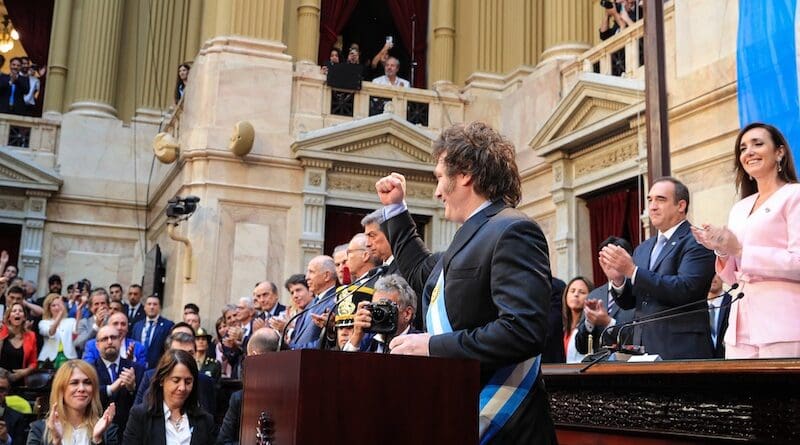
Argentina's President Javier Milei. Photo Credit: casarosada.gob.ar
September 15, 2026
By Alejandro A. Tagliavini
Key Takeaways:
Official 2025 GDP +4.4% is tied partly to state-levered finance. About 31,000 firms closed (DW Español); July 2026 manufacturing and construction fell. The state’s share of jobs rose because private work fell more.
CPI ~33.5% y/y, very high real lending rates, and a peso ~30% stronger in real terms since 2023 are blamed for arrears and cheaper imports. The slump, the piece argues, is a heavier state—not a free market.
Soon we met at a seminar, and the room where I was doing my dissertation was practically empty, his was packed. I took the opportunity to listen to him.
I couldn’t get over my surprise: he uttered elaborate phrases, quotes from famous authors, with a lot of logical disconnection between them. Clearly, he “spoke in difficult”, to pass for a great intellectual and so that most would not understand what he was saying and would not notice his intellectual laziness.
Ten minutes later, the shame of others for him and for the listeners overcame me and I withdrew. Years later, I read a proposal of his that included aid from the IMF which, as a (multi) state bank, by the principle of survival, promotes the sustained intervention of the State.
Milei from the beginning is incapable of establishing a free economy because, as his already long government confirms, he never understood how a society, the market, works. And, of course, he does not understand freedom, but only for himself and for those he considers deserving it, not in its entirety as it should be or is not.
The first year of his government, 2024, GDP fell 1.7% according to official data, my perception is that it fell more.
I have heard a lot of “reasons” about what happened, starting with the classic official disclaimer blaming the “inheritance received” when common sense, logic, says that a bad inheritance means starting with few resources if any, even debts, but not that it continues to fall.
Most analysts, those who have been the most cited and listened to for decades – hence the vicious Argentine mediocrity – rehearsed excuses such as inertia, the international scenario, the lack of consumer confidence and other arguments without scientific foundation.
When the question is very simple: an economy that falls is one that produces less, why, because it has “less strength” – less money – because it is absorbed by the State. Milei does not understand this and believes that he must first “put the State in order”, even at the cost of the private sector, which shows his true ideology: first it is the State and, with this excuse, he does not release even the most basic, the monetary system by keeping the currency exchange corseted.
At the beginning of his term, in December 2023, he strongly increased the relative tax burden, thus taking away strength, resources, from the private sector, which is the one that produces efficiently. He raised some taxes – such as the “For an Inclusive and Supportive Argentina”, very woke, from 7.5% to 17.5% – but the most serious thing was that he removed subsidies from many companies, which resulted in a sharp increase in tariffs that he did not compensate for by returning the taxes with which those subsidies were financed, then, with personal disposable income reduced by the rise in tariffs and taxes, the economy fell.
Real private wages fell 3.6% since 2023, but disposable income plummeted between 22% and 31% as utility rates accumulated an increase of up to 944% since December 2023, when the official CPI advanced by around 328.57%.
This extraordinary initial increase in the tax burden was never reversed despite the official discourse, and my perception is that it increased even more, although this is difficult to calculate since some taxes were cut, others went up and there is a lot of cross-information impossible to quantify seriously.
His incoherent discourse is severely damaging the idea of freedom, because many, with little scientific ability, repeat his rant and attribute the economic debacle to the free market. For example, The Economist publishes an unserious article propagating the idea that the free market is faltering in Argentina, when the crisis is due to the sharp increase in the weight of the State.
If I had to define Milei ideologically, I would say that he is neo-fascist, which is not surprising in the conservative – like any human society – Argentina that has lived like this for decades. Its political system is based on corporations: the business (now strengthened by the so-called RIGI), the trade union, the military exultant by Milei and the media.
How the economy continued after 2024. In the best of cases, mediocre with a tendency to fall. In 2025, according to official data, GDP rose 4.4% thanks, for example, to financial intermediation (+24.7%) leveraged by the State. In 2026, GDP is weak and with a downward trend, according to official data. In addition to the fact that this is official data, let us remember that GDP measures the “inflow of money”, not the real growth of the economy, which is the increase in production when it results from a consolidated increase in productivity.
As DW Español has achieved, so far during Milei’s government, some 31,000 companies have closed and although new ones have emerged, they are not enough to compensate. Among the direct causes is the 10% drop in mass consumption, including e-commerce.
In July 2026 – the latest data known – manufacturing production plummeted 5% month-on-month, while construction plummeted 4.6%, according to official data. Sectors that represent 25% of registered private salaried employment.
As can be seen in the chart published by the prominent economist Roberto Cachanosky, the Industrial Production Index is on a downward trend:

It is not accurate to say that the structure of the State was “reduced” because, although it was reduced by a minimum proportion in absolute terms, the fall of the private sector was greater, so that, in relation to – which is what counts – Milei has achieved what he really wanted: to strengthen the State, to enlarge it. Consistently, a few state jobs were cut, but the fall in the private sector was greater, so today there are more state employees for each in the private sector, which is what counts.
As for deregulation, in the best of cases, it can be said that they have been few and weak.
The uncontrolled state interventions in the monetary system cause very high inflation with an official CPI rising to 33.5% year-on-year because of an excess of issuance. It has no scientific basis, it is only propaganda, to justify it by arguing that it fell compared to the previous government.

In addition, interest rates are destined, literally, to destroy the citizens. The graph of the Argentine Fintech Chamber shows the real rate reaches, in this case, 850% per year:

Causing a record in the delinquency of family debts:

To top it off, due to state control over the currency exchange market, the peso appreciated by 30% – discounting the rise in the CPI – since 2023, which raised local production costs and made external competition cheaper. This leads to the accusation of free trade, the “indiscriminate opening” – “opening” that is only partial – of imports, for the destruction of local industry, which is not true, but that, with the overvalued peso, foreign products have been artificially cheapened.
Corollary: in addition to Milei’s lack of knowledge about how the market and society work, the fall in the economy brings a drop in tax collection, causing, in a vicious circle, that in his eagerness to keep the State strong, he punishes the private sector even more.
About Alejandro A. Tagliavini
Alejandro A. Tagliavini works in private investment and academic activities. Since 2006, he has been a member of the Advisory Board of the Center on Global Prosperity of The Independent Institute of Oakland, California, USA. He is a graduate of the University of Buenos Aires, where he received a degree in civil engineering.
View all posts by Alejandro A. Tagliavini →
Argentina moves to tighten Falklands sanctions as Milei defends economic course

Argentine President Javier Milei met with his cabinet on September 14 to review the economy and advance a government strategy on the British-controlled Falkland Islands (also known as Malvinas), with the executive preparing legislation that would tighten sanctions on companies involved in hydrocarbon and fishing activities in the disputed territory.
The meeting at the Casa Rosada lasted about 90 minutes and included Chief of Cabinet Diego Santilli, Economy Minister Luis Caputo, Foreign Minister Pablo Quirno, Human Capital Minister Sandra Pettovello, Health Minister Mario Lugones and Justice Minister Juan Bautista Mahiques, as well as congressional leaders Martín Menem and Patricia Bullrich.
Quirno briefed the cabinet on criminal complaints and notifications sent in recent days to companies linked to activities around the islands. He also presented an updated version of the sovereignty bill that the government plans to submit to the lower house this week.
The legislation would strengthen Law 26,659, passed in 2011 under former president Cristina Fernández de Kirchner, which already bans and penalises hydrocarbon activities carried out without Argentine authorisation on the disputed continental shelf. The government plans to boost the sanctions framework after filing a criminal complaint against five companies associated with the Sea Lion oil project, run by British firm Rockhopper Exploration and Israel-based Navitas Petroleum, and opening administrative proceedings against 60 people and companies.
The proposed package would also establish a National Security Council involving the foreign, defence and economy ministries and the State Intelligence Secretariat. The government says the body would help identify potential threats to national security.
The sovereignty initiative, stemming from a recently revived long-standing Argentine claim over the disputed archipelago, comes alongside plans for greater Argentine strategic involvement in the South Atlantic. During the cabinet meeting, officials reviewed the geopolitical importance of the region in the context of international trade and growing interest in its natural resources.
The economic discussion focused on preserving the government's current policy framework. Milei told ministers that Argentina needed to protect what he described as its restored economic reputation and avoid changes that could undermine the programme used to stabilise key economic indicators.
“Populism is not defeated with populism,” Milei said.
The president is also due to meet La Libertad Avanza lawmakers as the government prepares for a busy period in Congress. The 2027 budget is expected to be submitted this week, while the Senate is due to discuss electoral reform and the administration continues to seek support for other economic measures.
The sovereignty bill is heading into a difficult legislative environment. La Libertad Avanza, Milei's right-wing libertarian party, recently lost votes in the lower house and was unable to secure enough support to convene a Senate session.
Opposition lawmakers have questioned whether the government should introduce tougher sanctions before fully enforcing the existing legal framework. Socialist deputy Esteban Paulón has also called for the reactivation of the National Council on Matters Relating to the Malvinas Islands, established in 2020 but convened only once, in August 2024.
The package also intersects with the government's plans for security and defence. A recent emergency decree allocated 30.519bn pesos to the State Intelligence Secretariat, 217.954bn pesos to defence and 119.290bn pesos to the National Space Activities Commission. The planned integrated naval base in Tierra del Fuego is covered by the decree, although no separate amount was specified.
Defence Minister Carlos Presti and Foreign Minister Pablo Quirno travelled to Tierra del Fuego to restart the naval base project in recent days. But the move has drawn criticism over what opponents call the government's inconsistent policy: former Peronist defence minister and lawmaker Jorge Taiana said construction had begun in 2021 and reached only about 9% completion before the current administration halted it on cost-cutting grounds, citing the province's short construction season.
This week's legislative agenda therefore combines the Falklands sovereignty initiative with the 2027 budget and political reforms, while Milei seeks to stay the course with the sweeping economic agenda his administration considers central to its stabilisation strategy.
No comments:
Post a Comment