_3.jpg)
Not to put watermelons under the arms of the Iranian leadership (getting a big head, to borrow a Persian-language phrase), but Canadian Prime Minister Mark Carney's recent boomerang-like tough rhetoric back at the American leadership's hardline demands shows an entirely new side to Canada's relationship with the United States.
Under Carney's premiership, Canada has moved away from the happy-go-lucky air of Justin Trudeau toward a more serious, businesslike approach. We need not mention that Carney has run both the Bank of England and the Bank of Canada, along with holding a slew of other top roles, before entering power in Ottawa.
But that quick change between the Trudeau and Carney regimes in Canada also belies a significant shift in strategy in dealing with the elephant down below. Ever the career professional, when meeting US President Donald Trump in person for the first time, the Canadian leader managed to bat off his quite unreasonable demands.
"As you know from real estate, there are some places that are never for sale. We're sitting in one right now — Buckingham Palace, you visited, as well — and having met with the owners of Canada over the course of the campaign these last several months, it's not for sale. Won't be for sale ever."
He also said afterwards that he'd told Trump the 51st-state comments were "not useful", and described the talks as "wide-ranging" and "constructive".
Still, the forthright nature of Carney's comments appears not to have placated the Trump administration's desire to call the shots with Ottawa, and has hardened the Liberal government's stance on the situation between the two neighbours.
Trump, with his ever-shortening attention span, appeared to have forgotten about the subject of Canada for several months until the Iranians managed to bat off American aggression by blocking the Strait of Hormuz. By strangling the international oil, gas and fertiliser markets, the Iranians got the world's attention — and, some would say, admiration in certain quarters, probably not Ottawa's. Nonetheless, they have moved the dial on what the US is able to do and the limits of American power and hubris.
Countries and populations across the world are now beginning to emulate certain aspects of the Iranian position. Canada, potentially the latest punching bag, has also learned a lesson from the Islamabad negotiations between Tehran and Washington, which appear to have gone nowhere fast. They are in fact directly emulating that set of failed discussions by not playing ball.
What those negotiations showed was the US — with its all-star duo of Jared Kushner (the president's son-in-law) and Steve Witkoff (the property developer), both of whom appear to be pulling strings and running rings around the Oval Office — is not using the breadth of experience of diplomats and subject-matter experts, but gut feelings and vibes in negotiations. Well, you can imagine how well those negotiations go when you are dealing with people with singular agendas and limited context on situations.
We could say the same is true for the collapsed trade negotiations in Canada: requests like hugely damaging auto tariffs, and even more bizarre cultural demands such as French being removed from packaging because Americans can't read French, show the lengths to which the US will go to in its singular-minded mission in recent discussions.
The outcome is then entirely predictable and part of a long-term pattern now repeating itself with actual opponents — bar Venezuela, where the US appears to be negotiating with itself over oil imports from Caracas. Canada will keep rejecting hugely damaging demands because it's not in its interests to collapse its own economy, much like the other countries before them.
We have not yet had the so-called "Hormuz moment" for Canada, one in which Canada does something drastic to the Americans. But if social media is anything to go by, the vitriol directed at the Americans is spilling over.
Whether it is an oil pipeline traversing its territory being cut off from the Americans, or border closures, or even the Canadians blocking access for American trawlers going through the Great Lakes area, all of these are looking more appealing to many across Canada as negotiations between the neighbours turn "nasty", to use Carney's own words. Just take a look at Canadian Twitter accounts, which were previously reasonable, now visibly cursing the Americans; this is an entirely new situation.
At the August 22 press conference in Ottawa, Carney said: "We were not prepared to compromise Canada's sovereignty or to undermine key industries", adding: "You are at war when you get attacked. We got attacked."
"Canada will match those tariffs dollar for dollar" — concentrated on steel, dairy, appliances, agricultural equipment, pulp and paper, and electronics, from September 8. On critical minerals, he said Canada would never give the US "exclusive access".
So, if the course has been set, where do both countries go from here? A US blockade of Canadian entry points? Is the US Navy going to block the port of Saint John in New Brunswick and force players like DP World out? Who knows where this is all going.
The rest of the world is also noticing, including the Iranians. The country’s foreign ministry spokesperson, Esmail Baghaei, noticed the mess between Ottawa and Washington and decided to pile in on August 16, saying: "Washington calls Canada its 51st state; Washington imposes tariffs on Canadian goods; Washington insults Canada and threatens to punish it over wildfire smoke; Ottawa's response: Understood, Sir! Meanwhile, Ottawa participates in the US-led unlawful war of choice against Iran, to appease Washington! What's the reward? THIS IS NOT HOCKEY NIGHT IN CANADA; IT IS WASHINGTON'S FARM TEAM."
That "farm team" is a hockey reference indicating that Canada was a minor-league team being used as a subordinate by the US. Remember, relations between Tehran and Ottawa are still at an all-time low, with Canada, on several occasions, doing the US's bidding and closing its embassy in the Iranian capital, so there is no love lost between the two.
To understand where this is all going, then, is to assume we have a magic ball into the minds of the respective governments. Carney will not be calling Iran’s President Pezeshkian for tips on how to deal with the White House anytime soon, but the Ottawa administration should look at how those discussions have effectively failed and become stagnant, and attempt to avoid the same fate.
Crowd goes nuts as Canadian rock band tells Trump to shove it: 'You’re good Canadians'
Tom Boggioni
August 31, 2026
A beloved Canadian alt-country band that's been entertaining crowds since 1984 just handed President Trump a musical middle finger over his push to rename Lake Ontario.
According to a report from the Daily Beast, Blue Rodeo took the stage at Toronto's RBC Amphitheater on Saturday, a 16,000-capacity venue sitting directly on the Lake Ontario waterfront. During the show, the band played their 1993 fan favorite "Hasn't Hit Me Yet," which features the lyrics: "Watching the snow fall on this cold December night, and out in the middle of Lake Ontario, the same snow is falling on the deep silent water."
"On Saturday, before lead vocalist Greg Keelor played the tune, he told the audience, 'At the end of this song, there’s a mention of a lake. It’s a lake right behind us right there,'" the Beast is reporting before adding, "Pointing to the lake and noting that its name has 'become a little controversial,' Keelor added, 'I would just like you to sing tonight with full authority and ownership. And we’ll sing this one for the shining waters that have been there long before any of us were ever here.""
The crowd erupted, chanting "Lake Ontario" throughout the song in defiance of Trump's executive order renaming the lake "Lake America" amid his escalating trade war with Canada.
According to the report, the screens behind the band displayed a map still labeled "Lake Ontario."
After the song wrapped, Keelor told the audience: "That was some good singing, folks. You're good Canadians. God bless you. We love you for it."
Lake Ontario or Lake America? Google Maps results differ in Canada, US and across the world
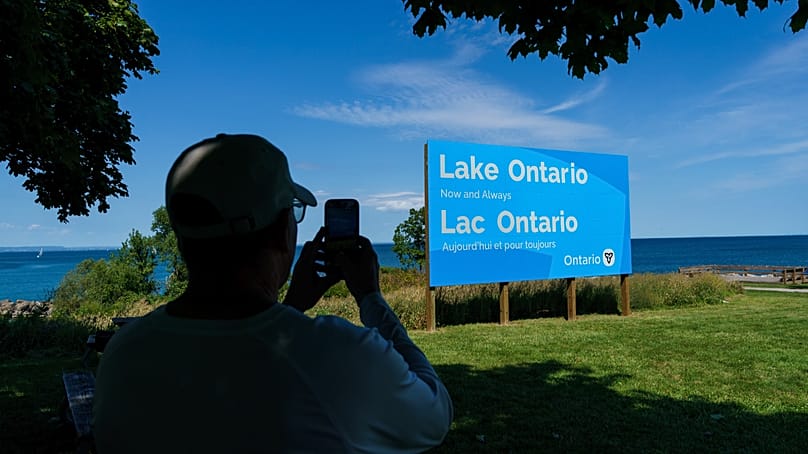
What you call Lake Ontario now depends on where you are logging in from. Google Maps has begun showing "Lake America" to US users following US President Donald Trump's executive order, while Canadians still see the name that has stood for more than 400 years.
Google has relabelled Lake Ontario "Lake America" for US map users after President Donald Trump ordered the Great Lake renamed, in a move Ontario Premier Doug Ford branded "absolutely backwards" as the US-Canada trade war deepens.
Canadians will still see "Lake Ontario," the Indigenous-rooted name used since the 17th century on their screens, the tech giant said.
The nomenclatural spat erupted as the latest element of Trump's "America First" narrative, with the longtime allies ramping up a trade war that has seen Washington and Ottawa slap tit-for-tat tariffs on each other.
Trump launched a new salvo of criticism Sunday, taking aim at the auto industry — even as the United States and Canada have deeply interconnected auto manufacturing sectors, with a hefty amount of Canadian parts used in US-made vehicles.
Canada exported C$78.6bn (€50bn) in automotive products in 2025, with nearly 95% of that bound for the US market, according to DesRosiers Automotive Consultants.
Parts often cross the Canada-US border several times before a vehicle is fully assembled, so a tariff on a single component can compound more than once before the car reaches a showroom.
Washington has applied a 25% tariff on the non-US content of Canadian-built vehicles since April 2025, a rate due to double to 50% from 1 January 2027 after trade talks between Trump and Canadian Prime Minister Mark Carney broke down on 21 August.
"I don't want Canadian cars, I don't want Canadian parts, I don't want Canadian anything," Trump said in a post on his Truth Social platform.
A lake by any other name
Apple as of Sunday has maintained the name Lake Ontario on its Maps app, which comes pre-installed on iPhones in the United States.
Google said it made its change in line with the US Geographic Names Information System (GNIS), the official federal database for geographic names.
"Since we update Google Maps to reflect name changes in official government sources, which is GNIS for the US, people using Maps in the US will see 'Lake America,' those in Canada will continue to see 'Lake Ontario,' and those outside of the US and Canada will see both names," Google said on its blog.
The change mirrors Trump's unilateral altering of the name of the Gulf of Mexico to the Gulf of America in January 2025 — a move Mexico has also rejected.
Ontario is the smallest by surface area of the five Great Lakes, which straddle the Canada-US border between Ontario province and the US state of New York.
The province's premier, Doug Ford, offered fresh criticism Sunday of the trade dispute and Trump's lake name change.
"It's absolutely backwards. It was like something out of Saturday Night Live when he signed documents saying change it to Lake America," Ford said in an interview on ABC's This Week.
"No one is going to call it Lake of America. It's been Lake Ontario for hundreds of years, it's going to continue being Lake Ontario."
"It's just so disappointing," he said.
'A tax on American people'
Ford also warned that while a trade war would harm both countries, "it [would] definitely be devastating on the US" given that Canada has been by far the largest purchaser of US vehicles. Should those buys dry up, US auto factories would be hit hard.
"A tariff on Canada is nothing more than a tax on American people," he said. "It's probably the worst move you could ever do," he continued.
In his comments, Trump highlighted the success of Ford Motor Company's plant in the Detroit area that is working overtime to assemble F-150 pickup trucks.
"They've been ripping us off for decades, and it's going to stop," Trump said of Canada.
Many F-150 engines are built just across the border in Windsor, Ontario. But Trump has threatened to double tariffs on such auto parts to 50%, along with other Canadian products.
Canada has slapped its own counter-tariffs on US goods ranging between 15% and 50%, intensifying the trade war between the historically close allies.

.jpg)

No comments:
Post a Comment