“Pink Corridor” to Explore Nuclear-Powered Transatlantic Container Shipping
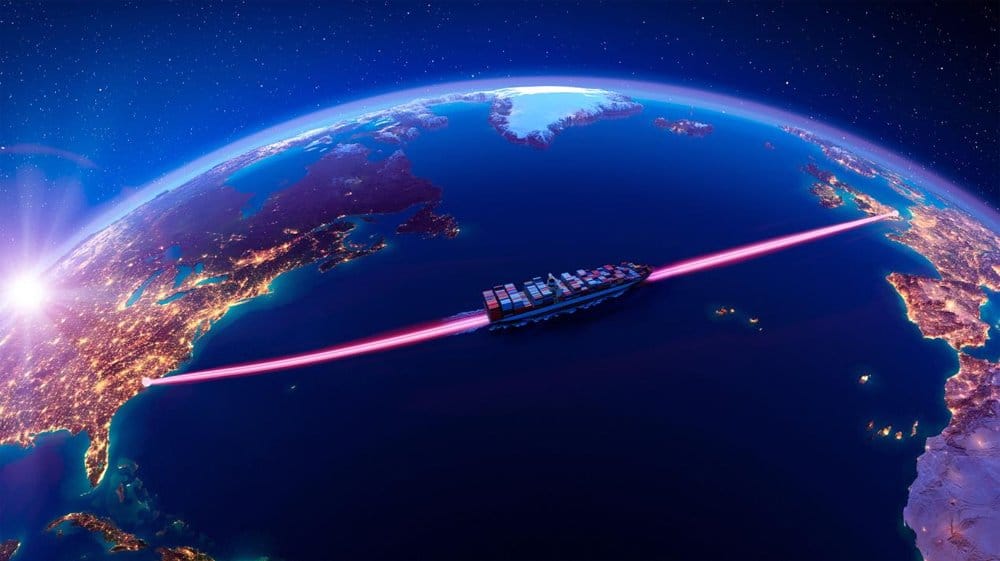
A new project focusing on the challenges of developing a so-called “pink corridor” for nuclear-powered transatlantic container shipping is taking shape. It will be led by Lloyd’s Register and A.P. Moller - Maersk working with the ports of Charleston, South Carolina, and Felixstowe in the UK to examine the security and safeguarding requirements for the theoretical deployment of a nuclear-powered containership route.
It comes as the prospects of nuclear-powered commercial shipping continue to entice the industry and regulators. Earlier forays into nuclear power for commercial shipping failed to gain traction in the 1950s and early 1960s other than the U.S. demonstration project Atoms for Peace that resulted in the passenger-cargo ship NS Savannah. Japan experimented with nuclear propulsion and the Soviets built a ship, Sevmorput, that remains active, as the industry is reawakening to the potential from a new generation of small nuclear reactors.
Last week, US Secretary for Transportation Sean Duffy posted, highlighting the potential for nuclear propulsion. It came as the US Maritime Administration signed a new agreement with UK-based Core Power’ that envisioned a fleet of 50 nuclear-powered merchant vessels. MARAD also announced agreements with the Port of Long Beach, California, and the Port of Corpus Christi, Texas, to explore nuclear projects.
According to the organizers, the Pink Corridor aims to provide a structured basis for collaboration, helping stakeholders understand the practical requirements, gaps and future work needed before any potential nuclear maritime corridor could be considered. Centered on a conceptual nuclear-powered container ship, the Pink Corridor will examine the requirements for theoretical port access on the specified route. Lloyd’s, Maersk, and the ports will focus on key areas including ship security, safeguards, cyber resilience, emergency response, insurance regimes, and alignment between maritime and nuclear regulatory expectations.
Nick Gross, Global Containerships Segment Director, LR, highlights they are taking a practical, collaborative approach to explore the issues. “The partnership brings together industry-leading players across shipping, ports and classification, reflecting the growing interest in nuclear technology as a route to more sustainable maritime operations,” says Gross.
The work is expected to support broader maritime development under the US-UK Technology Prosperity Deal and its bilateral commitment to explore civil maritime nuclear applications, including the potential creation of a shipping corridor between the two nations.
The collaboration also builds on LR and Core Power’s 2024 regulatory assessment study, which was formalized with Maersk through a joint development project exploring the safety, operational, and regulatory requirements for applying advanced nuclear power to container shipping.
The outcomes of the initial phase of the Pink Corridor project will inform the scope of a potential second phase, including areas requiring further study across engineering, regulatory, legislative, security and safeguards frameworks for nuclear merchant ships.
Project to consider trans-Atlantic nuclear-powered cargo ships
_75167.jpg)
The Pink Corridor project will focus on the security and safeguards considerations needed to inform future regulation and support the safe, secure and responsible adoption of nuclear power for commercial shipping between the Port of Charleston in South Carolina and the Port of Felixstowe in Suffolk, England. Centred on a conceptual nuclear-powered container ship, the partners will examine the requirements for theoretical port access on the specified route. Key areas of focus will include ship security, safeguards, cyber resilience, emergency response, insurance regimes and alignment between maritime and nuclear regulatory expectations.
The work is expected to support broader maritime development under the US-UK Technology Prosperity Deal and its bilateral commitment to explore civil maritime nuclear applications, including the potential creation of a shipping corridor between the two countries.
Lloyd's Register said the Pink Corridor project aims to provide a structured basis for collaboration, helping stakeholders understand the practical requirements, gaps and future work needed before any potential nuclear maritime corridor could be considered.
The outcomes of the initial phase of the Pink Corridor project will inform the scope of a potential second phase, including areas requiring further study across engineering, regulatory, legislative, security and safeguards frameworks for nuclear merchant ships.
"The Pink Corridor joint development programme is an important step for the application of nuclear technology in merchant shipping," said Nick Gross, Global Containerships Segment Director at Lloyd's Register. "By taking a practical, collaborative approach, the project will examine the security and safeguards that would need to be addressed for safe operations. The partnership brings together industry-leading players across shipping, ports and classification, reflecting the growing interest in nuclear technology as a route to more sustainable maritime operations."
Adam Ramsey, Commercial Director of the Port of Felixstowe, added: "As the UK's largest and busiest container port, the Port of Felixstowe is well-positioned to support the Pink Corridor and contribute practical insight to this important early-stage work. We are committed to improving the efficiency and resilience of our own operations, while supporting the wider industry as it explores sustainable, long-term propulsion options for global trade."
"As a major US East Coast port, Charleston is always looking for innovative, cost-effective, and sustainable ways to move freight," said Tom Boyle, SC Ports' Director of Vessel Operations and Carrier Sales. "The conceptual Pink Corridor project allows for the study of the possibility of a nuclear-powered maritime corridor."
The collaboration builds on an earlier study by Core Power, Maersk, Lloyd's Register and the Port of Rotterdam in the Netherlands which examined the safety, operational and regulatory considerations associated with a nuclear-powered container ship calling at a European Union port. Released in June, the study found that "the principal barriers to nuclear ship port calls are not technical, but relate instead to local and international regulatory alignment, governance, risk management integration and public acceptance".
The shipping industry consumes about 350 million tonnes of fossil fuel annually and accounts for about 3% of total worldwide carbon emissions. In July 2024, the shipping industry, via the International Maritime Organization (IMO), approved new targets for greenhouse gas emission reductions, aiming to reach net-zero emissions by, or around, 2050.
In July 2024, Lloyd's Register released a report that concluded nuclear power could transform the maritime industry with emissions-free shipping, whilst extending the life cycle of vessels and removing the uncertainty of fuel and refuelling infrastructure development. However, it said regulation and safety considerations must be addressed for its widespread commercial adoption.
There are a range of different development projects for using nuclear power in civilian vessels. The IMO is also revising the Safety Code for Nuclear Ships and the International Atomic Energy Agency launched its Applications at Sea (ATLAS) initiative last week, which "aims to support the maritime industry's exploration of small modular reactors to power civilian ships and to provide offshore energy, as operators consider alternative fuels and seek to strengthen long-term energy security."
No comments:
Post a Comment