Iceland’s 'no' vote deals a blow to Brussels’ security pitch to wealthy nations
Iceland rejected reopening EU membership, dealing a blow to Brussels' hope that security fears could draw wealthy neighbours closer to the bloc.
Brussels had hoped it could attract wealthier nations into its orbit by positioning itself as a pillar of defence and security in an increasingly volatile geopolitical landscape
Icelandic voters proved it wrong.
After the Icelandic government announced a referendum on whether to resume negotiations for joining the bloc, EU officials hailed the move as a sign the Union was shifting from being seen purely as a market to a fully fledged political actor.
As a result, security considerations were expected to override the historic reluctance of wealthier Nordic nations to join the Union.
"In a world where we face pressures from East and West, where old alliances are fading, and new ones emerging, where dependencies are weaponised, and where we are experiencing direct attacks on our democracy and our way of life, becoming stronger together is our biggest asset," Enlargement Commissioner Marta Kos said at a conference last week.
With 52.8% of Icelandic voters rejecting a resumption of EU membership negotiations, Brussels will now have to reckon with whether it can genuinely offer candidate countries a compelling security case.
Shifting world order
Recent geopolitical developments backed this reasoning: US President Donald Trump threatened to seize Greenland by force, Russia's war of aggression in Ukraine entered its fifth year, and the Arctic is becoming an increasingly contested arena for access to rare earth minerals and emerging trade routes.
In April, Iceland's Prime Minister Kristrún Frostadóttir told Euronews she expected the shifting geopolitical order would affect the public debate on the referendum, while stressing she did not want the discussion to be driven by fear.
Brussels also began interrogating itself on how it could bolster the security guarantee provided under Article 42.7 of the EU treaty, following a drone strike — likely carried out by Hezbollah using an Iranian-made drone — on the UK airbase in Cyprus, one of the few member states that is not a member of NATO.
A Eurobarometer survey from spring found that 75% of Europeans think the EU is a place of stability in a troubled world, with the share of people seeing the benefits of European Union membership reaching an all-time high.
However, Saturday's historic referendum delivered a powerful reality check for Brussels, as Icelandic voters rejected the prospect of negotiating EU membership, following an electoral campaign heavily focused on economic issues.
"Iceland's referendum offered a cold splash of reality on where the EU stands as a security provider," Chris Kremidas-Courtney, a senior advisor at the European Policy Centre, told Euronews.
"EU membership did not offer any unique territorial security guarantee. The referendum therefore turned on the economic bargain, especially on fisheries, currency, and sovereignty," Kremidas-Courtney said.
Economy over security
On both sides, the economy took centre stage in the referendum campaign — at least on the surface.
For the 'Yes' camp, the focus was on joining the euro as a way to lower the state's debt interest rates, offering immediate relief on mortgage rates and inflation. For the 'No' side, the focus was on maintaining Icelandic control over fishing and farming.
For Hulda Þórisdóttir, a professor at the University of Iceland, the referendum touched a deeper nerve around the nation's sovereignty and independence, and more broadly Iceland's place in the world — and the 'No' campaign tapped into issues much closer to Icelandic identity.
"The security angle might have reinforced existing views for voters already leaning towards a 'Yes' or a 'No', in light of pre-existing beliefs. But it was not a decisive issue during the campaign, as it was much less present than many anticipated," Þórisdóttir told Euronews.
Þórisdóttir argued that defence and security were probably top of mind for the political elite worried about international developments, whereas common people were more concerned about day-to-day economic issues.
The security argument may have cut both ways: talk of Europe's rearmament and the creation of a European army generated anxiety among Icelanders that they would be required to serve in the military for Brussels.
The defence issue touches a long-standing ambiguity in Icelandic society, which manages to see itself both as a founding member of NATO within a clear-cut international alliance, and as a peace-loving nation with no standing army.
NATO takes precedence
When Russia launched its full-scale invasion of Ukraine in 2022, it immediately prompted Sweden and Finland to apply for NATO membership. No similar impulse towards EU membership was registered among its immediate neighbours, such as Norway and Iceland.
Both Norway and Iceland are already NATO members and deeply integrated into Europe's security architecture. Despite Trump-driven US disengagement from the alliance, both countries appear to believe NATO membership suffices, and that Brussels has little more to offer on this front.
"If the Norwegian government did not believe the NATO security guarantee was credible any longer, it would have already started discussions on EU membership," said Espen Emil Thygesen, an advisor at the Norwegian think tank Agenda.
"Norway is already deeply integrated in EU defence cooperation. The calculation with the average voter is probably that the cost of full membership would outweigh the security benefits. Membership or not, the EU also has an interest in keeping Norway and Iceland close," Thygesen said.
In a recommendation on Arctic security adopted last year, the European Parliament went as far as suggesting the EU's security guarantee under Article 42.7 be extended to Norway, as part of deeper cooperation with Oslo to address critical gaps in Europe's collective defence.
Norway, for its part, considers itself to hold significant leverage with Washington, given its role in surveilling Russia's nuclear submarine fleet in the Kola Peninsula.
Iceland, in turn, did not feel threatened by Trump's claims over Greenland, seeing itself as a far more independent country and not as rich in the natural resources the Americans are interested in.
"In the end, Icelanders still see the EU primarily as a market to join — or not," the EPC's Kremidas-Courtney said.
Relief and sorrow in Iceland after EU membership talks referendum fail
The result of the referendum has also been hailed by right-wing figures from across the UK and France.
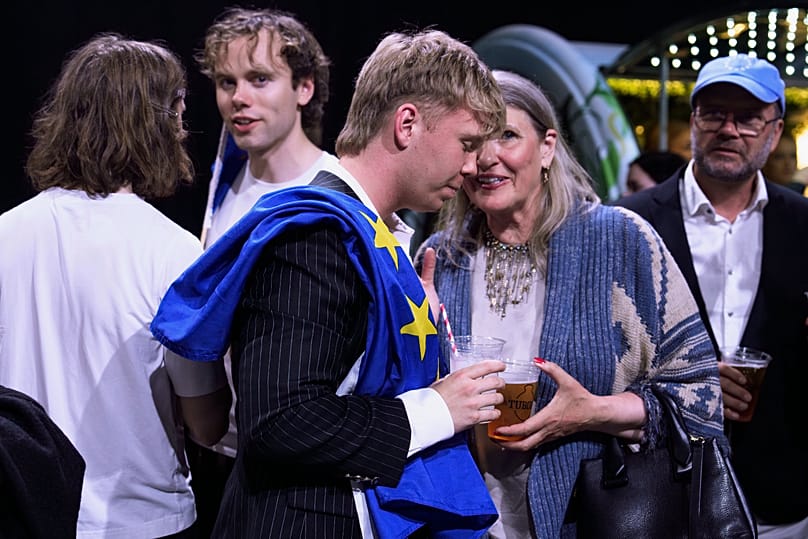
A mix of relief and dejection spread across Iceland on Sunday after the country narrowly voted "No" to resuming talks with the European Union on potential membership.
Many Icelanders had gathered in the capital Reykjavík to follow the results as they came in overnight, with both supporters and opponents of accession negotiations celebrating as the count progressed.
In Saturday's vote, 52.8% rejected resuming EU entry talks, while 47.2% voted "Yes," according to public broadcaster RÚV.
Speaking from Reykjavík after the result was called, Skuli Olafsson Skuli, a pastor, said he was "a little bit relieved."
"It has been quite aggressive, this discussion," he said. "But now I hope the opposing parties will find a way to make this community here in Iceland a little bit better just by using our own methods and, of course, those relations we have with Europe, America, and Asia."
Anna Maria Bogadottir, an artist, said the outcome of the vote had left her "in a kind of denial."
"It's hard to grasp that it's a no," she added.
Iceland's centre-left prime minister, Kristrún Frostadóttir, has pledged to "respect" the result while also praising the high voter turnout.
"It's obvious that close to half of the country wanted to continue these negotiations, but over half of the population did not. We will respect that result," Frostadóttir told a press conference on Sunday.
"The fact that we got people to the table on a matter like this is extremely important for us," she continued. "It gives us a stronger mandate to make a decision on this matter."
Writing on X, former Icelandic President Ólafur Ragnar Grímsson - who had backed the "No" campaign - said the "nation has spoken.
The result of the referendum has also been hailed by right-wing figures from across the UK and France.
Reform UK leader Nigel Farage - who was a key supporter of Brexit - congratulated Iceland on "voting to keep their independence."
France's Marine Le Pen added: "At a time when some are pushing for greater federalism and the transfer of sovereignty to the European Commission, this vote serves as a reminder that another Europe is possible – a Europe of free, sovereign nations cooperating voluntarily on matters of common interest."
For its part, the European Commission offered a short statement on the result, saying it "takes note of the outcome" and that it "respects the choice of the Icelandic people."
Iceland first applied for EU membership in 2009 in the wake of the 2008 financial crisis, with the Commission issuing a favourable opinion in February 2010. A new Eurosceptic government ended talks in 2013.
No comments:
Post a Comment