Federal Panel Halts What Would Be First Data Center on Public Lands
“The Trump administration is pulling out all the stops to let tech companies build massive data centers on our public lands. This tremendous victory proves communities have the power to fight back and win.”
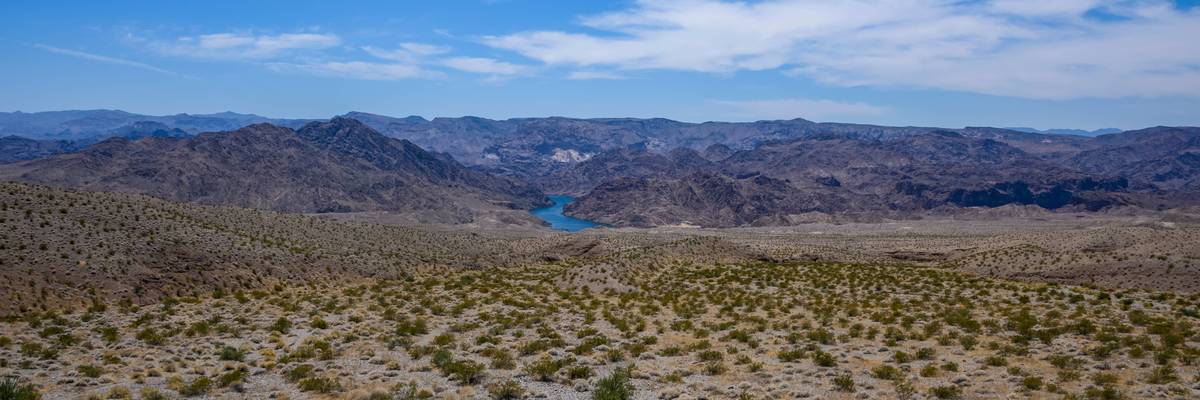
A stretch of desert near Boulder City, Nevada
(Photo by Judit Dombovari/Getty Images)
Stephen Prager
Sep 01, 2026
COMMON DREAMS
Environmental groups are celebrating on Tuesday after a federal panel halted construction of what would be the first artificial intelligence data center to be built on US public lands.
The Interior Board of Land Appeals, an appellate body within the US Department of the Interior, put a temporary stay on the Bureau of Land Management’s (BLM) approval of the proposed 80-acre Townsite Data Center near Boulder City, Nevada, which environmental groups warned would jack up electricity demand and water usage and threaten local species.
The board sided with the Sierra Club, the Center for Biological Diversity (CBD), and the local government of Boulder City, which argued that the BLM had not conducted the legally required review of the plan’s environmental impacts.
The BLM had approved the site based on a review of a proposed solar power plant, but had not reevaluated the impacts of a data center.
The board said that the environmental groups were “likely to prevail” in their case that the BLM had acted illegally “because the two projects are not ‘substantially the same.’” It also ruled that continuing the project without a proper review was likely to cause “irreparable harm” to the landscape—including soil disruption, habitat loss for species like the Mojave desert tortoise, and construction activities that pollute the air.
The temporary stay blocks the data center project from continuing while the board considers the environmental groups’ appeal.
While it was not a final ruling on whether the project will be built at all, Patrick Donnelly, Great Basin director at the CBD, said the group was “thrilled that this data center has been stopped dead in its tracks.”
Townsite has been described as a test case as BLM considers approving other data center proposals on federal lands, including in Nevada, where 80% of the land is federally managed.
Building data centers on federal lands is a major priority of the Trump administration’s “AI Action Plan,” which was published by the White House in 2025 and directs US agencies to identify public lands “well-situated for large-scale data centers.”
Under the plan, the US Department of Energy announced in July 2025 that it had identified at least four other sites around the country for potential development, including the Idaho National Laboratory, the Oak Ridge Reservation in Tennessee, the Paducah Gaseous Diffusion Plant in Kentucky, and the Savannah River Site in South Carolina.
Donnelly said Tuesday’s ruling had shown BLM would not be able to approve these and other sites without conducting the appropriate environmental reviews.
“The Trump administration is pulling out all the stops to let tech companies build massive data centers on our public lands,” he said. “This tremendous victory proves communities have the power to fight back and win.”
Boulder City is one of many locales around the country where plans for large data centers have received public backlash. For months, the project faced protests at City Hall from residents who raised concerns about energy and water use, light pollution, and impacts on the local desert habitat.
Public anger ultimately led the Boulder City Planning Commission to turn against the project, voting in May against adding data centers to the city’s land management process. To bypass the city, BLM approved the same project on adjacent federal lands. Boulder City responded by joining environmental groups’ appeal against the project.
“The BLM essentially, sweepingly, approved a new land use without following processes in federal law, which include a meaningful engagement process with the city,” City Attorney Brittany Walker told the Nevada Current in July, after the City Council unanimously voted to appeal.
Olivia Tanager, director of the Sierra Club Toiyabe chapter, called Tuesday’s ruling “a victory for democracy, public participation, and the principle that our public lands should serve the public.”
“The people of Boulder City have made clear that they do not want a data center on public lands, and this ruling gives their voices the weight they deserve,” she said. “Data centers do not belong on public lands, and we will continue to fight unfettered data center development.”
Townsite is just one of several data center proposals being considered on federal lands in Nevada. In June, BLM officials told local leaders that it had received four applications for data centers on public lands around Silver Springs, a small community east of Reno in Lyon County, which has eight facilities planned in total, according to the US Data Center Map.
The sudden explosion of data center planning in the area has led many residents to push for a moratorium on new data center approvals.
Brynn deLorimier, a Boulder City resident who joined the appeal, said she hopes her city’s victory will help to protect neighboring communities from unaccountable data center growth.
“We love our community and our desert, and we’re so grateful to our friends and neighbors for working hard to protect both,” she said. “We’re also grateful to the Interior Board of Land Appeals for recognizing that this case matters far beyond Boulder City and could set an important precedent for public lands in Nevada and across the country.”
“The Trump administration is pulling out all the stops to let tech companies build massive data centers on our public lands. This tremendous victory proves communities have the power to fight back and win.”
A stretch of desert near Boulder City, Nevada
(Photo by Judit Dombovari/Getty Images)
Stephen Prager
Sep 01, 2026
COMMON DREAMS
Environmental groups are celebrating on Tuesday after a federal panel halted construction of what would be the first artificial intelligence data center to be built on US public lands.
The Interior Board of Land Appeals, an appellate body within the US Department of the Interior, put a temporary stay on the Bureau of Land Management’s (BLM) approval of the proposed 80-acre Townsite Data Center near Boulder City, Nevada, which environmental groups warned would jack up electricity demand and water usage and threaten local species.
The board sided with the Sierra Club, the Center for Biological Diversity (CBD), and the local government of Boulder City, which argued that the BLM had not conducted the legally required review of the plan’s environmental impacts.
The BLM had approved the site based on a review of a proposed solar power plant, but had not reevaluated the impacts of a data center.
The board said that the environmental groups were “likely to prevail” in their case that the BLM had acted illegally “because the two projects are not ‘substantially the same.’” It also ruled that continuing the project without a proper review was likely to cause “irreparable harm” to the landscape—including soil disruption, habitat loss for species like the Mojave desert tortoise, and construction activities that pollute the air.
The temporary stay blocks the data center project from continuing while the board considers the environmental groups’ appeal.
While it was not a final ruling on whether the project will be built at all, Patrick Donnelly, Great Basin director at the CBD, said the group was “thrilled that this data center has been stopped dead in its tracks.”
Townsite has been described as a test case as BLM considers approving other data center proposals on federal lands, including in Nevada, where 80% of the land is federally managed.
Building data centers on federal lands is a major priority of the Trump administration’s “AI Action Plan,” which was published by the White House in 2025 and directs US agencies to identify public lands “well-situated for large-scale data centers.”
Under the plan, the US Department of Energy announced in July 2025 that it had identified at least four other sites around the country for potential development, including the Idaho National Laboratory, the Oak Ridge Reservation in Tennessee, the Paducah Gaseous Diffusion Plant in Kentucky, and the Savannah River Site in South Carolina.
Donnelly said Tuesday’s ruling had shown BLM would not be able to approve these and other sites without conducting the appropriate environmental reviews.
“The Trump administration is pulling out all the stops to let tech companies build massive data centers on our public lands,” he said. “This tremendous victory proves communities have the power to fight back and win.”
Boulder City is one of many locales around the country where plans for large data centers have received public backlash. For months, the project faced protests at City Hall from residents who raised concerns about energy and water use, light pollution, and impacts on the local desert habitat.
Public anger ultimately led the Boulder City Planning Commission to turn against the project, voting in May against adding data centers to the city’s land management process. To bypass the city, BLM approved the same project on adjacent federal lands. Boulder City responded by joining environmental groups’ appeal against the project.
“The BLM essentially, sweepingly, approved a new land use without following processes in federal law, which include a meaningful engagement process with the city,” City Attorney Brittany Walker told the Nevada Current in July, after the City Council unanimously voted to appeal.
Olivia Tanager, director of the Sierra Club Toiyabe chapter, called Tuesday’s ruling “a victory for democracy, public participation, and the principle that our public lands should serve the public.”
“The people of Boulder City have made clear that they do not want a data center on public lands, and this ruling gives their voices the weight they deserve,” she said. “Data centers do not belong on public lands, and we will continue to fight unfettered data center development.”
Townsite is just one of several data center proposals being considered on federal lands in Nevada. In June, BLM officials told local leaders that it had received four applications for data centers on public lands around Silver Springs, a small community east of Reno in Lyon County, which has eight facilities planned in total, according to the US Data Center Map.
The sudden explosion of data center planning in the area has led many residents to push for a moratorium on new data center approvals.
Brynn deLorimier, a Boulder City resident who joined the appeal, said she hopes her city’s victory will help to protect neighboring communities from unaccountable data center growth.
“We love our community and our desert, and we’re so grateful to our friends and neighbors for working hard to protect both,” she said. “We’re also grateful to the Interior Board of Land Appeals for recognizing that this case matters far beyond Boulder City and could set an important precedent for public lands in Nevada and across the country.”
Trump Commerce Secretary Once Said Data Centers ‘Suck Water,’ Now Scoffs That Such Concerns Are Just ‘Propaganda’
“Data centers don’t use water,” laughed Howard Lutnick during an interview. In fact, across seven states, they rely on about 3.4 trillion gallons of it per year.

US Secretary of Commerce Howard Lutnick attends a meeting with President Donald Trump and Prime Minister of Hungary Viktor Orban in the Cabinet Room of the White House on November 7, 2025 in Washington, DC.
(Photo by Roberto Schmidt/Getty Images)
“Data centers don’t use water,” laughed Howard Lutnick during an interview. In fact, across seven states, they rely on about 3.4 trillion gallons of it per year.
US Secretary of Commerce Howard Lutnick attends a meeting with President Donald Trump and Prime Minister of Hungary Viktor Orban in the Cabinet Room of the White House on November 7, 2025 in Washington, DC.
(Photo by Roberto Schmidt/Getty Images)
Stephen Prager
Sep 02, 2026
COMMON DREAMS
President Donald Trump’s commerce secretary, Howard Lutnick, told a brazen lie on Wednesday while trying to defend the administration’s support for rapid data center expansion amid growing public backlash from voters concerned about their extreme electricity and water use.
Asked on CNBC’s “SquawkBox” about how politicians in both parties were responding to voter outrage, Lutnick laughed the concerns off.
“One of my favorite things is when people talk about data centers using water,” Lutnick chuckled. “The number one product in America that uses water is cattle.”
“I mean, data centers don’t use water,” Lutnick continued. “This is propaganda by our adversaries to try to slow us down.”
Lutnick is correct that beef cattle production—which uses about 6 trillion gallons per year, according to the US Department of Agriculture—involves much greater amounts of water consumption than data centers.
But the contention that data centers “don’t use water” is egregiously false. A report out Tuesday from the Pacific Institute, a nonprofit water policy research organization, found that data centers in the US directly use anywhere from 270 to 3.9 million gallons of water per day.
About 74% of that water, which is withdrawn from local sources near the data center, is consumed rather than returned to the same watershed, the report found.
The Lawrence Berkeley National Laboratory estimated that in 2023, US data centers directly consumed about 17 billion gallons of water. Since then, data center capacity in the US has more than doubled, according to the commercial real estate firm CBRE.
Water directly consumed by data centers also only represents a fraction of their overall demand. Most of the water being used is not directly pumped into the centers to cool servers, but is used for the power generation that supplies the centers.
A report out last month from the corporate sustainability organization Ceres found that across the seven US states that host about half of all US data centers—Virginia, Texas, California, Illinois, Georgia, Ohio, and Arizona—the facilities depend on 3.4 trillion gallons of freshwater for electricity generation per year.
Lutnick’s comparison of national water use between data centers and cattle farming also overlooks that the effects are often concentrated heavily in the areas where data centers are located.
In Newton County, Georgia, for instance, families told The New York Times that shortly after Meta broke ground on a $750 million data center project in 2018, their taps began to run dry, and water rates soared. According to Meta’s environmental data, the center withdrew about 146 megaliters, or 38.6 million gallons, of water in 2024.
In Fayette County, Georgia, residents complained of low water pressure only to find that a QTS data center had covertly used about 29 million gallons of water without paying for it, far exceeding the amount agreed upon during the planning process. The company was ultimately required to pay back nearly $150,000.
In New Carlisle, Indiana, about a dozen residents reported that their wells had gone dry during the construction of Amazon Web Services’ massive data center campus. One resident told the Indy Star that she’d gone 18 months without running water and had to bathe using bottled water from the store.
Lutnick’s claim doesn’t just contradict the facts, but his own statements from just over a year ago on Fox News, as MeidasTouch senior digital editor Acyn Torabi noted.
Attempting to promote data centers as a vehicle for job growth, the secretary emphasized that “these AI things suck water” and that they will “need a plumber.”
The Trump administration has made the rapid expansion of data centers central to its “AI Action Plan.” But Trump and his team have struggled to sell the vision to voters, including in their own party.
A national survey by the Annenberg Public Policy Center last month found that 61% of voters oppose the construction of new data centers in their area. That included 69% of Democrats, but also 54% of Republicans, and 53% of independents.
Critics described Lutnick’s dismissive remarks about voters’ concerns as a sign of how out of touch the administration was with the public on this issue and how much their data center PR push is failing.
Rep. Seth Magaziner (D-RI) said it showed that “our government is being run by morons.”
Sep 02, 2026
COMMON DREAMS
President Donald Trump’s commerce secretary, Howard Lutnick, told a brazen lie on Wednesday while trying to defend the administration’s support for rapid data center expansion amid growing public backlash from voters concerned about their extreme electricity and water use.
Asked on CNBC’s “SquawkBox” about how politicians in both parties were responding to voter outrage, Lutnick laughed the concerns off.
“One of my favorite things is when people talk about data centers using water,” Lutnick chuckled. “The number one product in America that uses water is cattle.”
“I mean, data centers don’t use water,” Lutnick continued. “This is propaganda by our adversaries to try to slow us down.”
Lutnick is correct that beef cattle production—which uses about 6 trillion gallons per year, according to the US Department of Agriculture—involves much greater amounts of water consumption than data centers.
But the contention that data centers “don’t use water” is egregiously false. A report out Tuesday from the Pacific Institute, a nonprofit water policy research organization, found that data centers in the US directly use anywhere from 270 to 3.9 million gallons of water per day.
About 74% of that water, which is withdrawn from local sources near the data center, is consumed rather than returned to the same watershed, the report found.
The Lawrence Berkeley National Laboratory estimated that in 2023, US data centers directly consumed about 17 billion gallons of water. Since then, data center capacity in the US has more than doubled, according to the commercial real estate firm CBRE.
Water directly consumed by data centers also only represents a fraction of their overall demand. Most of the water being used is not directly pumped into the centers to cool servers, but is used for the power generation that supplies the centers.
A report out last month from the corporate sustainability organization Ceres found that across the seven US states that host about half of all US data centers—Virginia, Texas, California, Illinois, Georgia, Ohio, and Arizona—the facilities depend on 3.4 trillion gallons of freshwater for electricity generation per year.
Lutnick’s comparison of national water use between data centers and cattle farming also overlooks that the effects are often concentrated heavily in the areas where data centers are located.
In Newton County, Georgia, for instance, families told The New York Times that shortly after Meta broke ground on a $750 million data center project in 2018, their taps began to run dry, and water rates soared. According to Meta’s environmental data, the center withdrew about 146 megaliters, or 38.6 million gallons, of water in 2024.
In Fayette County, Georgia, residents complained of low water pressure only to find that a QTS data center had covertly used about 29 million gallons of water without paying for it, far exceeding the amount agreed upon during the planning process. The company was ultimately required to pay back nearly $150,000.
In New Carlisle, Indiana, about a dozen residents reported that their wells had gone dry during the construction of Amazon Web Services’ massive data center campus. One resident told the Indy Star that she’d gone 18 months without running water and had to bathe using bottled water from the store.
Lutnick’s claim doesn’t just contradict the facts, but his own statements from just over a year ago on Fox News, as MeidasTouch senior digital editor Acyn Torabi noted.
Attempting to promote data centers as a vehicle for job growth, the secretary emphasized that “these AI things suck water” and that they will “need a plumber.”
The Trump administration has made the rapid expansion of data centers central to its “AI Action Plan.” But Trump and his team have struggled to sell the vision to voters, including in their own party.
A national survey by the Annenberg Public Policy Center last month found that 61% of voters oppose the construction of new data centers in their area. That included 69% of Democrats, but also 54% of Republicans, and 53% of independents.
Critics described Lutnick’s dismissive remarks about voters’ concerns as a sign of how out of touch the administration was with the public on this issue and how much their data center PR push is failing.
Rep. Seth Magaziner (D-RI) said it showed that “our government is being run by morons.”
“It’s so sad what’s happened in our city, to see people being robbed of what they thought they had,” said one data center opponent.
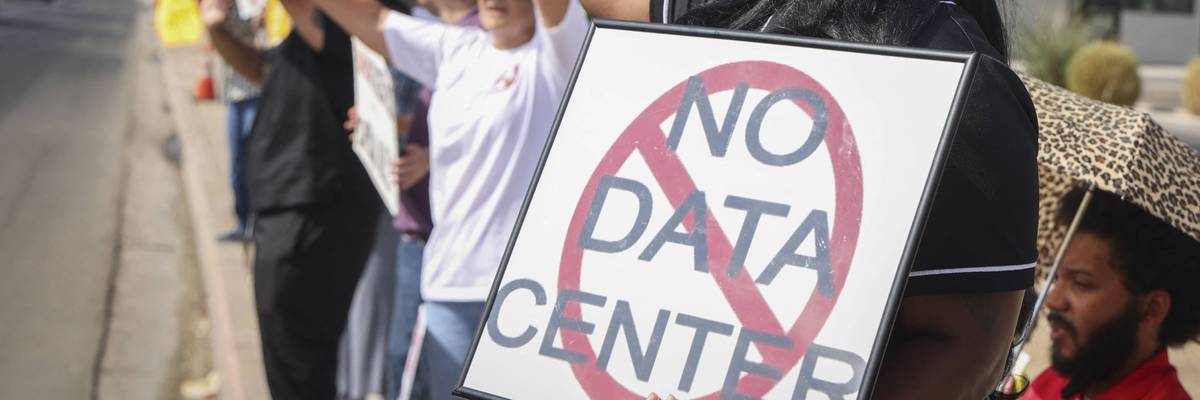
Demonstrators wave signs during a nationwide protest against AI data center expansion in Imperial, California on July 18, 2026.
(Photo by Sandy Huffaker/AFP via Getty Images)
Brad Reed
Sep 02, 2026
COMMON DREAMS
Residents in Independence, Missouri on Tuesday voted overwhelmingly to recall a city councilman—apparently over his vote to approve tax incentives for an artificial intelligence data center in the community.
In total, 68% of voters in the city’s District 1 voted to recall Councilman John Perkins, with just 32% voting to let him stay in office.
According to KMBC News 9, Perkins had originally been elected to serve through June 2028, but he will now be forced to step down as soon as the results of the Tuesday election are certified.
The election marked the first time in Independence’s history that a councilperson has been successfully recalled.
In an interview with Spectrum News Kansas City, Perkins expressed no regrets about his decision to approve the data center even though it led to him getting soundly rejected by voters.
“I still have a 40-hour-a-week job, I cut meat for Price Chopper,” Perkins explained. “I’ve laid some really good foundation, so it was time to pass the baton.”
Perkins was targeted by the recall campaign after he was one of five council members who voted to approve a $150 billion Nebius AI data center that is projected to take up 2.25 million square feet of land in the city.
Two other council members, Bridget McCandless and Jared Fears, were also voted out of office in April after voting in favor of tax incentives for the project.
Independence resident Elisa Breitenbach, an opponent of the planned data center, grew emotional during an interview with Fox 4 Kansas City when explaining her support for the recall campaign.
“It’s so sad what’s happened in our city,” said Breitenbach, “to see people being robbed of what they thought they had.”
Perkins’ recall is just the latest sign of a nationwide backlash against AI data centers, which have been criticized for being major sources of pollution and for raising local utility bills by consuming so much power.
A poll conducted by Embold Research and published by Heatmap Pro last month showed that 75% of Americans now oppose building AI data centers in their area, including 61% registering strong opposition.
Data centers do have an ally in President Donald Trump, however, as he warned Americans this week that their communities will “end up being backwards and poor” if they reject the power-hungry AI facilities.
But McKenna Cobb, a resident who led the recall effort, said people in Independence had spoken loud and clear about their views on the data center—and were ignored by Perkins and other council members.
“There are hours of public testimony,” she told KMBC News, “and they still voted in favor of billions of dollars in tax incentives.”
No comments:
Post a Comment