EU eyes Arctic cable linking Greenland to Europe amid growing security threats
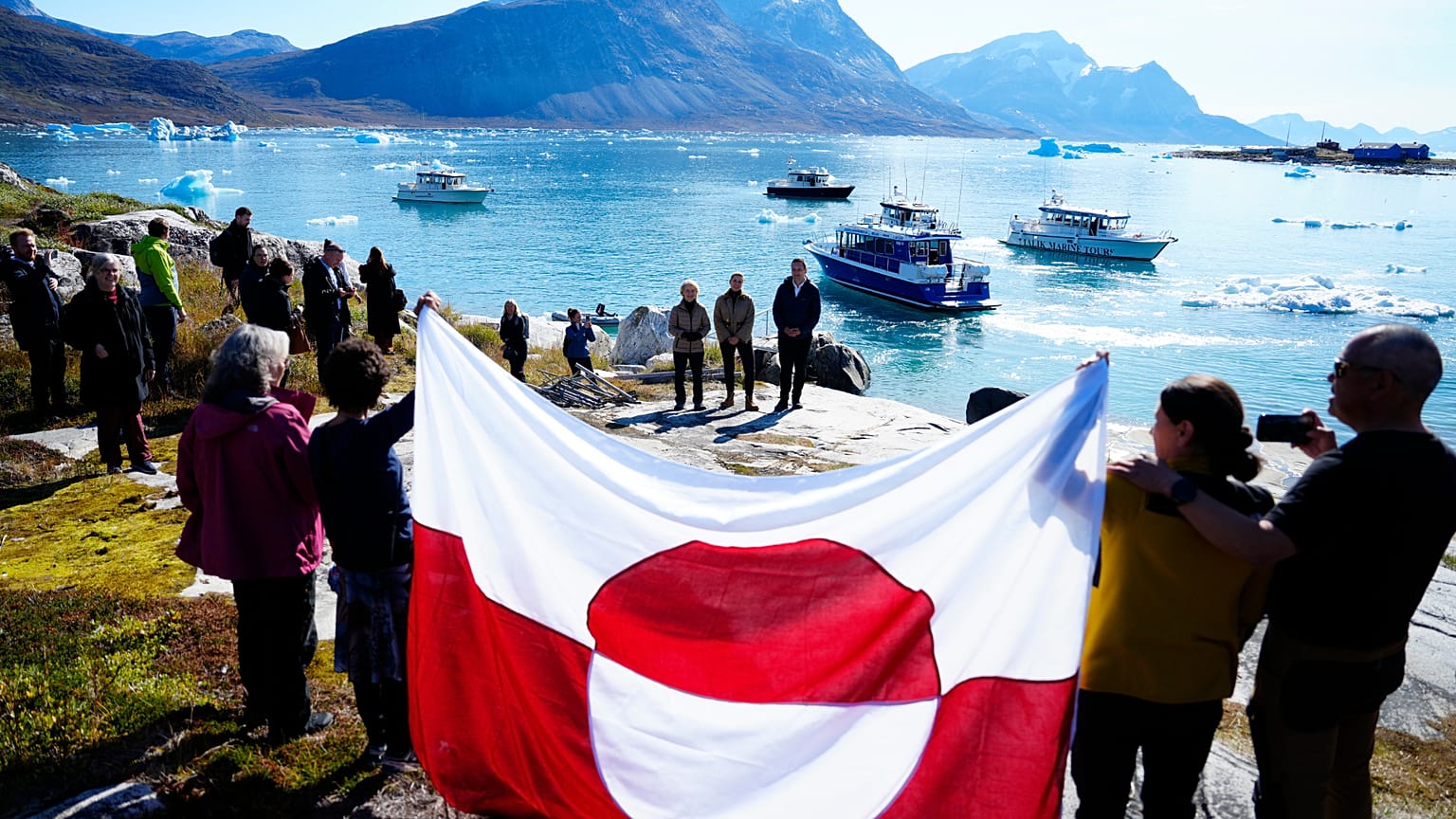
Brussels wants to secure digital infrastructure in the Arctic as melting ice and growing geopolitical tensions turn the polar region into a strategic corridor for trade, communications and security.
The European Union is planning a secure submarine cable linking Greenland directly to Europe, with ambitions to extend the network through Canada to Japan and South Korea, according to a draft Arctic strategy seen by Euronews.
The project is part of a broader effort to strengthen Europe's digital infrastructure and security in the increasingly contested Arctic region.
"The EU is working on a Pan-Arctic Cable concept that will connect Europe to Japan and South Korea via Greenland and Canada. In the coming years, the EU will connect Greenland to the European Union with a sovereign and secure submarine cable," the document reads.
The plans, outlined in the EU's new Arctic strategy, due to be unveiled on 20 October, reflect growing concerns in Brussels that undersea telecommunications cables have become a matter of strategic security rather than simply commercial infrastructure.
The initiative comes amid a deteriorating security environment in the Arctic, where Russia has expanded its military presence and European governments are increasingly concerned about hybrid threats, including interference with satellite navigation and sabotage of undersea infrastructure.
Meanwhile, growing US interest in Greenland ,has added another layer of geopolitical tension to the region, underlining Europe's concerns about its dependence on infrastructure controlled by others.
The North Atlantic has roughly 17 submarine telecommunications cables, with US technology giants playing a dominant role in the wider infrastructure network.
Submarine cables carry the vast majority of international data traffic, underpinning everything from everyday communications to financial transactions. Their vulnerability to accidental damage or deliberate sabotage has become a major concern for European governments.
For Brussels, improving Arctic connectivity goes beyond bringing faster internet to remote communities. The EU is looking to create more resilient routes for data and reduce exposure to infrastructure that could be disrupted during a geopolitical crisis.
Greenland occupies a particularly sensitive position. Situated between Europe and North America, the autonomous Danish territory has become increasingly important to transatlantic security as competition intensifies over Arctic resources, shipping routes and military access.
A more direct digital connection with Europe could strengthen the territory’s links to the EU while giving Brussels a greater stake in the infrastructure underpinning the region’s future.
"The new submarine cable routes will enhance the access of Arctic communities as well as boost resilience and redundancy in Europe’s digital connectivity. Such connection is a pre-condition for further investments highly relevant for both competitiveness, inclusion, preparedness and defence," reads the document.
The proposed extension towards Asia through Canada would add a broader strategic dimension. Rather than treating Greenland as an isolated connectivity challenge, the EU is considering how Arctic infrastructure might form part of a wider network linking European and Asian economies.
Whether that vision becomes a viable project will depend on technical feasibility, commercial demand, financing and cooperation with Canada and other partners.
Who will pay?
The EU has already earmarked €107 million for connectivity projects involving Greenland, meaning the proposed cable would build on existing commitments rather than represent an entirely new area of investment.
The Commission had presented the idea of co-financing Far North Fibre, a route planning a subsea cable in the Arctic area, to EU member-state representatives. The project was estimated to cost around $1.15 billion, but the project received around €11 million.
The potentially significant development is the prospect of a wider strategic connection between Greenland, Europe and, through Canada, Asian partners.
Such a network would raise difficult questions about who pays for construction, who owns and operates the cables, how they would be protected and whether the route would be commercially viable.
Any extension towards Japan and South Korea would also require agreement and coordination with partners beyond the EU.
However, the strategy does not settle those questions. Nor does it establish a final route, budget or construction schedule for the proposed network.
Still, it mentions creating an Arctic Cable Hub for EU countries, Norway and Iceland, to monitor, protect, and support the repair of submarine cables in the North Atlantic-Arctic. The hub will likely require support from an enhanced icebreaker fleet.
Expanding the icebreaker fleet
The EU's Arctic ambitions extend beyond digital infrastructure to the ships needed to operate in the region's increasingly contested waters.
At the Arctic Summit in September, the EU's special envoy for the region, former Finnish Prime Minister Jyrki Katainen, warned of a critical shortfall in European icebreaker capabilities.
“This is not just an issue for Finland, for Norway, for Sweden. This is something for the entire European Union, for the entire European continent. And that's the reason why we are talking about that. And you have my support on that to do that jointly,” German Chancellor Friederik Merz said at the summit’s press conference.
Indeed, the strategy goes in this direction, and vows to put in place an EU Industrial Maritime Value Chains Alliance meant to map icebreaking needs, available manufacturing capacity in Europe and the technical specifications required.
“The EU, together with member states and like-minded partners, will develop options for joint procurement, pooling and sharing icebreaker capabilities and other capabilities relevant for the Arctic,” reads the strategy.
The intent is to pool together funding and technological resources with Nordic countries and examine whether it is possible to facilitate the operational viability of nationally owned assets, while respecting the national command structure.
The strategy explicitly mentions “assets with special focus on icebreakers for extreme high North environments utilising advanced, high-endurance propulsion systems, including nuclear.”

October 18, 2026
By K.M. Seethi
Key Takeaways:
Russia’s military presence, China’s Arctic ambitions and the emerging Northern Sea Route have intensified strategic competition. Britain’s NATO-first approach strengthens Western military preparedness while raising concerns about further militarisation.
Climate change, resource competition and expanding shipping opportunities are transforming the Arctic. The critical challenge is preventing geopolitical rivalry from undermining international cooperation, environmental protection and the interests of Indigenous communities.
The Arctic has already emerged as one of the geopolitically contested regions in the world. Climate change, expanding military activities, competition over natural resources and the opening of new maritime routes have significantly changed a region once associated primarily with scientific exploration and environmental cooperation. For Britain, these developments have acquired greater urgency. The United Kingdom’s October 2026 policy document, The UK and the Arctic: An Update to the United Kingdom’s Arctic Policy Framework, indicates a changing assessment of the region’s geopolitical and economic significance. It also underlines how the Arctic has become part of the wider confrontation between Russia and the Western alliance, with China emerging as another important participant.
Introducing the policy framework, Uma Kumaran, Britain’s Minister for the Polar Regions, observes:
…we must also be clear-eyed about a more contested geopolitical context. While our ambition is for a more secure and co-operative Arctic, the challenges to that vision continue to intensify. The region today is far removed from the ‘zone of peace’ envisaged at the end of the Cold War, and the conditions that enabled close co-operation, including through the Arctic Council, have been significantly undermined.
She continues:
Russia’s sustained militarisation of the Arctic over nearly two decades, compounded by its full-scale invasion of Ukraine, has disrupted established patterns of cooperation and increased risks to regional stability. At the same time, wider strategic competition, including China’s stated ambition to become a Polar great power by 2030, is shaping the region in new ways. Greater accessibility is opening economic opportunities, from shipping to resource development, but also increasing pressure on environmental and social systems.
These observations point to the major dilemma confronting British Arctic policy. The government seeks to preserve international cooperation and environmental protection while preparing for an increasingly militarised regional order. Its latest framework attempts to reconcile these objectives, although the growing emphasis on NATO raises questions about whether military competition will eventually overshadow the Arctic’s environmental and developmental priorities.
From Arctic Cooperation to Strategic Competition
Britain’s Arctic policy has evolved considerably over the past decade. Its 2013 framework, Adapting to Change, approached the region primarily through scientific cooperation, environmental protection and responsible economic engagement. The 2018 policy document, Beyond the Ice, continued this approach while acknowledging the growing economic significance of Arctic resources and shipping.
The February 2023 framework, Looking North, indicated a more pronounced concern with regional security. Russia’s invasion of Ukraine in February 2022 had already disrupted diplomatic cooperation and raised questions about the future of Arctic governance. Nevertheless, Britain continued to emphasise scientific partnerships, environmental responsibilities and international institutions.
The October 2026 update marks a further change. It explicitly declares that the era of Arctic exceptionalism, commonly associated with the expression High North, low tension, has ended. The Arctic is now treated as an essential component of Britain’s national security and NATO’s collective defence.
This change has several explanations. Russia’s military infrastructure in the Arctic has expanded over many years. Finland and Sweden have joined NATO, substantially altering the strategic geography of northern Europe. China’s economic and scientific engagement has increased. Meanwhile, climate change is making previously inaccessible areas more open to navigation, resource extraction and military operations.
The British response brings out these developments. However, the assumption that greater military preparedness will necessarily produce regional stability deserves closer examination. An expanding NATO presence may strengthen deterrence, but it could also encourage Russia to reinforce its military capabilities, creating a cycle of mutual suspicion.
The Ukraine war has profoundly affected Britain’s assessment of Arctic security. Russia’s Northern Fleet, based on the Kola Peninsula, remains central to its naval and nuclear deterrence capabilities. Moscow has modernised military installations, strengthened surveillance systems and expanded its ability to operate across the Barents Sea and North Atlantic.
The British framework identifies Russian submarine activities, threats to undersea infrastructure and the growing use of sanctions-evading vessels as major security concerns. It specifically refers to Russia’s Main Directorate for Deep-Sea Research, whose capabilities have raised Western concerns about the vulnerability of submarine cables and pipelines. Britain’s response is increasingly organised around NATO. Its 2025 Strategic Defence Review established a NATO-First approach, which the new Arctic framework incorporates into regional policy.
Britain plans to double the number of troops undertaking cold-weather training in Norway from 1,000 to 2,000 by 2029. It is expanding maritime surveillance across the Greenland–Iceland–UK Gap, strengthening cooperation with Iceland and Canada, and developing advanced naval capabilities under the Atlantic Bastion programme. This programme combines maritime patrol aircraft, frigates, autonomous systems and artificial intelligence to improve the detection and monitoring of potential threats. In September 2026, Britain assumed command of NATO’s Joint Force Command Norfolk, which has responsibilities across the North Atlantic and Arctic. The UK also intends to coordinate more closely with NATO’s Arctic Sentry initiative through the ten-country Joint Expeditionary Force.
The accession of Finland and Sweden has strengthened NATO’s geographical position. Seven of the eight Arctic states are now NATO members, leaving Russia as the only Arctic state outside the alliance. This transformation has major implications. From NATO’s perspective, the enlargement strengthens collective security. From Moscow’s perspective, the expansion brings the Western military alliance closer to strategically sensitive Russian territories. Britain’s framework recognises the danger of escalation and repeatedly states that it does not seek unnecessary militarisation. However, its operational commitments indicate that defence and deterrence are becoming increasingly prominent in British Arctic policy.
Greenland, Trump and the Changing Atlantic Relationship
Greenland has acquired renewed importance in Arctic geopolitics, particularly following President Donald Trump’s efforts to strengthen American strategic influence over the territory. The September 2026 agreement involving the United States, Denmark and Greenland is an important development in this context. The agreement addresses American security interests while recognising the constitutional and political position of Greenland within the Kingdom of Denmark. Britain’s new Arctic framework welcomes the agreement, describing it as a contribution to Arctic and North Atlantic security. It also explicitly supports Denmark’s sovereignty and territorial integrity and Greenland’s right to self-determination. This position underlines Britain’s attempt to maintain two important relationships: its longstanding strategic partnership with Washington and its commitment to European allies, particularly Denmark.
Trump’s approach to Greenland has nevertheless exposed tensions within the Western alliance. American interest in Greenland is driven by its strategic location, military facilities, critical minerals and growing significance in Arctic navigation. For Denmark and Greenland, questions of sovereignty, political autonomy and control over natural resources remain fundamental. Britain’s response has been relatively cautious. Rather than directly challenging Washington’s expanding Arctic ambitions, London has welcomed the negotiated arrangement while seeking stronger bilateral relations with Greenland.
The UK resumed negotiations on a Partnership, Trade and Cooperation Agreement with Greenland in October 2025. It is also expanding scientific collaboration, including research into climate tipping points. The larger question is whether Greenland will increasingly become an arena of strategic competition among major powers. Britain’s position suggests that it recognises this possibility while seeking to protect its diplomatic and economic interests.
China, Russia and the Northern Sea Route
China’s expanding Arctic presence has been another major concern for Britain. Beijing describes itself as a near-Arctic state and has developed scientific, commercial and technological partnerships across the region. Its cooperation with Russia has become particularly important following the deterioration of Moscow’s relations with Western countries. The Northern Sea Route, running along Russia’s Arctic coastline, is central to this emerging partnership. It offers a potentially shorter maritime connection between East Asia and northern Europe.
In October 2026, Russian and Chinese officials discussed proposals to integrate China’s Maritime Silk Road with Russia’s Trans-Arctic Transport Corridor. These included port development, container shipping connections, shipbuilding cooperation and maritime technologies. As Adriel Kasonta argues, such cooperation could gradually create an alternative maritime network less dependent on traditional shipping routes and Western strategic influence. For China, the Northern Sea Route offers an opportunity to diversify maritime connections and reduce dependence on vulnerable chokepoints such as the Strait of Malacca and Suez Canal. For Russia, Chinese investment and shipping demand could accelerate the development of Arctic infrastructure.
Britain’s position towards the Northern Sea Route is more complex than outright opposition. The October framework acknowledges the commercial opportunities arising from Arctic shipping. Britain could benefit through its ports, maritime insurance industry, shipping technologies and associated services. London remains an important centre for international maritime insurance and financial services.
However, the report also expresses concern about the environmental and operational risks associated with the route. It notes that sanctioned vessels account for nearly one-third of cargo traffic along the Northern Sea Route, raising concerns about maritime safety, environmental damage and sanctions enforcement. The UK therefore approaches the route as both a potential commercial opportunity and a strategic concern.
There is also a wider geopolitical dimension. Greater Chinese participation could strengthen Russia’s economic resilience and reduce the effectiveness of Western sanctions. At the same time, the development of alternative shipping corridors could weaken the relative importance of established maritime networks. However, the Northern Sea Route faces considerable limitations. Seasonal ice conditions, inadequate infrastructure, insurance costs and environmental risks continue to restrict its commercial viability. Its emergence as a major alternative to the Suez Canal remains uncertain.
Climate Change, Science and Economic Interests
Although security dominates much of the new framework, climate change continues to be fundamental to Britain’s Arctic engagement. The Arctic is warming much faster than the global average. Melting sea ice, thawing permafrost, coastal erosion and changing ecosystems are affecting Indigenous communities and regional livelihoods. These developments also have consequences for weather patterns, sea levels and environmental security beyond the Arctic.
Britain has invested substantially in polar research. The framework records more than £145 million in investment by the Natural Environment Research Council in Arctic science since 2014. It also identifies new funding commitments for research cooperation with Norway, Greenland and other partners. Scientific collaboration is increasingly connected with technological development. Satellite communications, artificial intelligence, climate modelling and maritime monitoring are becoming important areas of investment.
The economic dimension is equally significant. Arctic critical minerals are attracting attention because of their importance for clean energy technologies, advanced manufacturing and defence industries. Britain seeks diversified mineral supply chains and stronger commercial partnerships with Arctic states. It also emphasises environmental safeguards, Indigenous participation and responsible resource development.
A contradiction, however, remains. Climate change is creating new economic opportunities precisely because the Arctic environment is deteriorating. Expanding shipping, tourism and mineral extraction could intensify ecological pressures in an already vulnerable region. Britain’s commitment to environmental protection will therefore be tested by its willingness to regulate commercial activities, including those involving its own companies and strategic partners.
Can the Arctic Remain a Region of Cooperation?
The October 2026 framework reflects a fundamental change in Britain’s understanding of the Arctic. What was previously approached mainly as a region of scientific cooperation and environmental responsibility is increasingly being incorporated into the strategic calculations of NATO and the wider Western alliance.
Russia’s military activities, China’s growing economic influence, the Ukraine war and the renewed geopolitical significance of Greenland have accelerated this transition. Nevertheless, the framework retains important commitments to international law, the Arctic Council, scientific cooperation and Indigenous rights. These commitments deserve greater attention because the challenges facing the Arctic cannot be addressed through military preparedness alone. Climate change, marine pollution, environmental degradation and threats to Indigenous livelihoods require sustained international cooperation, including engagement across geopolitical divisions.
The growing confrontation between NATO and Russia, combined with China’s expanding Arctic activities, could further weaken the institutions that have historically supported regional cooperation. The danger is that the Arctic may become another geopolitical terrain of global strategic rivalry at precisely the moment when collective environmental action is most urgently required. Britain’s new policy recognises this dilemma but offers no easy resolution. Its emphasis on deterrence shows genuine security concerns, while its commitment to cooperation points to the continuing need for collective governance.
For Britain and the other Arctic powers, the critical question is whether they can prevent strategic competition from overwhelming the shared responsibility to protect the High North whose future has consequences for the entire world.

About K.M. Seethi
K.M. Seethi is Director, Inter University Centre for Social Science Research and Extension (IUCSSRE), Mahatma Gandhi University (MGU), Kerala. He also served as ICSSR Senior Fellow, Senior Professor of International Relations and Dean of Social Sciences at MGU. One of his latest works is "ENDURING DILEMMA Flashpoints in Kashmir and India-Pakistan Relations."
View all posts by K.M. Seethi →
No comments:
Post a Comment